Philosophy
Mostafa Malekian's Lecture: 'Rationality and Spirituality After Ten Years'
In revisiting the 'Rationality and Spirituality' project, Malekian distinguishes it from religious intellectualism projects and describes the ideal life as having three characteristics: happiness, goodness, and worthwhileness; happiness is maximizing personal pleasure, and goodness is reducing the suffering of others.
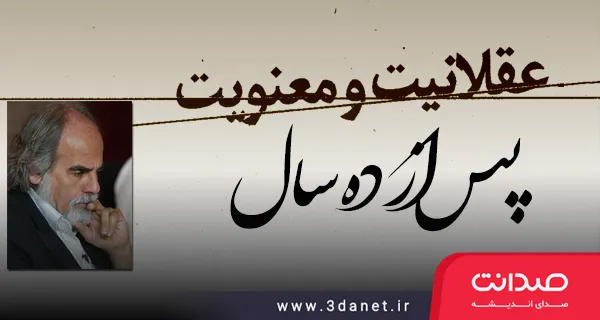
In the name of God, the Most Gracious, the Most Merciful. Greetings to all the ladies and gentlemen! In the two hours that we are together, I will try, with utmost brevity yet clarity, to outline the geography of what I have sought to set forth in the project of Rationality and Spirituality.
Therefore, friends should not expect in this session that what I say will be greatly detailed or that I will elaborate at length on what I have been expressing over these years. I will state what I have wanted to say in a very, very concise but clear and distinct manner; the elaboration of these matters has appeared over these years in the lessons, lectures, dialogues, debates, and articles I have written or translated.
The fact is that I had never referred to Rationality and Spirituality as a project; * I always said: a plan concerning the synthesis of rationality and spirituality; of course, today the term "project" is abundantly used regarding many ideas; for instance, one speaks of the project of intellectualism, or the project of religious intellectualism, or the project of modernity, or the unfinished project of modernity; this term is used for a specific view. But I myself had not used this term for Rationality and Spirituality. I always spoke of the synthesis of rationality and spirituality. I mention this at the outset, and from here on, if I use the term "project," it is because others have applied it to this plan.
Rationality and Spirituality, a Project Emerging from the Heart of Religious Intellectualism
The project of Rationality and Spirituality emerged from the core and heart of religious intellectualism. When I expressed this project in a lecture in the year 1379 (2000) and put it forward in an interview with the magazine "Rah-e No," at that time, in the eyes of observers, I was considered a religious intellectual, albeit a meager, humble, and unpretentious one. But in any case, I was counted as a religious intellectual. Therefore, whether you now place this project within religious intellectualism or not, in its early days, it was a project from someone considered a religious intellectual. However, it was very distant from what religious intellectuals before and after the revolution had said. That is, it was distant from what the late Dr. Shariati, the late Bazargan, the late Taleghani before the revolution, Dr. Shabestari, Dr. Soroush, Dr. Kadivar, and others were saying, and this distance and divergence became clear very quickly; because I speak clearly and never speak ambiguously, with double or multiple meanings, and so it became clear very quickly that this discourse was distant from what others were saying.
Now, in this project, after I briefly state what it intends to say, some of its features differ from the projects of religious intellectuals in the four cultural regions of the Islamic world (the Persian-speaking part of the Islamic world [Iran], the English-speaking part of the Islamic world [such as Pakistan, the Indian subcontinent, Bangladesh, Kashmir, Indonesia, and Malaysia], the Turkish-speaking part of the Islamic world [such as Turkey], and the Arabic-speaking part of the Islamic world), and my discourse differs from all of those discourses. Of course, it is possible that my discourse happens not to be on the right path either; I do not mean to say there is any truth in it; however, I want to say that, in any case, there is a difference.
An Account of the Rationality and Spirituality Plan
Now, after ten years, if I want to set forth this project, I will start from here, and this account is also a true-to-reality account of what has been on my mind during these ten years. It is not the case that these matters have only arisen for me in recent days.
Characteristics of the Ideal Life
In my view, the ideal life is a life that has three characteristics: 1) it is a pleasant life, 2) it is a good life, and 3) it is a worthwhile life. I consider every ideal life to possess the three attributes of "pleasantness," "goodness," and "worthiness," and you may accept this or not, and whether you want to accept it or not, you must present it to your own intuition and see whether an ideal life is such a life or not.
The First Component of the Ideal Life: The Pleasantness of Life
The first characteristic of an ideal life is the pleasantness of life. In a pleasant life, a person seeks the greatest possible pleasure for themselves and the least possible pain and suffering for themselves. If I have a life in which, to the extent of my capacity, I attain the greatest pleasure for myself and the least possible pain and suffering, again for myself, then it is said to be a "pleasant life." The pleasantness of life lies in experiencing the greatest pleasure and the least pain and suffering. In my view, an ideal life must be a pleasant life. Of course, there is no doubt that what I consider pleasant for my own life, you might consider unpleasant for yours, and what I derive pleasure from, you might not derive pleasure from.
Something that causes me pain and suffering might not cause you pain and suffering. Regarding why I find something pleasurable and you find something else pleasurable, five factors are influential:
- The issue of genetics
- The issue of education and environment. Especially the educational environment of the first 9 years of life, and particularly the educational environment of the first three years of life.
- Our psychological type: meaning whether we are introverted or extroverted, passive or active, and so on.
- Age
- A person's physical and mental abilities, meaning the extent of one's knowledge, thought, understanding, and mental experiences.
These five factors are, of course, influential in determining what I consider pleasurable or not, and what you consider pleasurable or not. These factors create differences, and this is what makes our paths in life different. One person detests fame, while another derives great pleasure from it. But in any case, despite the fact that, due to these five factors, not all human beings derive pleasure from the same thing, nor do they all suffer pain and suffering from the same thing, nevertheless, a human being has an ideal life if they have a pleasant life. That is, to have the greatest pleasure that, from their own perspective, is pleasure, and to have the least pain and suffering that, from their own perspective, is pain and suffering. The pleasantness of life, in the terminology of psychologists, happiness, is one of the three fundamental components of an ideal life.
The Second Component of an Ideal Life: The Goodness of Life
But an ideal life, besides pleasantness, has a second characteristic, and that is the "goodness of life," meaning that besides happiness, goodness is also necessary. The goodness of life means that a person lives in such a way that they cause the least pain and suffering to others and make the greatest effort to reduce the pain and suffering of others, without considering the slightest personal pleasure in this matter. In other words, firstly, I must live in such a way that the least pain and suffering is caused to others by my life, and secondly, I must live in such a way that, to the extent of my ability, I reduce the pain and suffering that others endure. A good life is a life that possesses this characteristic.
You will notice that in the first point, that is, the pleasantness of life, our emphasis, psychologically speaking, is entirely on "egoism"; that is, the pleasantness of life is completely based on psychological egoism. We are egoistic, self-loving, and self-centered, and because we have self-love, we are naturally self-preserving, and because we are self-preserving, we naturally want to attract the greatest pleasure to ourselves and repel the greatest pain, suffering, and affliction from ourselves. This psychological egoistic motivation, from which none of us can escape or avoid, drives us toward a life in which there is the greatest pleasure and the least pain and suffering. But an ideal life, besides pleasantness, must also have the second characteristic, that is, "goodness."
In goodness, there is no egoism or self-centeredness. If I try to reduce your pain and suffering with the intention of personal pleasure, I am still operating within the circle of pleasantness and have not yet entered the stage of goodness. It is in the goodness of life that I always want to treat you as myself, and just as I want the greatest pleasure and the least pain and suffering in my own life, I want to arrange my life in such a way that, regarding you as well, the same outcome is achieved through me; that is, to truly consider you as myself, and therefore I try to make this least pain and suffering and greatest pleasure applicable to you as well.
Here "altruism" prevails; this "altruism," which exists potentially and latently in the physical, mental, and psychological constitution and structure of all of us, becomes actualized in some people, and of those in whom it becomes actualized, we say that their life is a good life. This, at first glance, is "altruism," but unfortunately in some people its scope becomes less than altruism, and fortunately in some people its scope becomes greater than altruism.
That is, in superior human beings, it is altruism. In human beings who are below the superior level, it transforms from altruism into nationalism, meaning I love my own nation and society, or I love my co-religionists and fellow believers. Or I love my fellow townspeople. Or I love my neighbors, and less and less and less. It may reach a point where, as sociologists say, I love only my nuclear family, that is, myself, my spouse, and my immediate children. And it is possible that even my spouse and children fall outside this circle, and it can become narrower and narrower. Of course, in some people, this "altruism" actually becomes broader than "altruism," and "altruism" gradually extends to love for animals, and from there to love for plants, and from there to love for inanimate objects, and we see a kind of expanding altruism. In fact, altruism meant love of humankind, but here a "love of all else," meaning "love for everyone but myself," emerges.
This state exists in a rare few human beings. But from what does this goodness of life arise? As I said, it arises from altruism. Therefore, its source is "love," and not what we speak of regarding the "pleasure of life."
The Third Component of the Ideal Life: The Worthwhileness of Life
But the ideal life, besides pleasure and goodness, must have another characteristic; if it lacks this characteristic, it seems that it is not the ideal life.
In what sense is it not ideal? That is, when you consult your own intuition, you see that there must be a third factor for me to consider that life the life of the highest perfection and the ideal. And that third characteristic is that life must also be "worthwhile." That is, my life must be such that it is worth living; because it seems that in the first and second components, it was assumed that life is worth living. Then I was saying, now that life is worth living, it must possess the characteristics of pleasure and goodness. But is life fundamentally worth living?
You and I debate whether toasted bread is good or doughy bread, or whether thin bread is good or thick bread, only after we have first assumed that bread is necessary for life and must also be present in our diet; otherwise, if we had not assumed this, why would we quarrel over what characteristics bread should or should not have?
In the first component, which is the pleasure of life, and in the second component, which is the goodness of life, it has been assumed that life is something that ought to be. Life ought to exist, and now that it ought to exist, it is good that instead of being unpleasurable, it be pleasurable, and instead of being not good, it be good.
But in the third component, the discussion is about why life should exist at all. Is life fundamentally worth living or not? Then, if it is worth living, we must then say how one should live. In Nietzsche's phrase, until we know the "why of life," discussing the how of life is of no use. First, we must know why one should live, to then say how one should live.
In discussing the pleasantness and goodness of life, we were talking about the how of life, but an ideal life is one in which, for those who live it, the why of that life has also been answered. Why shouldn't we commit suicide? I return to the life of Albert Camus, who said the most important problem of philosophy is the problem of suicide; that is, until philosophy can answer us whether we should commit suicide or not, it has answered no problem at all. The fundamental principle in philosophy is to answer us why one should commit suicide or why one should not. This goes back to the third component: whether life is worth living or not. Our coming was not in our own hands. But our going is in our own hands. So why don't we go? Someone who has not answered this question for themselves, even if their life is full of pleasantness and full of goodness, still does not have an ideal life. An ideal life, in the view of the one who lives it, besides pleasantness and goodness, must be worth living; otherwise, just as you stop any activity the moment you are certain its cost exceeds its benefit, if you are certain that the cost of life exceeds its benefit, you should stop it. Well, why don't you stop it? This is where I must say that we humans are of two kinds:
One kind does not stop it because life is valuable to us, and its cost does not exceed its benefit. But the second kind, of which countless numbers of us are a part, are those who say life is not valuable to us, meaning we have never insisted that its benefit exceeds its cost. But we lack the nerve and courage for suicide.
Now, my argument is that an ideal life is a life that, if it continues, is not because of the cowardice and timidity of the one living it, who has understood that the cost of life exceeds its benefit but still continues living because they lack the courage for suicide. Like a merchant who has understood that continuing trade with a certain partner is not profitable, but lacks the courage to propose ending the partnership. Well, this person has not only failed to act according to the dictates of rationality, but is in fact also a cowardly human being. So an ideal life must be 'pleasant,' 'good,' and 'valuable.' The pleasantness of life invites us toward happiness and self-interest; the goodness of life invites us toward other-interest and living ethically. And the value of life makes life meaningful.
A valueless life is a meaningless life. We want a life in which our self-love is satisfied to the greatest possible extent; our altruism is also satisfied to the greatest extent through living ethically, and at the same time, it is a valuable life. That is, we are truly certain that it is worthwhile to continue this life.
The Possibility of Attaining an Ideal Life
The attainment of this ideal life is, for the most part, in our own hands. And a part of it is not in our own hands. This is the second premise of my talk.
That part which is beyond my own control is itself divided into two parts. One part of attaining an ideal life is beyond my control because it is beyond the control of all humanity. And this is what I refer to in discussions as the tragic aspects of life. The tragic aspects of life are those aspects in which we do not have a good, pleasant, and valuable life, but we also cannot have one, because the nature of human life does not allow for more than that to be realized.
The other part (the second part) is not among the tragic aspects of life, meaning it is not beyond the capacity of humanity, but it is in the hands of social institutions that are not under my control. Ultimately, the institutions of family, economy, politics, education, law, and religion largely determine our course for us, and whether we want it or not, and whether we are aware or not, they have positive or negative effects on our lives.
Therefore, in my view, a major part of an ideal life depends on the individual human being, but one part of it does not depend on the individual human being. Either because it is fundamentally not within the capacity of humanity and humankind, or because it is within the capacity of humanity and humankind but depends on social institutions, and it is certain that those social institutions are not like wax in my hands.
The Claim of the Rationality and Spirituality Project
The claim of the Rationality and Spirituality project was this: (I am not concerned with that part of the ideal life that is beyond your control, or lies in the hands of social institutions, or is fundamentally beyond the control of all human beings. But) do you want to know how, by using that portion of life that is within your own control, you can attain an ideal life? Do you know by what path a good and valuable life, to the extent that it is within your control, can be achieved?
In answer to this question, we have heard many responses throughout history. The answer of this project was that the attainment of the ideal life is achieved through rationality and spirituality. Rationality and spirituality are the two components that provide the ideal life for me, insofar as it lies within my power as the possessor of that life. Only to the extent that it lies within my power as the possessor of that life, not that part which belongs to the tragic aspects of life and is fundamentally ineradicable, or that portion which is attainable but which social institutions prevent me from achieving.
If you were to ask someone else this same question, they might give you a different answer. When you ask religious intellectuals this question, what answer do they give you? If you ask a religious intellectual, since you are a religious intellectual, what path do you propose for an ideal life, they will say: I suggest you turn to religion, but not just any religion; turn to an intellectual and modernist religion.
Now, if you ask religious fundamentalists what path they propose for an ideal life, they will say: refer to religion, but not to a modernist and modern religion; rather, to a fundamentalist religion.
The third solution in response to this question says: refer neither to modernist religion nor to fundamentalist religion, but refer to traditionalist religion. A fourth solution says: have nothing to do with religion at all. You can only attain the ideal life through reason alone.
I want to say that answering this question in the form of the "Rationality and Spirituality project" is meaningful; why do I emphasize that it is meaningful? Because if you say something that has no opposition, that statement is of no use. The first sign of a statement's usefulness is that it has opponents. That is, there are people who say something against it. Otherwise, if you say something that everyone agrees with, that is not your statement. We all agree that "2+2=4." But whose opinion is this? Because everyone accepts that two plus two equals four. This opinion is no one's specific opinion; it is everyone's opinion.
Rationality and Spirituality are not the goal but the means
The next premise of my talk is that since rationality and spirituality are the two components that lead us to the ideal life, we conclude that neither rationality nor spirituality are goals; rather, both are means. Therefore, we must look at these two as means. We are not in love with the face and features of "rationality" and "spirituality." Because we see that the ideal life cannot be attained apart from rationality and spirituality, we look at these two as two means. Inevitable means, of course. Two means that can in no way be avoided and still reach the ideal life, and, of course, both of these are unique for reaching the goal. There is no alternative path — at least in the view of the proponent of this statement.
Years ago (in the year 2000), I had used an expression that I believe in with all my being, and now I want to repeat that same expression regarding rationality and spirituality. Because at the time I used that expression, I had not employed the terms rationality and spirituality. If you remember, and if friends have read it, I said in an interview with "Rah-e No": I am not concerned about tradition, nor am I concerned about modernity, nor about civilization, nor about culture, nor about any abstract matter of this kind. I am concerned about the flesh-and-blood human beings who come, suffer, and go.
Well, at that time I had not mentioned the name “Rationality and Spirituality.” “Rationality” must not become a new idol for us, nor must “Spirituality” become a new idol. Nothing should be an idol; everything must be in the service of human beings and the reduction of human suffering. Now, if you find something in your culture and civilization, in your religion, in your sect, in your philosophy, in your mysticism, in your theology, in your natural empirical sciences, in your human empirical sciences, in your art, literature, and historical sciences—anywhere, anything that serves to reduce the suffering of this flesh-and-blood, skin-and-bone human being, we will adopt it.
Therefore, while I have no concern for religion, nor for any creed, sect, rite, -ism, school, culture, or civilization, I nonetheless do not turn my back on any of them. This is because in all of these there are components which, when we adopt them, yield raw materials from which we can prepare our salve and remedy for human suffering. The salve, the remedy, the ointment, the balm that we wish to prepare for the reduction of human suffering, we gather from the heart of all these—from the heart of religion, culture, creed, rite, disposition, doctrine, mysticism, empirical science, philosophy, literature, and art.
Among all these sources and origins from which we gather the raw materials for that salve and remedy, I place great emphasis on three: philosophy, psychology, and literature. But we make use of all other sources as well.
Thus, we repeat the same point regarding rationality and spirituality. Nothing but the human being and human suffering should be the focus of our attention; anything else, in my view, is a pseudo-problem, not a real problem.
The Life of One Human Being Is Worth More Than All Historical Monuments
I recall that when the Taliban blew up that enormous, historic, and magnificent Buddha statue—which was truly one of the most barbaric and unethical acts that could be committed, and global public opinion reacted negatively to it—I said something somewhere, and of course, it was misinterpreted, and now I repeat that statement.
I had said that, in my view, the destruction of the Buddha statue is not as regrettable as the killing of one Afghan. As much as the killing of one Afghan; not the twenty years of torture and killing of Afghans. The value of one human life is greater than all historical monuments. Therefore, if one day we were faced with a choice between one human being being killed, or all of humanity's historical monuments—which are cultural and civilizational prides—I say that the life of this one human being must be saved, even at the cost of the destruction of all of humanity's historical artifacts. Why? Because historical artifacts do not have the value of a human being; everything must be for the human being.
Therefore, if we regret the destruction of that statue, it is again because that statue was, firstly, the product of the labor of human beings who were disregarded by this destruction, and secondly, it wounded the feelings and emotions of Buddhists around the world. That is, if the world's Buddhists had not been wounded, we should not have considered it objectionable from that aspect. Thus, our regret and sorrow again return to the human beings whose feelings and emotions were unnecessarily hurt. We unnecessarily wounded the feelings and emotions of one and a half billion Buddhists worldwide; otherwise, what significance can stone and metal have compared to a human being?
I am always regretful that when a historical artifact is disregarded, we react strongly, but in the face of the destruction of flesh-and-blood, skin-and-bone human beings and disregard for them, we do not react to that same extent.
So, rationality and spirituality have value only as a means on the path to reducing human suffering.
Now, What Is Meant by “Rationality”?
Rationality is divided into “theoretical rationality,” “practical rationality,” and “discursive rationality” (if we separate speech from action). Since I have explained this elsewhere, I will present it briefly here.
A: Theoretical Rationality
“Theoretical rationality” means that we should proportion the degree of our adherence to a belief to the strength of the evidence and indications that support that belief. The more the indications and evidence supporting a belief increase, the less our degree of attachment and adherence to that belief should become. Of course, this is a clear matter, and anyone to whom it is presented will accept it. But in practice, we do almost the opposite. In the words of Abu al-ʿAlaʾ al-Maʿarri, in a very fine poem where he said: “When I speak with evidence, I speak in a low, murmuring voice, but when my speech lacks evidence, I shout.” In our lives, too, our zeal and fervor are directed toward those statements for which the least amount of evidence and indications exist in their favor.
But regarding beliefs for which the most evidence and indications exist, we have no zeal whatsoever. For example, if someone here were to state that today, which is in fact Tuesday, is Wednesday, or is Monday, I do not think any of you would show fervor or zeal, even though they have denied a plain truth. But if it were said that at the fifth bend of the bends of the intermediate realm (Barzakh), contrary to what some have said, so-and-so is not standing and someone else is standing, then you would show fervor and zeal.
In Pascal’s time, a debate arose among Christians concerning how many angels can fit on the head of a pin. Some Christian theologians believed that all the angels in the world could fit on the head of a pin. Some said that not even one angel could fit on the head of a pin. And some chose another view. Many massacres occurred around this subject. Friends should refer to the book by Auguste Valensin, which was translated into Persian many years ago. Many massacres took place over this point: why did you say that one angel fits on the head of a pin, or that no angel fits, or that all the angels in the world fit on the head of a pin. And it is interesting that Pascal also participated in this dispute and took one of the sides of the conflict.
Now, if someone in the world were to say: two plus two equals five, or equals three, would any massacre take place in the world? Even though the individual has denied a plain truth, we show no fervor or zeal. But we show fervor and zeal when someone says: No, the temporal distance between the intermediate realm and hell is such-and-such, and the distance between paradise and hell is such-and-such, the width of paradise is this much, and so on. The degree of our attachment and adherence to these beliefs is completely inverse to the strength of the evidence and indications that support these beliefs. Now, apply this to the beliefs you hold. That is, once, list your beliefs for yourself and see whether the degree of your adherence and attachment is proportionate to the amount of evidence and indications that exist in favor of your beliefs, or not.
[Continuation of Professor Malekian’s lecture, as quoted from Mizan News]:
b) Practical Rationality:
Rationality has a second branch, and that is practical rationality. Practical rationality means making the means as proportionate as possible to the goal or goals. The greater this proportion, the more rationally we have acted. If it is said, for example, that to prevent earthquakes, women must observe their hijab more strictly, the speaker of these words seems to have no conception whatsoever of practical rationality. The speaker does not know that this is not the means to that goal. Not every means is for every goal, and not every goal can be reached by every means. Women’s hijab, if it has any benefit, lies in another direction, but it has none for causing miracles, because if it did, you would have committed the greatest betrayal by knowing this matter for 1400 years and not informing humanity so that all these earthquakes would not occur. So, when practical rationality is spoken of, it means there must be proportion between our goals and our means. Not every goal can be achieved with every means, and every goal requires its own specific means.
c) Discursive Rationality
One category of our actions consists of our statements and utterances. And our speech is a kind of deed. Nevertheless, discursive rationality is usually discussed separately. In practical rationality, we said that ends and means must be proportionate. In discursive rationality as well, the end (or ends) must be proportionate to the means. The end of speech is to convey what is in one's mind; therefore, we must adapt our means to this end. With this end, in speech we want to convey to our audience what passes through our mind and consciousness, through our heart and soul. So we must choose means in speech that better achieve this end, and here a third kind of rationality emerges, called discursive rationality. In discursive rationality, all we must observe is that our speech has as little ambiguity, as little equivocation, and as little obscurity as possible, for ambiguity, equivocation, and obscurity prevent what is stirring in my mind from being transmitted to your mind exactly as it stirs in mine. These three branches are what I mean by rationality.
2) What is Spirituality?
When I say I want to combine rationality with spirituality, I must also clarify what I mean by spirituality. I have said many times that by spirituality I do not mean religion. But I do not mean that the spirituality I speak of is necessarily incompatible or in conflict with religion. A brother is not a sister; of this there is no doubt. But this does not mean that every brother and sister are always in strife. We must not think that every difference means conflict. The spirituality I speak of is not religion. However, it does not follow from this statement that every spiritual person is necessarily irreligious. Of course, it also does not follow that every religious person is necessarily spiritual. Some people are spiritual but not religious, others are both spiritual and religious, another group is religious but not spiritual, and some are neither spiritual nor religious. The spirituality I speak of means subscribing to the following three propositions.
a) In order to be a spiritual person (in my view), I must believe that the world is not confined to the laws of physics, chemistry, and biology as you say. This is in terms of ontology. A spiritual person, ontologically, believes that the world is not confined to the three great sciences of physics, chemistry, and biology. In other words, physics, chemistry, and biology help me in knowing the world, but in knowing a part of the world and not the whole of it. The universe, ontologically, is far, far vaster than what the laws of physics, chemistry, and biology present to us.
b) Epistemologically, a spiritual person believes that the world is not confined to whatever human intellects say. There are things in the world that lie beyond the limits of human reason (are beyond human reason). That is, epistemologically, if we believe that the universe is exactly what human reason reveals, and if something falls outside human reason it falls outside existence and there is no mystery, we are not spiritual persons. Epistemological spirituality means acknowledging the existence of mystery in the universe. That is, there are things that are mysteries, not puzzles or problems. Mystery is different from problem and puzzle. In a problem, I do not know something, but both I myself and humankind potentially have the ability to know it. A problem is not condemned to remain unknown. A problem is an unknown that has the possibility of becoming known. In mathematics, logic, in various branches of philosophy and also various branches of the natural and human empirical sciences, in religion and creed, etc., problems exist. There is another thing called a puzzle. To put it simply, a puzzle is not a problem but a pseudo-problem. A puzzle is something presented in such a way that we think it is a problem. If it were presented correctly, it would be clear that it is not a problem. Its manner of expression has been such that it has become a problem for us. A spiritual person is one who accepts that beyond these, there is something called mystery. And mystery is something we do not know and, as long as we are human, cannot know. That is, we do not have the ability to know it. If we believe in the existence of mystery, it has numerous effects on our psyche. I especially emphasize that you should refer to the works of Gabriel Marcel, who placed the greatest emphasis on the existence of mystery. In this sense, Gabriel Marcel is a spiritual person.
ج) اما معنویت، شق سومی هم دارد. به لحاظ روانشناختی، انسان معنوی معتقد است که روان من، روان مطلوب نیست. روان مطلوب، روانی است که من باید به سوی حصول آن روان بکوشم. در معنویت روانشناختی، مراد این است که من به وضع موجود روانی خودم راضی نباشم و معتقد باشم که یک ارتقا معنوی و تعالی روحانی، امکان پذیر است. یک مثال بزنم تامنظورم واضح تر شود. کسانی هستند که استحمام نمیکنند و برای اینکه بوی بدنشان دیگران را نیازارد، از عطر و ادکلن، استفاده می کنند. راهحل ساده را رها می کنند و راهحل سخت را میچسبند. بوی بدن راهحل درستش استحمام است. اما کسانی هستند که به جای استحمام از عطر استفاده میکنند. من این مثال را از این جهت میزنم که کسانی هستند که میخواهند درونشان، عوض نشود ولی بیرونشان عوض شود. یعنی میخواهند در درونشان هیچ دگرگونی در عقاید، احساسات و عواطف، و هیجاناتشان پدید نیاید. و همان وضع درونی را داشته باشند و در همان حال میخواهند بیرونشان عوض شود. در واقع میگویند ما همین هستیم! اما با اینکه در درونمان هیچ تغییری را راه نمیدهیم و انگار از وضع درونی خود راضی هستیم ولی تمام نارضایتیها را به وضع بیرونی خود مربوط میکنیم. این به نظر من، یک دید روانشناختی غیر معنوی است. از لحاظ روانشناختی، انسان معنوی، انسانی که سعی درارتقا درونی خود دارد و میداند که عقاید بهتر از عقاید او وجود دارند و باید به سمت کسب آن عقاید، احساسات و هیجانات حرکت کند.که به این، معنویت روح شناختی نیز میگویند. کسانی که میگویند در درونمان همین هست که هستیم ولی میخواهند مناسباتشان در نهاد خانواده، در نهادهای اقتصاد، سیاست، حقوق، دین و مذهب بهتر شود، چنین انسانی به نظر من از نظر اجتماعی انسانی ماتریالیست است. ولی انسان معنوی، پذیرفته است که باید درونش نیز تغییر کند و به سمت بهتر شدن برود. یعنی یک رشد درونی هم برای بهبود در بیرون از خودش لازم دارد. ما در دورن خود سه ساحت داریم، ساحت معرفتی-عقیدتی (cognitive) ، ساحت عاطفی- هیجانی (emotive) و سوم ساحت ارادی- خواستی، انسان معنوی همیشه ذره بین اش را روی این سه ساحت قرار داده و از خود می پرسد عقاید، احساسات و عواطف، و خواسته های؛ بهتر از عقاید، احساسات و عواطف، و خواستههای من؛ چگونه امکان حصولش است؟ و به سمت بهبود اینها حرکت میکند. توانستی که در درون آن بایستن است.
مراد من از انسان معنوی، کسی است که به این سه ایده قائل باشد. این معنویت را کسانی از راه عرفان حاصل می کنند، کسانی از راه تشرع به دین و شریعت خاصی، کسانی از راههای دیگری که راههای سکولارتری است. این که چگونه این معنویت حاصل می شود، به آن کاری نداریم. آنچه اهمیت دارد قائل بودن به سه ایده ی بالا است.
وقتی میگویم عقلانیت و معنویت ، یعنی معنویت با این سه شقی که دارد و عقلانیت با آن سه شقی که ذکر شد؛ در من جمع شود، آن بخشی از زندگی آرمانی که بدست آوردنش در عهده من است را حاصل می کند. این پروژه البته با پروژه روشنفکر دینی البته تفاوت دارد. این راه حلی است که متفاوت با روشنفکران دینی جهان اسلام (جهان انگلیسی زبان، ترک زبان، فارسی زبان و عرب زبان) ، عرضه شده است.
معنویت و عقلانیت؛ پنج نکته
چنانکه گذشت مدعای پروژه معنویت و عقلانیت، این است که جمع میان معنویت و عقلانیت زندگی آرمانی را برای ما حاصل میکند. همچنین این پروژه با پروژه روشنفکری دینی تفاوت های بنیادین دارد. در بخش آخر این گفتار، پس از نکات تکمیلی، چند نکتهای که پروژه معنویت و عقلانیت بر آن تاکید دارد را بر میشمارم. در پایان نیز انتقادات وارد بر پروژه را به صورت فهرستوار ذکر میکنم که پاسخ تفصیلی این انتقادات در کتاب « عقلانیت و معنویت » که مراحل پایانی نگارش را میگذراند، و به زودی منتشر میشود، خواهد آمد.
الف) نکات تکمیلی:
1) The first point is that if we wish to consider the project of spirituality and rationality an intellectual project, we must note that this project does not fit within the French tradition of intellectualism. The French intellectual tradition, when spoken of, refers to a tradition whose fundamental principle is that the greatest problem of a society, or the sole problem of a society, is the political regime governing it. Intellectualism in its French tradition is summed up in this point. From Émile Zola to others after him. Iranian intellectuals (both religious intellectuals and secular intellectuals) generally have a French disposition. That is, they believe that the greatest and the cause of all causes of our society's problems is the ruling political regime. Therefore, their audience is always the powerful and the statesmen. What I say in spirituality and rationality is precisely the opposite. I believe that the greatest problem of a society, or the sole problem of a society, or the cause of all causes of a society's problems, is the culture of that society and not the political regime governing it. The political regime governing a society is the fruit that grows on the tree of that society's culture. When a society's culture is decadent, the fruit that grows on the tree of this culture is a decadent political regime. Therefore, the root and foundation is the culture of a society. By culture, I mean the inner being of human beings. I have said many times that when I say culture, I mean our beliefs plus our emotions, feelings, and passions, plus our desires. These three components constitute culture. If the economy is disordered, it is an unhealthy fruit that has grown on the unhealthy tree of culture. Likewise, the institution of the family, the institution of politics, the institution of law, the institution of religion and creed, and so on... all of these, whatever corruption, rot, and defect they may have, must be considered the fruits of an unhealthy tree with rotten roots, which we call culture. Therefore, unlike French-oriented intellectuals, my adversary is not the political regime governing society. Rather, it is the people who, because of the beliefs, feelings, emotions, passions, and desires they possess, have brought this regime into existence. This, of course, differs from the conventional intellectualism in society, which is Zola-esque intellectualism and is always directed at the critique of power. Intellectuals who critique power, and especially political power, are, from this perspective, flatterers of the people and sycophants to the people. I say exactly the opposite. I say we must not flatter the people at all. We must tell the people that whatever you see outside that is undesirable, look within yourselves and see why such a thing has manifested externally. Look within yourselves and re-examine your beliefs, feelings, and desires; then you can understand why we have political tyranny, corruption, bribery, short-changing, lying, arrogance, and so on externally. I have said in detail elsewhere that intellectualism is not representing the people; it is judging the people. The intellectual should not be the representative of the people against the ruling political regime. Rather, they should be the judge of the people and say: people, whatever exists comes from within yourselves, and this, of course, does not mean absolving any political regime.
2) The second point I must mention emerges from the first point, and that is that the project of spirituality and rationality is an individualistic project rather than a collectivist one. I never say elitist, as some of my critics claim. This project addresses each and every individual and not some imaginary entity called society or social institution or the institution of politics and economics.
3) This project is a secularist project. In the sense that, as far as possible, it does not consider a religious basis for collective decision-making in various spheres. That is, it does not believe that we should have a conception of religion as a law book. I have said in detail elsewhere that one can have three conceptions of religion: the conception of a prescription, the conception of a map, and the conception of a law book. The conception of religion as a prescription is a defensible conception. But the conception of religion as a map and a law book is an incorrect conception, and secularism in fact means that we accept religion as a prescription but do not accept it as a law book. Secularists do not make the religious and creedal beliefs of a specific group in society the basis for decision-making. Religious intellectualism, to the very extent that it is religious, must in any case give weight to religion in collective decision-making, and it is precisely here that I distance myself from religious intellectuals. Therefore, if a religious intellectual is secular, they cannot be secular in the full sense of the word. Of course, religious intellectualism is secular compared to fundamentalist and traditionalist Islamological currents, but it cannot be secular in the true sense of the word.
4) The project of spirituality and rationality has a predominantly psychological and ethical dimension, rather than a sociological and political one. I have said this before and wish to emphasize it again here. If various projects are to be successful, they can never neglect any dimension of human existence. The human being is what it is, and nothing about this human being can be denied, but one can prioritize and establish what is more important and what is less important. One can say that among the various dimensions of one's life, this dimension is more important than that one, and that dimension is less important than this one. No dimension can be forgotten, but a gradation can be created based on which the degree of relative importance—that is, the degree of importance in comparison—becomes clear. This project is a psychological-ethical project. That is, its entire emphasis is on psychology and ethics. Its emphasis is not on sociology and politics. Therefore, while it is not oblivious to the sociological and political dimensions, it places greater emphasis on the psychological and ethical dimensions.
5) Another point I want to make here is that spirituality, in the sense I intend, is the common denominator of all the world's religions. I have made this claim many times, but I have never proven it and have left it to the reader (though it is, of course, necessary for me to prove this claim itself). Nevertheless, it seems to me that if we take all the world's religions and denominations—whether dead religions or living religions, whether Abrahamic religions that emphasize a personal, anthropomorphic God or non-Abrahamic religions that place greater emphasis on an impersonal God—if we seek the very quintessence of all these religions, in my opinion, we arrive at that spirituality whose three dimensions I have explained. That is, those three dimensions I mentioned for my definition of spirituality are common to all religions. Once we move past these three points, the differences begin. In my view, on these three points, no religion or denomination differs from any other, but as soon as we enter into the details, the differences begin. Abrahamic religions believe in resurrection, and Eastern religions believe in reincarnation. Abrahamic religions believe in a personal, anthropomorphic God, whereas Eastern religions do not believe in such a God, and so on. That is, the differences emerge when we enter into the details.
B) Emphases of the Project of Spirituality and Rationality
This project emphasizes four points, which I will only mention:
1) The first point is that because the project emphasizes rationality, and the most important characteristic of rationality is being argument-based, the entire emphasis is therefore on argumentation. Now, in the Qur'anic expression, which states it in the most eloquent manner: "Bring your proof, if you are truthful"—meaning, if you are truthful, bring your proof (proof here is not meant in the Aristotelian sense). Proof in the Qur'anic sense means a clear reason, a manifest reason. From whomever we want to accept their word, they must present their reason. If accepting a statement is intended, it must be with reason, and for acceptance, one must demand a reason. Being argument-based is strongly emphasized by this project.
۲) The second point emphasized by this project is the issue of the authentic life. An authentic life means living based on one’s own understanding and discernment. That is, a life in which imitation and blind obedience, suggestibility, conformity to public opinion, and the intellectual fashions of the age have no place. I must act based on my own understanding and discernment. Of course, this idea of acting based on one’s own understanding and discernment has been misunderstood. Some critics have criticized me, saying that if we are to act based on our own understanding and discernment, then what becomes of all the sciences we do not possess? I have said time and again that acting based on one’s own understanding and discernment does not mean I will not refer to the sciences you possess. It means I refer to all four capacities that all other human beings besides myself possess. You have sciences that I do not, powers of thought, understandings, and experiences that I do not. These four capacities are not confined to me; all six billion human beings on earth, according to their own degrees, possess degrees that I lack. Therefore, for any task I wish to undertake, I must utilize the latest achievements of your science, your power of thought, your understanding, and your experience. But the whole point is this: when I refer to you and, based on your science, understanding, power of thought, and experience, seek a solution from you for my problem, if by referring to you I arrive at ten opinions, which of these ten opinions should I turn to? This is where I have no choice but to present those ten proposals to my inner self. To refer to my inner self. That is, to my own reason and moral conscience. Thus, the scale is within me. While I utilize all the achievements of humanity in the areas of science, power of thought, understanding, and experience, if this science, power of thought, understanding, and experience lead to various proposals for solving my issue or resolving my problem, I must present all those solutions to my inner self—my reason and moral conscience—and let them judge among these solutions. Therefore, the scale remains within me. I trust no external scale. Hence, any form of imitation, blind obedience, suggestibility, and conformity to the thoughts and fashions of the age is rejected in this thought and project. This is where I oppose blind obedience and have said that the foundation of institutionalized and historical religion and historical, institutionalized religiosity rests on blind obedience, and in this respect, I oppose it. Because I believe it contradicts the authentic life. The authentic life, as I said, means acting with one’s own understanding and discernment, the scale of which is my reason and moral conscience. These two inner assets, namely reason and moral conscience, can only be consulted with two moral virtues. One is honesty, and the other is seriousness. That is, I must refer to my reason and moral conscience, but with two characteristics: the utmost possible honesty and the utmost possible seriousness. Seriousness means that my reason and moral conscience should not be part of the decoration and luxuries of my life, but rather must be like oxygen for my life. It should not be the case that I do everything else, my recreation is in its place, my lust is in its place, my power, popularity, and social prestige are in their place, and only occasionally do I study and reflect. Rather, with the utmost seriousness, I must constantly be in consultation with my reason and moral conscience. These two must be my constant advisors. I must constantly refer to these two. Not that I inquire after the well-being of my reason and moral conscience every once in a while. This is the unexamined life that I emphasize. I have said many times that the unexamined life Socrates warned us against is the inauthentic life. An unexamined life means that just as we inherit the color of our eyes and our height from our parents, we also inherit our beliefs, our feelings, emotions, and excitements, and our desires from them, and we ourselves have never examined these beliefs. This contradicts the authentic life. Therefore, let no one say why you make an exception for consulting a specialist. Consulting a specialist does not mean imitation and blind obedience. If I go to a certain specialist who is a member of the medical board of 50 international universities and my heart ailment does not improve, can I say this error is ours and it is the fault of our uncooperative heart?!! But believe me, in our society, with the imitation we practice toward them, they solve no issue, they resolve no problem; then they say that you are uncooperative. You have some problem, either you have tampered with your innate nature, or there is an issue with your morsel of food, or in your blood, and ultimately, you are the ones with the problem. I cannot accept imitation and blind obedience in any form, and I emphasize this point.
3) The third emphasis of this project is realism. Realism means referring to the facts themselves. I have said time and again that, in another sense that I intend, we are idealists and not realists. And that sense is that we measure beliefs against beliefs, not against facts. That is, we measure beliefs against ideas, not against facts. Therefore, we are idealists. Being idealists means we are belief-oriented; that is, we assess the truth or falsity of beliefs by comparing them with other beliefs. I say something to you and ask whether you agree or not, and you say, 'Well, this statement does not align with the words of Jesus Christ,' or 'It does not align with Kant's words.' So what if it doesn't? Must a statement align with another statement? A statement must align with reality, not with the words of another person. In this sense, we are all idealists. I believe in realism and fact-orientedness in the fullest sense, meaning referring to reality. In my view, the growth of Western culture and civilization began the day they came and said, 'Let us set aside authorities.' Every statement must be tested by referring to the facts. From this point, a de-authorization of individuals and personalities took place, and a kind of egalitarianism emerged; meaning everyone is equal. In what sense? In the sense that everyone is equal in that if their statement is without reason, it will not be accepted from them, and if it has reason, it will be accepted. Everyone is equal in this respect: if their statement is reasoned, we accept it, and if their statement is unreasoned, we do not accept it.
4) The final point emphasized by this project is what I call the wisdom of 'What is it to me?' I have stressed this matter before, and here I will only mention that we must, in fact, fully adhere to the 'wisdom of what is it to me' in life. This is a requirement of spirituality and rationality. 'What is it to me' means not wasting our time on things that are of no concern to us. To avoid misunderstanding, I must also say this: for anyone to live ethically, they must have an independent life and not be a burden on others. Therefore, they must have an income, and to have an income, they must have a job and a profession. To have a job, they must have expertise in a field. Thus, each of us must have a specialty and a profession in our lives. I have never denied this. The requirement of living ethically is living independently. The discussion is about this: once we move beyond that field of expertise, on what knowledge should we spend the rest of our lives? The rest of our lives should be spent on knowledge that is relevant to us. If it is not relevant to me, why should I spend my life on it? The fact that so many mystics, religions, and sects have emphasized pursuing beneficial knowledge does not mean that non-beneficial knowledge is not knowledge. Rather, non-beneficial knowledge is also knowledge. But it reveals a reality that, when it appears in your life, has no effect on your life. Non-beneficial knowledge is not ignorance; it is knowledge and reflects reality, but it has no impact on my life. Look at your own life and see that most of the things you know are of categories that cure none of your pains. The wisdom of 'What is it to me' is a requirement of the project of rationality and spirituality. One must only pursue knowledge that is of benefit to us, and these are knowledges that have three characteristics: questions that, before they arise in your mind and after they do, make a difference in your life; questions that, before you find an answer for them and after you find the answer, create a difference in your life; and questions for which finding answer 'A' or finding answer 'B' makes a difference in your life. Otherwise, in the precise sense of the word, there are infinitely many unanswered questions in the universe, but our lifespan is limited and not infinite.
c) Criticisms
This project has received many criticisms. I divide these criticisms into three categories:
1) Criticisms from the standpoint of fundamentalist religiosity (the religiosity of the Taliban and all the Talibans of the world) and traditionalism (René Guénon, Seyyed Hossein Nasr, Eckhart, and Schuon)
2) Religious modernists (religious intellectuals)
3) Postmodern thinkers
Criticisms of the fundamentalists and traditionalists: The first group's criticism is that if this is what you are saying, you are not religious at all and have stepped outside the circle of religion. Rationality and spirituality, with its elements of rationality and the spirituality you derive from within rationality, means exiting religion.
Criticisms of the religious intellectuals: This group does not say you have stepped outside the circle of religion, but they say you do not give religion its due weight. They also have two types of arguments. One is a pragmatic argument and the other a theoretical argument. From the pragmatic dimension, they say that when your audience is a society whose majority are devout, you must give more weight to religion (expediency dictates that more weight be given to religion, because your audience is religious; when you want to speak to this audience, you must use this very religion so that you can command them to do something or restrain them from something). From the theoretical perspective, they say that some of the issues you raise are incompatible with the truthful words found in the Quran or in the language of the great figures of religion. Here, the discussion is no longer about the audience, but the fact that my words contradict those truthful words, which is problematic.
Criticisms of the postmodernists: Their greatest criticism focuses on two points, and in my opinion, both points merit serious reflection. One is that they say if the rationality you speak of is taken seriously, there will be no room left for spirituality. It is as if you are acting paradoxically; serious rationality leaves no room for spirituality. If we adhere to rationality with all its implications, we arrive at a kind of value nihilism in which there is no spirituality. The second criticism of this group is that you speak of rationality as if there exists a rationality that is trans-temporal, trans-spatial, trans-historical, trans-civilizational, and trans-situational. That is, as if there is a scale to which all human beings can refer, regardless of where, when, and in what culture and civilization they live. But rationality is dependent on place, time, situation, civilization, etc., and there is no bare, unadorned rationality. In other words, there is no rationality without a name; rationality is either modern, pre-modern, postmodern, religious, or non-religious, and so on.
As mentioned in the introduction, I have answered the criticisms of all three groups, to the best of my limited intellect, in the book Rationality and Spirituality, which is in its final stages of writing.
But I never tie my own personality to a theory such that if you attack it, I think I have been attacked and want to defend it at any cost. If I wanted to do that, I would have had to remain with the thoughts of my seventeen or eighteen-year-old self. Unlike some, I believe that one should thank God and existence for the fact that we undergo intellectual transformation. Therefore, I have undergone intellectual transformation and may undergo it again. Friends should not think that I have zeal and fervor for this theory; if one day the arguments show that this theory has an error, I will quickly and explicitly turn away from it, retract my words, and say that I was mistaken.
.
.
* Lecture by Professor Malekian at the session "Rationality and Spirituality After Ten Years," dated 18 Ordibehesht 1389 (May 8, 2010) at the Sheikh Ansari Hall of the Faculty of Law and Political Science, University of Tehran
* Mostafa Malekian's explanation here relates to the moderator's remark during the program, in which the phrase "the project of rationality and spirituality" was used; that remark became a pretext for Malekian to point out that calling his claim a project was initially done by others.
.
.
PDF file of the lecture Rationality and Spirituality After Ten Years
Download from first server | Download from second server
.
.
Audio of the Lecture: Rationality and Spirituality After Ten Years
Download from Server 1 | Download from Server 2
.
.



Discussion0 comments
No comments yet; let yours be the first voice.