Religion
Naimeh Pourmohammadi's Article “An Analysis and Critique of the Discourse of Traditional Theodicies in Response to the Problem of Evil”
Traditional theodicies addressing the problem of evil are open to critique for being overly theoretical and neglecting the lived reality of suffering. In contrast, modern theodicies—such as narrative and feminist approaches—have undergone a discursive turn, adopting a practical, text-centred engagement with evil.
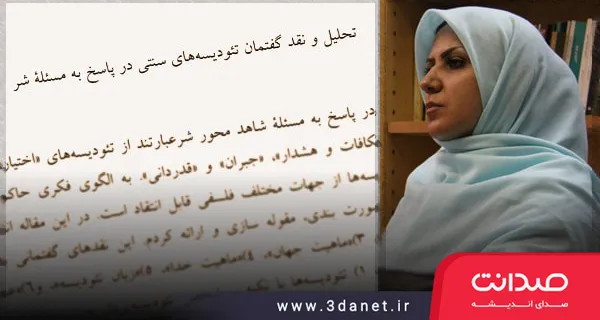

Naeimeh Pourmohammadi
AuthorAn Analysis and Critique of the Discourse of Traditional Theodicies in Response to the Problem of Evil
Author: Naimeh Pourmohammadi (Assistant Professor of Philosophy of Religion, University of Religions, Qom)
Abstract:
The most important traditional theodicies in response to the evidential problem of evil are the theodicies of “free will,” “soul-making,” “purity,” “submission and dependence on God,” “retribution and warning,” “compensation,” and “gratitude.” The intellectual pattern governing these theodicies is called the “discourse of theodicy.” The discourse of theodicies is open to criticism from various philosophical perspectives. In this article, I have extracted, formulated, categorized, and presented various criticisms of the philosophical discourse of theodicies. These discursive critiques can be divided and expressed in six directions: 1) “the person of the theodicist,” 2) “the nature of evils,” 3) “the nature of the world,” 4) “the nature of God,” 5) “the language of theodicy,” and 6) “the practice of theodicizing.” To elaborate, 1) theodicies, relying on the person of the theodicist, are open to criticism because they are “theoretical,” “subject-centered,” and “ahistorical.” 2) Theodicies are open to criticism regarding the nature of evils because they are “abstract,” “essentialist,” “observer-centered,” and “second-order.” 3) Theodicies are open to criticism regarding the nature of the world because they are “causal” and “God-centered.” 4) Theodicies, regarding the nature of God, follow “traditional theology,” and this is open to criticism. 5) Theodicies, in terms of language, are “non-tragic” and “non-mysterious,” and this is open to criticism. 6) Theodicies, in terms of the practice of theodicizing, are “secular,” “non-text-centered,” and seek “professionalization” and “systematization,” and this is open to criticism. After the discursive critique of traditional theodicies, I turned to examples of theodicies presented in the modern era and found options that, through a “discursive turn,” have transformed the grammar of theodicies: “theodicies based on the cross,” “theodicy of protest,” “narrative theodicy,” and “feminist theodicy” are examples of these theodicies that have undergone discursive reform; that is, their discourse has become “practical,” “object-centered,” “historical,” “concrete,” “non-essentialist,” “non-causal,” “tragic,” and “text-centered,” and they possess a “first-order language.”
Keywords:
Problem of Evil, Theodicy, Discourse Critique, Kenneth Surin
Introduction
Traditional theodicists are usually engaged in understanding and explaining evil within the mind of the knowing subject, and typically do not consider that there might be an explanation of evil that simultaneously alleviates the pain of the suffering and leads to the resolution or removal of the human problem of evil. They are, in principle, more concerned with the perceptions of the observer than with the victim. Theodicists regard evil as a fixed, static, singular, common, and universal concept and attempt to confront that concept, whereas absolute evil does not exist in a vacuum; it is fundamentally temporal, spatial, highly diverse, extensive, strangely abundant, and unevenly and discordantly distributed. In this state, it must be said that theodicists have not confronted the reality of evil at all, but have instead offered an abstract, general, and essentialist response to the concept of evil or the "specter of evil." Theodicists pay no attention whatsoever to history and do not present their answers to the horrific evils of history in order to assess their explanatory power, acceptability, and efficacy. Theodicists fundamentally employ a second-order language, meaning they theorize about the evils that befall humanity, whereas they have never considered that the language of suffering people is a first-order language that can be inspiring and insightful, and that highly effective, original, and living responses can emerge from the narratives of their suffering—narratives that are capable of being modeled and implemented. Theodicies still operate with a pre-modern cosmology and theology in explaining the phenomenon of evil in this world, and appear to be entirely unaware of modern science and the various contemporary and modern theologies. By virtue of their claim to overcome evil, theodicies strenuously avoid emotional and tragic language, believing that the more tragedy enters their language, the weaker their theodicy becomes; whereas if the suffering do not feel that the theodicist has understood their suffering and empathized with them, they will not accept that the theodicist has spoken about them at all. By virtue of their desire to be rational, theodicies have deliberately distanced themselves from human religious and non-religious traditions and cultures, whereas the stories of sacred scriptures and human cultures are filled with the suffering of holy or semi-holy individuals, whose confrontation with their suffering can provide theodicists with an insightful model. Finally, theodicists have been more engaged in professional processes and their occupational rituals, wanting their theories about evil to have a systematic relationship with other parts of their thought. Yet how can one expect those suffering on the verge of the collapse of their faith to accept answers produced out of a concern for systematicity or professionalization?
It is here that we can speak of the merit and necessity of a discourse critique of theodicies, and consider this discourse critique as a prelude to a transformation and discursive turn whose fruit is the production of new types of theodicies. In this article, first, by studying works of theodicy discourse critique such as those of Wetzel, Trakakis, Pihlström, Geddes, and Jensen, and especially by relying on Kenneth Surin's highly important and influential work Theology and the Problem of Evil, I extract, formulate, categorize, title, and present six discourse critiques of traditional theodicies. In his book, written in 1986, Surin was not particularly concerned with presenting a critique of discourses using the method of formulation, categorization, and titling. He merely expresses some points as a critique of theodicies in the two chapters "Critique of Theodicy One" and "Critique of Theodicy Two," and of course, his book, as a classic work in the critique of theodicy, is highly referenced in later works. Nevertheless, I have not found a text in the original language that could formulate the 18 critiques based on Surin's intended content and supplement them based on the works of other philosophers of evil. After doing this, I then turn to examples of modern-era theodicies which, according to my analysis, were produced and developed following the formation of this discourse critique. I believe that the "theology of the cross" theodicy, the "protest" theodicy, the "narrative" theodicy, and the "feminist" theodicy are the results of the discursive turn of theodicies.
1- Critique of the Discourse of Theodicies from the Perspective of the Theodicist's Mind
1-1 Critique of Theoretical Discourse
The approach of theodicies is entirely theoretical, and relying on a theoretical approach, the problem we face regarding evil is as follows:
Is evil something inherently intelligible?
Given the diversity and abundance of evil, is the existence of God probable?
Whereas if theodicies had a practical approach, their problem would be:
What does God do to overcome the evil and suffering that exist in His creation?
What do we, God's creatures, do to overcome evil and suffering?
What are the social and historical structures that allow oppressors to victimize their victims? (Surin, 1986, p. 62-3)
Fundamentally, the fact that theodicies place theoretical problems at the center of their focus originates from the epistemological model of the Enlightenment, which begins with Descartes. In the Cartesian turn to the mind, the categorization of realities is carried out based on the mechanisms of human cognition. Theodicists approach the problem of evil with the Cartesian epistemological model and want humanity to know evil with its mind and explain it, not to confront evil in practice and eliminate it. (Surin, 1986, p. 48) Whereas if we consider philosophy to be something more than a purely theoretical category and regard it as a category with inseparable personal and social dimensions, the rigid demarcation between the theoretical problems of evil and the practical problems of evil seems dubious and contrived, and is also morally and socially harmful. (Trakakis,2013,368) Essentially, the distinction that renowned theodicists, including Plantinga and Hick, draw between theoretical theodicy and practical consolation is a kind of cleansing of theodicies of practical and ethical sensitivities, and this indicates that theodicists are unfamiliar with their practical commitments. (Wetzel,1992, 360)
What is at issue here is the importance of contextual philosophy. Evil and suffering are rooted in human relationships and not in our cosmic narratives about the nature of the world. As a result of this reorientation, as Grace Jantzen points out, our main task becomes "ending suffering." Indeed, understanding the roots of evil actions is only important to the extent that we can gain awareness in order to change phenomena. (Jantzen 1998, 111)
2-1 Critique of the Discourse of Subject-Centeredness
According to Surin, in the Enlightenment era, the self-defining knowing subject considers the world, which includes good and evil, as an object that it can recreate. In this period, Kant concurs with Descartes that all experienced matters should be categorized with laws imposed on reality by the mechanisms of human cognition. In this state, social and objective categorizations upon the object are blocked, and the world is shaped based on how the subject understands it. Surin, 1986, p. 43
The impact of this view on the response to the problem of evil is also evident. Theodicists merely fit evils into mental frameworks and shape theodicies in such a way that the knowing subject can understand them. Whereas theodicies could turn to an object-oriented approach and, more than and prior to being concerned with understanding evil in the mind of the knowing subject, be concerned with resolving and eliminating evil for the object and the recipient of evil.
3-1 Critique of the Discourse of Ahistorical Mentality
Theodicists neglect that reality is historical, that their own modes of thinking and mental foundations are historical, that theological problems and theological narratives differ in every era and are consequently historical, and that their own personal narratives of evil in their lives are historical. Surin says:
Historically, the philosophical tradition of Hegel, Marx, and Nietzsche has emphasized the social history of human consciousness, something apparently neglected in the philosophical tradition of Descartes, Hume, and Kant, and it is important to know that most famous theodicists, such as Plantinga, Hick, and Swinburne, belong to the non-historical philosophical tradition; a tradition that never accepts that the materials of cognition arise in society and are shaped by historical forces. (Surin, 1986, p. 48)
The theodicist, above all, needs to be aware of the historicity of their own mind, and must also be aware of the historicity of their mind's disposition toward something or criticism of something. Likewise, they must know that theological methods and the image of God are subject to historical and social conditions. Furthermore, their personal narrative of evil is influenced by their own biography and their encounter with evil, and even more generally, life and reality for them is also a reflection of the socio-historical conditions of their own era. It is having a historical mentality that brings the theodicist closer to the reality of evil and human suffering.
2. Critique of the Discourse of Theodicies Regarding the Nature of Evils
2-1 Critique of Abstract Discourse
The important point in this discourse critique is that theodicies seemingly do not believe at all that evil, in order to exist, requires its own specific victims, torturers, and criminals. The Warsaw Ghetto, Auschwitz, the Gulag, the Beirut refugee camp, Biafra, Pol Pot's Year Zero must exist for evil to emerge and manifest. Evil is not a subjective concept. In Herzog's words, "Destruction is no longer a metaphor. Good and evil are real." (Surin, 1986, p. 51) Surin believes that theodicists who speak of abstract, general, and impersonal evils, knowingly or unknowingly, cultivate theories that deny the characteristic horror, violence, and cruelty of human evils, and implicitly give rise to a social or political practice that turns a blind eye to the cruelties existing in the world. The theodicist must address the specific and concrete realities of evil: "If theodicy does not allow the cries of our community to be heard, it is not worth heeding." (Surin, 1986, p. 52) Evils that are not identified by reference to specific victims and perpetrators do not have the power to torment a person and ultimately will not be a problem for anyone that needs solving. Therefore, theodicies are oblivious to the realities of historical and social evils. Evil, without time and place, and victim and executioner, is not evil but a pure concept. Evil has a specific temporal and spatial reality, and the response to it is situation-dependent, non-conceptual, and non-absolute. Hence, theodicies overcome not evil, but the "specter of evil."
Also, Jennifer Geddes, through Charlotte Delbo's reflections on her experiences as a prisoner of Auschwitz, is dissatisfied with the abstract approach of theodicies. Delbo refuses to diminish the horror of the experience of real suffering: real suffering is savage, empties a person of humanity, and has no feature indicating the possibility of future salvation. Delbo describes the ultimate limit of what human savagery can inflict upon a person. (Geddes 2003, 106) What Geddes pursues in this discussion is that evil, in the true sense of the word, is savage and horrific, provided we describe it based on the real situation, not a concept our mind has abstracted from the outside.
2-2 Critique of Essentialist Discourse
When the theodicist responds to evil, they actually assume that evil has a fixed and determinate essence, which is defined in their mind as a general concept and is not derived from social and political structures. It is with this presupposition that the theodicist provides a single, common answer for all types of evils throughout history. However, evil does not have a general and essential nature. Every evil is dependent on its own time, place, form, and conditions, and evil cannot be subsumed under a single category and a single solution found for it. The more abstract and theoretical the theodicy, the more essentialist it will be, and the more it will separate evils from their socio-political contexts and historical settings. The view of theodicies toward evil, along with the exclusive answers they consider for all the diverse types of evils, their uneven distribution, and their great quantity, is replete with this essentialist perspective.
2-3 Critique of Spectator-Centric Discourse
The logic of explaining evil from the perspective of the victims of evil demands a grammar entirely different from the logic of explaining evil prevalent in theodicies. A victim-centered theodicy possesses a discourse that takes shape among the inhabitants of the realm of suffering and pain themselves—for instance, among the inhabitants of Auschwitz. If the language of Auschwitz contained a grammar capable of formulating a theodicy, that theodicy would be reliable and acceptable; otherwise, by virtue of being observer-centered, the theodicy is of no use to the victims of evil. (Surin, 1986, p46) The great apologists and theodicists themselves are also aware of this point: Alvin Plantinga, author of the “Free Will Defense,” says: “neither the Free Will Defense nor the Free Will Theodicy is of much help to someone suffering from ... a storm in the soul” (Plantinga, 1974, p. 29). John Hick, author of the “Soul-Making Theodicy,” says: “what a Christian theodicy ... provides is an understanding of our human situation; but this is something other than practical help and consolation to those who are in severe pain or deep suffering” (Hick, 2001, p. 68)
Furthermore, from a theoretical perspective, one can discuss the distinction between physical and moral evil and the philosophical or theological priority of the two, but according to Surin, from the viewpoint of individuals who are victims of evil and suffering, these discussions are entirely insignificant and irrelevant:
From the viewpoint of individuals who are victims of evil and suffering, it is entirely irrelevant whether what is more or less difficult to reconcile theoretically with the existence of a good, omniscient, and omnipotent God is human evil or physical evil. A person suffering from incurable liver cancer, should they engage in the theoretical discussion of theodicy, would most likely wish to give priority to the problem of physical evil. Conversely, a theodicist who happened to be a prisoner in Auschwitz or Treblinka would probably tend to give priority to the subject of human evil. Theodicies, therefore, are observer-centered, not victim-centered; that is, the logic and the space of explanation of theodicies are alien to the victim, and the benefit of theodicies does not serve the victim. From the viewpoint of the victims of evil, the problem of the intelligibility of evil may not even arise at all, or if it does, it is mostly of merely incidental or secondary importance. What holds priority for them is the practical problem of evil, which consists of removing the affliction or enduring the affliction (Surin, 1986, p. 62-3)
In this respect, the victim of evil does not involve themselves in theoretical discussions such as the types of evil; rather, how to overcome the evils that have ensnared them holds priority. Whether the existence of evil or its abundance constitutes evidence against theism is not their primary concern.
4-2 Critique of Second-Order Discourse
Theodicies do not look upon evil as a first-hand experience, but rather view it as a second-hand experience in the mind of the knowing subject, for example, the theologian or philosopher. Instead of turning to the narrative and lived experience of evil, theodicies turn to theory. The perspective and language of theodicists belong to philosophers and theologians, not to those who are themselves victims of evil and suffering and possess first-hand, lived experience. Surin refers to the view of Susan Shapiro, who believes that the experience of suffering causes the prevalent theological language, which is a second-order language, to collapse: “The prevalent theological language collapses with the narratives of suffering and allows itself to be broken by the reality that its narrators give voice to.” (Surin, 1986, p. 149) The first-order language we must develop should be a language that enhances our solidarity with those who were forced to endure these experiences. “Therefore, our first-order theological language is a language that records and conveys the stories of the victims.” (Surin, 1986, p. 150) Surin quotes Wiesel:
Let us tell tales. Let us tell tales all the time; all the time. Let us tell tales, for this is our primary duty: tales of children so old; tales of old men silenced by fear; tales of victims who went to meet death like old acquaintances; tales of despair; tales of longing; tales of the immense fire that rose to the heavens; tales of the night that obliterated life, hope, and eternity.
Let us recount, so that we remember how indomitable the human being is in the face of pervasive evil. Let us recount, so that we do not allow the executioner to have the last word. The last word belongs to the victims. It is the duty of the witnesses to gather them, to give them shape and form, to preserve them as a secret, and to pass it on to others. (Surin, 1986, p. 150)
For Geddes, too, the philosopher of evil or theodicist can all too easily become the interpreter of the experiences of the one who is suffering. As Geddes reminds us, the problem is that we may simply "impose our own 'view' of evil onto their experience" instead of attending to what the suffering individual is actually saying. And this difference in perspective is crucial for addressing how suffering might be understood. Only the suffering individual can judge how their suffering has been beneficial. Centering the suffering individual is "the sign of the end of those hegemonic discourses in which the theologian speaks about evil from a superior position, with knowledge about evil." The implicit consequence here is that the language of theodicy will fall short of truly listening to suffering. When we think about suffering and evil, "we must act in such a way that the victims can speak and be heard, rather than forcing our own words and concerns into their mouths." (Geddes 2003, 105).
3. Critique of the Discourse of Theodicies Regarding the Nature of the World
3.1 Critique of the Causal Discourse
Theodicies posit a final cause for all matters; whereas in modern philosophy, the final cause is rejected. One of the changes after the Enlightenment is the denial of final causes in the operations of nature. In modern philosophy, there is no concealed theology behind nature, and final causality in the world is denied. Spinoza called these final causes or ends merely imaginary constructs inspired by human desires. In this new picture of the world, evils have no teleological framework and do not necessarily come into existence for the purpose of achieving a greater good. (Surin, 1986, p. 45)
Similarly, in modern philosophy, the "principle of sufficient reason," which was considered necessary in Aquinas's time for explaining phenomena, is no longer an absolute presupposition, and thus, for any evil that occurs, there is no necessity to seek a sufficient reason to explain it. Therefore, in modern philosophy, it is possible to conceive that some evils are gratuitous and lack a sufficient reason for their explanation. It is not strange or peculiar for evils to be described as gratuitous. (Trakakis,2013,370)
3.2 Critique of the Theocentric Discourse
In the Aristotelian theology of the Middle Ages, theodicy was based on "the assumption of God as the supreme architect and sustainer of the universe," but in Surin's words, "the period in which we live is precisely one in which there is no longer any argumentative or non-argumentative combination that creates discourses in which the transcendent creator God is deemed necessary as the absolute presupposition of discourse." (Surin, 1986, p. 39) In the modern period, the "rational, mechanical, anti-animistic (and therefore anti-theological) conception of the universe" initiated by Galileo was completed by the "Newtonian world-machine." Based on modern physics, "mathematical laws govern the world so completely that one can conceive of no need for divine intervention," and "this universe is a mechanical and independent apparatus." In this view, the problem of evil exists, but the problem of evil is not constituted by the compatibility between the existence of evil and "the operations of divine providence." In this natural theology and mechanical, anti-theologized universe, a new form of theodicy is necessary; a form in which the important thing is to provide a natural explanation for evil, and of course, for our response to also be religious, it is merely necessary that the natural explanation we offer for evil not be incompatible with theology. (Surin, 1986, p. 42)
4. Critique of the Discourse of Theodicies Regarding the Nature of God
Although a long time has passed since the failure of Aristotelian-Thomistic theology and natural theology in the contemporary period, the core of theodical thought remains traditional theology. In new theologies, God does not hold that traditional and former position. Therefore, new theodicies must be born that are compatible with this new theology. The God of theodicies is still the same God of “perfect being theology,” who is omnipotent, omniscient, and purely good. However, in the contemporary period, non-anthropomorphic concepts of God abound:
One of the assumptions in perfect being theology or anthropomorphic theology is that God's morality is essentially the same as our morality, and therefore there are universal moral principles that are jointly applicable to human and divine beings. But we can assume this to be false. For example, we can appeal to the doctrine of divine simplicity, according to which God has no parts or elements and is therefore absolutely simple. Based on this view, instead of God possessing the attribute of goodness, God is goodness itself or the standard of goodness. With this assumption, we would have no moral standard independent of God by which to judge God's actions, whereas theodicists do precisely this. Another alternative is to argue that the nature of God's goodness is metaphysical, not moral. In this case too, God is not subject to our moral evaluation or criticism. (Davies, 2004, 226-230)
Therefore, it is with the exclusive conception of past theologians regarding the moralization and juridification of the world that, with the occurrence of evil, God is accused and theodicy becomes necessary. The moral God is considered to possess moral maturity like a human being. However, theodicists must accept this variety of theological assumptions in the contemporary period and abandon the monopoly over the concept of God and God's attributes. In Surin's words, “In a world where the voice of God (the traditional God) can no longer be heard, the theodicist's words have no echo. He shares the fate of his God, and his voice too is no longer heard.” (Surin, 1986, p. 44)
5. Critique of the Discourse of Theodicies in Terms of Language
1-5 Critique of the Discourse of Non-Tragic Language
Theodicies are detached, lack the language of emotions, and are didactic; whereas the language of evil and suffering is entirely a tragic and sorrowful language. It is natural that there is a constant conflict between tragedy and theodicy. In Surin's words, the most attractive escape from tragedy ever proposed is theodicy's use of the strategy of compensation: the claim that whatever now appears dark will ultimately end in good and happiness. Choosing theodicy and escaping tragedy causes theodicies to lose their efficacy for the afflicted and the suffering. Nicholas Wolterstorff, in his book Lament for a Son, speaks of the painful grief of losing his adolescent son, who lost his life in a mountaineering accident. In this book, he considers the language of emotions and feelings appropriate for facing someone who is suffering, and deems the language of wisdom the most inappropriate language:
What do you say to someone who is suffering? In this situation, some people speak wisely. We are deeply grateful for such individuals. There are many people who comfort us, but not all people possess such a gift. Some of them utter strange and inappropriate words. Even such words are acceptable. Your words do not need to be wise. Words spoken by the heart are heard better than the words that are uttered. And if nothing at all comes to your mind to say, just say: “I cannot say anything. But I want you to know that I share in your sorrow.”
Or even, instead of saying the best words that could soothe their pain, just hold them in your arms....
But please do not say that this pain of yours is really not so bad. Because it really is bad. Death is terrible, it is demonic. If you think your task as a comforter is to tell me—given the circumstances—that my pain is really not so bad, do not sit with me in my sorrow, but stand at a distance from me. There you can no longer be of any help. What I need to hear from you is that you understand how painful this suffering is. I need to hear from you that you share in my helplessness. To comfort me, you must come close to me and sit beside me in the place of my mourning. (Wolterstorff 1987, p34)
Surin quotes Forsyth as saying that theodicies “are merely the glory and beauty of thought” (Forsyth,1916, p137) and “are more concerned with wisdom and reason than with practical engagement, and think more of cultivating an imposing theory than of enduring truth” (Forsyth, 1916, p 150). If we pay attention to the assumption behind theodicy, we realize that the assumption is that we have no right to become sad, to grieve, or to despair, let alone the right to become angry, to rebel, to show disrespect, and even to cry out against God. It seems this type of protest is forbidden in advance within theodicy: “because theodicy, with its belief that God had a strong reason for ordaining everything, considers reactions such as grief and protest (at best) natural but short-sighted and (at worst) sinful and blasphemous” (Trakakis,2013,372)
2-5 Critique of the Discourse of Non-Apophatic Language
Evil is a mystery, and one cannot speak of mystery with reason. In the discourse of theodicies, reason is applied in a place where it has no application at all. The goal of theodicy is to make evil comprehensible and explicable, whereas evil and suffering are inherently such that they cannot be resolved by the mere application of rational principles. The Enlightenment era, relying on and trusting in reason, introduced the process of rationalization into all human issues, including the problem of evil. Hence, in theodicy, an effort is made to render evil and suffering comprehensible and explicable: “The core of theodicy is the attempt to provide a theology of evil and suffering; the effort to place the occurrence of evil and suffering within the realm of things that are consistent with the inherently rational acts of divine providence.” (Surin, 1986, p. 52) This is while evil is not among the issues into which reason can find a way; because “evil and suffering, in their deepest layer, are fundamentally mysterious; they reduce the human mind to impotence ... Theodicies founder in the mud before the mystery of evil.” Surin, 1986, p. 54
6- Critique of the Discourse of Theodicies from the Perspective of Theodicy-Making
1-6 Critique of the Discourse of Secularization and Non-Scriptural Centeredness
After the philosophization of theology, theodicies moved toward the rationalization and theorization of evil in the human mind. It was no longer sufficient that God, and only God, knows the reason for evil and we do not; rather, human beings also want to understand and know the motive and reason for the ordination of evil. The pillars of modernity, which began with the Enlightenment era, are three characteristics: the authority of reason, human autonomy, and the primacy of the individual. In light of this conception of the human being, God gave way to humanity, and the human being appeared in the position of a self-defining knowing subject who considers the world, including good and evil, under their own will and wants to recreate it. Theodicy-makers, influenced by modern philosophy, have sought to explain evil with the centrality and pivot of the human being, and all possess a secular character. (Surin, 1986, p. 54) Theodicy-makers deliberately distanced themselves from sacred scriptures as one of the sources of knowledge and meaning and sought to have the human being, independent of religious traditions, understand the reason and meaning of evils. This is while sacred scriptures, as well as the cultures of nations, are filled with the sufferings of holy or semi-holy people whose encounter with their sufferings could provide theodicy-makers with an insightful model.
2-6 Critique of the Discourse of Professionalization
There exists a ritual of theodicy-making in the tradition of theology and philosophy. Theologians and philosophers engage in theory-building to obtain doctorates, articles, and books. Theodicy-making has become a professional ritual. From Surin’s perspective, specialists have never grasped these dangers: “the danger of quoting oneself, the danger of endless repetition, and the danger of having conceptions that a discipline itself generates for reasons more related to politics and ideology than to external reality” (Surin, 1986, p. 50). The problem emerges here: the orientation of the educational system regarding the problem of evil, through professionalization and outputs such as books, dissertations, and scholarly articles, creates conditions in which theodicy is regarded as a “purely theoretical exercise.” Yet, as we stated earlier, any discourse that causes theodicy to take the form of a theoretical and logical task is subject to critique and must undergo transformation.
3-6 Critique of the Discourse of Systematicity
A theologian or philosopher typically presents a theory on evil that, together with other elements of theology or philosophy, provides a coherent system or confirms and validates their intellectual system. In this respect, they are more engaged with systematicity than with the mission and goals of theodicy. If specific theological or philosophical priorities are considered, the mission of theodicy no longer matters; instead, the compatibility of the theodicy with those theological and philosophical principles becomes central. A clear example is the Christian tradition, in which Christ was sacrificed on the cross for the atonement of sin. Now, if one accepts the Christian cross, “the problem of evil as a norm” must exist so that the entire system that philosophers and theologians have constructed from original sin, atonement, and the divine kingdom remains coherent and meaningful. But the question here is: why must theodicy make itself compatible with Christian or Islamic philosophy or theology in a systematic and coherent manner? The explanation of evil can take place outside of a particular overarching philosophical or theological system: “If it were otherwise, perhaps a pure confrontation with the problem of evil has not taken place” (Surin, 1986, p. 61).
7- The Discursive Turn of Modern Theodicies
Under the influence of the writings of thinkers such as Surin, Wetzel, Trakakis, and Fales (Fales, 2013), in my view, theodicies have emerged in the modern period that, with a general awareness (though not highly organized) of these six discursive critiques, have brought about a transformation in theodicies and have created a new discourse that is practical, object-oriented, historical, concrete, non-essentialist, victim-centered, first-order, non-causal, non-theocentric, tragic, text-centered, and non-systematic. An example of the formation of this new discourse of theodicies, in my belief, is the theodicies based on the cross (see Pourmohammadi, 92a, pp. 89–109) by Soelle (Soelle, 1975), Forsyth (Forsyth, 1916), and Moltmann (Moltmann, 1974). I can also point to the theodicy of protest (see Pourmohammadi, 92b, pp. 143–162), narrative theodicy (Lara, 2001), and feminist theodicy (Clack, 2013), which, from my perspective, are entirely the result of the creation of a new discourse of theodicies. Below, I will point to prominent examples of contemporary theology’s contribution to the production of a new discourse concerning theodicies.
1-7 Theodicy Based on the Cross
The theodicy based on the Cross, by taking its model from the cross of Jesus Christ, provides insights to sufferers so that they may receive a divine reason or consolation in their suffering. Given the broad dimensions of the doctrine of the Cross, this theodicy has found various narratives—seven, according to my research. The theodicy of “Christ’s atoning death” relies on the atonement, through Christ’s cross, for some of the evils resulting from the Fall. The theodicy of “understanding Christ’s greatness” views evil and suffering as a way to grasp the preeminence and virtue of Jesus Christ and the necessity of following him. The theodicy of “the redemptive sufferings of believers” considers evil as enabling the suffering person to share with Christ in the redemptive experience of union with God. The theodicy of “completing Christ’s redemptive work” sees enduring evils as completing the redemptive work of Jesus Christ throughout history and extending its effect across time. Just as Christ, through his suffering, was the redeemer of believers, suffering believers in every age are likewise redeemers of their believing brothers and sisters and cause the effect of Christ’s redemptive work to extend throughout history. The theodicy of “receiving God’s consolation” regards evils—which brought about the Cross and God’s participation in human experience—as the sole way to understand God’s compassion and consolation. The theodicy of “the Kingdom of God” holds that evils will become the ground for the establishment of the divine Kingdom in all its glory, and the theodicy of “the transformation of suffering” relies on the idea that, in light of the Cross, the nature of evils is such that they are transformed within the human being and turned into grace and blessing. (See Pourmohammadi, 92 a, pp. 89–109)
We see that the dominant discourse in Cross-based theodicies is a “practical,” “sacrifice-centered,” and “text-centered” discourse.
2-7 The Theodicy of Protest
In the theodicy of protest, which took shape in the era of post-Holocaust theology, the premise is that the suffering person, through faithful protest to God, draws God’s bewildered goodness and grace toward themselves. The theodicy of protest seeks, through faithful complaint and lament to God, to strengthen hope for the removal of evil by God and to address a God whose power is not limited by any rational or moral rule and depends entirely on His absolute and arbitrary will. The expectation of the theodicy of protest is that God will change the circumstances in favor of the suffering person.
John Roth, a Protestant Christian theologian, claimed in his article “A Theodicy of Protest” that the theodicy of protest solves the problem of evil. In the Jewish tradition, David Blumenthal, in his book Facing the Abusing God, is a pioneer of protest theology in general and the theodicy of protest in particular. Also in the Jewish tradition, one can mention Anson Laytner with his book Arguing with God: A Jewish Tradition. In Islam, Navid Kermani, the renowned German writer of Iranian descent, has claimed in his book The Terror of God: Attar, Job and the Metaphysical Revolt that a part of the Islamic mystical tradition, and specifically Attar’s Book of Affliction (Musibat-nama), is a perfect example of protest theology.
If a person, while preserving faith and trust in God, addresses Him, speaks to Him with complaint and lament, and shows Him their anger and wailing, this plaintive address causes the person to find God, just as Job, with his sighs and laments, compelled God to reveal Himself to him. Furthermore, the theodicy of protest, citing the Book of Job, holds that human beings must protest against a God who, despite being omnipotent, is content with the ruin and corruption of the world through non-intervention. This protest is accompanied by faith and trust in God and seeks to seize God’s heart to make Him consent to change the situation. Just as in Job’s case, protest and faith came together in a tense duality and ultimately led to Job’s victory, compelling God to support Job, we too must, by challenging divine ethics and justice, compel Him to support us. Through the universal protest of all the world’s people, we must bring divine ethics and justice closer to human ethics and justice. God, by virtue of His absolute will, power, and sovereignty, can be indifferent to intervening in the world’s destiny, but we must compel Him to pay attention to us. (See Pourmohammadi, 92 b, pp. 143–162; Pourmohammadi and Fasihi, 96, pp. 607–629)
It is evident that the discourse governing the protest theodicy is a “practical,” “object-oriented,” “historical,” “concrete,” “tragic,” and “non-secular” discourse. The protest theodicy, compared to other theodicies that are maximally engaged in finding God’s motives and reasons, is moderate and skeptical, responding simultaneously to the intellectual and emotional problems of evil. More than being concerned with solving the theological and philosophical problem of evil, it is concerned with solving the human and humanitarian problem of evil through a humanistic approach.
3-7 Narrative Theodicy
In narrative theodicy as well, which is part of the narrative theology that took shape in the postmodern era, the emphasis is on beginning not from theories but from the narratives of suffering human beings, so that others, by identifying with the characters of these narratives, may find a model for confronting their own suffering. How believers have maintained their faith in God while enduring terrible suffering can itself provide the basis for the best theory and solution to the problem of evil.
Furthermore, in narrative theodicy, we are meant to construct our collective memory through storytelling and orient our behavior toward confronting the injustices perpetrated against others. How narratives help in the formulation and reshaping of reality is important to us, because narratives can morally “construct” their readers and change the orientation of their behavior. This is why our goal in demonstrating the importance of narratives is not to find scientific explanations or fact-based correctness; rather, behind the narratives lie the historical and particular meanings of evil that help us act more ethically regarding the particularities of the present time. (Lara, 2001, p239-251)
In Surin’s own words, the only permissible theological discourse about Auschwitz is the discourse that took shape among its own inhabitants. As Metz says, one can pray after Auschwitz only because there was prayer in Auschwitz itself. Elie Wiesel, in his play “The Trial of God,” creates a dialogue between Gregor, whose faith was on the verge of destruction because of the Holocaust, and a Hasidic rabbi:
Gregor was angry. After what happened to us, how can you believe in God?
The rabbi, with a thoughtful smile on his lips, replied: After what happened to us, how could one not believe in God?
Surin’s point is that merely referring to the suffering persons themselves and their ways and insights for preserving faith in God amidst suffering can be the only way to construct a theodicy.
For Surin, the first-order language we must develop in theodicy is a language that enhances our solidarity with those forced to undergo these experiences. That language is based on Wiesel’s own injunction that the stories of the victims be allowed to be shared.
“Let us tell tales. Let us tell tales all the time; all the time. Let us tell tales, for that is our primary duty.
Let us tell tales so that we remember how indestructible the human being is in the face of pervasive evil. Let us tell tales so that we do not allow the executioner to have the last word. The last word belongs to the victims. It is the duty of the witnesses to gather them, to arrange and present them, to keep them like a secret, and to pass them on to others.” (Surin, 1986,150 -153)
Therefore, our first-order theological language is a language that records and conveys the tales of the victims. In this task, one must bear in mind Wiesel’s sharp criticism that the tales not only can, but must be conveyed. It is clear that the discourse governing narrative theodicy follows the “first-person, first-order grammar” and confronts evil in a thoroughly “concrete,” “practical,” “historical,” “emotional,” and “non-essentialist” manner.
4-7 Feminist Theodicy
Feminist theories always return to the practical solutions that can be devised to confront the evil and suffering present in our world. The feminist critique of theodicies is this: to what extent have the various answers philosophers might give to the problem of evil been able to lessen the experience of human suffering? Almost none. From the feminist perspective, evil is a problem and remains a problem. They draw everyone's attention away from the metaphysics of evil toward the moral problem of human evil and, especially, the ways of recognizing and confronting it. In feminist analysis, the efforts of philosophers and theologians to prove that suffering is not meaningless or that it has a place in the world God created, creates the space for us to marginalize political and social injustice and not join our voice with the victim's. The feminist philosopher of evil, Geddes, quotes Charlotte Delbo, a survivor of the Auschwitz prison, who refuses to diminish the horror of the experience of real suffering: real suffering is savage, it empties a person of humanity, and has no feature that indicates the possibility of future salvation. She likens this matter—that theodicists are trying to normalize our reaction to the evil and suffering of this world—to the experience of being informed of our mother's death while being utterly unable to shed a single tear. This is what theodicies do to us regarding evil and suffering. (Geddes 2003, 106)
From a feminist viewpoint, the theodicist can become the interpreter of the experiences of someone who is suffering. The problem is that we might impose our own view of evil onto their experience, instead of paying attention to what the suffering individual is actually saying. "Centering the suffering individual marks the end of hegemonic discourses in which the theologian, with knowledge about evil, speaks from a position of superiority." The implicit consequence of this statement is that the language of theodicy is incapable of truly listening to suffering. When we think about suffering and evil, we must act in such a way that victims can speak and be heard, rather than forcibly putting our own words and concerns into their mouths. The feminist concern is to place the discussion of evil and suffering directly within the context of concrete situations and to turn our focus from the discourse of God to the analysis of human relationships. Evil is understood as a relational matter between human beings, because evil happens among people. (Geddes 2003, 105)
Melissa Raphael provides a good example of Jewish feminist theology. Raphael stands against the efforts of male Jewish theologians who seek to find reasons to justify God's failure in the face of the suffering of the Holocaust. Raphael criticizes the free-will theodicy approach to the human catastrophes of the Holocaust. It is impossible to justify the catastrophes of the Holocaust by relying on the desirability of human free will and autonomy. Instead, Raphael emphasizes the experience of women in the camps and focuses on the "sisterly" relationships that emerged in some camps. Observing this collective network of support compels us, instead of imagining God as an absolutely free agent—which is the model of the free-will theodicists—to conceive of a God who is Shekinah, or Sakina (a source of tranquility), and is immanent and inner-worldly. This inner-worldly and suffering God is not removed from the experience of the camps, but can be sought in the existence of those who were in the camps and in the relationships between them. (Raphael, 2004, 136-150)
Therefore, in the feminist approach to evil, what matters is not justifying God's ways for male theologians, but taking the world and the people inhabiting it seriously, in order to find ways to challenge injustice and create the possibility of a better life for everyone in the world.
Conclusion and Result
We have understood that, first, theodicies have a theoretical concern and are in search of an answer to evil in the mind of the theodicist. It is natural that such a concern yields no answer that is practically useful for those who suffer. These theodicies are concerned with the subject and are not engaged in removing and resolving evil for the object. Likewise, theodicies have never confronted the realities of historical evil in their own time and fundamentally pay no attention to history and historical evils. In this respect, one must think of devising practical, object-oriented, and historicized theodicies.
Second, theodicies are abstract, meaning they abstract a general concept of evil and engage with it. Theodicists do not confront themselves with the realities of evil in specific times and places, nor with specific victims and perpetrators. Likewise, theodicies have constructed a universal essence of evil and respond to that universal essence, whereas evils are highly diverse and context-dependent. In this respect, we need to create a discourse that dismantles the common discourse of theodicies and establishes a new grammar that is concrete, objective, and anti-essentialist.
Third, theodicies still view the world in such a way that, based on the principle of sufficient reason, we require efficient and final causality to explain the world and its phenomena, whereas from the perspective of modern philosophy, efficient and final causality have sometimes been denied. Similarly, theodicies still insist on interpreting and explaining evils in a divine manner, whereas what is necessary is that any explanation offered for evils, even if it is a natural explanation, should not be incompatible with theology. Hence, we need a new discourse in theodicies that is non-causal and non-theocentric.
Fourth, the discourse of theodicies is entirely shaped by the grammar of traditional theology, whereas, at least for all those who have set aside classical theology and turned to various kinds of modern theologies, traditional theodicies, which are rooted in traditional theology, can no longer hold any meaning or significance. In Surin's terms, the resonance of traditional theodicies, like the traditional God, no longer echoes. For this reason, we need to create a discourse of modern and contemporary theology within theodicies.
Fifth, theodicies speak in a non-lamenting and non-emotional language, whereas, due to the practical commitments of theodicy to be answerable to victims, we need theodicies that employ first-order language. Second-order language is the language of philosophy and theology; first-order language is the language of the narrative and story of the suffering of afflicted human beings, and certainly, in this new discourse, burning grief, helplessness, and supplication will find their way into the literary structure of theodicy.
Sixth, by distancing itself from scripture and religious traditions, theodicy has deprived itself of an immense source of justifications, meanings, and consolations for human suffering and has opted for a secular discourse, whereas it could have drawn inspiration from traditions and cultures. Likewise, what necessity is there for theodicies to be situated professionally and systematically in books of philosophy and theology? Theodicies can break free from the constraints of coherence with theological systems and adopt a freer discourse in relation to theological systems—a discourse that is, instead, more committed and answerable to the victims of evil.
After the discursive critique of traditional theodicies, I turned to examples of theodicies presented in the modern era and found options that, through a "discursive turn," have transformed the grammar of theodicies: "theodicies of the cross," "protest theodicy," "narrative theodicy," and "feminist theodicy" are examples of these theodicies that have undergone discursive reform; that is, their discourse has turned towards being "practical," "object-oriented," "historical," "concrete," "anti-essentialist," "non-causal," "tragic," "text-centered," and possessing "first-order language." In my view, these new theodicies can be considered prominent examples of contemporary theology's participation in producing a fresh discourse in theodicies.
.
.
References
1) Pourmohammadi, Naimeh (2013a) "Theodicies of the Cross," Haft Aseman, no. 60, pp. 89–109.
2) Pourmohammadi, Naimeh (2013b) "Two Innovative Theodicies in the Bible," Haft Aseman, no. 59, pp. 143–162.
3) Pourmohammadi, Naimeh and Fasihi, Meysam, "An Evaluation of Protest Theodicy in Response to the Problem of Evil," Journal of Philosophy of Religion, vol. 14, no. 3, 2017, pp. 609–629)
4) Beverley Clack “Feminism and the Problem of Evil”, in: The Blackwell Companion to the Problem of Evil, First Edition. Edited by Justin P. McBrayer and Daniel Howard-Snyder, Wiley-Blackwell, 2013, pp. 326-339.
5) Davis, S.T. (2004) “Truth and Action in Theodicy: A Reply to C. Robert Mesle” In American Journal of Theology and Philosophy 25: 270–275.
6) Fales, Evan (2013) “Theodicy in a Vale of Tears”, In The Blackwell Companion to The Problem of Evil, edited by Justin P. McBrayer and Daniel Howard Snyder, Willy Blackwell, 2013, 349-363
7) Forsyth, P. T. (1916) The Justification of God, London: Duckworth.
8) Geddes, J. (2003) “Banal Evil and Useless Knowledge: Hannah Arendt and Charlotte Delbo on Evil after the Holocaust” Hypatia 18: 104–115.
9) Hick, John, (2001), “An Irenaean Thedicy” in Encountering Evil, edited by Stephen Davis, Westminster John Knox Press.
10) Jantzen, G. (1998). Becoming Divine: Towards a Feminist Philosophy of Religion. Manchester: Manchester University Press.
11) Lara, María Pía (2001) “Narrating Evil: A Postmetaphysical Theory
of Reflective Judgment”, in
Rethinking Evil;Contemporary Perspectives, EDITED BY María Pía Lara, UNIVERSITY OF CALIFORNIA PRESS Berkeley . Los Angeles . London.
12) Moltmann, Jurgen (1974) The Crucified God, trans. R. A. Wilson and John Bowden, London: SCM.
13) Plantinga, Alvin, (1974), God, Freedom and Evil, London: Allen & Unwin.
14) Soelle, Dorothee (1975) Suffering, London: Darton, Longman & Todd.
15) Surin, Kenneth, (1986), Theology and the Problem of Evil, Basil Blackwell.
16) Trakakis, N. N. (2013) “Antitheodicy”, In The Blackwell Companion to The Problem of Evil, edited by Justin P. McBrayer and Daniel Howard Snyder, Willy Blackwell.
17) Raphael, M. (2004). The Price of (Masculine) Freedom and Becoming: A Jewish Feminist Response to Eliezer Berkovits’s Post-Holocaust Free-Will Defence of God’s Non-Intervention in Auschwitz in Feminist Philosophy of Religion: Critical Readings, B. Clack, pp. 136–150. London: Routledge.
18) Wetzel, James (1992) “Can Theodicy be Avoided? The Claim of Unredeemed Evil”, In The Problem of Evil Selected Reading by Michael Peterson, University of Notre Dame Press.
19) Wolterstorff, Nicholas (1987), Lament for a Son,Grand Rapids: Eerdmans.
.
.
PDF file of the article “An Analysis and Critique of the Discourse of Traditional Theodicies in Response to the Problem of Evil”
.
.





Discussion16 comments
ضمنا از لطف شما ممنونم . اگر فرصت شود و بر من منت بگذارید شاگردی شما را خواهم کرد .
ویتگنشتاین گرامی نوشته شما نشان میدهد که ماشاللا استاد هستید و من باید پیش شما شاگردی کنم. اما چون رای بنده را جویا شدید سلمنا . من تصور میکنم ( شاید به غلط ) بیشتر اشکالات قابل رفع و رجوع است . البته اذعان میکنم که در مورد آن اشکالات مطالعه ندارم . ضمنا من تاکید اکیدی روی نظریه انطباقی صدق ندارم و اشاره من به نظریه انطباقی صدق از آن جهت بود که نظریه مختار عموم فلاسفه و متکلمین اسلامی است . من فقط به این قسمت نوشته شما پرداخته ام : "... اما بدین ترتیب، به راحتی می توان نتیجه گرفت که این تعریف صدق خودش راابطال می کند: به نظر شما، کدام واقعیت، کدام امر واقع عینی ای در جهان به صدق این تعریف شهادت می دهد؟ چه چیزی ما را مجاب می کند که خودِ این تعریف را «صادق» بدانیم؟ " 1- شهود عقلی من میگوید ( واین به این معنا نیست که الزاما درست است ) نظریه انطباقی صدق درست است . چرا که اگر کسی بگوید " باران میبارد " و در واقع هم " باران ببارد " ، پس گفته او واجد صدق است . "صدق " گفته گوینده بمعنای وجود گونه ای اینهمانی ( یا بگو تناظر ، یا تطابق ، یا تشابه ، یا .... ) بین جمله او و واقعیت است . - اما در عین حال این پرسش پاسخ میطلبد که : آیا " تعریف صدق به تطابق با واقع " خودش مطابق با واقع هست یا نه ؟ علی الظاهر ما نمیتوانیم "تعریف صدق" را با " واقع " تطبیق دهیم . گیر کار کجاست ؟ به زعم من گیر آنجاست که " صدق " واقعیتی از واقعیات عالم - بمعنای متعارف - نیست . صدق به تعبیر فلاسفه مسلمان یک معقول ثانی است و نه یک معقول اول ( = عینیات ، ماهیات ) . - حال جای این پرسش است که متدولوژی راستی آزمایی معقولات ثانی چیست ؟ در اینجاست که پای معیارهای صدق و شروط توجیه وارد میشود . همانگونه که مفهومی مثل " علیت " معروض بحث و فحص است ، تعریف انطباقی صدق هم میتواند محل بحث و فحص باشد . لب حرف بنده اینست که : نباید واژه " واقع " را در یک چارچوب خشک پوزیتیویستی محدود کرد . 2- اما ناگفته نماند که تعریف صدق تقریبا هیچ گرهی ( یا گره مهمی ) از کار ما نمیگشاید و بسیاری از انچه قائلان به نظریه بیهودگی وصف صدق ( با قرائت های شدید و رقیق ) میگویند درست است . عالم انسانی عالم اثبات است ( عالم حدسها و ابطالها ) و عالم حقایق "عالم ثبوت " . نتیجتا آنچه اهمیت دارد معیارهای صدق ( شروط توجیه ) است . علی ای حال بقول پوپر : حتا اگر ما به واقع رسیده باشیم ، آن را نخواهیم دانست . ما هیچگاه نخواهیم توانست از یک دیدگاه سوم میزان تطابق " باور" و "واقع " را بررسیم . - بعد التحریر : من متن بالا را صرفا به احترام شما نوشتم چون دوست ندارم در مورد موضعی که مطالعه کافی ندارم نظر بدهم .
جناب سید گرامی لطفا پرسش ( یا اشکال ) خودتان را به صورت واضحتر بیان کنید . من الان نمیدانم اشکال شما دقیقا چیست ؟ من میتوانستم بصورت تلگرافی بگویم : من واژه "صدق " را از زبان گرفته ام ، و واژه " صدق " مثل تمام واژه های دیگر " جعل و وضع " است ، یا به تعبیری دیگر " نماد و نشانه " است . ضمنا به خوبی آگاهم که تعریف صدق به " مطابقت با واقع " تنها تعریف صدق نیست . تعاریف کارکردی ، انسجامگرایانه ، زائد بودن ( بیهودگی ) صدق و... نیز وجود دارد . شما اشکال خودتان را واضح اعلام کنید . اگر مخالف تعریف انطباقی صدق هستید بفرمایید چرا ؟
منوچهر عزیز این دقیقا پرسش من است. من تعریف انطباقی صدق را غیر قابل دفاع میدانم به چند دلیل: 1) آشکار است که گزاره ها و یا جملات «موجه» Modal صدق و کذب شان از طریق ارجاع به امور واقع محقق نمی شود؛ احکام ضروری ،به عنوان مثال «باید عقلانی اندیشید!» و یا مثلا «باید از خرافات امتناع ورزید!»، طبق تعریف انطباقی، کاذب هستند زیرا که لفظ «باید» معطوف به هیچ امر واقعی در جهان خارج نیست. 2) در همین راستا، گزاره های ارزشداورانه(به خصوص در اخلاق) نیز کاذب خواهند بود؛ مثلا گزاره ی «عشق بهتر از نفرت است» و یا «زندگی بهتر از مرگ است». کدام امر واقعی در جهان «بهتر» بودن عینیِ امری نسبت به امر دیگر را تصدیق می کند و چگونه؟ 3) همچنین گزاره های خلاف واقعcounterfactual نیز به طرز آشکاری تعریف انطباقی صدق را مختل می کنند: کدام امر واقعی عینی ای گزاره ی «اکنون در اتاق من کرگدنی وجود ندارد» را صادق می سازد؟ خواهید گفت «خوب! واضح است: نفسِ نبودِ کرگدنی در اتاق شما خود امر ی است واقع، امر واقعی سلبی a negative fact». اما آیا اساسا می توان امر واقعی سلبی داشت؟ یک امر واقع یا fact بنا به یک تعریف «بروز یا تجلی خاصه ای از سوی یک شئ است»--"the instantiation of a property by an object"-- به عبارت دقیق تر، همواره باید «جوهری» در میان باشد تا عرضیات حادث بر آن را همچون امور واقعی facts ادراک کنیم. حال، چگونه می توان در نبود شیءای از عرضیات و یا خاصه ها ی آن سخن گفت؟ 4)همچنین بنا به تعریف انطباقی از صدق جملات شرطی نیز ظاهراً ،و علارغم شهود ما مبنی بر صادق بودن شان، کاذب هستند: «اگر تا ده روز متوالی آب نخورم، قطعا خواهم مرد»؛ چه امر و یا امور واقعی این جمله را اکنون ( به هنگام ادای جمله) صادق می سازند؟ در حالی که من نه هنوز به مدت ده روز متوالی از نوشیدن آب خودداری کرده ام و نه هنوز مرده ام، بنا به «انطباق» با کدام امر واقع و یا اساسا بنا به «انطباق» با چه چیزی جمله ی شرطیِ «اگر تا ده روز متوالی آب نخورم، قطعا خواهم مرد» صادق است؟ با این همه، به نظر من مهلک ترین نقد علیه تعریف انطباقی از صدق خود-ابطال گر بودنself-refuting آن است، بدین معنا که خودِ تعریف انطباقی از صدق بنا به خودِ تعریف مذکور کاذب است!!! پس: 5) تعریف انطباقی از صدق را جان سرل در مقاله ای با عنوان «عقل و عقلانیت؛ چه چیزی در خطر است؟» اینگونه تصریح می کند: « یک گزاره صادق است اگر و تنها اگر [گزاره ی مذکور] با امری واقع انطباق داشته باشد». اما بدین ترتیب، به راحتی می توان نتیجه گرفت که این تعریف صدق خودش راابطال می کند: به نظر شما، کدام واقعیت، کدام امر واقع عینی ای در جهان به صدق این تعریف شهادت می دهد؟ چه چیزی ما را مجاب می کند که خودِ این تعریف را «صادق» بدانیم؟ برای من همیشه سوال بوده که چگونه است که ما در کتاب ها ی تاریخ فلسفه همواره می خوانیم که پوزیتیوست ها ی منطقی خود پس از مدتی به خود-ابطال گر بودن نظریه ی معناداری شان پی بردند و در نتیجه پوزیتیویسم منطقی آن اقتدار پیشین خود را از دست داد، اما این اتفاق برای نظریه ی انطباق نیافتاد؟! آخر، به همان اندازه که خودِاصل تحقیق پذیری ی پوزیتیویستها تحقیق پذیر نیست، خودِ اصل انطباق با واقعِ واقع باورانReaists با واقع انطباق ندارد! در مورد 1)، 2)، 3) و 4) به دفاعیاتی که از سوی فیلسوفانی همچون کریپکی، لویس، تارسکی، خود جان سرل و ... اقامه شده توجه دارم، اما شخصا هیج کدام را قابل دفاع نیافتم. با این حال قطعاً به قول معروف پرونده ی اصل انطباق برای من بسته نشده است و حتما مایلم که هرگونه دفاعی را بشنوم. در مورد5)، یعنی خود-ابطال گر و یا خود-متناقض بودن تعریف انطباقی، به دفاع صریحی برنخورده ام --و اساساً مگر می شود از یک اصل خود-ابطال گر دفاع کرد؟. جالب تر اینکه، بسیاری فیلسوفان واقع باور(و شاید خود شما هم) در برخورد با نسبی گرایان نخستین و به تعبیری یگانه حربه ای که به کار می بندند این پاداستدلال سقراطی است که «نسبی گرایی خودش خودش را نقض می کند». درست، اما، اکنون در روشنای آنچه که پیشتر نشان دادم، آیا نمی توان خودِ همین پاداستدلال را عیناً علیه تعریف «انطباقی» از صدق به کار برد؟ آیا خود-ابطال گر بودن فقط برای نسبی گرایی نقیصه است؟ و در آخر، اگر ساکن تهران هستید، بسیار مفتخر خواهم شد ( بی تعارف عرض می کنم) که شما دوست باریک اندیش را به حلقه ی فلسفی کوچکی دعوت کنم . خودتان بهتر می دانید که به هر حال در فضای مجازی جدای از خوبی ها یی که دارد، مجال بسیاری بحث ها نیست و مباحثات جالبی از این سنخ لاجرم ناتمام می ماند. به هر حال، من چندین سال است که به همراه سه و گاها چهار دوست فلسفی اندیش محفل ناقابلی را یکشنبه ها در پردیس مرکزی دانشگاه تهران بر گراز می کنیم و بسیار خوشحال خواهم شد اگر شما نیز برای یک جلسه هم که شده به ما بپیوندید.
با اجازه منوچهر گرامی، نکاتی به ذهنم میرسد که میخواهم با جناب مسعود بزرگوار در میان بگذارم. در رابطه با آزمون خدا، خدمتتان عرض کنم که شما اول باید بتوانید ثابت کنید اینجا آزمایشگاه است؛ چرا که در قرآن آیاتی هست که با استناد به آنها میتوان اینجا را تبعیدگاه و یا حتی عبادتگاه دانست؛ حال اگر فرض را بر آزمایشگاه بودن اینجا بگذاریم باید دید چرا شرایط این آزمون تا این حد برای شرکت کنندگان متفاوت و غیرمنصفانه است؟ به این مسئله هم دقت بفرمایید که خیلیها هنوز به آزمون وارد نشده خارج میشوند، مثل کودکانی که هنوز از قوه به فعل نرسیدهاند و دست به هیچ انتخابی نزدهاند.از همه اینها که بگذریم این آزمون میتوانست بسیار کمهزینهتر و بدون این همه شکنجهی روحی و جسمی برگزار شود. به نظر شما در آزمون صداقت، دروغ منصفانهترین باخت نیست؟ در آزمون وفاداری، خیانت چطور؟ در آزمون عبادت خالص، ریا چطور؟ در آزمون مهربانی، بخشش چطور؟ در آزمون شکرانهی بازوی توانا، بگرفتن دست ناتوانان چطور؟ و ... پس این آزمون هیچ نیازی به این همه زجر و درد و اشک و آه نداشته و ندارد. در رابطه با لهو ولعب این دنیا، واقعآ نمیدانم با توجه به حساسیت وجود ما و انتخابهای ما در این جهان؛ چرا آن را لهو و لعب مینامد. اگر لهو و لعب را سرگرمی و بازی معنا کنیم، به نظر شما مکان آزمونی اینچنین جدی و حساس میتواند جای بازی و سرگرمی باشد!؟ در هر صورت یکی از دلایل جدی نگرفتن زندگی و عقب افتادگی مسلمانان، شاید ریشه در همین برداشت داشته باشد. اگر ما خوابیم و بعد از مرگ بیدار میشویم شایسته است در بیداری، آزمونی اینچنین حساس و سرنوشت ساز از ما گرفته شود و نه در خواب. معمولآ آزمونهای جدی شایستهتر است در بیداری گرفته شود. جناب مسعود عزیز، با توجه به موارد آزمونی که اشاره کردم، میتوان آزادی کامل داشت و در آزمون خدا شرکت کرد و قربانی شدن آن دختر جزء هیچ کدام از مراحل این آزمون نباشد. باور کن برای اثبات خوبی و بدی هیچ شخصی، مطلقآ نیازی به این قسمت و دیگر قسمتهای دهشتناک و چندشآور در این آزمون نیست.
دوست فرزانه جناب منوچهر، از آنجا که تحلیلی اندیشی شما را بسیار می پسندم، مایل بودم پاسخ شما را به یک مسئله در باب واقع باوری معرفتی جویا شوم--عذر می خواهم که سوالم به کلیت بحث ربط ندارد. من شخصا پیرو ویتگنشتاین متاخر( بنا به یک خوانش) نسبی گرای معرفتیEpistemc Relativist هستم؛ به بیان ساده تر، نظریه ی صدقی که آن را(در تحلیل نهایی) قابل دفاع تر می دانم چنین است :« یک گزاره صادق است اگر و تنها اگر باور به آن گزاره متعلق خواست فرد (یا گروهی از افراد)قرار گیرد.» همانطور که می دانید، نخستین و ماناترین حمله به این اصل--از «تئای تتوس» افلاطون تا «هراس از معرفت» پول بوغوسیان--همواره این بوده است که اصل مذکور علناً خود-شکن و یا خود-متناقض است: اگر «همه چیز نسبی است»، آنگاه خود این گزاره که «همه چیز نسبی است» تنها در نسبت با کسانی که دلبسته ی این گزاره هستند صادق است و ... در صحت چنین نقدی علیه نسبی گرایی شکی نیست. اما مسئله این است که یک نسبی گرا می تواند ضمن پذیرش نقد مذکور، همین نقد را عیناً علیه نظریه ی صدق مطلق گرای معرفتی نیز به کار بندد ، به عبارت دیگر پاسخی «نقضی» و نه «حلّی» پیش روی خصم مطلق گرای خود قرار دهد. نظریه ی صدقی که بسیاری از واقع باوران به آن ملتزم هستند (فکر می کنم شما هم این گونه باشید) بنا به تصریح جان سرل از این قرار است: «یک گزاره صادق است اگر و تنها اگر آن گزاره با امری واقع fact مطابقت داشته باشد.» جدای از انتقادات مرسوم از این اصل--اینکه این اصل از صادق سازی گزاره های خلاف واقع، شرطی و موجه در می ماند-- نقد خود-متناقض بودن عینا به این اصل هم وارد است: اگر «یک گزاره صادق است اگر و تنها اگر آن گزاره با امری واقع fact مطابقت داشته باشد.»، آنگاه خودِ این اصل ( خود این گزاره) صادق نخواهد بود زیرا که امر واقعی در جهان خارج نیست که این گزاره به جهت مطابقت با آن صادق باشد. پس خودِ اصل صدق به مثابه ی تطابق با واقع ،بنا به خودِ اصل مذکور، صادق نیست! حال سوال این است که واقع باور معرفتی مطلق گرا بنا به چه استدلالی نظریه ی صدق خود را برتر از نظریه ی صدق نسبی گرای معرفتی می داند؟ اگر بنا بر امتناع از خود-متناقض بودن باشد که هر دو اصل به یک اندازه خود-متناقض اند؟
- ویتگنشتاین گرامی از حسن نظر شما ممنونم ، ولی برای پرهیز از سوء تفاهم باید خدمت شما عرض کنم بنده " ف " ی فرزانه هم نیستم چه رسد به فرزانه . میزان مطالعات بنده بسیار کم است و این عین واقعیت است و کمترین تواضعی در سخن بنده وجود ندارد . در باب سوالی که پرسیدید متاسفانه متوجه مطلب نشدم که قطعا ناشی از سواد کم بنده است . در صورت امکان کمی توضیح دهید چون بنده هم کنجکاو شدم .
در پاسخ به جناب مسعود - راستتش انکار خدا برای من با عدم تمایل قلبی توام است . چرا ؟ چون اولا موضع واقعی نظری من ندانم گرایی ( اگنوستیسیسم ) است . در آتئیسم جزمیتی هست که من نمیپسندم . صد البته جزمیت آتئیسم یک هزارم ادیان هم نیست . تمامی مدعیات ادیان ( اسلام ، مسیحیت و غیره ) مبتنی بر شبه دلایل ، حرفهای سست ، ضد اخلاقی ، و ضد عقلانی است . علت گلاویز شدن من با فرضیه خدا " دین " است . راستش " دین " هم نیست ، بلکه حکومت دینی است . حکومتی که با تئوری "ولایت فقیه " دیکتاتوری تام و تمامی را حاکم کرده است . تئوری ای ای که یک نفر را به مقام خدایی میرساند . تئوری ای که حاصلش سلاخی نامزدهای انتخابی ، تحت عنوان نظارت استصوابی است ، حاصلش قلع و قمع روزنامه نگاران و تبدیل قوه قضاییه به یک نهاد شخصی ( قوه قصابیه ) است . حاصلش هزینه کردن امکانات ملی جهت اهدافی است که نود و پنج درصد مردم رضایت ندارند . حاصلش نابودی اخلاق و اعتماد عمومی و افسرده کردن مردم است . به ضرس قاطع میگویم که الان از هر پنج نفر سه نفر به دین بی اعتقادند ( روش شناسی تحقیق میدانی من کاملا شخصی - ولی مطمئن- است ) . میخواهم بگویم دیکتاتوری دینی علاوه بر نابودی امکانات مادی و معنوی کشور ، خود "دین " را هم نابود کرده است ( و تنها از اینجهت جای تشکر و تقدیر و سپاس دارد ) . در و دیوار فریاد میزند که مردم مخالف تئوری ولایت فقیه هستند . حال اگر ذره ای انصاف و اخلاق و صداقت در مردان حکومت باشد باید برگزاری یک همه پرسی را روا بدانند و از مردم بپرسند که آیا تئوری ولایت فقیه را میخواهید یا نه ؟ تئوری ولایت فقیه دیکتاتوری ترین تئوری قابل تصور است . هیچ حکومت ستمگری تا این اندازه در جزئیات ( در واقع در تمامی اجزاء) زندگی مردم دخالت نمیکرده است . علتش هم معلوم است : حاکمیت فقه بر ذهن حاکمان ( و نه عشق ، و نه اخلاق ، و نه محبت ، و نه رفاه ، و نه پیشرفت ، و نه شادی، و نه دمکراسی ، و نه عقلانیت . فقط و فقط فقه خشک و متصلب ) . ---------------- - حال میرویم سر بحث اصلی . من در بندهای زیر ادامه بحث را پی میگیرم . 1- مهمترین مشکل "دفاع مبتنی بر اختیار " اینست که وارد حیطه ای میشود ( مسئله جبر و اختیار ) که خودش از اعظم مسائل است و خود فلاسفه اسلامی جوابی برای آن ندارند . لب حرف فلاسفه و متکلمین اینست : لاجبر و لاتفویض بل امر بین الامرین . یعنی چی ؟ یعنی هیچی ! شما تصور کنید ما یک کلاف گره خورده نخ داریم و برای باز کردن آن آن را قاطی یک کلاف نخ گره خورده دیگر میکنیم . ایا نام این کار حماقت نیست ؟ خود اختیار محل اشکال ( و بلکه ابطال ) است . 2- نفی اختیار به واسطه زیست شناسی و روانشناسی : ما چه هستیم ؟ افعال ما و انتخابهای ما از کجا میاید ؟ از ژن ما ، از فرهنگ و تربیت خانوادگی ما ، از فرهنگ اجتماعی ما ، از آموزشهای ما ، و هکذا و هکذا . شما فرض کنید جناب یزید ( نه یزید واقعی بلکه یزید شیعه ساخته ) واجد ژن جناب حسن ابن علی بود ، و مربی اش علی و فاطمه بودند . آیا تصور میکنید ماحصل اینها همان یزید میشد ؟ معلوم است که نه ! . اختیار یک افسانه است . ما تصور میکنیم صرف اراده دال بر اختیار است . چنین نیست ! . افعال ما مسبوق به صدها عامل ( پیش زمینه ) است . 3- نفی فلسفی اختیار : نفی اختیار به واسطه علوم تجربی ( و شهود متعارف ) کافی کفایت هست ، اما سعی میکنم به نحوی فلسفی نیز با "اختیار " در بپیچم . شما موجودی را فرض کنید که مطلقا فاقد هر گونه "میل" است . در واقع این موجود هیچگونه احساس و عاطفه ای ندارد ( همچون ماشینی محض ) . ایا میتوان برای این موجود فرضی قائل به انتخاب ( و بلکه هر گونه فعل ) شد ؟ عقل صرف میگوید نه . فرض کنید مثلا این موجود فرضی در حین عبور ، کودکی را میبیند که به چاه افتاده و تقاضای کمک میطلبد . حال سوال اینست که آیا این موجود فرضی میتواند واجد انتخاب باشد ؟ عقل صرف میگوید نه ( تاکید بر من عقل صرف بدینمعناست که معتقدم تجربه غیر از عقل است . تجربه است که داور واقعی بوده و مصحح تعقلات ماست ) . نتیجه سخن من اینست که فعل مسبوق به عدم ( عدم تمایلات ) نداریم . به دیگر سخن اینگونه نیست که انسانها در وضعیتی " تهی " دست به انتخاب بزنند . و باز به بیان دیگر افعال ما مسبوق به تمایلات ماست ، و تمایلات ما مسبوق به مواریثی است که به نحو جبری بر ما عارض شده اند ( ژن و فرهنگ و تربیت و...) . 4- دفاع مبتنی بر اختیار ، کماکان پاسخی برای شرور طبیعی ( زلزله ، سیل ، بیماریها ، نقص عضوهای مادرزادی و.....) ندارد . 5- دفاع مبتنی بر اختیار کماکان پاسخی برای این پرسش ندارد که : جناب " غنی بالذات " ( بی نیاز مطلق ) چه دردی داشته که این جهان نکبتی را آفریده ؟ شما هر پاسخی بدهید ( عرفانی و شعری و هورقلیایی و امثال ذلک ) خدا را نفی کرده اید . خدا علی التعریف یعنی موجودی که هیچ نقص و نیازی ندارد . تصور هر گونه تحرک و انگیزه برای چنین موجودی ، مساوی است با نفی خدا . اتفاقا مباحث دقیقی در فلسفه اسلامی هست که ثابت میکند خدا نمیتواند متجزی و متحرک باشد . 5- شما گفته اید : " بهتر است موضع خود را شفاف کنید که از چه دیدگاهی دفاع می کنید؟ فرموده اید واقعیت یعنی تجربه! پوزیتیویست هستید یا خیر؟ تجربه را چگونه مترادف با واقع کردید؟! " - خب ! برداشت خودتان را به دهان من نگذارید . من نگفتم واقعیت یعنی تجربه . من گفتم ما محکی بهتر از تجربه نداریم . ورود به بحث معرفتشناسی از حوصله این کامنت خارج است . مضاف به آنکه باعث اختلاط مباحث میشود . ضمنا بنده پوزیتیویست ( بمعنای کلاسیک / وینی ) آن نیستم . ضمنا گفته اید جناب ویگنشتاین گفته در باب چیزی که نمیتوان در باب آن سخن گفت باید سکوت کرد . اولا که هنوز نمیفمم ویتنگشتاین چی میگه . دوما اگر شما خودت معنایش را میفهمی و ان را قبول داری ، پس چرا اینقدر حرف میزنی ؟ مرگ خوب است اما فقط برای همسایه ؟؟؟ 6- شما گفته ای : " آدمیان خوابند زمانی که مرگ به سراغشان آیند، بیدار می شوند " . - پاسخ بیهوده ای است . چرا ؟ چون که اولا خواب یک "شیء " ( بمعنای فلسفی آن ) است . خواب که عدم نیست . بنابراین شر شر است ، چه در خواب چه در بیداری . خواب و بیداری هر دو واجد وجودند . رنج رنج است چه در خواب چه در بیداری . 7- ایکاش روزی بیاید که این حکومت حق مردم را به رسمیت بشناسد و بساط این تئوری ای که ناقض حقوق ملت ایران جمع شود . آن روز روزی خواهد بود که بنده تا اخر عمر ، حتا یک سطر هم نه علیه دین خواهم نوشت و نه علیه فرضیه خدا .
با این حساب، دین را هم باید در شمار مقولاتی قرار داد که همچنان سر بشر را گرم میکند تا ذهنش را از آن پرسشهای سترگ و ویران کننده منحرف کند؛ چرا شر -آن هم تا این حد گسترده، مخرب و رنجزا - وجود دارد؟ اگر رنج سازنده و معناآفرین است چرا در میان انسانها میزان و شدتش اینهمه متفاوت است؟ و بسیار چراهای دیگر... تا کنون که بیشتر بار مسئولیت کم کردن رنج و درد بر عهدهی علم بوده و همچنان هم خواهد بود و الحق والانصاف در این زاه سنگ تمام گذاشته و از هیچ کوششی دریغ نکرده است. همین اواخر همه شاهد بودیم که حتی دستگاهی ساخته که اگر کسی به هر دلیلی نخواست ادامه دهد فقط کافی است وارد یک دستگاه کپسول مانند شود و دکمه را بزند و با کمترین حد درد به رنج اصلی خاتمه دهد. در این میان هیچ اشکالی ندارد که فیلسوفان و الهیدانان هم از شدت ملال و یکنواختی خیرگی به یک منظره تکراری از وادی شر، سر خود را بچرخانند و ابعاد دیگری از این هستی غمانگیز را به ما نشان دهند. حداقل فایدهی کارشان این است که انسانهای عالم و دانشمند را از وجود موارد دیگر مطلع میکنند تا آنها هم چارهای بیندیشند.
به منوچهر نخست اینکه همانطور که به درستی اشاره کردید فعل اخلاقی در گرو اختیار است، در نتیجه فعلی که حائز مرتبه ای از رشد یا سقوط می شود حتما می بایست «آزادانه» باشد. حتما تصدیق می فرمایید آزادی در گرو رفتن یا نرفتن، کار درست کردن یا کار غلط کردن است. در نتیجه برای جناب خدا دو راهکار باقی می ماند، یا اینکه اصلا آزمونی برگزار نکند و نتیجه بدهد به متقاضیان، که این قطعا دور از عدالت است. و یا اینکه آن آزمون را با اعطای آزادی به مخلوقاتش از آنها بگیرد و راه را برای اوج و حضیضشان باز گذارد. با فرض این مقدمات شما از خداوند طلبکارید که چرا به شما آزادی داده؟ بله برادر من، آزادی دو سو دارد، اگر نمی توانی یکسوی آن را قبول کنی که توسط انسان های پست و خود فروخته رخ می دهد (شرور غیر طبیعی)، همان بهتر که از جناب خدایت دست کشیدی! دوم آنکه اساسا خداوند دنیا را لهو و لعب خوانده، یعنی چه؟ آیا تامل کرده ای؟ سخن زیبایی محمد دارد، که آدمیان خوابند زمانی که مرگ به سراغشان آیند، بیدار می شوند. متوجه می شوید؟ یعنی آن شروری که شما سینه چاک می کنید برایشان، مثل همان بلاهایی است که در خوابی به سراغ شما می آید، خوابی که گاهی تصدیق می کنید بنظر می رسد یک عمر برای شخص خفته طول کشیده است. خوابی که پس از چند ساعت از ضمیر شما فراموش می شود. اما چه باقی می ماند؟ چه اثری از آن می ماند؟ ملکات آدمیان که با استفاده از آزادی خود برای خود ساخته اند. جهنم و بهشت هم اکنون هم حاضر است. هم اکنون می خواهید بپرسید خب آن دختر بچه که تقصیری نداشت، چرا اینگونه شد؟ دختر قربانی آزادی آدمیان شد، آیا باید جرم مجرمین را به حساب خدا بنویسیم؟ خب فرضا هم که در دنیا، که آزمون کده است، و من اضافه می کنم سرای بازی، قربانی شد، و در انتهای بازی تمام آن درد و رنج را فراموش کرد، و نعمت های بیشتری به او تعلق گرفت، چه ادعایی درباره عدالت جناب خدا داری؟ ضمنا بهتر است موضع خود را شفاف کنید که از چه دیدگاهی دفاع می کنید؟ فرموده اید واقعیت یعنی تجربه! پوزیتیویست هستید یا خیر؟ تجربه را چگونه مترادف با واقع کردید؟! عمر پوزیتیویست خیلی وقت است که سرآمده، در عجبم چگونه انقدر در بحث های متافیزیکی فعال هستید با وجود چنین پیش فرض هایی. اگر ویتگنشتاینی هستید هم «در باب آنچه نمیتوان سخن گفت، سکوت باید کرد». در پایان آرزوی بهروزی و آرامش برای شما دارم.
جناب منوچهر عزیز حضور شما در این سایت، غنیمت است. سپاس سپاس سپاس
سرکار فروزان عزیز ممنونم . امیدوارم لایق لطف و سپاس شما بوده باشم .
قبلا راجع به شرور با کسانی گفتگو داشته ام و به همین جهت بسط کلام نمیدهم ، اما مایلم بگویم : حتا و حتا اگر یک کودک زنده زنده در آتش بسوزد ، کافی است تا مطمئن شویم خدایی وجود ندارد . حتا و حتا اگر فقط یک کودک خردسال معروض تجاوز واقع شود کافیست تا مطمئن شویم خدایی وجود ندارد . حال انکه نمونه هایی از این دست ( و حتا بدتر ) هر روز( و به وفور ) در گوشه و کنار جهان اتفاق میافتد . آری .... هیچ پدر آسمانی ای مراقب ما نیست . تنها حافظ ما عقل و درایت و اراده خود ماست . - ضمنا از نویسنده مقاله تشکر میکنم .
لطفا بفرمایید این عقل و درایت و اراده از کجا آمده است؟! (حتما اجی مجی لا ترجی)
شما کل درجات و مراتب آن کودک و دنیا و آخرت و ... کودک را دیده اید؟ شما صد متر جلوتر خودرا نمیتوانید ببینید. آیا اجر و منزلتی که آن کودک برای آن سوختن در آن دنیا دریافت میکند دیده اید؟ آیا نظام هستی را از بالا مشاهده میکنید و تمام فعل و انفعالات آن را که منجر به چه اتفاقاتی خواهند شد میبینید؟ آیا مطمئنید آن پسر اگر میبود خود ده هزار نفر را آتش نمیزد؟ آیا مطمئنید که آن حادثه موجب تلنگر برای عده بسیاری و یک اتفاق بزرگ نشده؟ مشکل شما این است که اینجا و همان را میبینید. در روایت هست که مؤمن اگر میدانست برابر سختیهای اینجا چه چیز به او می دهند حاضر بود به دنیا برگردد و تنش را با قیچی تکه تکه کننند. همان چیزی که شما سخت از آن متأثر خواهید شد که البته طبیعی ذات انسان است. شما از این طریق نمیتوانید عدم وجود خدا را اثبات کنید. چرا که حداقل این است که از آینده و گذشته و علتها و معلول ها بیخبرید. راستی اگر من شما گرسنه مان شود باید برویم پای یخچال غذا را بخوریم و بجویم. تشنه مان میشود ممکن است یک دقیقه دیرتر به آب دسترسی پیدا کنیم. خانه عالی داشته باشیم اما پول برای عالی تر کردن آن نداشته باشیم. وقتی نشسته ایم فشاری را تحمل کنیم. وقتی راه میرویم. عرق که می کنیم باید حمام برویم. چقدر شرور که از ذهن ما دور مانده اند ....... اگر منظورتان از پدر آسمانی خداوند متعال است بله خداوند پدر نیست. اما فرشته و فرشتگانی هستند که از ما محافظت میکنند و این به این معنا نیست که ما دچار هیچ حادثهای نشویم. این عقل و درایت ما اگر زایل بشوم و دیوانه شویم پس هیچ پشتوانهای نخواهیم داشت! میشویم یک خسران دیده و بد بخت ولی خیر همان دیوانه مادرزاد هم روزی عاقل خواهد شد. ما با عقل و درایت و اراده خود میتوانیم از خود محافظت کنیم اما آن ها تنها حافظ ما نیستند.
سلام و سپاس از خواندن این متن فلسفی حظ و بهره بردم. جا دارد صدانت از این استاد و نویسنده توانا و خوش قلم، آثاری دیگری در مسئله شر منتشر کند؛ بویژه مباحثی این چنینی که در زبان فارسی نداریم.