Philosophy
On Ali Zahed's Latest Work, 'Order and Disorder'
Order and Disorder, the latest book by Ali Zahed, approaches reality and its interwoven layers from a philosophical perspective. Beginning with language, the author arrives at being and confronts its contradictions—an attempt to transform our way of seeing.
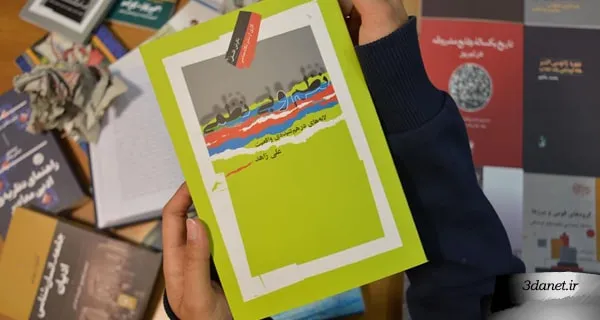
"Order and Disorder" is the latest book by Dr. Ali Zahed, which addresses "reality" and its "intertwined layers" from a philosophical perspective. Those familiar with Mr. Zahed's writing trajectory know that his first book, Towards a Non-Metaphysical Theology, took shape around that profound statement of Allameh Tabatabai: "There is a reality." It can be said that this issue has not released its grip on the author since then, and in every subsequent piece of writing and book, his mind has been preoccupied with this subject.
It seems to me that in Order and Disorder, that "mental wound!" has resurfaced in a more concrete manner, overflowing onto Zahed's existence through various apertures! Reality sits at the center, and Zahed's thought, focused on the subject, darts off in a thousand directions; although "thinking is swimming against the current of the river" (p. 7), nevertheless, in Order and Disorder, we witness a beautiful effort by a philosopher who sheds light on a profound and perhaps inaccessible subject in the most engaging way, showing us a fresh face of it:
"Philosophical thought, by bending back upon itself, drives its concepts to a critical point, warping, crumpling, and tearing them apart, and thus renders its own language stammering. But it is only this stammering of language and these twisted, deformed, and misshapen concepts that might perhaps be able to gesture towards the unattainable. Perhaps the stammering of language, in its inability to send a message, can communicate in an unconventional way." (p. 36) "Philosophy does not change things, but it changes our way of looking at things, and this is perhaps the greatest revolution." (p. 78) And this "revolution" is the sole ultimate goal that can truly be found in this book and in most of Zahed's writings.
The author begins with "language" and proceeds to elaborate on it: "I have a language... it is through the mediation of language that I, as a conscious human being, am situated in the world... Language is the link between me and my world..." (pp. 8 and 9) In these treatments, as if grappling with a great challenge, Zahed arrives at "being" through "language" and sees the contradictions facing the two:
"...if the self and the world are considered as two relatively differentiated aspects of indeterminate being; then, in the human being's relationship with the self and the world, we constantly witness a struggle and contradiction in the 'casting of being into language' and its 'coming into language.' 'Casting being into language' emphasizes the human will and freedom in transforming reality, and its 'coming into language' insists upon necessity and human submission to it." (p. 10) This is how "necessity" and "freedom" once again set a perpetual trap and do not release the author's searching mind:
"Language is the arena of our free activity, and on the other hand, it can simultaneously be said that language is the domain of our passivity before a necessity into which we have been thrown. Although we do many things with language, we are at the same time subject to it and have been thrown into its vast environment..." (p. 10)
This thrownness is, in fact, the very tunnel the author digs into being through language, and from a paradoxical perspective, he reveals being in this way. By explaining the two aspects of language's "disclosure" and "creativity," he shows this juxtaposition more concretely and unveils the intertwining of being and language:
"Language is not the understanding of a single word; for the meaning of each word in a language depends on the other words of that language. Language is not the understanding of a single sentence; for understanding one sentence depends on understanding a totality of other sentences... Rather, language is precisely the meaningful living of the human being in a world where, strugglingly, it tries to simultaneously grasp and construct things and concepts and to establish a relationship with human beings in a fragile and trembling proportion..." (p. 19) Although philosophy has no starting point, it seems that after the author's treatment of this intertwining of language and being, an aperture opens onto "reality" and its nested layers. In my view, this aperture becomes evident in paragraph 12 of the book: "In understanding language, one must not ignore the resistance of being... In understanding language, one must not ignore the cultural and epistemic frameworks and the biological characteristics of the human being in shaping reality... In understanding language, one must also not forget the human will, playfulness, and creative and arbitrary imagination..." (p. 23)
Language, being, reality, and so on are thus intertwined, and from this very entanglement, the various layers expressed through language take on the face of reality, and in this way, the author, across numerous passages, extends his exposition to the four layers of reality.
In summary, the intertwined layers of reality from Zahed's perspective are as follows:
1. Bio-foundational 2. Culture-foundational 3. Onto-foundational and 4. Persona or Phantasy-foundational.
I do not intend here to elaborate on these four layers; for if this task is not undertaken by readers through reading the entire work—which is, in fairness, readable and profound—my own commentary will yield nothing but ambiguity and perhaps bewilderment! However, I will try, to the extent of my meager understanding, to concisely express some points based on the feeling I encountered after reading the work several times:
1⃣ I believe that in "Order and Disorder," we are not faced with a book in its conventional sense. The book, like its title, has taken shape in an orderly disorder! A paragraph in the middle of the book might, like lightning, create such insight in the reader that perhaps there is no need to read the initial passages to understand it.
2⃣ Although the fragmentary nature of the writings, which manifest themselves in 52 passages, possesses an exemplary coherence, the author's artistry lies in the independence not of each fragment, but even of a single sentence within it. Perhaps the book could also be called a collection of golden sentences; sentences thoroughly internalized by Zahed, originating from his life and experience.
3⃣ "Order and Disorder" is a work of art. I emphasize this point. In Order and Disorder, we encounter a text where, aside from its philosophical orientations, a capable pen, influenced by a creative mind, holds the upper hand. I think a multitude of people, even those with no introductory familiarity with philosophical topics, can purely and simply both enjoy Dr. Zahed's pen and his style of writing, and take away abundant provisions.
4⃣ Zahed's work is entirely his own. Although Zahed stands on the shoulders of great thinkers and cites their sayings throughout his book, his writing and work bear his own stamp upon their brow. That is, a reader familiar with his pen can easily discern that the author has properly digested the possessions of those greats and produced an original product bearing his own mark.
5⃣ In the book "Order and Disorder," we encounter a philosophical work, albeit with a Zahedian reading of it! Zahed, neither in this work nor according to his intellectual disposition, is a prescriber of any matter. Zahed illuminates in the most beautiful way and uses every tool at his disposal to shed light on his subject. He does the same in this book, examining the various layers of reality. But this examination contains a nuance:
6⃣ The author's perspective is not linear. That is, he does not intend to proceed in a straight line, or even a winding one, from point "A" to point "B." In my view, his outlook is circular or something akin to it. He critiques and dissects the matter under discussion in such a way that, from the reader's perspective, there seems to be no foothold left at the starting point; but, and yet, the reader's astonishment peaks when they find not only no place to stand at the destination, but upon looking up, they see themselves at the initial point, gazing at the path they have traversed! This time, of course, with a clearer and perhaps more bewildered vision!
Thus, doubt is an element you can observe throughout the work; as mentioned, this "hammer of doubt" strikes such blows at the layers of our existential reality that it seems we no longer have the strength or ability to rise; yet a subtle point is also discoverable beyond this approach, and that is "hope." Despite the "vertigo and turmoil" Zahed creates in the minds of his readers in "Order and Disorder," he concludes his work with "rain," a symbol of growth and hope:
«In hot, arid deserts, plant seeds use a special method to survive. They draw a tough, protective membrane around themselves and wait patiently for years beneath the dark bed of soil: waiting for the rain.» (p. 142)
"Hope/faith" is the only commodity in our hands; Zahed makes this vividly clear to us in his writings. In this vehicle where vertigo, bewilderment, doubt, untruth, groundlessness, disorder, and... everything that constitutes the requisites of restlessness in the most precarious form; it is only "hope-faith" that can still be held onto, through an aperture as thin as a hair, yet luminous.
After a meticulous examination of "order" and "disorder," he mercilessly dissects both these categories, leaving us no ground that offers comforting stability; yet after all this, he sees an aperture and a refuge in that very element of bewilderment (mystery), and thus he continues to show the path as endless...
"Order and disorder are both tied to the state of being a mystery. Order exists, but why does order exist? No one knows. The evil of disorder exists, but why is this so? There is no explanation. Order and disorder, in their entanglement and intertwining with each other, point us toward the hidden nature of existence and the mystery of life. Would it not be better to fundamentally not think about mysteries and simply pass them by in silence?" (p.131)
"One who knows that at the very foundation of life's forms, there exists an unanswerable and mysterious content and substance; might be prepared to confront the forms of life with an open and flexible perspective. They are prepared to use them as borrowed things, to continually refine their coarseness and ugliness, and to reduce the venom of their violence." (p.133)
"Living on the horizon of mystery and contemplating it can liberate a person from depressions and tediums, and grant them a possibility for joyful living." (p.136)
"We are in dire need of mysteries, of thinking about them, and of living in their realm, so they may protect us from two things: absurdity and futility; an artificial world empty of mystery, and also the bigotry and savagery of a mythic, anti-reason world!" (p.137)
.
.
On Ali Zahed's Latest Work, 'Order and Disorder'
Author of the above piece: Masoud Qorbani
.
.


Discussion0 comments
No comments yet; let yours be the first voice.