Philosophy
Philosophy for Non-Philosophers, Mostafa Soleimani
The Philosophy for Children program cultivates critical and creative thinking; in honor of Children's and Young Adult Literature Day, books such as Sophie's World, The Silent Philosophers' Circle, and The Big Question for Non-Philosophers are introduced.
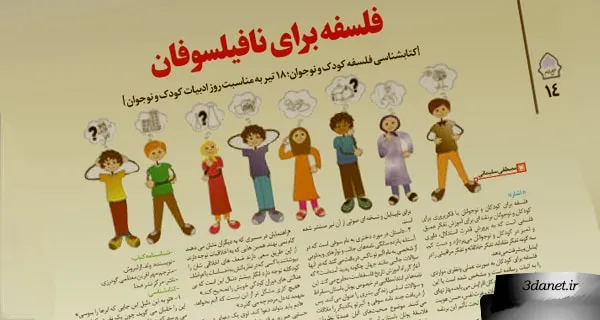
Philosophy for Children and Adolescents, or Thinking Cultivation for Children and Adolescents, is a program for teaching deep philosophical thinking that focuses on nurturing the power of reasoning, judgment, and discernment in children and adolescents, and advances at least three kinds of thinking in them: critical thinking, creative thinking, and caring thinking. Philosophy for Children has practically and theoretically proven several things, and it has been shown that with this program, children's IQ increases, their academic skills improve, and their ethics, self-esteem, sense of identity, and understanding of the world around them are also transformed under the influence of this program. This article intends to introduce books that have been authored or translated in the field of philosophy for children and adolescents.
.
.
Philosophy for Non-Philosophers
[A Bibliography of Philosophy for Children and Adolescents; July 9, on the occasion of Children's and Young Adult Literature Day] Mostafa Soleimani
1- Sophie's World
- Book Details: - Author: Jostein Gaarder. - Translator: Hassan Kamshad. - Publisher: Niloofar Publications. - Bibliography: 1- Sophie Amundsen, a few weeks before her birthday, receives mysterious letters. In the first few letters, the author only poses strange questions. "Who are you?", "How did the world come into being?", ... After this, the unknown author of the letters begins, in subsequent letters, without introducing himself, to talk to Sophie about the history of philosophy and the answers that great thinkers throughout history have given to these questions ... 2- The good thing about this novel is that a philosopher-storyteller wrote it, and this reassures one about the accuracy and credibility of the text. (The rest of Gaarder's novels are also philosophical; his own personal philosophy is laid out in the novel "The Solitaire Mystery") and, moreover, one of the best current translators has rendered it into Persian. That is why reading it is very much "a piece of cake." Four other translations of this book, as well as a Braille version for the blind and an audio version, have also been published. 3- The story is about a girl named Sophie who, on the verge of turning fifteen, receives interesting letters and video tapes from a person named Alberto Knox, in which he poses intriguing questions like "How did the world come into being?" which serves as the starting point for teaching the history of philosophy. These letters initially cover topics regarding ancient Greece, Socrates, and the fundamental questions of human life. After receiving several letters, Sophie and Alberto meet each other. The subject of their conversations is mainly the theories of the philosophers of ancient Greece, the Roman Empire, the Middle Ages, the Renaissance, the Age of Enlightenment, and topics such as great revolutions up to contemporary human issues. The story is engagingly told and tries, within the narrative, to teach the history of philosophy to the reader in a categorized manner; also, events occur in the story that encourage the reader to continue the novel. - An excerpt from the book: The story begins with these sentences: "Sophie Amundsen was on her way home from school. She had walked the first part of the way with Joanna. They had been discussing robots. Joanna thought the human brain was like an advanced computer. Sophie was not sure she entirely agreed. Surely a person had to be more than a machine? They parted ways near the big supermarket, and each went their own way. Sophie lived at the end of a cul-de-sac of detached houses, and her journey to school was almost twice as long as Joanna's. Her house felt like it was at the end of the world, because there were no more houses beyond their garden. From there, a large forest began. She turned into Clover Close. At the end of the street, there was a sharp bend known as 'Captain's Bend.' Except on Saturdays and Sundays, hardly anyone else came down that street ..."
2- The Silent Philosophers' Circle
- Book details: - Author: Vittorio Hösle. - Translator: Kourosh Safavi. - Publisher: Hermes. - Bibliography: 1- Excerpts from the book: “Guides do not walk the path they show to others. Those very people who are so concerned with morality are trying in this way to cover up their moral weaknesses, or someone whose theories pay attention to childish feelings or emotions seems more intent on correcting the injustices of his own childhood.” “There is nothing more difficult than trying to understand what is really going on in people’s hearts.” “One must be able to argue. In a proper argument, brute force and power are not very important. Perhaps war and conflict can be called a kind of very passionate and emotionally charged discussion and dialogue. In any case, even if these conflicts and arguments do not lead to a result, one must be able to tolerate the other side. I think when a person expresses their opinion and provides reasons to prove its correctness, and also hears the opinion and reasoning of the other side, they feel a sense of relief and peace of mind.”
- The present book is a collection of letters exchanged between January 1994 and January 1996 between an eleven-year-old girl named Nora K. and Vittorio Hösle, a professor of philosophy at the University of Essen in Germany. Nora’s childish questions are among the most complex philosophical problems and force Professor Hösle, in these letters, to walk hand in hand with the curious and bewildered Nora through the labyrinthine path of philosophy and find answers to her questions. Together, they create a dreamlike and beautiful gathering in which great philosophers from Plato to Hans Jonas speak and debate about God, the universe, and the right way to live. This strange and unusual correspondence ultimately provides a collection that is, in its own way, an introductory text on philosophy and captivates curious minds. 3- Professor Vittorio Hösle was born in 1960 and teaches philosophy at the University of Essen. Several books by him have been published to date. The translation of this book was done by Kourosh Safavi and published by Hermes Publications.
3- The Big Question
- Book Details: - Author: Wolf Erlbruch. - Translator: Mehrafarin Moazzami Goudarzi. - Publisher: Seda Publishing Center. - Bibliography: 1- "You are here to kiss the clouds," says the pilot, because someone in the book asks him why he is here, and the pilot wonders, indeed, why is he here, and then gives this answer. The book "The Big Question" poses this great question to various people and things: "Why are they here?" and each, according to their position and duty, answers it, answers full of kindness, altruism, tolerance, hope, and love for life. Some, like the duck, have no opinion on why they are here. Reading this book aloud and collectively for children and adolescents (it is suggested that adults read it too) prompts them to think about the meaning of existence and the reason for their own being, and paves the way for a meaningful and beneficial dialogue among the audience about their responsibilities and duties in the universe and the value of life. The correct, wise, and of course non-indoctrinating guidance of the conversation about this "Big Question" leads children to the conclusion that the existence of nothing and no one in this world is without cause, and only those things and people who do not walk in line with its system are condemned to exit the cycle of existence and nature. 2- The answer to a child's big question, "What was I born for?" includes various answers. As each child grows up, they will find new answers to this big question. For example, the brother says: You are on earth to celebrate your birthday. The pilot says: You are here to kiss the clouds. The mother says: You are here because I love you, and the sister says: You are here to love yourself. In the present book, the cat, the baker, the grandmother, the sister, the brother, the duck, the father, and others have given various answers to the child's big question. 3- The translator stated her motivation for translating this book was to further strengthen her own language and the suggestion of her teachers, and said: Living is the main axis of this book; in line with Descartes' philosophy that says I think, therefore I am. Meanwhile, the text of this book has a childlike prose. She added: The main question of this book is from the language of a child who says, why were we born, and asks this question of everyone, from the brother, the cat, the pilot, the grandmother, and ... and each answers in their own way.
4- Imagine a World Where... (Philosophy in Simple Language)
- Book Details: - Authors: Brigitte Labbé; Michel Puech. - Translator: Parvaneh Oroujnia. - Extensive Introduction by: Professor Mostafa Malekian. - Winner of the Literary Council Award. - Bibliography: 1- Part of the book's text: "A hippopotamus or a fly never asks itself how the world began, they have never asked themselves why there is something called life, why the sun shines, or why some humans are happier than others. We humans, unlike the hippopotamus and the fly, have always found thinking about such subjects exciting. That is why such a book exists. Of course, you will not find any final answers to your questions in this book, but this book shows you how everyone can have their own particular conception of the world. And you will also discover: how delightful thinking is! So imagine a world where...!" 2- The book consists of a long introduction by Professor Mostafa Malekian and four chapters. - The titles of the book's sections are as follows: An introduction that is itself an essay, with the "Title: Illusion or Imagination." Chapter 1: Life and Death Chapter 2: Freedom and Unfreedom Chapter 3: Happiness and Unhappiness Chapter 4: Good and Evil 3- The book is illustrated and in color. At first glance, it seems the audience is only children and adolescents. But upon closer examination, we find this book has a wider audience, because it explains the most complex philosophical concepts in the simplest language.
5- The Secret of the Cards
- Book details: - Author: Jostein Gaarder. - Translator: Abbas Mokhber. - Publisher: Markaz. - Bibliography: 1- An excerpt from the book: "The story of The Solitaire Mystery is about a boy named Hans Thomas whose mother left her husband and child years before. When they see a picture of Hans's mother in a fashion magazine and realize she is living in Greece, the father decides to go in search of his wife. By chance, they win a lottery ticket and obtain the money needed for the journey. On the way to Greece, a series of mysterious events befall them, creating a fitting suspense in the story. During the trip, they meet a baker, who gives Hans a tiny book written in very small letters. With the help of a magnifying glass given to him by a dwarf, Hans begins to read the book. From this moment on, the story splits into two parts. One concerns the events happening to Hans and his father, and the other the events and stories contained in the little book, which makes up the bulk of the novel. As events unfold, the story gradually approaches the apex of the pyramid so that we discover the mysteries that are posed. Many of the secrets are contained in the sticky-bun book. Like the rainbow soda, which, when drunk, makes one feel all the tastes they have ever experienced throughout their entire body. For instance, one can feel saltiness and sweetness even with the tips of their fingers. After the events that take place in the story, Hans realizes that the author of the sticky-bun book is the baker himself, who has placed his memories at his disposal..." 2- In this book, as in his other famous work, Sophie's World, Jostein Gaarder demonstrates his literary ability to blend real and imaginary worlds, leaping from one to the other, and to interweave a story full of twists and turns with philosophical and ontological questions. The journey of Hans and his father from Norway to Greece is a real journey, but during it, Hans finds a magical book with tiny writing in which the figures on the cards come to life, and the imaginary adventures of this miniature book intertwine with the story of his own life, while his father's thoughtful reflections acquaint him with the great questions of existence. 3- The issues considered in this novel and carefully pursued throughout the story are among the fundamental problems of philosophy, and since the author is well acquainted with Western philosophy and has taught philosophy for many years, he has attempted in this book to express deep philosophical questions in a simple, pleasant manner within an interesting adventure, while also seeking answers to his own intellectual concerns. In this book, one can find clear traces of the thought of philosophers such as Socrates, Plato, Berkeley, and Friedrich Nietzsche, and despite the expression of certain philosophical ideas, the enigmatic sentences, and the multi-layered nature of the story's adventure, every reader enjoys reading the book. The novel The Solitaire Mystery is considered an exceptional book in many respects, the most important of which is its narrative-like, simple, yet simultaneously enigmatic and imagination-provoking expression of profound philosophical findings, which subconsciously challenges the reader's mind in a strange way.
6- Asking Is More Important Than Answering
- Book details: - Authors: Daniel Kolak; Raymond Martin. - Translator: Hamideh Bahreini. Publisher: Hermes. - Bibliography: 1- By posing questions about various issues, the authors of this book show that philosophy is not a collection of information, but rather questioning and rational inquiry, and they draw students' attention to the skills needed for a critical approach to the material typically covered in introductory philosophy courses. The authors of this book have endeavored, in a Socratic manner, to delve into the realm of our possessions and knowledge, ultimately reminding us of Socrates' "I know that I know nothing." Asking questions is an art that, by taking as its basis the view that the other person is a human being just like us, can be the main cornerstone in reaching appropriate answers and valuable results in any conversation. Asking questions, besides being one of the main keys to creating and starting any relationship, makes it possible to keep a conversation on a correct and healthy path. Whether these questions are about the weather or the time, or about other matters such as occupation, interests, fundamental questions about existence and the like, they make it possible to establish any conversation. 2- Hamideh Bahreini, the translator of the book "Asking Is More Important Than Answering," is a teacher. She is
Gam has encountered individuals in his teaching who needed a book to begin their philosophical studies. This prompted him to translate the book Asking is More Important than Answering. In his view, the writing style of this book is Socratic for two reasons: the first is its abundant questioning and analysis, such that a chapter sometimes begins with a question and ends with a question. The other is that the authors seem to share Socrates' existential concerns, which is evident in their expression. In their analyses, they teach us that philosophy is an activity like swimming, and one should not expect philosophy to hand us a package of information. 3- The authors believe we are trapped by a set of answers that have made philosophizing difficult for us, and we must set them aside and ask these questions of ourselves in a different way. The book's merit is that it compels us to be precise both in asking and in answering. They believe their intention is not to deny the audience's knowledge but to teach them where that knowledge came from. Our society needs this kind of questioning because we, too, are trapped by these answers and speak about issues with great certainty. Our society's need is to abandon dogmatism and speaking with certainty, and in some cases, to speak with more reflection. This book is valuable insofar as it teaches us how to ask questions and engage in mental activity.
7- Philosophy Club for Children
- Book Details: - Author: Christopher Phillips. - Translator: Rahil Ranjbar. Publisher: Porsesh. - Bibliography: 1- In the "Philosophy Club for Children" series, "Christopher Phillips," with illustrations by "Kim Doner," attempts, through dialogue in the manner of the philosopher Socrates, to teach children how to think and strengthen their thinking power. He believes: Socratic dialogue helps children become critical and tolerant thinkers. In the first volume of this series, the questions focus on topics such as: philosophy, violence, dwelling, the time gap between two human qualities at once, and the difference between lies and truth. 2- This book is the result of thinking with children; if we look at them, we see that they are constantly amazed by everything and explore everything with an inquisitive gaze. Although they do not always encounter positive reactions to their questions, they always return with more questions and cannot be easily satisfied. In fact, the prerequisite for having a philosophical outlook on life is this very curiosity and desire to ask. Although many of them, as they grow up, stop asking and conducting personal experiments under society's influence. But to have a better society, we first need to educate our children, and many believe the philosophy club is a place where children, along with adults, can practice thinking. This book is a practical and hands-on book for increasing children's thinking and evaluation power, from which even the adult reader will not be without benefit. Moreover, by internalizing this process and pursuing it in our personal lives, we can certainly hope that in the near future, we will have a better society and become better human beings. 3- As the book's author says: A Socratic dialogue is a very simple method of inquiry that inspires people to discover their own questions and uncover the truth with the light of their own knowledge... In the process of Socratic dialogue, we learn, by cultivating creative and critical thinking skills, to become ever more independent and self-made individuals, to ask better questions, and to answer important questions like "Who am I?" and "Who can I be?"... A practical and hands-on book for increasing children's thinking and evaluation power, from which even the adult reader will not be without benefit. The book is written for children, but since children resemble philosophers more than any other group, it can be said to be suitable for anyone who wants to practice thinking and philosophizing!
.
.
** And Other Books:
Below is a list of books that are in some way related to the field of children and adolescents: 1- Teaching Thinking to Children: Dr. Masoud Safaei Moghaddam and Afsaneh Najarian, Philip Christopher. 2- Thinking Together, Philosophical Inquiries for the Classroom: Mozhgan Rashtchi, Joanna. 3- Philosopher Kids: Abdolrasoul Jamshidian, Margaret. 4- The Doll Hospital: A Philosophy for Children Curriculum for Preschool and Early Elementary Years: Fatemeh Ranjbaran, Brigitte. 5- How to Unite the World: Ethics for Children and Adolescents, Parvaneh Oroujnia, Philip. 6- Intellectual Stories 1: Philosophical Inquiries for Children with 74 Activities for Elementary
and Middle School Years: Farzaneh Shahrtash and Mozhgan Rashtchi, Philip. 7- Intellectual Stories 2: A Philosophical Inquiry for Children: Zohair Bagheri, Jespersen, Per. 8- Philosophical Stories for Children and Adolescents: Mehdi Kianian, Shirin Sharifian, Jespersen, Per. 9- Short Intellectual Stories for Teaching Philosophy to Adolescents: Mozhgan Mohaghegh, Robert. 10- Stories for Starting to Think: Leila Lotfipour, Robert Fisher. 11- Stories for Thinking (Thirty Stories, Thirty Themes): Jalil Shahri-Langeroudi, Tehran, Institute for Humanities and Cultural Studies, Brigitte. 12- Little Philosophers: Yahya Ghaedi, Ayizh, Naji, Saeed. 13- Philosophical Inquiry for Children and Adolescents (Conversations with Pioneers of a New Revolution in Education): Tehran, Institute for Humanities and Cultural Studies, Haynes, Joanna. 14- Philosopher Children: Learning through Dialogue and Questioning, Abbas Ardakanian, Jespersen, Per.
.
.
PDF file of the article Philosophy for Non-Philosophers
.
.
Philosophy for Non-Philosophers
Author: Mostafa Soleimani
Source: Harim-e Emam Journal, Issue 224
.
.

Discussion1 comments
سلام چگونه متوان کتاب های که معرفی شده را تهیه کرد -متشکرم