Philosophy
Physicalism Is Dead
By denying phenomenal experience or reducing it to neural processes, physicalism fails to account for consciousness. In contrast, idealism and dual-aspect monism regard consciousness as prior to matter or as an aspect of a single reality.
Marc Wittmann
Author
Yaser Mirdamadi
TranslatorPhysicalism Is Dead
Mark Wittmann[1]
Translated by Yaser Mirdamadi
In his book, The Gay Science[2], Friedrich Nietzsche depicts a madman who runs into the marketplace crying out: "Where is God?... I will tell you. We—you and I—have killed him. All of us are his murderers." In the marketplace, many people do not believe in God and laugh at the madman who wanders the city with a lantern in broad daylight. Nietzsche thus sought to point out that the people in the street had not grasped the consequences of a life without God. According to the madman, [with the death of God] we are straying through an infinite nothingness, and the people had not understood this point.
When I read a text on the problem of consciousness by defenders of physicalism, especially reductive physicalism, I am often reminded of this passage from Nietzsche. The essence of the physicalist idea is that only matter matters for understanding human behavior. As many neuroscientists and philosophers, both in equal measure, have declared: in principle, our thoughts and feelings are explicable solely on the basis of neural processes. The only condition necessary for describing what makes us human is the study of brain function. My feeling is that neuroscientists and physicalist philosophers see themselves as the new Nietzsches, the fearless avant-garde thinkers who are informing an unaware public of a truth: we, in the guise of the movements of charged ions and neurotransmitters, are infinite nothingnesses.
The reductive physicalist position entails that phenomenal consciousness[3] does not exist, meaning that which exists primarily and immediately for every person does not exist at all. This has led a philosopher named Galen Strawson—in an article citing thinkers from antiquity to the psychologist and Nobel laureate Daniel Kahneman—to write: "We know that people can have an unshakable faith in any proposition, however absurd, when it is supported by a like-minded community."[4] According to Strawson, "the most remarkable episode in the history of human thought" is that these believers categorically deny the existence of something everyone knows to exist, namely: conscious experience, or the first-person phenomenal perspective. Other physicalists at least acknowledge that we are conscious beings, but that phenomenal consciousness is "produced" by the brain. In their view, future science will undoubtedly explain mentality[5] solely from the perspective of neurobiology regarding how consciousness is produced by neural signals.
However, the insoluble problem here is that "neurobiological processes" originate from an epistemological framework that differs from the epistemological framework of "subjective experience," even if there is a non-causal correlation between neural processes and subjective experience. The liver produces bile to convert fat into energy. In the biological framework, of course, the liver produces something. The brain, however, cannot produce consciousness because subjective experience is not something that is part of a measurable biological mechanism. The proposition "the brain produces consciousness" is something of a category mistake[6].[7]
But perhaps physicalism is dead, and we are still warm and have not noticed? Several contemporary madmen have declared the death of physicalism. In one of my recent writings, I wrote about the Romantic movement, those who thought unconventionally about the science of consciousness.[8] In recent years, a similar movement has formed in cognitive science. For instance, the prominent neuroscientist Christof Koch now advocates a modern version of panpsychism[9]: the idea that mind is the ubiquitous feature of reality and must therefore exist in the fabric of the cosmos.
So if physicalism is dead, what are its alternative views today? In opposition to the absurdity of self-denial (the denial of phenomenal consciousness), a form of idealism declares that only consciousness exists and nothing else. When we speak of our knowledge of ourselves and the world around us, phenomenal subjectivity has an undeniable priority. Consciousness has primacy of rank. In the conceptualization of philosophical idealism, following Immanuel Kant, one can say that the experienced world is a representation of the external world. We have no direct access to the external world. This idea in its modern form is known as analytic idealism, and has been formulated by, among others, Bernardo Kastrup.[10] So there is no matter? According to this view, no. When we realize that what we call the external world is my experience of that world, what at first glance seemed absurd now becomes more convincing. The physical world is created through the observation of our senses. Of course, the sensory organs are also part of the alleged external world—the eyes and ears in my head. Yet, these biological structures are also my experiences. The claim that everything is experience seems more convincing than the claim that says we have no conscious experience at all and everything is matter.
The reality is that even staunch researchers who forgo the potential phenomenological analysis of experience must still rely on the subjective experience of the human participants in their studies. In experimental settings, participants must convey their subjective experience in some way—for example, by pressing buttons for "seeing" specific targets. Intending to be consistent with this fact, the experimental psychologist Max Velmans has proposed the concept of reflexive consciousness.[11] To understand consciousness, we need first-person and third-person perspectives as complementary frameworks. Inherently personal and subjective experience, supplemented by the third-person perspective, provides complementary natural knowledge for any consciousness researcher.[12]
A more radical step forward is the idea of dual-aspect monism.[13] This idea can be found in the writings of the Romantic philosopher Friedrich Schelling [19th-century German philosopher]. The idea is also built upon the Pauli-Jung conjecture, which originates from the dialogue between Wolfgang Pauli,[14] the Nobel Prize-winning physicist, and the psychiatrist Jung.[15] Dual-aspect monism has recently been formulated in contemporary scientific terms by a physicist named Harald Atmanspacher and a philosopher named Dean Rickles.[16] According to dual-aspect monism, consciousness and the brain are two different aspects of the same fundamental reality. In other words, consciousness and mind are a duality of a single, undivided reality. The interpretations of "mind" and "matter" are a useful and pragmatic distinction, but fundamentally they can be traced back to a structurally neutral limit, that is, to a fundamental background reality that is neither mind nor matter.
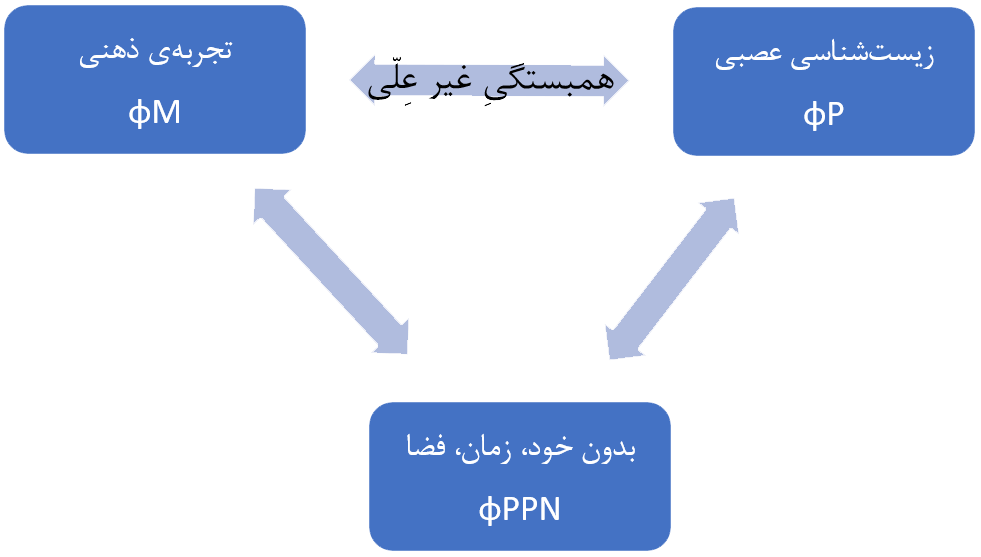
φM = mental state
φP = physical state
φPPN = psychophysically neutral state
According to the Atmanspacher-Rickles model (designed in the figure above), both neurobiological processes (ΦP) and the subjective experience (ΦM) correlated with them originate from an undivided reality (ΦPPN). Note that in the conventional physicalist conception, neurobiology (ΦP) produces the state of subjective experience (ΦM). In this view, consciousness "somehow" emerges from matter. In contrast, according to dual-aspect monism, mind and matter are effects of an underlying neutral structure that is itself neither mind nor matter.

This fundamental, neutral psycho-physical reality is ineffable. It is not bound to the usual structure of time and space, that is, to a structure that only emerges in the distinction between experiential and physical reality, i.e., the production of subject and object. The correlations between consciousness (ΦM) and neurobiology (ΦP) are one-sided manifestations and appearances of an undivided, neutral reality (ΦPPN). These non-causal correlations can be measured biologically; for example, when subjective joy about an event occurs alongside a bodily reaction (e.g., an increased pulse rate). These correlations are, in principle, predictable. An emotional state is accompanied by specific bodily activities. Or, as shown in my research, our inherent ability to perceive the passage of time is linked to activity in the insular cortex[17] of the brain, which is the primary brain region for processing bodily signals.[18] These examples relate to the everyday reality of the body-mind correlation. Note that by referring to the physical, I explicitly refer to the body and not just the brain. The brain is embedded in the intertwined system of the entire body [and not just in the skull].
More and more people have realized the absurdity of the extreme version of physicalism, the version that says: consciousness does not exist. Scientists are also increasingly recognizing that, in principle, it is impossible to explain how phenomenal consciousness is "produced" or "generated" by the brain. The movement to deny extreme physicalism is advancing. The aforementioned alternative conceptions of the meaning of subjective experience may seem strange at first glance. But they have the virtue that at least now we have exited the ideological dead end. We are free to think outside the box in the hope of understanding what consciousness could mean for us humans.
.
.
[1] Marc Wittmann received his PhD from the Institute of Medical Psychology at the University of Munich. He is a senior researcher at the Institute for Frontier Areas in Psychology and Mental Health in Freiburg, Germany. What you are reading is an article by him with the following details:
Marc Wittmann, ‘Physicalism Is Dead’. Psychology Today, 2024. https://www.psychologytoday.com/intl/blog/sense-of-time/202411/physicalism-is-dead.
[2] Die fröhliche Wissenschaft
[3] phenomenal consciousness
[4] Galen Strawson. “A hundred years of consciousness: ‘a long training in absurdity’”. Estudios de Filosofía, 59 (2019): 31.
[5] Subjectivity
[6] category mistake
[7] A “category mistake” is a type of logical error that occurs when something is mistakenly classified into an irrelevant category, and as a result, properties are attributed to it that can only be attributed to members of a different category of things. In the author’s view, the proposition “the brain produces consciousness” is a judgment arising from a category mistake. This is because a biological process (production) has been mistakenly attributed to subjective experience (consciousness). Consciousness is not of the nature of physical matter such that it could be produced by an organ like the brain in the same way that, for example, the liver produces bile. Subjective experience belongs to a different category of phenomena, distinct from neurological processes, even if there is a (non-causal) correlation between subjective experience and neural processes — M.
[8] Marc Wittmann. ‘Why Consciousness Research Should Be Conducted by Romantics’. Psychology Today, 2022. https://www.psychologytoday.com/intl/blog/sense-time/202211/why-consciousness-research-should-be-conducted-romantics.
[9] Panpsychism
[10] Bernardo Kastrup. Analytic idealism in a nutshell, A straightforward summary of the 21st century’s only plausible metaphysics. London: iff Books, 2024.
[11] reflexive consciousness
[12] Max Velmans, Understanding Consciousness. 2nd ed. New York: Routledge, 2009.
[13] dual-aspect monism
[14] Wolfgang Pauli
[15] C.G. Jung
[16] Atmanspacher, H., & Rickles, D. (2022). Dual-aspect monism and the deep structure of meaning. New York/London: Routledge.
[17] Insular Cortex
[18] Marc Wittmann ‘The Mystery of Subjective Time: A Case for Embodiment’. Psychology Today, 2021. https://www.psychologytoday.com/intl/blog/sense-time/202112/the-mystery-subjective-time-case-embodiment.
.
.




Discussion2 comments
سلام و ارادت و عرض ادب. یک پرسش از محضر شریف جنابعالی:در جملهی آخر فرمودید:به زعم من. این زعم ما به ازای خارجی اش کجاست ؟ آیا کر و کور مادرزاد ، زعم ندارد ؟ آیا زعم همیشه به محسوسات تعلق می گیرد ؟! منظور حقیر از زعم ، عین و خود خود خود ادراک زعم است و نه آثار ادراک زعم در مغز . مغز یک موجود مادی و بنابراین دارای ابعاد سه گانه و سایر ویژگی های ماده هست. خوب بفرمایید این زعم کدامیک از ویگی های یک ماده را دارد ؟!
اصلا آگاهی یعنی چی چی ؟ آگاهی ، یعنی آگاهی از چیزی . مثلا دیدن یک درخت ،مساوی است با آگاهی از وجود درخت . به قول پدیدارشناس ها آگاهی حیث التفاتی دارد . یعنی ما آگاهی غیرانضمامی نداریم . ما همیشه آگاهی و شناخت داریم به چیزی . آگاهی بحت و بسیط وجود ندارد . خب ! حالا مسئلتن : آیا آگاهی بدون استفاده و واسطه گری حواس ممکنه ؟ خیر ! یک کور مادرزاد هیچگاه درکی از رنگ نخواهد داشت . لب حرف من اینست که آگاهی حاصل تعامل حواس و مغز است ، که اگر چنین نبود یک کور مادرزاد هم میتوانست تصوری از رنگ داشته باشد . تکرار میکنم آگاهی غیرانضمامی وجود ندارد ، و اگاهی حاصل انضمامیات ( جهان خارج ) و حواس است . گیرم که تبیین های فیزیکالیستی هنوز ضعیف است ، سلمنا ! ، ولی آیا تبیین های غیرفیزیکالیستی قوی ترند ؟ به زعم من خیر .