Reflections on the Prospects of Religious Transformation in Contemporary Iran
Religious change in our society is harder to observe because it requires transformation in the 'innermost layers of the social'. To explain this, Hassan Mohaddesi analyses social reality along the horizontal and vertical axes of Georges Gurvitch's theory.
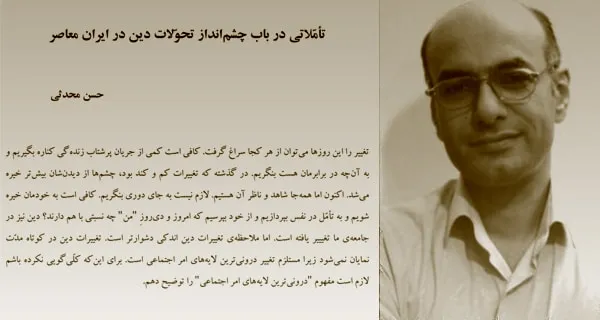
These days, change can be sought from anywhere. It is enough to step back a little from the fast-paced flow of life and look at what lies before us. In the past, when changes were few and slow, eyes were more dazzled by seeing them. Now, however, we witness and observe it everywhere. There is no need to look far away. It is enough to gaze at ourselves, engage in self-reflection, and ask ourselves what relation exists between the "I" of today and yesterday. Religion, too, has changed in our society. But observing the changes in religion is somewhat more difficult. Changes in religion do not become apparent in the short term because they require a transformation in the innermost layers of the social matter. To avoid speaking in generalities, I must explain the concept of the "innermost layers of the social matter."
Among sociologists, the views of a sociologist mutilated in Iran can help us understand this subject, and that is none other than Georges Gurvitch, whose works' Persian translations themselves require re-translation! In his societal theory [1] (which, in my view, is less detestable than other societal theories), he explains social reality along two axes: horizontal and vertical. These two axes correspond to the "depth levels of social reality and the corresponding social types" (Thomoson, 1971: xii). On the horizontal axis, Gurvitch distinguishes three social types: 1) forms of sociality (in French, socialité), 2) groups; and 3) encompassing or global societies. Sociality pertains to the fluid, unstructured, dynamic, and complex subjective matter that flows at the micro level. Groups are more tangible and observable than socialities and are social frameworks that are "structurable and sometimes even organized" (Ibid: xvi). Global societies encompass and include groups and also possess a certain degree of stability.
However, the vertical axis of social reality also comprises various depth levels, which are, in order: the morphological and ecological surface, social organizations, social patterns or models, regular social behavior that is not limited to social organizations, the network of social roles, collective attitudes, social symbols, spontaneous, innovative, and creative collective behavior, collective ideas and values, and collective mentalities or collective consciousness (Ibid: xiii-xvi). ....
.
.
pdf Article "Reflections on the Prospects of Religious Transformation in Contemporary Iran"
Author: Hassan Mohaddesi
.
.


Discussion0 comments
No comments yet; let yours be the first voice.