Religion
Religious Language Free of Violence and Social Well-Being, Mohammad Mojtahed Shabestari
Drawing on the philosophy of language and hermeneutics, Mohammad Mojtahed Shabestari views speech as a human activity for creating meaning, and asks whether religious language strengthens social health or destroys it, institutionalizing violence or fostering understanding.
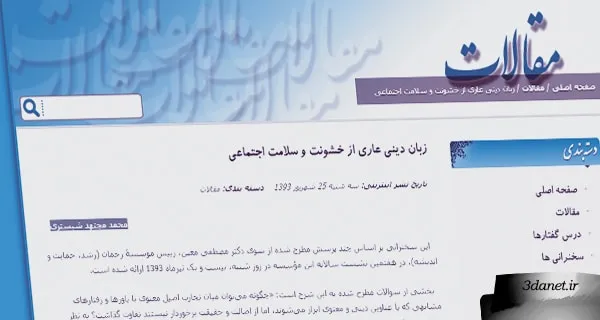
Mohammad Mojtahed Shabestari:
This lecture is based on several questions posed by Dr. Mostafa Moein, head of the Rahman Institute (Growth, Support, and Thought), at the institute’s seventh annual meeting on Saturday, July 12, 2014.
A portion of the questions raised is as follows: “How can one distinguish between authentic spiritual experiences and similar beliefs and behaviors expressed under religious and spiritual labels but lacking authenticity and truth? It seems that in our society, there are two extremes in this regard: one is the negation of any spiritual disposition differing from the dominant ideological discourse, with labels such as false and deviant, and the other is a tendency toward various forms of literalism, superstition, and sometimes violence under the name of religion and spirituality. What is the boundary between desirable spirituality and these two extremist currents? What is the impact of these intellectual currents on social well-being?”
The scope of these questions is very broad, and answering them in general terms is not useful. Therefore, I will here address some of the topics related to these questions from one angle, which is: “What is a religious and spiritual language free of violence?” So that you, the listeners, who are people of reflection, may analyze its connection to social well-being, draw the necessary conclusions, and see whether the official religious language in our society reinforces social well-being or destroys it. Does this language make it possible to separate spirituality from superstition or not? Does it prepare the ground for thought or for stagnation and delusion? Does it institutionalize violence or understanding and interaction? Since time is limited, I will confine myself to brief remarks on this matter, drawing on the new philosophy of language and hermeneutics.
1. In modern philosophy, one of the issues raised is whether the original version of human language is writing or speech. Understanding this subject is an important matter. What is the original version of human language? What manifests itself initially and authentically in the linguistic phenomenon—speech acts or written texts? Today, the view of most thinkers and philosophers of language is that the original version of human language is its spoken form, which has been transformed into written form, and they take this as established.
2. There are two conceptions regarding the nature of oral speech: The first conception is that oral speech is a set of signs that signify a series of meanings. These signs are produced by someone, and they signify a series of meanings. These signs are the very words and sentences. The meanings exist a priori, in some manner, regardless of the utterance of the words and sentences. The person who utters the words and sentences expresses that meaning through the instrument of words, terms, and sentences. The second conception, which has more proponents today, is that every oral speech is a "human activity" or act. A person who speaks performs a human activity, and that activity is carried out with their entire being, structure, and personality, and possesses an intentional and purposive aspect. That is, they want to bring something into being, which is meaning. Humans bring meaning into being through oral speech; they do not express meanings that previously existed. Therefore, according to the second definition, the speaking of each one of us is a movement, a movement of transcendence. Whoever speaks moves from one point to another, from one situation to another. In the multilateral human communications that exist in social and historical life, multilateral realms are formed. For example, in my current lecture, you could say that so-and-so is uttering sentences one after another with certain sounds and a certain tone of voice. Yes, that is correct. But what is observable here is the fact that I am uttering these sentences one after another in order to arrive somewhere and bring a meaning into being, so that after my lecture ends, you can say so-and-so said this and the concept of their talk was that. I am not standing here statically producing a series of signs so that those signs signify meanings; rather, I am moving here from one step to another, from one situation to another, and from one meaning to another, so that the final meaning emerges, and this is an intentional and purposive aspect. I am constantly moving from one moment and utterance to another moment and utterance. It is not clear from the beginning to which point I am moving, but after the lecture ends, you can discern that final point and central meaning. Perhaps I will have a conclusion at the end of the lecture and state where I wanted to arrive. This is a continuous transcendence. In this movement, the meaning of the sentences uttered one after another depends on the overall and final meaning that will eventually be found. If you separate these sentences, no meaning will be found in them. The final meaning takes shape as a result of these sentences being arranged one after another. In modern hermeneutic philosophy, this action is called the "hermeneutic circle." That is, a "circle" exists; the meanings of the sentences depend on the overall and central meaning, and the attainment and emergence of that central meaning depends on these sentences being arranged one after another. Upon analysis, we realize that this is a complex situation. This situation helps us to free ourselves from the pitfalls of simplistic thinking about understanding speech and the notion of "he spoke, we understood, and that's it."
3. Another very important point is that the meaning you understand from this lecture of mine is constructed and shaped through your accompaniment of me, and without your accompaniment, this meaning is not constructed and shaped. For this reason, it is not only I, the speaker, who performs the movement of "transcendence." In this movement, the listener also participates, and understanding is itself an act of transcendence. The listener constantly waits to see what the speaker's intention and purpose is and where they want to arrive. This carrying of expectation and following the speaker's movement moment by moment is the very act of the "listener's transcendence." If I, the speaker, had no audience, I could not produce meaning; unless I imagine a hypothetical audience for myself or engage in soliloquy. Fundamentally, speaking has a dialogical and conversational nature.
4. On the other hand, the meaning produced in any utterance is connected with meanings produced in the past and the future, even though we may not be paying attention to them now. What I mean is that meanings are not produced in a vacuum. For example, the meaning of this lecture of mine is preceded by meanings that have emerged in our society and culture through other utterances, and it is produced in connection with them. As an example, this lecture refers back to our definition and understanding of social well-being in society, and if a concept such as social well-being, which has been produced over time through numerous studies in society, did not exist, you would not grasp my lecture. In other words, my lecture and my action here are connected to the presence of past meanings here. The problem and pain we feel from the lack of social well-being in our society is present here, and my speaking is connected to it.
5. Another issue is whether I can express everything I want to here or not. Can I speak in such a way that all pronouns find their referents? Can I deliver such a comprehensive speech that the answers to all the questions that might arise in connection with my speech are implicit within it? Certainly not. We have an awareness of the limitations of our speaking that accompanies us here. I must speak within a framework and do not have complete freedom of action; my hands and feet are tied. And everything I think should be said does not come to language in a single lecture. Listeners, too, do not understand everything that can be understood from a lecture in a single hearing; with repeated hearings, more points are understood, and so on.
The Alienation of Religious Language
If we accept the premises I have presented, it becomes clear that authentic language is that which produces a "new meaning"; under the conditions mentioned, new language brings new speech, and new speech is productive. This speech opens up a "horizon." Such speech opens the eyes and washes them, acquainting us with new meanings upon which we reflect and think. Authentic language prompts us to think. But unfortunately, human language in various realms becomes alienated in different ways, just like the human being itself, and that is when language loses its authenticity. Here I want to answer the question of how the language of religion and spirituality, which is one of the languages of humankind, loses its authenticity:
If the dominant, prevalent religious language is productive, creates new meaning for the listener, places the listener in connection with past and future meanings, is dialogical in a way that prompts the listener to reflection, thought, and response, and fosters conversation, it will be an authentic language in the realm of religion. But if the dominant religious language is monophonic, a monologue that does not take others into account—does not consider science, art, philosophy, dissidents, non-believers, and other meanings, and is imposed unilaterally—this language is an alienated language.
One of the great afflictions of religious language is monophony: that one person must speak and others must listen, or a few speak and others are obliged to listen, with no questioning or discussion in between. When the language's connection with the conscience of humanity, with sciences, and with ethics is severed, when it does not have the character of offering but rather the character of condemning, such a language is alienated. That is, it is not the language of religion and spirituality.
If religious language severs its connection with the language of science, philosophy, and art, it will become alienated. Human beings do not live by religion alone. Human beings live with all the domains of science, philosophy, art, and religion, and the several-thousand-year history of humankind demonstrates this reality. None of these domains is subordinate to another, but dialogue and interaction can be established among them. Religious language must produce new and authentic meaning; otherwise, it becomes alienated.
On the other hand, if the language of religion and spirituality is reduced to form and shape, it becomes alienated from itself. That is, if the sole emphasis is placed on preserving the form of actions, customs, rituals, etc., and it is said that if these forms are observed, religion and spirituality exist, and if these forms are not preserved, religion and spirituality do not exist, this perception prevents attention to what lies beneath those forms, to the foundation and content of religion and spirituality. When you say that a certain religious ruling must be implemented because it is in the Book and the Tradition, you must note that this is a form, and one must see what its content is. What is its purpose? Should one not ask about the purpose of God's ruling? Is questioning God not a human right? Does a human being have the right to question God once, twice, or several times, and ultimately say: O God, I tried to understand Your address but could not? If a human being exerts all their effort to understand what are called the rulings of God and ultimately does not comprehend them, and yet God says that whether you understand it or not, you must obey, this statement is coercion; and does God coerce?
The third alienation of the language of religion and spirituality is that it be reduced to outward beauties, eloquence, rhetoric, a pleasant voice, and so on. This, too, is a form of alienation.
The fourth alienation of the language of religion and spirituality is that religion and spirituality be reduced to sanctities and the sanctity of sanctities. Of course, sacred symbols exist in religions. But it must be noted that these symbols are sacred insofar as they radiate meaning. If a religious symbol or emblem loses its property of giving meaning and inspiration, it becomes a lifeless, alienated symbol. Scholars of religion say that a religious symbol is sacred in the true sense when it is a symbol and a sign, evoking deep metaphorical meanings in minds; otherwise, it becomes alienated from itself.
The fifth alienation of this language is to say that if you hold certain beliefs, you are among the saved, and if you do not, you are among the perished. This situation means reducing religious language to beliefs.
The sixth alienation is that religious products be produced as consumer goods, with the intention that people need these products and those needs must be met. Religious books, religious lectures, etc., are considered commodities that have buyers. In this case, religious and spiritual language becomes a means of trade and business, subject to the law of supply and demand!
The seventh alienation of religious and spiritual language is that this language only responds to the expectations and demands of the general populace of the faithful and neglects the expectations and questions of the elite. In this case, the language of religion faces the danger of lowering itself to the level of the thoughts and sometimes the illusions of the common people and going along with them.
But the eighth alienation of religious language, which is also the most dangerous, is that it severs its connection with its past and its future. Severing the connection with the past can happen in two ways:
I might look at a verse or a hadith and not pay attention that what was said was expressed in connection with what meanings and within what culture, and was produced to create what meanings and purposes. If I do not consider these things, I sever the connection of the produced text, whether oral or written, with its past; as if this text were produced instantaneously, and this approach to the text is incorrect. One must note that this text was, for example, spoken a thousand years ago under specific conditions, and its speakers produced a meaning through their speech, and that meaning was not produced in a vacuum but in connection with the culture of that time and other meanings of that time. My task is to see what the culture of that time, the contents of that culture, the meanings and beliefs of that time, and its other conditions were. If I do not do this and do not understand the religious text in connection with the semantic system of the past, I have severed the connection with the language of the past. This severing of the connection with the past means refraining from interpretation. It means stagnating on the words, as if the words themselves tell us something, and this is the very essence of severing the connection with the past, because words by themselves tell us nothing.
And now, the severing of religious language’s connection with the future. This severance occurs when, for example, we say that a certain religious ruling found in a particular verse or hadith must always be implemented, solely because it appears in that verse or hadith, without considering what the consequences of implementing this ruling might be. With this attitude, we effectively sever religious language’s connection with the meanings that will emerge in the future. Those meanings are, for instance, questions such as: What was the result of implementing the ruling? Did it prevent the spread of crime? Was justice realized? Was greater security achieved? Or did certain adverse outcomes occur? And so on and so forth... These questions will arise in the future after the ruling is implemented, but when we disregard them and say our duty is merely to implement the ruling, we sever the connection of the religious language of that verse or hadith with the future.
Several decades ago, the late Morteza Motahhari raised this issue in his book “The Marjaʿiyya and the Shiʿi Clergy,” stating that the main problem of the clerical establishment is its entanglement with the common people. He argued that because the Shiʿi clergy is financially dependent on the laity, it is compelled to follow their demands, thoughts, and inclinations and cannot bring forth new ideas, since the common people are not inclined toward new ideas and changing the status quo. If he were alive today, I would say to him: Mr. Motahhari! The main problem lies elsewhere, and that is that the scholars of legal theory (uṣūl) and jurisprudence (fiqh) in our seminaries have taken, and continue to take, great pains to sever the connection of the religious language of the verses and hadiths with their past and future, thereby preventing a historical interpretation of those verses and hadiths. And because they block the path of interpretation, they cannot bring forth new ideas within the realm of religion. (See the article “The Claim of the Jurists Lacks Scientific Basis” on the author’s personal website).
Just look at this recent uproar over the necessity of “commanding right and forbidding wrong” regarding the hijab that has swept through society in recent weeks. If we want our religious language not to be alienated from itself, we must analyze it as follows: To which people were the verses and hadiths about commanding right and forbidding wrong in the public sphere addressed? In the social situation in which those people lived, what role did commanding right and forbidding wrong in the public sphere play? They were a people among whom a government in its modern sense had not yet taken shape. But in our contemporary society in Iran, where the “nation-state” system is recognized in the constitution and the permissible and impermissible boundaries in the public sphere are determined by laws passed by the parliament, what does the arbitrary interference of individuals in the public sphere under the title of commanding right and forbidding wrong mean, other than the disruption of the constitution?! These predicaments, insofar as they relate to theory, arise from severing the connection of religious language with its past and future.
I conclude from my remarks that if, in a society, the language of religion and spirituality becomes alienated from itself in various ways—the most dangerous of which is the severance of its connection with the past and the future—such a language becomes “oriented toward power,” and a language oriented toward power legitimizes violence and institutionalizes it. It is evident that such a language threatens social well-being!
.
.
Source:
Official website of Mohammad Mojtahed Shabestari | 16 September 2014
.
.


Discussion0 comments
No comments yet; let yours be the first voice.