Sociology
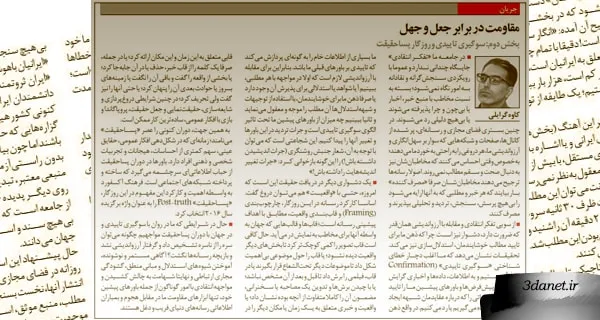
Resistance Against Forgery and Ignorance
The uncritical acceptance of fabrications in cyberspace is rooted in 'wishful thinking' and the preference for the pleasure of comforting beliefs over truth. Confronting ignorance requires critical thinking and the courage to revise prior beliefs when faced with the framed realities of the media.
Resistance Against Forgery and Ignorance
Part One: The Necessity of Confronting Wishful Thinking and Negligence
Recently, a beautiful song has been circulating on social media under the title "National Anthem of Tajikistan", part of whose accompanying description reads:
"It's as if it's Iran's national anthem! They boast about everything that belongs to Iranians in the world. Once is not enough, watch it a thousand times and enjoy it: We are the fire of Zoroaster; a tribe from Tus; fellow citizens of Ferdowsi!"
Regardless of the fact that the content of this song's lyrics (parts such as the reference to an Iranian city and poet, or the mention of Zoroaster's name) does not seem very reasonable for the national anthem of an independent country with a population over 90% Muslim, a simple internet search can "fact-check" this matter. It is enough to find the national anthem of Tajikistan within 30 seconds; listen to it within 2 minutes, and in total, realize the falsity of this content within 3 minutes. But hundreds of thousands of people have not and do not do so.
The cultural ties and shared roots between Tajikistan and Iran are undeniable, but the reality is that over the course of history, this country has been separated from Iran for many years, and it is natural that its national anthem does not refer to Iranian elements.
Some time ago, another video was published in cyberspace titled "Congratulations on the Birth of the Prophet of Islam at Germany's Borussia Dortmund Club Stadium"; with a little attention to the video, it was clear that:
Both the song the spectators are singing is in Arabic; the advertisements around the field are in Arabic, and the faces of the players in the video resemble a West Asian team. Not to mention that even if a German club were supposedly to decide to congratulate the birth of the Prophet of Islam, it would naturally not use the phrase "Habibi ya Rasul Allah."
In fact, the location of that video was the stadium of the Saudi Al-Ittihad team (simply wearing yellow jerseys the same color as Borussia Dortmund's kit) and its time belonged to 2 years before the content was published. Yet that content, with the same incorrect description, had been viewed a total of about one million times on Telegram.
But why do we so easily accept such forgeries, circulate dozens of unreliable pieces of content daily in cyberspace, and fall into such errors?
The answer is simple and somewhat unexpected: Because we ourselves want to fall into such errors; because these errors are pleasurable, and for us, "pleasure" is more important than "truth"; even if the ignorance resulting from that short-term pleasure leads to our great suffering in the long term; which it has, many times.
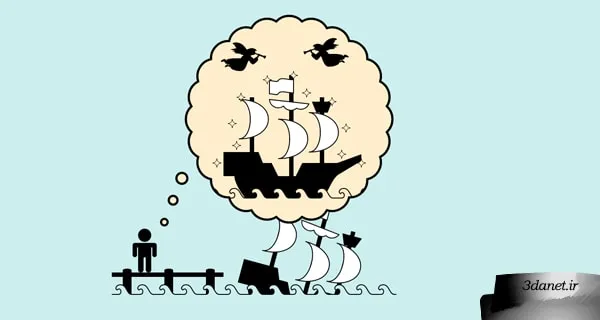
In fact, we are afflicted with "wishful thinking."
Wishful thinking means turning our desires and pleasant matters into our beliefs; without having a valid reason, witness, or document for them.
We like it when other countries' national anthems show respect to us Iranians, so we believe that this is the case. It is pleasant for us if a European team congratulates the birth of the Prophet of Islam in an official match and respects our religious beliefs, so we believe that it is so.
This pattern is, of course, a global phenomenon in popular culture, and the British journalist Christopher Booker calls it the "cycle of delusions," which repeats itself in personal life, politics, and history. Many of us Iranians are not far from it either, and we accept without any scrutiny anything that confirms our wishes and pleasantries. That is why we believe that: "Iranians are the most intelligent and hospitable people in the world"; "Iran is the wealthiest country in the world"; "NASA is full of Iranian scientists"; "We citizens have no share or responsibility in the country's current problems," and so on. Propositions that may even carry a "part" of "reality," but because they express our wishes and pleasantries, they have become our absolute belief without verification, valid reason, research, or a credible source. This is, of course, the flip side of the "self-deprecation" phenomenon in another part of society, where people enjoy belittling Iranians and, without any evidence or reasoning, consider Iranians the worst people in the world.
Part Two: Confirmation Bias and the Post-Truth Era
In our society, "critical thinking" generally has little standing, and matters are not viewed with a scrutinizing and critical approach; depending on the audience's relationship with the news source, news is either accepted unquestioningly or rejected without any reason. In such a context, the virtual and media space is filled with channels, pages, and networks that, riding on our negligence and wishful thinking, easily feed us any lie; especially when they feel their audiences also do not seek the truth or falsity of the content. Basically, the media prefer their audiences to grow up as mere "consumers" who accept and consume any news or content presented to them without any question, scrutiny, doubt, or analysis.
On the one hand, critical thinking and confronting wishful thinking are as difficult as they are necessary, because our minds also construct reasoning to confirm our pleasantries. Research shows that we often suffer from the cognitive error of "confirmation bias" and tend toward information, data, and news that confirm our presuppositions and prior beliefs, and we either ignore or reject information that raises doubts about our opinions. In fact, our minds process much raw information in a way that confirms our previous beliefs. Therefore, to confront wishful thinking, it is necessary first, when encountering any content, to see whether there is evidence or reasoning for accepting it, or whether our mind is merely making that content seem justified and reasonable for our pleasure, using justifications and pseudo-reasoning; and second, to see how much of our prior beliefs are influenced by the pattern of confirmation bias and to find the courage to doubt these beliefs and change them. This is a courage by which the slogan of the Enlightenment movement (Dare to think!) can be reread as: "Dare to change your thoughts!"
Another difficulty in apprehending the truth is that today, one can lie even with "reality." Essentially, the function of the media in this era is the framing of reality according to the media's prior goals; frames and formats through which the world is displayed to the audience. Now, it is enough to make the picture frame a little smaller so that other parts of reality are not seen; or to shape the frame around an unimportant subject so that other subjects are overshadowed; or to cut a film within the frame so that its before and after are not clear; or by arranging cuts and editing an interview or speech, to show its content completely different from what it was; or to present a reality or news belonging to another time or place in a frame belonging to this time and this place; or in a sentence, to simply delete or displace a single word from the news frame; or to tell part of an event and not tell the rest, or to hide the contexts of its occurrence or subsequent incidents; or even to tell them but distort them; under such conditions, fabricating lies and spreading rumors, simulating truth and forging truth, propaganda and playing with public opinion, is the simplest thing possible.
For this reason, the present era is called the age of “post-truth.” A time in which, in the shaping of public opinion, objective facts play a lesser role than the feelings, emotions, and personal, subjective experiences of individuals. Beliefs in the post-truth era originate from the information bubble created and crafted by social networks. Due to the importance and function of this concept in our time, Oxford Dictionaries selected “post-truth” as the word of the year for 2016.
Part Three: The Ethics of Belief and Our Responsibility
These days, many Iranians, however distrustful they are of official domestic news sources and news agencies (which itself has reasons worth pondering), conversely place complete trust in unofficial news sources or official ones abroad. Some imagine that Telegram and Instagram are news agencies, and when you ask, “What is the source of this news?” you hear in reply: “I saw it on Telegram/Instagram.” This is while part of the content on social networks is produced either by ordinary users and unknown individuals and pages that have no competence to send news and material, or by channels and pages pursuing specific political or commercial goals. In fact, there is no awareness that many pages in cyberspace, in order to attract audiences and generate more income or to advance their own agendas, publish a great deal of audience-pleasing material with no commitment to the truth, based on their knowledge of society’s tastes.
It is in such a situation, and in the vacuum of trusted media inside the country, that “Amad News” in cyberspace and “Manoto” among television networks gain an audience of millions and become the source of many of people’s everyday beliefs and analyses; the former, a medium full of yellow journalism, lies, and even contradictions, whose strange news and claims are readily accepted and disseminated by users without any credible source or fact-checking, and the latter, a medium with a selective and biased narrative of history that initially hid its political project behind the glitter of its entertaining programs and has now, for some time, removed its mask; media outlets with unclear financial resources that shape the public opinion of society with a specific aim.
The dissemination of certain untruths in the country’s official media, the imposition of filtering in cyberspace, and restrictions in the media sphere have been among the factors increasing the penetration rate of other alternative media in the country; otherwise, in an open atmosphere and with the existence of professional and free media inside the country and widespread public education, firstly, the mere publication of material on Telegram and Instagram, without a specific and credible source, would not be a sign of its accuracy, and secondly, distrust of official domestic news sources would not lead to blind, unquestioning trust in unofficial or official news sources abroad.
About 140 years ago, the eminent English thinker and mathematician, William Kingdon Clifford, founded a concept called “the ethics of belief,” to state what ethical precondition is necessary for adhering to a belief. In his view, accepting a belief is ethically justified only when we have sufficient evidence to support it. In fact, since we, as members of society, are connected to one another and the beliefs of each of us will affect the lives of others, we are ethically obliged not to readily accept news or a belief without sufficient evidence and proof. For information that does not correspond to reality leads to erroneous analysis, and erroneous analysis leads to wrong decisions, and the harm of individual wrong decisions will ultimately affect the entire society.
I believe one of our most urgent duties in this era is “individual and collective resistance” against this situation. But in circumstances where we face confirmation bias in our psyche and a post-truth era in the world, how can we distinguish the genuine from the counterfeit, avoid falling into wishful thinking, and not become a plaything of the media? I am not saying we should be pessimistic about everything and believe nothing; or, to protect ourselves from the harm of fake news, remain uninformed and oblivious to everything; or become the belief police for others and constantly accuse them of not observing the ethics of belief. However, in the collective sphere, we can be advocates and defenders of free and independent media, and in the individual sphere, we can be guardians of our own mind’s domain and not allow every lie and nonsense to take up residence in this house; continuous and renewing awareness, learning methods of reasoning and the fundamentals of logic, and keeping channels of communication open are our tools of resistance against the onslaught and information bombardment of the media of a world of deceit and fraud. When encountering the content we see daily in the virtual space, before believing and subsequently sharing it, let us first evaluate and consider whether there is a reliable source, reasoning, or a degree of rationality and justification behind that content, and let us be aware not to accept something simply and carelessly just because it is pleasing to us or confirms our presuppositions and mentalities. In fact, with critical thinking, let us fact-check the news and content; demand a source and evidence and test the credibility of that source, or demand a reason and assess the caliber of that reasoning. Let us have the courage to challenge and critically confront various matters, and the bravery to pose questions and doubt our previous beliefs, and to open new frames for discovering and understanding the world differently. Ultimately, by maintaining mental balance against momentary feelings and emotions, let us not easily accept every pleasing lie presented to us in a glossy, colorful shell, relying on our desires and wishful thinking, and let us not become victims of our own “ignorance” and a plaything of others’ “forgery.”
.
.
Resistance Against Forgery and Ignorance
Kaveh Gerayeli
Published in Etemad Newspaper
Source: Jaryan Telegram Channel
.
.

Discussion1 comments
مطلب خیلی مفیدی بود و از خواندنش هم لذت بردم و هم استفاده کردم