Environment
Seminar on “Capitalism, Domination, Environment” with Farhadpour, Ganji, and Issapour
The seminar 'Capitalism, Domination, Environment', featuring Farhadpour, Ganji, and Issapour, examined the relationship between environmental destruction and capital accumulation. Farhadpour described capitalism as a universal barbarism, arguing that the choice between civilisation and barbarism is already behind us.
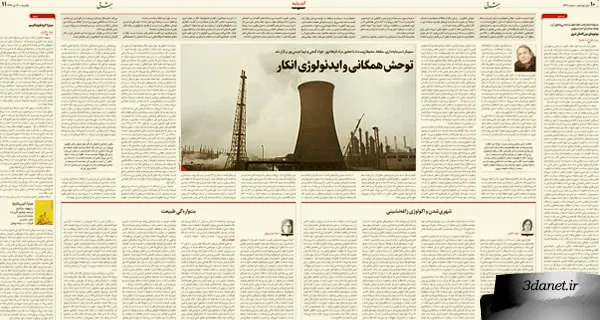
Seminar on “Capitalism, Domination, Environment” with the presence of Morad Farhadpour, Javad Ganji, and Nima Issapour, along with the audio of the lecture by “Morad Farhadpour” titled “The Ideology of Half-Crazed American Billionaires” at this session.
.
.
Shargh Newspaper’s report on the seminar “Capitalism, Domination, Environment”:
.
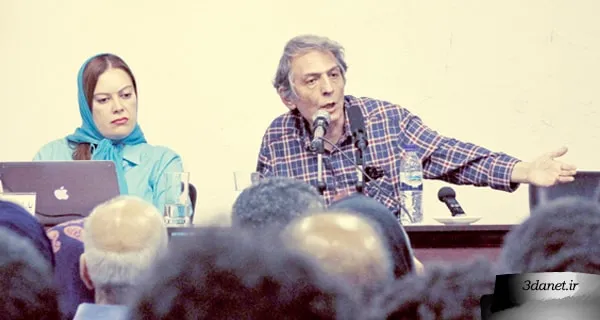
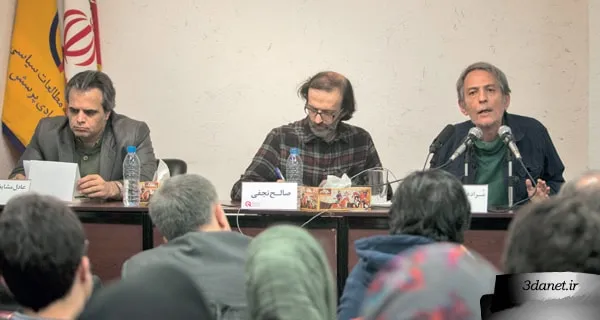
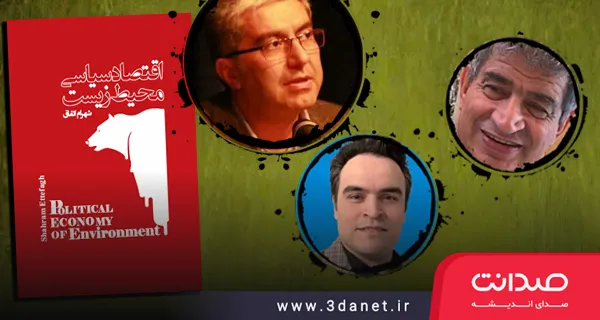
The seminar “Capitalism, Domination, Environment” was held with the presence of Morad Farhadpour, Javad Ganji, and Nima Issapour
Universal Barbarism and the Ideology of Denial
Andisheh Group: The global destruction of the environment has, for the first time, raised the issue of the survival of the environment and the continuation of the human species. This year was the hottest year in the past hundred years. In addition to global warming caused by greenhouse gases, seasonal temperature changes in geographical regions, drought, the melting of polar ice caps and rising sea levels, the depletion of the ozone layer, the extinction of many animal and plant species, and so on, are among other environmental problems. The connection between this widespread destruction and the productive forces of capitalism has been discussed in the works of Marx and Engels.
Capitalism only embarks on the path of growth by destroying the primary sources of wealth, namely the land and the worker. Is it possible to solve the environmental crisis without considering its role in securing value and accumulation within the capitalist formation and without transforming this formation? How much hope can be placed in the effectiveness of institutions active in the environmental field? The prime example of this was the German Green Party, which, in alliance with Merkel, supported cluster bombs.
Last Thursday, a seminar on this very theme, titled "Environment, Capital, and Domination," was held at the Porsesh Institute. First, Nima Issapour spoke about the fetishism of nature. Then, Javad Ganji addressed the connection between urbanization and, consequently, the forced marginalization of the lower classes and widespread dispossession in the history of capitalism. He considered the immediate result of neoliberal policies to be the expansion of a vast class of unskilled workers, the creation of unemployment tsunamis, the widespread destruction of the economic and social infrastructure of many Third World countries, the creation of the informal labor sector, the fueling of economic, religious, and ethnic tensions in cities, the proliferation of mafia and underground forces in the urban economy, and many other crises and problems, all of which have played a decisive role in the creation and expansion of the phenomenon of slum dwelling.
Finally, Morad Farhadpour spoke about the ideological discourse of denial in today's world, and specifically, the denial of the environmental crisis. A discourse with many spokespersons; from the half-crazed American billionaires, those who still insist there is no crisis and, with the help of Popper and Hayek, struggle to exclude geology and ecology from the realm of science, Farhadpour emphasizes that our choice is no longer between barbarism and civilization, because this choice is behind us.
He believes that capitalism has identified itself with its own essence, and this barbarism has become universal. In his view, ideology as denial means the spread of barbarism everywhere.
For Farhadpour, this denial does not mean the end of politics, but rather confronting the dualities that universalize barbarism together. Nevertheless, he shows that it is from the heart of this universalization of barbarism that exceptions emerge, and since capitalism has homogenized barbarism, these forms can also find each other after a while.
What you read below is the edited text of the first two lectures along with a report on Morad Farhadpour's discussion at this conference:
Morad Farhadpour: I will begin my discussion with the meaningless and misleading terms "savage capitalism," "savage neoliberal capitalism," "savage Thatcherite neoliberalism," and so on. They are misleading because they lead us to mistakenly think as if a non-savage capitalism also exists, as if there is a future other than neoliberalism and globalization, as if there is a possibility of returning to the 1960s and 1970s. Whereas, as Marx had predicted, the main issue is the essence of capitalism; an essence that realizes itself in historical form and retroactively posits its own presuppositions. Capitalism in Marx's time was not like today, but because Marx's attention was on the essence of capitalism, he was able to correctly predict today's capitalism and how it posits past conditions as its own presupposition. Here we are dealing with the historicity of essence in the Hegelian sense. For this reason, the term savage capitalism distorts this essence. In the following, I will try to show the meaninglessness of this term with examples.
One of the clearest examples is the current situation in Greece, where it seems as if there is no alternative other than savage repressive policies. This condition stems from the essence of the system itself. Although it appears to be the result of the efforts of individuals like Merkel, contrary to their appearance, they are no different from one another. With the example of Greece, one can well understand that what lies ahead of us is nothing but globalized neoliberalism and its continuation and intensification. Adjectives like savage and unbridled add nothing to it except a false notion as if a non-savage capitalism is also possible.
If we accept the meaninglessness of this term, Rosa Luxemburg’s prediction will be proven: that humanity faces a choice between socialism and barbarism. The current state of the world not only confirms this statement but goes a step further, showing us that since socialism does not exist today, humanity has chosen barbarism, and we witness that our current condition is nothing but barbarism. For this reason, it is pointless to add any word to it. Whether we say reality, capitalism and neoliberalism and globalization, or whether we say barbarism, they are all one and synonymous, expressing in different forms the situation in which we find ourselves. To prove this argument, one can point to Syria, where the manner of fighting of all involved parties has given a new meaning to barbarism; with the exception of Kobanî, which I will address later. The emphasis on this barbarism is not only because of the killing of over 200,000 people in Syria or the use of chemical bombs, cluster bombs, and barrel bombs, but because of the trivialization of the issue of killing. The fact that this event has been repeated so often and covered by the media to such an extent that the rest of the world treats the news of Syria like daily news and weather forecasts; a treatment that shows barbarism, more than savage, ISIS-like acts, is a global combination; in a world where, simultaneously, in one corner, in the Mediterranean, 700 people drown, and in another corner, in Japan, a large-scale mourning ceremony is held for the death of a cat, with the presence of the mayor and others. Incidentally, the seemingly civilized aspect of such treatments reveals today’s global barbarism more than the mere killing, burning, and beheading that have existed throughout human history, but with one difference: in the past, there was no internet or social media pages to share the barbarism on.
Our choice is not between barbarism and civilization, because that choice is behind us. All systems and powers are equally entangled in this barbarism, and in this sense, the role of denial emerges as ideology. The presence of this barbarism is pervasive and encompasses everyone. Ideological denial is different from the end of ideology and the end of politics. Denial means that there is no choice and we have all accepted barbarism; both in relation to second nature and in relation to external nature. It is enough to take a look at the world’s leading newspapers to realize how false binary poles have been formed for it. As soon as someone criticizes the US attack on Iraq, another, in response, interprets it as defending Saddam, or in the case of Libya, as supporting Gaddafi. Or if you point to America’s warmongering from Vietnam to the present day, they bring up the Second World War and the alliance against fascism. Dualities that ultimately lead to the false binaries of the First World and the Third World, or left and right, etc., on which futile energy has been and is being spent. The structural and formal function of ideology is more important than its content. The issue is not that oil companies do not take responsibility for global warming. That is the content of ideology; more important than that is its form. For example, consider a container of water into which you drop an object. It does not matter whether this object is made of iron or gold; rather, the volume, the shape of the object, the degree of wave, and the change in the water level in this container are what matter. Ideology, in the discursive space, prevents the posing of many questions, and this is more important than merely settling for the answers to existing questions. The polemics that form in discussions based on these dualities neutralize the possibility of any radicalism. Because any claim that is made, another will prove its opposite with an example, and no third solution can be found.
Furthermore, it is these same false dualities that turn the word radicalism into radicalization; into a name for the joining of European Muslim youth to ISIS. Hence, the word radical has been formally destroyed under these false divisions. Insisting on barbarism and its universality is necessary, and any form of popular radical politics must be able to begin by implicating everyone in this barbarism, and its starting point must be the universality of this barbarism; otherwise, it gets caught in these dualities, its discourse becomes the particular discourse of one group against another, and ultimately leads to relativization. Radicalism must accept that the choice between socialism and barbarism is behind us, and we are all entangled in barbarism. This must be set as the first condition, and all its manifestations must be named in political choices. This barbarism exists both in the system and in individuals. In 2008, when the economic and financial crisis occurred, the Occupy Wall Street movement formed in response to it. Its slogan was the 99 percent against the one percent of capitalists, bankers, and elites.
Badiou showed us how this slogan and method of struggle were wrong both statistically and politically, and that is why they failed. The 99% versus 1% dichotomy is false because this very 1% obscures the 99%'s complicity in the crisis. That year, they said this method could increase pressure on the bankers, but this method was a retreat from politics to ethics. Because without changing the system, its shop window is merely altered. Interestingly, throughout this period, governments gave about $800 billion of people's taxes to the bankers to prevent their bankruptcy. During this period, not only did liberalization and the move towards finance capital, which Marx identified as the essence of capitalism, continue, but its ethical aspect also came to nothing, and ultimately the bankers added to their own perks and bonuses during the crisis. So the ethical aspect cannot be effective either. Therefore, the system is the embodiment of barbarism, as are individuals like Merkel and Bush and their decisions. These are not contradictory. Because it is within this context that elites can make decisions knowing that thousands will be killed as a result. So focusing solely on a one-sided, ISIS-like barbarism is wrong, and these two must be seen as two sides of the same coin. Because the system is barbaric, elites make such decisions, and because elites are involved in the environmental crisis, warmongering, etc., they universalize the system's barbarism, and everyone is made complicit in it.
This issue can be seen concretely in Iran over the past three decades, where capitalist growth based on the rules of the World Bank and international organizations has inflicted the greatest damage on our environment, of which today's water scarcity is one result. Also, in recent years, according to official statistics for the years 1390, 1391, and 1392 (2011-2014), Iran's economic growth was negative five, four, and three percent. In those same years, during widespread banking and industrial sanctions, between 20,000 and 30,000 Maseratis and Porsches were imported into Iran annually; cars with high fuel consumption and astronomical prices. On the other hand, this year in Iran, after eight years, workers were allowed to hold a march, and the theme of one of the slogans chanted in Tehran is interesting; they advised their employers to have some shame and let go of the Afghan workers. The choice between barbarism and socialism is behind us, and we have chosen barbarism, and this includes all systems, factions, and groups in the world. Contrary to the legal principle that presumes innocence, we must presume the existing situation is rabid and barbaric until the opposite is proven. This applies to all powers, elites, and social classes. All of us, at some point, end up participating in this barbarism, and if we do not start from that premise, we cannot begin the movement from totality towards the concrete whole.
The difference between this view and postmodern relativism can be highlighted as follows: first, my pessimism has nothing to do with postmodernist hedonism. Second, when I speak of the negation of ideology, I mean the spread of barbarism everywhere, I mean the emptying of meaning from names and symbols that had meaning in the past, like radicalism. This negation does not mean the end of politics, but rather confronting the duality of the system and the elites who together universalize barbarism. When we speak of barbarism as a universal whole, we can call it based on a constitutive exception. Every whole always has an exception by excluding which it constitutes itself, and this whole is never complete. Apparently, this argument relativizes the exception, meaning anything can play the role of the exception, and the whole is always incomplete. But my argument is the opposite. In my view, the whole is complete, and we have all sunk into barbarism, but it is from the totalization of this barbarism that the exception emerges, and precisely because capitalism has identified itself with its own essence, this barbarism has become universal. So anyone or any group, anywhere, who offers the slightest resistance for honor, dignity, a shred of honesty and reputation, has resisted this global swamp and self-prostitution that they have named consumerism. Because civilization has become one with barbarism. Hence, resisting it not only becomes resistance to capitalism but also an attack on it. In the example of Kobani, one can clearly see this form of struggle and resistance. Perhaps here Walter Benjamin's statement can be read in reverse (all documents of civilization are documents of barbarism) and barbarism can be taken as the principle. Because everything has turned into barbarism and brutality.Wherever we see a particle of dignity, honesty, and resistance, this resistance turns into a struggle against capitalism. This can tie the fighters of Kobanî to those fighting through the ballot box in Greece and Spain, to the slum-dwellers of India and China, to the street movements of London and Paris. Since capitalism has homogenized barbarism, these forms too will eventually find one another. But the main issue is what Lukács said: theory, by relying on organization, can acquire a practical aspect, and in this way theory and practice can be bound together. Hence, more than theoretical discussions, political attention and sensitivity to these forms of struggle are important.
.
Shargh Daily -No. 2341 - Sunday, 14 Tir 1394
..
The present file is the lecture by “Morad Farhadpour” titled “The Ideology of the Half-Crazy American Billionaires” at the conference on “Capitalism, Domination, Environment”. This conference was held by the Porsesh Research Institute in Tir 1394 at this center.
Download the audio of Morad Farhadpour’s lecture at the conference on “Capitalism, Domination, Environment”
.
.
As part of its ongoing programs to commemorate World Environment Week and continuing its free seminar series titled “Porsesh Thursdays”, the Porsesh Institute for Political and Economic Studies held a seminar titled Capitalism, Domination, Environment on Thursday, 11 Tir at 5:30 PM.
.
.



Discussion0 comments
No comments yet; let yours be the first voice.