Religion
The Abrogation of Stoning by Islam by Amirhossein Torkashvand
In his book The Abrogation of Stoning by Islam, Amirhossein Torkashvand argues that this punishment was never legislated in Islam; rather, Islam invalidated it. The work presents a sixth theory against five existing views on stoning.
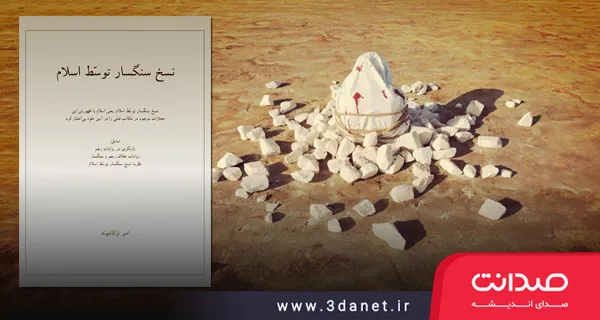
The book The Abrogation of Stoning by Islam by Amirhossein Torkashvand was published virtually and made available to the public in Shahrivar 1391 (September 2012). In this book, he argues that “not only has the punishment of stoning never existed in Islam, but Islam has actively opposed it.”
On the first page of this 200-page book, it states:
The abrogation of stoning by Islam means that with its advent, Islam invalidated within its own creed this punishment that existed in previous traditions.
In explaining this book on the Baznegari Telegram channel, he writes:
Stoning means killing a person by repeatedly throwing stones at them; abrogation means annulling the validity of a previously existing ruling. Accordingly, in the theory of “The Abrogation of Stoning by Islam,” I aim to explain that not only was such a ruling not legislated or even endorsed in Islam, but after its emergence, Islam abrogated this ruling that existed among the People of the Book and deemed it invalid.
Research Period:
Approximately 18 months; intermittently between Azar 1388 (December 2009) and Shahrivar 1391 (September 2012).Book Contents:
A Re-examination of the Narrations on Rajm (Stoning) Narrations Contradicting Rajm and Stoning The Theory of the Abrogation of Stoning by Islam ..
Foreword to the Book The Abrogation of Stoning by Islam
In the Name of God, the Most Gracious, the Most MercifulIn this book, I wish to explain the results of my research on “Islam’s stance on the punishment of stoning” to you, the faithful reader, so that we may see what position Islam adopted after its emergence regarding this ruling, which existed among the People of the Book and perhaps some pagan Bedouins.
As a preliminary point, it should be known that researchers hold five theories regarding the relationship of stoning to Islamic law:
Absolutely Canonical Conditionally Canonical Temporarily Canonical Semi-Canonical Non-CanonicalHere, I will provide a brief explanation of each:
1- Absolutely Canonical: The well-known opinion of the jurists indicates that stoning is canonical. Furthermore, they consider stoning neither a temporary ruling specific to early Islam, nor do they make its implementation conditional upon the presence of the Prophet (PBUH) or an Infallible. However, despite their belief in this severe ruling, they set such conditions for its establishment that make its occurrence practically impossible, because they consider stoning to be the punishment only for those married individuals who meet the following conditions:
a- They must have the possibility of sexual access to their spouse every morning and evening; therefore, if a man goes on a journey, even a trip of two or three days, and he commits adultery while traveling and his wife commits adultery while at home, then neither of this husband and wife is stoned, because at the time of the adultery, they did not have access to their spouse.
b- Either four just individuals must witness, with their own eyes, the unspeakable part of the sexual contact like a “kohl-needle in a kohl-jar” and also identify both parties, or the adulterer must himself go before a judge four times and confess to his sin. The matter becomes more complicated given that a Muslim is not legally permitted to gaze upon another’s private parts; with this in mind, it is unclear how a witness could give testimony akin to the “kohl-needle in a kohl-jar.” Also, the confessor, firstly, is not obligated to appear before the judge, and as soon as he regrets his action and repents, it suffices; and secondly, at the time of the first confession, the judge must deal with the confessor in such a way as to make him regret his subsequent visits (and the second through fourth confessions) and encourage him to simply repent.
It is for these reasons that proponents of this view consider its implementation practically impossible.
2- Conditional (suspended) Shar‘ī: Another well-known opinion among Shī‘a jurists is that although the ruling of stoning is Shar‘ī and possesses permanent validity, its implementation is nonetheless conditional upon the presence of the Infallible (Ma‘ṣūm). Since we are currently in the era of the Infallible’s absence, this ruling and its execution have been suspended until the advent of the Twelfth Imam.
Some consider the reason for the suspension of the ruling during the Occultation of the Infallible to be that, under such circumstances, the necessary and sufficient foundations for a healthy and transcendent life, as well as the possibility of growth and awareness in the manner desired by Islam, are not available for humanity. Consequently, the rulings of Islam (including stoning) cannot be implemented due to the incompatibility of conditions with Islamic standards, because the improper management of society also shares in the occurrence of error. However, if the Infallible were present, they would prepare the grounds and requirements for a healthy, prosperous, and spiritual life. Should someone commit adultery (zinā-yi muḥṣina) under those conditions, since the Proof (Ḥujjat) would have been fully established against them (by creating the necessary foundations), they could then be stoned, provided the conditions explicitly stated in the words of the Infallibles are proven. In other words, the implementation of the stoning penalty is the requital for someone who, throughout their life, has benefited from the blessings of the Infallible’s management in the arena of life.
3- Temporary (non-permanent) Shar‘ī: Some researchers consider the ruling of stoning (and sometimes other penal rulings) not as a fixed and permanent ruling, but as temporary and pertaining to the early Islamic period with its specific characteristics, particularly the existence of harsh temperaments. They do not consider it compatible with the present, where the face of humanity has transformed and become more elevated in ethical and human terms. In other words, today the context and conditions that led to the enactment of the stoning ruling during the Prophet’s era (including the normalcy of harsh and severe punishments) have disappeared. Consequently, due to the loss of the components present in the context and subject, the conditions for the enforcement and extension of stoning to the current era do not exist in terms of the subject matter. On this basis, the punishment of stoning was, from the outset, a ruling limited to the Prophet’s era (and similar eras) and suited to the violent temperament of that time, not to the pain-sensitive and gentle natures of today.
4- Semi-Shar‘ī: Some also believe that although the principle of rajm (stoning) is an absolute Shar‘ī ruling, according to the explanation and definition of it found in the words of the Infallibles, only half of its current well-known definition can be considered Shar‘ī, while the other half, which indicates the lethality of rajm (and even its severity of injury), does not conform to the Sharī‘a.
In this jurisprudential view, rajm is merely a formal chastisement and expression of disgust which, naturally (according to the transmitted narrations), must be limited in its execution to the use of small stones (pebbles) and without striking sensitive areas (head, face, groin, etc.), and [after some minutes] ends once the concept of rajm is fulfilled.
5- Non-Shar‘ī: Some contemporary jurists, however, believe that such a ruling was fundamentally never legislated. They usually consider this ruling to be related to the Jewish tradition (and sometimes arising from the policy of ‘Umar ibn al-Khaṭṭāb), which infiltrated Islamic society. They believe that the punishment for married individuals can be clearly found in the Qur’an, and therefore there is no need to refer to other evidence. Since the Qur’an never mentions the punishment of rajm and stoning, they thus consider it a non-Shar‘ī ruling.
In this view, the narrations of stoning are rejected for two main reasons: first, due to their contradiction with the Qur’an, because, as stated, the Qur’an itself speaks of the punishment for adultery by a married person, and it is something other than stoning. Second, by weakening the key narrations, which naturally causes them to lose their authoritative basis.
And now the sixth theory: The Abrogation of Stoning by Islam
Stoning means killing the adulterer by repeatedly throwing stones at them; abrogation (naskh) means the annulment of the validity of a ruling that previously existed. On this basis, in the theory of “The Abrogation of Stoning by Islam,” I intend to explain that not only was such a ruling not legislated or even endorsed in Islam, but rather, after its emergence, Islam abrogated this ruling existing among the People of the Book and considered it invalid!
What an astonishing theory! Until now, it was thought that stoning was an Islamic ruling, but now a theory is being proposed that is 180 degrees (and perhaps more) opposed to it, because it says Islam came and abrogated stoning, annulling and invalidating it!
I will not rush to bring you to this astonishing theory, for if I present the theory and its evidence right at the outset, it will be indigestible due to its 180-degree difference from the well-known view; therefore, I will gradually bring the reader closer to the theory, removing the obstacles to its acceptance one by one.
In line with this gradual approach;
First, I organized Part One, at the beginning of which we examine the term rajm, and then we carefully re-read the narrations of rajm so that, firstly, we see what meaning this word carried among the Arabs and what definition it had as a punishment, and secondly, from within the narrations, we arrive at the "comprehensive law of rajm," including the method of proving rajm, the quality of its execution, and its ultimate end and purpose. In this Alawid law, it becomes clear that all three clauses of the law differ from what is currently in our minds, because neither is its method of proof confession and admission, nor is the quality of its execution with lethal stones and to fatal points, nor is its ultimate end death and killing. I named Part One "A Re-examination of the Narrations of Rajm." In this part, a significant portion of our path toward approaching the theory is traversed.
Then, in Part Two, I unveil the narrations opposing rajm and stoning, and several categories of narrations are introduced to esteemed readers for the first time, in which the punishment for the adultery of married persons is something other than rajm and stoning. In this way, it can be conjectured that perhaps the narrations of rajm referred to in Part One were not the definitive and original words of the Imams, or were issued out of dissimulation (taqiyya); accordingly, since the Imams did not believe in rajm and stoning, in some instances they spoke their hearts and, in determining the punishment for muhsana adultery, made no mention of rajm and stoning, but in some instances, when they sought to express the "law of the day" and the ruling current in the legal system governing society, they brought up the principle of rajm—of course, with humane characteristics differing from the quantity and quality current in the law of the day—and as stated, it was never equivalent to legal stoning. With the end of Part Two, which I named "Narrations Contrary to Rajm and Stoning," we approach the goals of the book, and the mind stands one step away from the final part and becomes ready to hear the theory.
And finally, in Part Three, by presenting twenty-one Quranic proofs, I show how Islam absolutely abrogated the ruling of the People of the Book concerning the killing and stoning of the adulterer! The name of Part Three of the book is the very title of my theory.
Perhaps the reader will object that, contrary to the gradual plan, you placed your theory as the name of the book on the cover, and this itself is a major violation of this gradual approach? I accept this criticism, but I had no choice because the name is very important, and by choosing this exceptional name, "The Abrogation of Stoning by Islam," I wanted to "boost the morale" of the Muslim community and the religious people of Iran, so that they hold their heads higher and higher and say from the depths of their souls: Our Islam came and decreed the abrogation of the stoning that existed among the People of the Book! Of course, to reduce the extent of this violation, I decided to also bring the titles of the book's parts onto the cover, so that the reader, upon seeing the book's title, is delighted, and upon seeing the titles of the parts, grasps the investigative and gradual nature of the content.
.
.
PDF file of the book "The Abrogation of Stoning by Islam"
.
.





Discussion0 comments
No comments yet; let yours be the first voice.