Philosophy
The Death of Socrates: The Platonic Account and a Nietzschean Interpretation
In the Phaedo, Plato presents Socrates' death as noble, a new model, but Nietzsche sees it as decadence. Critiquing Socrates' last words, he diagnoses his life-denying rationality as a degenerative sickness, not a virtue.
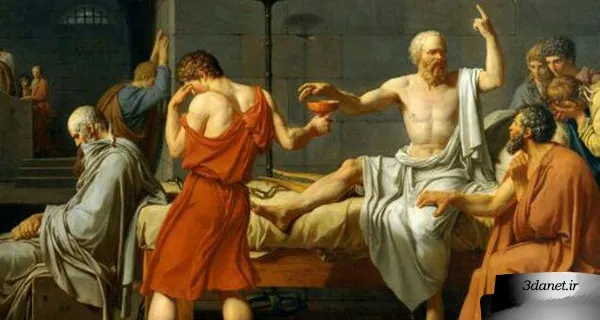
In the history of European philosophy, it has been widely believed that Plato, through the creation of the Socratic treatises or dialogues, compels all lovers of enlightenment and free thought to an indescribable reverence and veneration for his beloved master, Socrates. It might be said that, in this regard, the Phaedo has a more profound impact than all the other dialogues. In the words of one Hellenist, in the Phaedo, Plato erects such a magnificent monument to Socrates that one cannot imagine anything more glorious. Nietzsche, however, has a completely different assessment of the Phaedo, saying that with his glorious narrative in the Phaedo dialogue, Plato portrays Socrates in the final hours of his life in a way that becomes a new ideal for the youth of Greece in that era, and thus Socrates replaces Achilles, the mythical hero of the Homeric age, in Greek civilization. But Nietzsche, as will be discussed, cannot be pleased with this cultural transformation and evaluates it negatively, as the beginning of a cultural decline. Nietzsche interprets Socrates and Plato as geniuses of decadence and paragons of corruption, considering them historical symptoms of the sickness and decay of Greek culture.
Plato's Account of the Death of Socrates
We know that Plato himself was not present at the farewell gathering with Socrates due to illness, and therefore his account is indirect. In fact, years later, the story is reported through the words of Phaedo, one of those present. Phaedo recounts that in the prison, a serious critical dialogue ensues between Socrates and two members of the Pythagorean school, with the question of "human immortality" or "the survival of the soul after death" at the heart of these discussions and conversations. Indeed, in Socrates' eyes, even on the threshold of death, just as in the other days of his life, nothing was more precious than philosophical dialogue and nothing more valuable than the search for truth. In the Phaedo, the sublimity of Socrates' soul is manifested, above all else, in his spirit of truth-seeking and inquiry, as he is prepared to hear any criticism of the belief that had given meaning to his life and, in these final hours, is closer to his heart and soul than anything else, making the confrontation and acceptance of death easier for him, all with complete openness. Even on his deathbed, Socrates compels those present to openly voice any doubt they harbor in their hearts concerning his most central ideas. Socrates has no fear of death, but he is seriously afraid that his disciples' affection for him and their fear of upsetting him at the moment of death might become an obstacle to continuing the dialogue and the search for truth. Hence, when those present at the gathering, in order not to upset Socrates, try to conceal their doubts and objections, Socrates reminds them of the swan song, which at the moment of death is more beautiful and exhilarating than at other times. And when it seems they have given up further effort to advance the discussion and have grown slack in their thinking, it is Socrates who, like a general rallying a defeated and scattered army, gathers them again, leads them back into the field of debate, and prepares them for a new attack; he reaches out, takes the locks of Phaedo, who is sitting beside him, plays with them, and says:
"Phaedo! Tomorrow morning this beautiful hair will be shorn! But you must not cut it for my death; rather, you and I must cut our hair today, if it turns out that our argument is dead and we cannot revive it."
Socrates' perspective, in this dialogue, rests on the idea that philosophy, in the true sense of the word, is nothing other than "preparation for death," and the true philosopher is constantly longing for death. Phaedo's report also testifies that Socrates himself, in ultimate conformity with this philosophical ideal of his, drank the hemlock cup and went into the embrace of death. In the final moments of his life, in gratitude for the cure he considered a gift of his death, which freed him from the illness of his entire life, namely bodily existence, Socrates makes a vow, and to fulfill it, he calls one of his disciples and says: "Crito! I owe a cock to Asclepius.* Pay my debt!"
Nietzsche's Interpretation of the Platonic Account of Socrates' Death
Plato's account of the death of Socrates, for all its glory in describing Socrates' exceptional courage in the face of death and his indescribable passion for the ideal of truth, harbored within itself a negative and contemptuous view of this-worldly life. This attitude influenced the direction of life for centuries across different eras in the ancient world and even contained the central core of the Christian worldview. However, in the modern period, thinkers gradually emerged who, despite its tragic aspect, granted authenticity to this-worldly life and showed a sharp reaction—after about twenty centuries—to this
attitude, which in their opinion was life-denying. Among them, the German philosopher Friedrich Nietzsche (1844–1900) criticizes Socrates with a more radical approach and, quoting the final sentence of his life (the matter of his debt to Asclepius, the god of medicine), says:
"I admire Socrates for the wisdom and courage of what he did, what he said, and what he did not say. This amorous and mocking Athenian rogue and rat-catcher, who made the most insolent youths tremble, was not only the wisest chatterer of his time but also displayed his greatness in keeping silent. I wish he had remained silent in the last moments of his life; perhaps he would have attained a far higher spiritual rank. In those moments, something—whether death, the poison, piety, or cunning—loosened his tongue and drove him to utter this sentence."
(The Gay Science, Section 340)
Nietzsche again addresses this same episode in his book Twilight of the Idols, in a chapter titled "The Problem of Socrates," in a more specific and serious manner, expressing his critical thought on Socrates with greater analysis and detail: "The wisest men of all ages have judged life the same way: life is worth nothing... Always and everywhere their song has been heard—a song full of doubt, of melancholy, of weariness of life, of rejection of life. Even Socrates said at his death: 'Living—that means being sick a long time. I owe Asclepius the Savior a rooster.' Socrates, too, was weary of life—what does this prove? What does it point to? ... One must look more closely at these wisest men of all ages! Perhaps none of them stood firmly on their own feet? Perhaps their time was up, and they had become weak and decadent? Perhaps wisdom on earth is like a raven stirred by the scent of carrion? ... Socrates was a misunderstanding. The entire morality of improvement, including Christian morality, was a misunderstanding... The brightest daylight, rationality at any cost, life that is cold, cautious, and conscious, life without instinct, life opposed to instinct, was itself nothing but a sickness; another sickness—and never a way back to 'virtue,' to 'health,' to 'happiness' ... That one must fight the instincts—that is the prescription of decadence: as long as life is flourishing, happiness equals instinct.
... But did he himself realize this, the most cunning of all self-deceivers? Did he finally say this to himself in that wisdom of his courageous approach to death? ... Socrates wanted to die—it was not Athens that gave him the cup of hemlock; it was he himself. He compelled Athens to give him the cup of hemlock... He whispered to himself: 'Socrates is no physician. Here, death alone is the physician... Socrates himself was nothing but a chronic invalid ...'"
Nietzsche says the decline of Greek culture began when a radical metamorphosis appeared in the educational model of Athenian youth and Socrates replaced Achilles (Achilles—one of the heroes of the Homeric epics). Socrates regarded this world as a “prison” and life in this world as an “illness,” and therefore saw the path to liberation from this prison and the healing remedy for this illness in “death,” and consequently sought salvation in that world (Hades: the world of the dead), whereas Achilles said, “I would rather be a slave to a peasant cowherd in this world than be lord and master of all in that world.” Of course, let us not forget that Nietzsche’s critique of Socrates is not a critique of an individual, but a critique of a historical and cultural idea. Even as Nietzsche criticizes Socrates, he appropriates him. In fact, Nietzsche wants to be the Socrates of the modern age, a Socrates suited to the problems and exigencies of his own time. But this aim is not realized for Nietzsche except through a constant critical dialogue with Socrates. Nietzsche sees himself surrounded by Socrates, and therefore sees no escape or alternative but a hand-to-hand combat with him. In his own words, “Socrates stands so close to me that I fight with him every day.”
Perhaps, in conclusion, it would not be amiss to mention the words of Theodor Gomperz (1832–1912), the renowned Hellenist and Nietzsche’s compatriot. In his commentary on the Phaedo in his book Greek Thinkers, he says: “Many of us moderns may disapprove of the thought of fleeing the world and life that is voiced in this dialogue. Yet there is no dark-minded enemy and no genuine, true lover of truth who reads this gospel of the boundless freedom of thought and does not kneel before it.”
.
.
* The god of medicine in ancient Greek myths
.
.
The Death of Socrates: The Platonic Account and a Nietzschean Interpretation
Author: Masoud Zanjani
.
.


Discussion0 comments
No comments yet; let yours be the first voice.