Sociology
The Social Network Twitter Under the Microscope
An analysis of Twitter data shows that users have genuine interactions with only a small fraction of their audience, and that the number of messages saturates as follower counts rise; an examination of the instability between declared connections and effective interactions on social networks.

The Social Network Twitter Under the Microscope[1]
Authors of the article in the footnote
Translator: Shahrbanoo Pahlavan
Translator: The article "The Social Network Twitter Under the Microscope," which is an academic study from December 2008, is noteworthy because it shows how social networks can have so-called "bubbles" in pursuing social issues. In the real or physical world, the number of followers and the number who can be influential are not congruent. In other words, we are witnessing an instability between the online and offline spaces.
Introduction
Social networks, a very old and pervasive mechanism through digital interactions among people, have become widespread in the web era. With interfaces (or platforms) that allow people to follow the lives of friends, acquaintances, and families. Networks have grown exponentially since the turn of this century. For example, Facebook, LinkedIn, and MySpace, which include millions of members, use these networks to follow one another, find experts, and participate in business transactions when necessary (Huberman, et al., 2008). Furthermore, commercial enterprises try to exploit them for marketing purposes, as they provide a ready medium for propagating recommendations through people with similar interests (Korgan, et al., 2001).
From an academic perspective, a great deal of knowledge has been accumulated about the formation and dynamics of these networks, benefiting from the easy access to data and the regularities in the statistical distribution of nodes and links within these networks (Feld, 1991; Golder, et al., 2007; Granovetter, 1973; Kleinberg, 2008; Leskovec, et al., 2007; Wasserman and Faust).
While the standard definition of a social network embodies the concept of all people with whom one shares a social relationship, in reality, people interact with a small number from their "list" as part of their network. One important reason for this fact is the attention to scarce resources in the web age. Users are faced with many daily tasks and a large number of social links, and by default, they engage with and pay attention to only a few of these. For example, a recent study on Facebook showed that users only interact with and message a small number of people, while having a large number of declared friends (Golder, et al., 2007). A casual search through recent calls on any typical mobile phone usually reveals that a small percentage of the contacts stored in the phone are frequently contacted by the user.
These preliminary observations suggest a systematic investigation into the nature of social networks that actually matter to people. By this, we mean networks constructed from the pattern of interactions individuals have with their friends or acquaintances, rather than being built from a list of all the contacts they might decide to declare.
Discussion or Analysis
Discussion: To find out how relevant a list of "friends" is for network members, we collected and analyzed a large dataset from the social network Twitter. [2] Twitter is an online social network used by millions of people worldwide to stay in touch with their friends, family members, and colleagues via their computers and mobile phones. The user interface allows users to post short messages (up to 140 characters) that can be read by any other Twitter user. Users declare the people they are interested in following, in which case they are notified when that person posts a new message. A user who is followed by another user does not necessarily reciprocate by following them back, which makes the links of the Twitter social network directed.
For each Twitter user in our dataset, we obtained the followers (people who follow the user) that the user has declared, along with the content and timestamp of all their posts. Our dataset included 309,740 users who, on average, posted 255 messages, had 85 followers, and followed 80 other users. Among the 309,740 users, only 211,024 posted at least twice. We call these active users. We also define an active user's active time as the time elapsed between their first and last post. On average, active users were active for 206 days. Twitter users can post public and direct updates. Direct public posts are used when a user has an update for a specific person and are marked by the "@" symbol next to the person's username, while indirect updates are used when the update is for anyone who wants to read it. Even though direct updates are used to communicate directly with a specific person, they are public and anyone can see them. Often, two or more users carry on a conversation by posting updates to each other. About 25.4 percent of all posts were directed, indicating that this feature is widely used among Twitter users.
We are interested in knowing how many users each user communicates with directly through Twitter.
We define a user's friend as a person to whom the user has directed at least two posts. Using this definition, we were able to discover how many friends each user has and compare this number with their declared number of followers and followings.
Based on our previous findings on the role of attention in generating productivity in a social network (Huberman, et al., 2008), we conjecture that users who attract a lot of attention from many people will post more than users who receive little attention. Therefore, we expect users with more followers and friends to be more active in posting than those with few followers and friends. Figures 1 and 2 show that, indeed, the total number of posts increases with the number of followers and friends.
However, as Figure 1 shows, the total number of posts eventually saturates as a function of the number of followers. This means that users with a very large number of followers are not necessarily the ones with a very large total number of posts. On the other hand, the total number of posts as a function of the number of friends does not saturate, as seen in Figure 2. Instead, the number of updates increases until it reaches a maximum point of 3201. This suggests that, for predicting how active a Twitter user is, the number of friends provides a more accurate signal than the number of their followers.
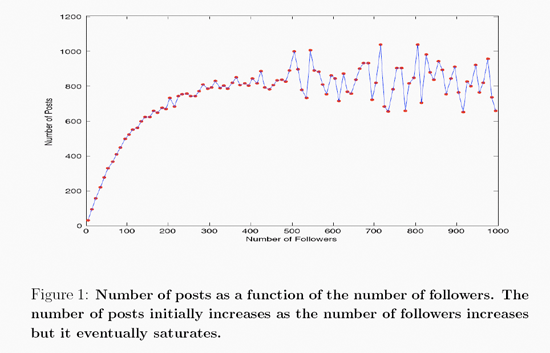
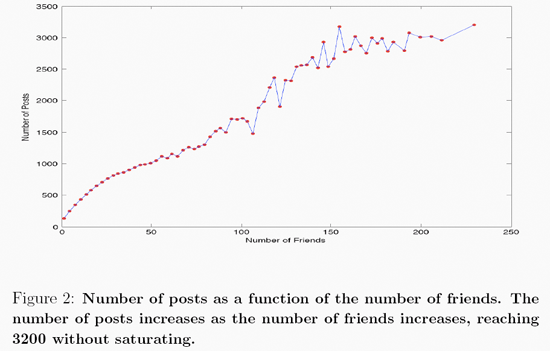

This means that to assess the size of the social network, what matters is to consider the people who actually exchange direct messages with one another, as opposed to the network created by declared followers and followings.
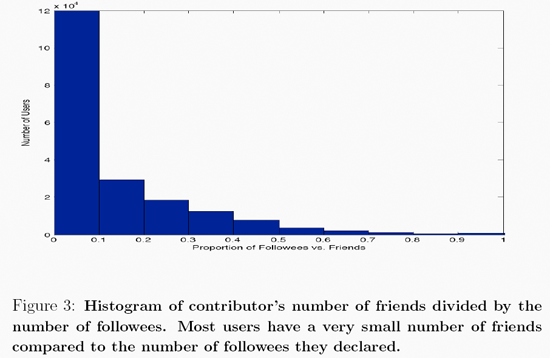
By showing that the number of friends is the main driver of Twitter user activity, we declared it alongside the number of followers a user has. We define δ as the number of friends a user has, divided by their declared number of followers. Since 98.8 percent of users have fewer friends than followers, almost all δ values are less than 1. Figure 3 shows a graph of δ values. As we can see, most users have a δ of less than 0.1, with very few users having a δ close to 1. The mean δ value is 0.13 and the median is 0.04. This indicates that the number of users a user actually interacts with is very small compared to the number of people they actually follow. Therefore, even if users declare that they follow many people using Twitter, they only interact with a small number of them. Hence, while the social network created by declared followers and followees appears very dense, in fact, the more influential network of friends shows that the social network is sparse. This means that to assess the size of the social network that matters, one must consider the people who actually exchange direct messages with one another, as opposed to the network created by declared followers and followees.
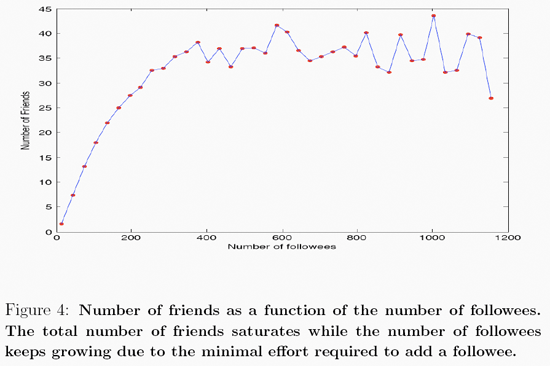
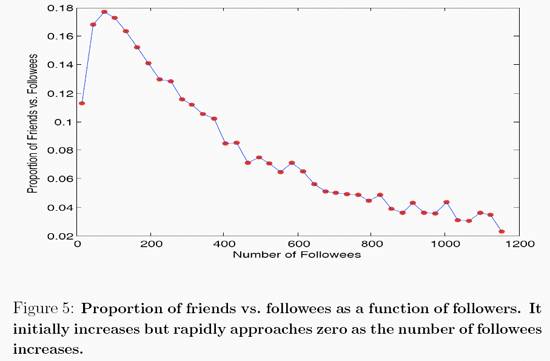
Another interesting aspect is considering how the number of friends and δ values change as the number of followers increases. Figures 4 and 5 show that although the number of friends initially increases with the number of followers, after a while the number of friends saturates. This trend can be explained by the fact that the cost of declaring a new follower is very low compared to the cost of maintaining friends (i.e., exchanging directed messages with other users). Hence, the number of people a user actually interacts with eventually stops growing, while the number of followers can continue to grow indefinitely.
Reciprocity plays an important role in many economic and social interactions (Fehr and Gächter, 2000). At the same time, scarcity of a good attracts people, and they therefore pay attention to a valuable private good
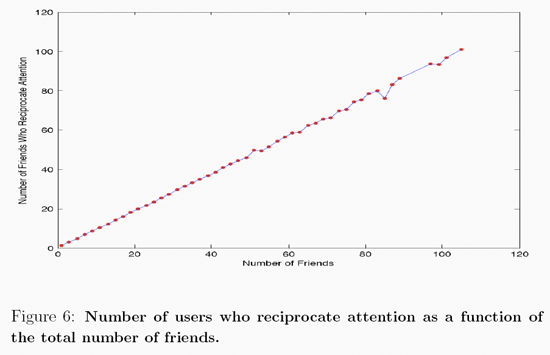
(Huberman et al., 2008). In the case of Twitter, we found that the notion of reciprocal attention exists. While our definition of a friend allows user X to be a friend of user Y while Y is not a friend of X, we found that on average, 90 percent of a user's friends reciprocate the attention by being a friend back. This indicates that the reciprocity of attention plays an important role in defining the "hidden network." Figure 6 shows that reciprocal attention is a very consistent trend, as it holds for users with many friends as well as for users with very few friends.
Conclusion
In conclusion, even when we use a very weak definition of "friend" (i.e., anyone to whom the user has directed a post at least twice), we find that Twitter users have a very small number of friends relative to the number of followers and followees. This implies the existence of two different networks: a very dense network consisting of followers and followees, and a sparser and simpler network of actual friends. The latter proves to be an influential network in the use of Twitter, as users with many actual friends tend to post more updates than users with few actual friends. On the other hand, users with many followers or followees update much more often than those with few followers or followees.
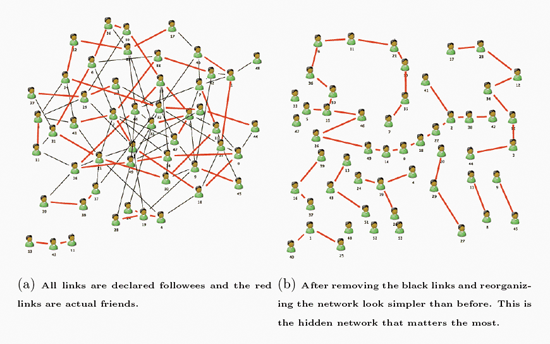
Many people, including scientists, advertisers, and political activists, view online social networks as an opportunity to study the propagation of ideas, the formation of social ties, and viral marketing, among other things. This view must be tempered by our finding that a link between any two people does not necessarily imply an interaction between them. As we have shown in the case of Twitter, most of the declared links on Twitter were meaningless in terms of interaction. Thus, when trying to spread an idea, a belief, or a trend, it is important to find the hidden social network.
.
.
Authors of the Article
Bernardo A. Huberman is a Senior HP Fellow and Director of the Social Computing Lab at Hewlett–Packard Laboratories, Palo Alto, Calif. Web: http://www.hpl.hp.com/research/idl/people/huberman/ E–mail: bernardo [dot] huberman [at] hp [dot] com
Daniel M. Romero is a graduate student at the Center for Applied Mathematics of Cornell University (Ithaca, N.Y.) and also a researcher in the Social Computing Lab of HP Laboratories. E–mail: dmr239 [at] cornell [dot] edu
Fang Wu is a researcher in the Social Computing Lab of HP Laboratories. E–mail: fang [dot] wu [at] hp [dot] com
.
.
Aknowledgment
One of us (BAH) thanks Dr. Josef Falkinger for useful discussions.
.
.
References
E.Fehr and S. Gachter, 2000. “Fairness and retaliation: The economics of reciprocity,” Journal of Economic Perspectives, volume 14, number 3, pp. 159–181.http://dx.doi.org/10.1257/jep.14.3.159
S.L. Feld, 1991. “Why your friends have more friends than you do,” American Journal of Sociology, volume 96, number 6, pp. 1,464–1,477.
S.A. Golder, D. Wilkinson and B.A. Huberman, 2007. “Rhythms of social interaction: Messaging within a massive online network,” Third International Conference on Communities and Technologies, at http://www.hpl.hp.com/research/idl/papers/facebook/facebook.pdf, accessed 21 December 2008.
M. Granovetter, 1973. “The strength of weak ties,” American Journal of Sociology, volume 78, number 6, pp. 1,360–1,380.http://dx.doi.org/10.1086/225469
R.E. Grinter and L. Palen, 2002. “Instant messaging in teen life,” Proceedings of the ACM Conference on Computer–Supported Work, pp. 21–30; version at http://www.cs.colorado.edu/~palen/Papers/grinter-palen-IM.pdf, accessed 21 December 2008.
B.A. Huberman, D.M. Romero and F. Wu, 2008. “Crowdsourcing, attention and productivity,” version of paper submitted for the 2009 World Wide Web Conference (Madrid); version at http://arxiv.org/abs/0809.3030, accessed 21 December 2008.
J. Kleinberg, 2008. “The convergence of social and technological networks,” Communications of the ACM, volume 51, number 11, pp. 66–72; version at http://www.cs.cornell.edu/home/kleinber/cacm08.pdf, accessed 21 December 2008.
K. Korgan, P. Odell and P. Schumacher, 2001. “Internet use among college students: Are there differences by race/ethnicity?” Electronic Journal of Sociology, volume 5, number 3, at http://www.sociology.org/content/vol005.003/korgen.html, accessed 21 December 2008.
J. Leskovec, L.A. Adamic and B.A. Huberman, 2007. “The dynamics of viral marketing,” ACM Transactions on the Web, volume 1, number 1, article number 5; version at http://www-personal.umich.edu/~ladamic/papers/viral/viralTWeb.pdf, accessed 21 December 2008.
S. Wasserman and K. Faust, 1994. Social network analysis: Methods and applications. New York: Cambridge University Press.
B. Wellman and N. Hampton, 1999. “Living networked in a wired world,” Contemporary Sociology, volume 28, number 6, pp. 648–654 . http://dx.doi.org/10.2307/2655535
.
.
[1] Social networks that matter: Twitter under the microscope
.
.






Discussion0 comments
No comments yet; let yours be the first voice.