Sociology
The Subordination of Women: Sex-Based Discrimination Against the Politics of Life
The subordination of women is neither a legal nor a cultural phenomenon, but a function of gender-based power relations within the very mechanism of the political. Overcoming this discrimination requires a new understanding of the political that transcends the register of instinctual power, not merely jurisprudential or legal reforms.
The question of superiority and inferiority is, willy-nilly and whether unconsciously or consciously, a question of the political. What is the understanding of the political if not varying degrees of this compound awareness and mastery: mastery of a situation in which the two sides of a relationship sit at two different levels of power, one superior, the other inferior; and awareness that this difference in the level of power always has a psychic inclination toward the domination of the superior side over the inferior side? And this is the most fundamental meaning of that very domination which, if some degree of it, however slight and subtle, were absent, not only the subject of politics, but the subject of most human relations and interactions, would disintegrate.
Human history, as far as our backward-looking gaze can see, is the scene of relations of domination arising from just such asymmetries. Our own time is no exception. In our time, of course, the scope, complexity, and overtness of women's subordination in the Middle East, Latin America, and parts of Africa and Asia have found meaningful differences from the scope, complexity, and overtness of women's subordination in Europe, America, and Oceania. Yet still and continually, the objective and actual subordination of women remains an almost global phenomenon.
This subordination, in the time and context that is the political ecosystem of us Iranians and our cultural neighbors across the world, has numerous and varied instances, including the structural prohibition of women from attaining high political office, or the inferiority of women to men in the eyes of religious or customary law, or in the labor market, or on the scales of social status, or within the family system. Yet none of these are purely legal and juridical, or cultural and social, or jurisprudential and religious phenomena.
This institutionalized and structural subordination, before and above all else, expresses gender-based power relations whose umbilical cord is connected to a primal and originary discrimination, a discrimination embedded in the mechanism of the formation of the political around the axis of the power differential between the male sex and the female sex. Filling the abyss of this discrimination and establishing material and status justice between the female sex and the male sex is one and the same as the glass of the lifespan of the most ancient power relations beginning to crack.
The difficulty of the problem of discrimination against women is that the overthrow of gender-based discrimination can only descend from the vague realm of hope and desire and step onto the hard, solid ground of reality when, in our society, a new possibility for the birth of the political and its understanding is provided, so that both the political, and our perception of it, can rise above the instinctual, ancient, and primal level of power. We and our cultural neighbors across the world live in a time and context where the political and our perception of it are still intensely instinctual. While, simultaneously, new experiences of the political and politics have been sprouting in other societies for decades and have now blossomed.
In other words, the key problem is that gender discrimination is not merely one of the characteristics of these political bodies, social entities, and religious and legal systems that we live within, but rather their constitutive element and fundamental cell, and their most principal, most "natural," and most renewable source for the production of power, wealth, and identity; it is the glass of their lifespan and the secret of their survival.
Nevertheless, many women's rights activists and campaigners, for whom suffering from gender-based discrimination is part of their lived experience and who have complete knowledge, indeed knowledge by presence, of it, are oblivious to the coarse, rough, and harsh aspect of this "fundamental reality" which is, from head to toe and in the deep and precise sense of the word, political, or they turn a blind eye to it and practice feigned neglect and feigned ignorance, and instead, devote all their efforts to interpretive critiques and jurisprudential, religious, theological, and legal reforms.
Religious intellectuals, if they have rarely and accidentally emerged from the veil of gender-blindness, have kept themselves and their readers busy and preoccupied with jurisprudential and interpretive revisions of religious texts concerning discrimination against women. Non-religious intellectuals, too, have often made the ideal of eliminating gender discrimination into a cold and ineffective weapon, so that, heartened by it, they might incite women against the political body or the devout body of society, and thus, by adding to the diversity and scope of social and political contradictions, they have practically and unintentionally placed the struggle against discrimination in the position of an imported and grafted member, which the body of society and politics (including an important part of its female section) voluntarily rejects...
.
.
PDF file of the article The Subordination of Women
.
.
The Subordination of Women: Sex-Based Discrimination Against the Politics of Life
Author: Mohammad Mehdi Mojahedi
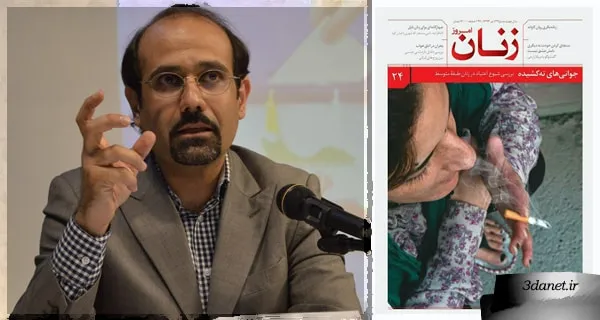
This article was published in Tir 1396 (July 2017) in the twenty-fourth issue of the magazine "Zanan-e Emrooz".
.
.




Discussion0 comments
No comments yet; let yours be the first voice.