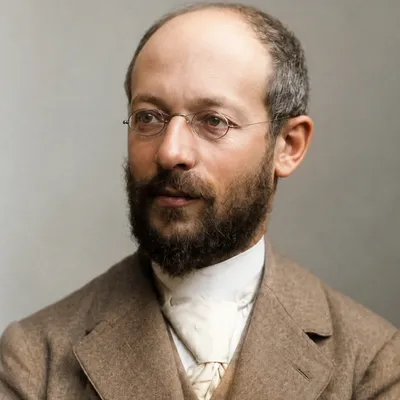
Foreign thinker
Georg Simmel
Georg SimmelSociology and philosophy of cultureGerman1858–1918
"Social life is a collection of forms of interaction among individuals."


Life and Thought
Georg Simmel was a German philosopher and sociologist and one of the founders of modern sociology. He is especially known for his analyses of urban life, social relations, money, and modern culture. By focusing on "social forms" and the individual's experience in modern society, he had a significant influence on twentieth-century social theory.
Georg Simmel was born in 1858 in Berlin, Germany. He studied philosophy and history at the University of Berlin and later became known as a prolific scholar in philosophy, sociology, and culture. Despite the wide influence of his works, he faced difficulties in obtaining a full academic position within the university system of his time.
Simmel was among the early theorists who presented sociology as an independent study of patterns of human interaction. Instead of focusing only on large social institutions, he examined forms of relations between individuals, including competition, conflict, exchange, the stranger, secrecy, and friendship.
Among his most important works are The Philosophy of Money (1900), Sociology (1908), and essays on modern culture. In The Philosophy of Money, Simmel showed how money transforms social relations, values, and the experience of modern human beings. His analysis of the metropolis and mental life in "The Metropolis and Mental Life" is also considered a classic text in urban sociology.
Simmel's thought influenced many later thinkers, including scholars of the Chicago School, social theorists, cultural studies researchers, and philosophers of life. He died in 1918, but his works remain influential in the study of modernity, individuality, and contemporary culture.