Foreign thinker
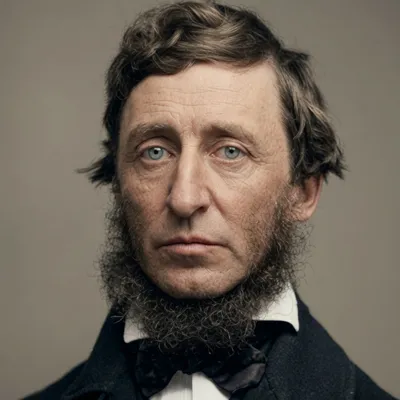
Henry David Thoreau
Henry David ThoreauTranscendentalism, Moral Philosophy, and Civil DisobedienceAmerican1817–1862
The mass of men lead lives of quiet desperation.


Life and Thought
Henry David Thoreau (1817–1862) was a prominent American philosopher, transcendentalist, poet, and essayist. He is best known for his book Walden and his essay 'Civil Disobedience,' which had a profound impact on nonviolent resistance movements around the world.
Henry David Thoreau was born in 1817 in Concord, Massachusetts. After graduating from Harvard University, he turned to teaching, poetry, and essay writing, and was a close friend and disciple of Ralph Waldo Emerson. Thoreau was one of the central figures of the Transcendentalist movement, an intellectual school that emphasized individual spirituality, a critique of materialism, and a deep connection between humanity and nature.
To put his ideas about simple living and self-reliance into practice, he lived for more than two years in a hand-built cabin beside Walden Pond. The result of this experience was his famous book Walden; or, Life in the Woods, a critical re-examination of the modern lifestyle and an invitation to reflect on the human relationship with nature.
Another of Thoreau's most enduring works is the essay 'Civil Disobedience.' After being imprisoned for refusing to pay taxes in protest against slavery and the Mexican–American War, he argued in this work that an individual has a moral duty to resist unjust laws. This theory later became a source of inspiration for major figures such as Mahatma Gandhi and Martin Luther King Jr. Thoreau died in 1862.