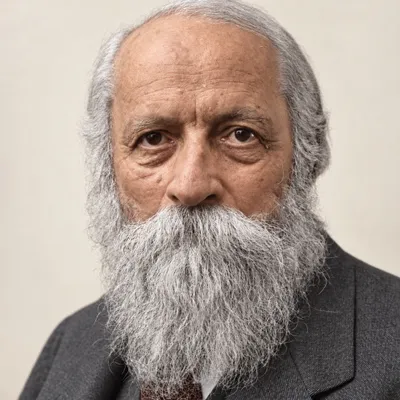
Foreign thinker
Martin Buber
Martin BuberDialogical philosophy (philosophy of dialogue) and Jewish existentialist theologyAustrian-Israeli1878–1965
All real living is meeting.


Life and Thought
Martin Buber (1878–1965) was an Austrian-Israeli Jewish philosopher and theologian, among the foremost figures of twentieth-century dialogical philosophy. In his book "I and Thou" (Ich und Du), he distinguished between the "I-Thou" relation and the "I-It" relation, a distinction that profoundly shaped theology, ethics, and existentialist philosophy. Buber was also a major reviver of Hasidic Jewish thought and an active figure in cultural Zionism.
Martin Buber was born on February 8, 1878, in Vienna to a Jewish family. After his parents separated in his childhood, he was raised by his grandfather, Solomon Buber, a distinguished scholar of Midrashic literature and Kabbalah, in Lemberg (present-day Lviv); this environment introduced him early on to Jewish tradition, and especially to Hasidic mysticism. He studied philosophy, art history, German philology, and literature at the universities of Vienna, Leipzig, Berlin, and Zurich.
In the first decade of the twentieth century, Buber turned to collecting and retelling Hasidic legends and tales, producing works such as "The Tales of Rabbi Nachman" and "The Legend of the Baal-Shem." His philosophical fame, however, rests above all on "I and Thou," published in 1923. In it, Buber distinguished between two fundamental modes of relation: the "I-Thou" relation, which is direct, reciprocal, and wholly present, and the "I-It" relation, in which the other is experienced and used as an object or instrument. For Buber, God is the "Eternal Thou" present within every genuine "I-Thou" relation.
From 1923, Buber held a chair in Jewish religious philosophy at the University of Frankfurt and, together with Franz Rosenzweig, undertook a German translation of the Hebrew Bible. After the Nazis came to power in 1933 he lost his chair and worked in adult Jewish education in Germany, until he emigrated to Palestine in 1938 and taught sociology and anthropology at the Hebrew University of Jerusalem. Buber was a critic of extreme nationalism and advocated for Jewish-Arab coexistence in a shared land, a position that set him apart from the dominant political Zionism of his time. He died in Jerusalem on June 13, 1965.