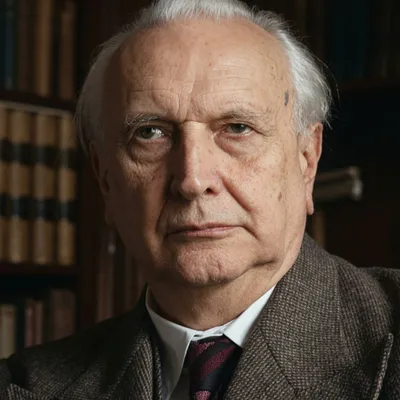
It is in limit situations that man comes to himself; there, where he confronts death, suffering, guilt, and chance, he either becomes nothing or recovers his Existenz.


Life and Thought
Karl Theodor Jaspers (1883–1969) was a German psychiatrist and existentialist philosopher who examined fundamental human experiences from a philosophical perspective. After studying medicine, he taught philosophy and left behind significant works in the fields of psychiatry and existential philosophy.
Karl Theodor Jaspers (February 23, 1883 – February 26, 1969) was a psychiatrist, philosopher, and one of the key figures of German existentialism. He initially worked in the fields of medicine and psychiatry, but gradually turned to philosophy and sought to explain fundamental human experiences such as suffering, death, guilt, failure, and freedom from a philosophical perspective.
Jaspers was born in Oldenburg, Germany. He first studied law for a time, but then turned to medicine and studied at the universities of Berlin, Göttingen, and Heidelberg. He received his doctorate in medicine in 1909 and worked and conducted research at the psychiatric hospital in Heidelberg. His important work, General Psychopathology, holds a prominent place in the history of psychiatry and shows that Jaspers was interested from the very beginning in the connection between inner human experience and scientific method.
From the 1920s onward, Jaspers increasingly devoted himself to philosophy and began teaching philosophy at the University of Heidelberg. Influenced by Kierkegaard and Nietzsche, he saw philosophy not merely as a theoretical system, but as a way to illuminate the existential condition of the human being. In Jaspers' view, humans confront their own limitations in "boundary situations" such as death, suffering, guilt, and struggle, and find the possibility of a more authentic experience of existence.
Jaspers spoke of "Transcendence" or the transcendent being, but understood it not as a concept that could be possessed, but as a horizon toward which humans open themselves when confronting the limits of their knowledge and power. He opposed any kind of closed intellectual system and considered philosophy an effort toward communication, freedom, and existential awakening.
During the Nazi regime, he was dismissed from the university due to his critical stance and his marriage to a Jewish woman. After the end of World War II, he returned to the university and played an important role in the intellectual discussions concerning guilt, responsibility, and the spiritual reconstruction of Germany. In 1948, he moved to the University of Basel and remained in Switzerland for the rest of his life. Jaspers died in Basel on February 26, 1969.
Bibliography
Writings and transcribed lectures16 titles
General Psychopathology
The Psychology of Worldviews
Philosophy, in Three Volumes
The Spiritual Condition of the Age
Nietzsche: An Introduction to Understanding His Philosophizing
Reason and Existence
Philosophical Logic
The Beginning and End of History
The Problem of Guilt
The Idea of the University
Great Philosophers
Philosophy of Existence
My Philosophical Biography
Nietzsche and Christianity
The Nature of Psychotherapy
Tragedy Is Not Enough
Sedanet articles about Karl Jaspers