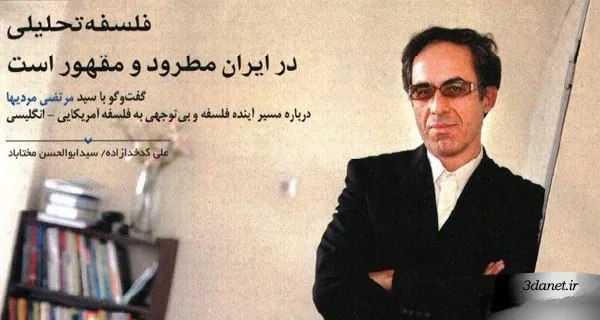
Iranian thinker
Morteza Mardiha
Morteza MardihaPhilosophyIranianb. 1964

Life and Thought
Morteza Mardiha, born August 3, 1960, in Isfahan, is a philosopher, writer, translator, and university professor. He works in the fields of rationality, liberalism, and analytic philosophy, and has taught at Allameh Tabataba'i University.
Morteza Mardiha, born August 3, 1960, in Isfahan, is a philosopher, writer, translator, journalist, and university professor. He has worked in philosophy, social sciences, political theory, communications, and literature, and is best known for his defense of rationality, liberalism, and analytic philosophy, as well as his critique of idealistic and leftist traditions.
Mardiha earned his master's degree in Islamic Theology and Philosophy at the University of Tehran, then studied philosophy and methodology in France at the universities of Toulouse and Nantes. During the Reform Era, he contributed to newspapers such as Jame'eh, Tous, and Neshat, and later taught in the philosophy department and subsequently the communications department at Allameh Tabataba'i University.
Mardiha is an advocate of analytic philosophy, empiricism, critical rationality, and liberalism. He takes a critical stance toward continental philosophies, grand ideologies, political romanticism, utopian leftism, and relativism. In his view, much of the intellectual appeal in Iran stems from ambiguity, passion, unregulated complexity, and grand promises; whereas the Anglo-Saxon tradition and philosophers such as Hume, Mill, Popper, and Quine, due to their precision, moderation, and clarity, are less exciting but far more beneficial.
He is also among the figures who have introduced and defended liberalism, utilitarianism, the philosophy of science, rational choice theory, and the critique of anti-liberal intellectualism in Persian. Alongside this theoretical dimension, Mardiha possesses a distinctive literary prose and has, in some of his works, engaged with love, classical Persian literature, Rumi, Saadi, and Hafez.
Bibliography
Writings and transcribed lectures12 titles
In Defense of Rationality: The Primacy of Reason over Religion, Politics, and Culture
In Defense of Politics: Authoritative Liberal Democracy
Foundations of the Critique of Political Thought
The Virtue of Uncertainty in the Science of Knowing Society
Psychedelic Philosophies
Security in Coma
Elite University, Mass University
The Reign of Sex
Authors: Mahboubeh Paknia, Morteza Mardiha
The Grace of Politeness
In the Presence of the Masnavi
Taking Refuge in D.T.
In Flames of Water