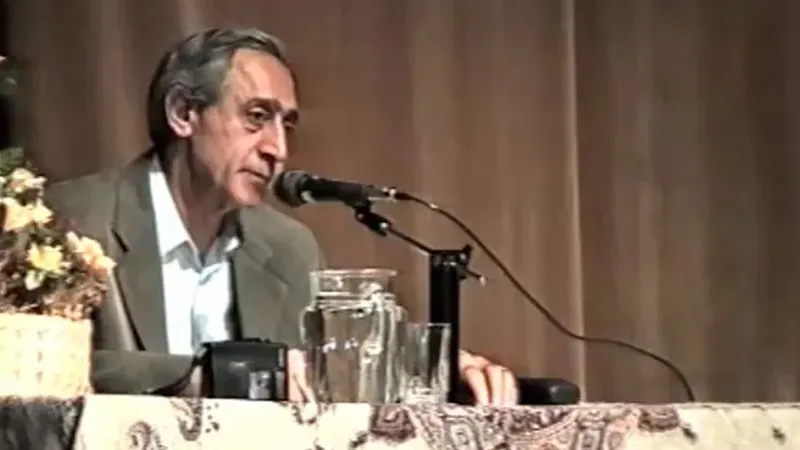
Iranian thinker
Mostafa Rahimi
Mostafa RahimiPolitical Thought and LiteratureIranian1926–2002
An intellectual is someone who, in their solitude, bears the pain of all.


Life and Thought
Mostafa Rahimi (1926–2002) was an Iranian jurist, sociologist, and translator known for translating existentialist works and authoring books on law and politics. His open letter in 1979 is one of the key documents of pro-democracy advocacy before the revolution.
Mostafa Rahimi, born in 1926 in Nain and died on 31 July 2002 in Tehran, was an Iranian jurist, sociologist, writer, translator, university professor, and one of the independent intellectuals of contemporary Iran. He studied law at the University of Tehran, then continued his education in France, earning a doctorate in law from the Sorbonne. In Paris, he became acquainted with the atmosphere of existentialism, committed literature, and the thought of Jean-Paul Sartre—an encounter that later left a deep mark on his translations and writings.
In the 1960s, Rahimi played a role in introducing modern Western philosophy and literature to Iranian intellectual life through his translations of works by Sartre, de Beauvoir, Camus, and Brecht. He was not merely a translator; his central concern was the relationship between freedom, law, intellectualism, social justice, and human moral responsibility.
Rahimi was among the intellectuals who forged links between law, literature, and philosophy. On one hand, he was well-versed in the legal tradition and pro-democracy thought; on the other, through his translations of Sartre, Camus, and Brecht, he introduced the language of “commitment,” “freedom,” “responsibility,” and “choice” into Iran’s cultural sphere.
His famous letter titled Why Am I Opposed to the Islamic Republic?, written in January 1979, is one of the most significant pro-democracy texts before the victory of the revolution. Its central argument was a defense of unconditional republicanism and a warning against restricting the concept of a republic with any ideological qualifier; the text of this letter continues to be reread as an important document in the history of Iranian political thought.
Bibliography
Writings and transcribed lectures9 titles
The Iranian Constitutional Law and the Principles of Democracy
Principles of Republican Government
The Tragedy of Power in the Shahnameh
Hafez-e Andisheh
Siavash on Fire
Freedom and Culture
Moving Beyond the Culture of Commerce
Marx and His Shadows
In Search of an Unmasked Humanity