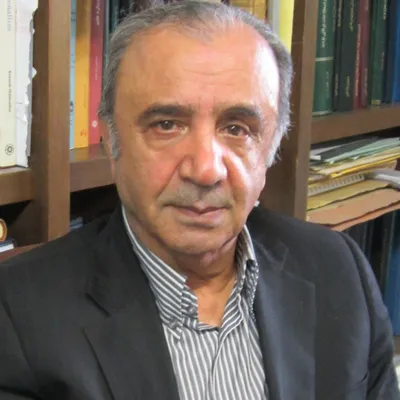
Iranian thinker
Taghi Pournamdarian
Taghi PournamdarianPersian Literature, Literary Criticism, and MysticismIranianb. 1941
Life and Thought
Taghi Pournamdarian is a poet, scholar, and professor of Persian literature, born in Hamadan in 1941. His research focuses mainly on the criticism and interpretation of Persian poetry, mysticism, and symbolic literature, and he has written on poets including Hafez, Rumi, Attar, Nima Yooshij, and Ahmad Shamlou.
Taghi Pournamdarian, born in Hamadan in 1941, is a poet, scholar, and professor of Persian literature at the Research Institute for Humanities and Cultural Studies. His principal fields of research are the criticism and interpretation of Persian poetry, mysticism, symbolic literature, and the relationship between form and meaning in literary texts.
After receiving a mathematics diploma, Pournamdarian taught for a time before studying Persian language and literature at the University of Tehran. He continued his studies at the master’s level at the Institute for Iranian Culture and, in 1979, earned his PhD from the University of Tehran after defending his dissertation, Symbol and Symbolic Tales, under the supervision of Mohammad Reza Shafiei Kadkani.
A significant part of his scholarly work is devoted to reading and analyzing the works of major classical and modern Persian poets. Encounter with the Simurgh examines Attar’s thought and art; In the Shadow of the Sun concerns Rumi’s poetry; The Lost One on the Shore of the Sea discusses form and meaning in Hafez’s poetry; My House Is Cloudy studies Nima Yooshij’s poetry; and Journey in the Mist concerns Ahmad Shamlou’s poetry. His book Symbol and Symbolic Tales in Persian Literature is the result of his research on the place of symbolism and symbolic narratives in Persian literary tradition.
In addition to his research on classical literature, Pournamdarian has also addressed modern poetry and its transformations and is himself a poet. Leafless Wayfarers is among his poetry collections. The range of his work—from research on Suhrawardi, Attar, Rumi, and Hafez to the analysis of Nima’s and Shamlou’s poetry—shows his sustained attention to textual interpretation and the formation of meaning in Persian literature.