Philosophy
We Haven't Thought Independently for 300 Years: Babak Ahmadi's Speech on World Philosophy Day
In a lecture, Babak Ahmadi pointed to the absence of a philosophical culture in Iran, stating, 'We have not thought at all for at least 300 years.' He sees philosophy as the link between the sciences and the overseer of the foundations of art, yet considers it unreasonable to expect philosophical work from Iranian works.
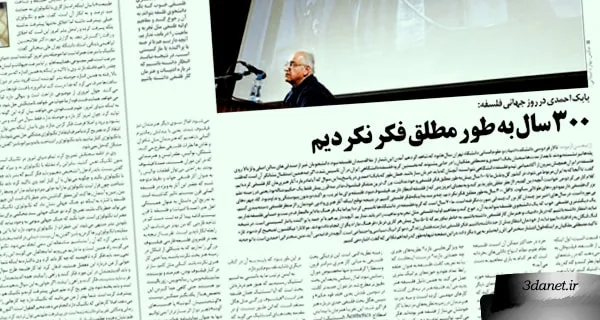
We have been establishing philosophy departments in universities for 70 years, yet we do not have a proper philosophical encyclopedia or dictionary. We lack a good philosophical dictionary that a philosophy student could consult to grasp basic philosophical concepts such as experience and essence. What we do have is either translated, scattered, or Marxist. Consequently, we should not expect to have produced philosophical work on our literature and art.
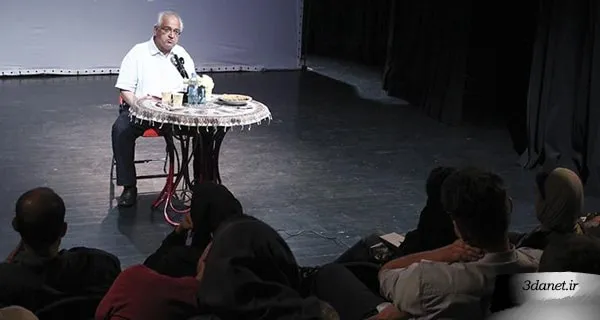
The Ferdowsi Hall of the Faculty of Literature and Humanities at the University of Tehran had not witnessed such a gathering of philosophy enthusiasts for many years. Students were seated not only on the chairs of the main hall and the upper balcony but also on the stairs, to hear Babak Ahmadi and Mostafa Malekian speak after a long time in the very place where Iran's first academic philosophy department was founded. Yet this very reception indicates that the heart of philosophy in Iran still beats outside academia, and that academic philosophy has not been able to become the trendsetter it should have been. As Babak Ahmadi said in response to the question of whether we have done philosophical work on our artistic works: As far as Iran is concerned, in our land of roses and nightingales, there was absolutely no philosophical thought until 100 years ago. Our greatest philosophical thinker three centuries ago was merely a theologian—that is, he worked in the field of scholastic theology and sought to make what religion says rationally believable. He was not a philosopher in the modern sense we expect of philosophy. Philosophy for us was alien, scattered, and without continuity or persistence. At times we have great philosophical figures, and then long periods of silence. For at least 300 years, we did not think at all, let alone think philosophically. As a result, expecting to categorize our own artistic and literary works from a philosophical perspective is unwarranted. In recent years, too, not much significant work has been done. We have been establishing philosophy departments in universities for 70 years, yet we do not have a proper philosophical encyclopedia or dictionary. We lack a good philosophical dictionary that a philosophy student could consult to grasp basic philosophical concepts such as experience and essence. What we do have is either translated, scattered, or Marxist. Consequently, we should not expect to have produced philosophical work on our literature and art. Let us remember that until 50 years ago, everything concerning our culture was done by others. Rumi was edited by Nicholson. We have only just begun to stumble forward, and we should not expect too much of ourselves. Philosophical thought requires a democratic political and social living space. What follows is the text of Ahmadi's speech. Given Mostafa Malekian's emphasis that he has promised the publication of his speech to another journal, on this page we will only briefly touch upon the key points he made.
My discussion has three parts: First, according to what definition of philosophy do philosophers permit themselves to comment on other specialized fields and, as often happens, make mistakes? Yet despite these mistakes, why is it accepted that philosophy has the right to intervene in other disciplines? In the second part of the discussion, I will address the nature of the philosophy of art, and based on the discussion in the first part, I will examine how those in philosophy comment on the fundamental issues of art and what distinguishes art from other fields. In the third part, I will turn to literature as an art that has an ancient affinity with philosophy, and it seems that it is through the intervention of this art that philosophy has gradually found the possibility to comment on other artistic fields as well.
It is not usually discussed why those in philosophy, with such authority, permit themselves to comment on almost all branches of human understanding and diverse disciplines, from the humanities to art or any other branch. As Lyotard said, philosophy appears to be an imperialistic, interventionist, and presumptuous discourse that seeks to explain the foundations of other disciplines. Naturally, it always faces opposition.
According to the Greek understanding, philosophia means the love of knowing, and there is supposedly a group of people—among whom we encounter names such as Plato, Aristotle, etc.—who possess a love of knowledge and are distinct from the rest of the world's people, whether they be in other fields of knowledge or ordinary individuals. According to Aristotle, however, philosophers are not distinct from other people. In the first line of the Metaphysics, he writes that all human beings by nature desire to know. He then emphasizes that the first sense through which humans attain knowledge is sight.
If all human beings by nature desire to know, why have those engaged in philosophy distinguished themselves from others and imagined that they alone possess this attachment? For they have added no attribute to this attachment. I think what philosophy has done in the modern centuries, especially since the time of Kant and Hegel onward—namely, the separation of philosophy from other fields of human knowledge and the emergence of so-called philosophies
But the philosophy of art, that is, philosophical thought about art or the discussion of the foundations of art, has a long history. At least in the realm of Greek thought, this is the case. It can be said that it was also the case in Mesopotamia, Egypt, China, and India. But as usual, the discussion begins with Greece, that is, with Plato, who had a philosophical view on art, and at times his view is, from our perspective, in no way justifiable, such as his opposition to poetry and art in the Republic. But this was not the only dialogue Plato wrote; in his other dialogues, he defined beauty or had brilliant discussions about types of arts such as poetry. After that, we have Aristotle's Poetics, which was discovered after centuries and remains one of the most important books in the field of literary theory. This closeness of philosophical discussion to the foundations of artistic work spanned the entire Middle Ages and was not exclusive to the Renaissance period. But from the Renaissance onward, this discussion was raised more precisely. In the modern era, with Kant, in his third critique, namely the Critique of Judgment, and then Hegel, serious philosophical discussion about art became widespread. This is almost simultaneous with the emergence of the term Aesthetics, which in Persian was mistakenly translated as 'zībā'ī-shenāsī' (the study of beauty). But the intention of its original coiner, Baumgarten, was a knowledge related to human sense, and through that to feeling, and through that, sometimes perhaps, to art. A part of Baumgarten's book is on this matter, where his meaning of sense is not instinctual senses, but rather he deals with human emotions and also gives artistic examples. In this way, with Baumgarten, the student of Leibniz's student, namely Wolff, we become acquainted with a discussion that had not taken place before him in Leibniz himself, Spinoza, or Descartes. That is, the discussion of how we can build solid scientific foundations for understanding human feeling, emotions, and passions, and most importantly, imagination. Kant, too, in the A edition, that is, the first edition of the Critique of Pure Reason, had discussed imagination. In the second edition, of course, he set imagination aside, because he most likely believed that he should address it in another book (perhaps the third critique).
In this way, we arrived at a discipline called aesthetics, about which there is still debate: is aesthetics the same as the philosophy of art? A great philosopher like Hegel believes it is not. In the introduction to his discussions on aesthetics, he says that the philosophy of art is broader. His understanding of the philosophy of art is the philosophical discussion of the roots of art and the main questions of art, such as the nature of beauty, the artwork, the historicity of an artwork, and so on. Hegel believed that aesthetics relates to two things: first, artistic technique and methods, and second, the history of art. He believed that through understanding styles, we can adopt a historical perspective for understanding art. Hegel made this important distinction, but did not discuss it much. If you refer to the introduction of the discussions on aesthetics, you will see that this separation is not presented with the explicitness I mentioned, but the emphasis is on distinguishing these two from each other. But in any case, as the nineteenth century began, philosophical discussion about art continued, and some of Hegel's followers and later philosophers in France and England discussed art. Such as the important book Benedetto Croce wrote on aesthetics. But on the other hand, artists also became philosophers. That is, with the emergence of German Romanticism, we witness artists like poets and painters putting forward philosophical views. Schlegel, Novalis, Hölderlin, and the artists of this era were primarily philosophers. One can easily read Novalis's fragments as philosophical works and precisely understand how much these works influenced twentieth-century German philosophy in particular.
Gradually, this story has continued into the twentieth century as a solidarity between people of art (mainly literature) and philosophy. At least in the continental branch, which I know better, this relationship is undeniable. Almost from Nietzsche onward, in the realm of continental philosophy, we do not have a major philosopher who has not discussed art in some form or even produced artistic work. Figures like Camus and Sartre, alongside being philosophers, are also artists and writers, playwrights, essayists, and journalists. Sometimes it is even impossible to separate these specializations from one another. We cannot read The Condemned of Altona or Dirty Hands (both works by Sartre) solely as plays; they are undoubtedly philosophical texts as well. The Plague and especially The Fall (both by Albert Camus) are also philosophical works.
This inseparability of philosophy and art brings me to the third part of the discussion. When we saw how philosophy intervenes in the work of art, and how artists, when they wished to discuss their own work, were compelled to found the philosophy of art or aesthetics, the third question arises: Where did this intervention come from? Which art was the principal one upon which philosophy set foot and entered the realm of art? That art was literature. Literature in its modern sense, that is, the meaning that emerged from the eighteenth century, meaning all branches that relate to writing—which are sometimes not even written, like a film that is not made based on a written screenplay and whose acts alone express forms of a narrative.
We return once again to the glorious world of the Greeks: we return and see that they too recognized and had discovered this solidarity between art and philosophy. In Plato's dialogue "Ion," the question of why there is a closeness between philosophy and poetry, and how far this solidarity extends, is discussed. When we read this treatise, we think with sorrow of the tenth book of the "Republic," which banishes poets from the ideal city. Plato's dialogues themselves are literary works and are very close to modern plays. For example, the famous dialogues "Symposium" or "Republic" are such, and are among the greatest literary works in the world. We witness this same solidarity in other great literary works as well. Truly, if you wanted to place Dante's "Divine Comedy" on library shelves, where would you put it? The religious section, philosophy, or literature or poetry? It must be placed in four sections, each of which would certainly be incomplete without it. Where does this solidarity come from? What substance has brought these two close to one another? Was it that, in the first step, great philosophers were literary figures, and in the next step, they thought about literature? Language is the crucial point in answering these questions. Philosophy did not exist without language. Without language, one cannot think, let alone think philosophically, express it, and bequeath it to posterity. This very language has been the origin of various theories. Among the arts, it is literature that is made with language. Poetry, the novel, the short story, and various literary genres are made with the raw material of language. It even seems that screenplays and plays remain impotent without attention to the literary aspect. Consequently, it seems that the discussion of philosophy's intervention in art must begin with literature.
.
.
Babak Ahmadi's Speech on World Philosophy Day
Etemad Newspaper, Issue No. 2830, dated 20/9/92, Page 11 (Thought)
.
.



Discussion4 comments
سلام. از شما به خاطر تلاشهای بسیار ارجمندتان در مسیر نشر دانش و اخلاق بسیار سپاسگزارم. به یاری شما می توانم از عمرم بهتر و بیشتر بهره ببرم و بسیاری از زمانهایی که جدای از حوزه کاری ام دارم را با مطالعه یا گوش کردن به صوت مطالب، سودمند کنم. برایتان ارزوی توفیق روز افزون دارم.
سلام اظهار نظر ایشان در مورد کارهای فلسفی در ایران بسیار ناقص است به حدی که مایه شرمساری است.ایشان ابن سینا، ابن رشد،سهروردی ، شهرزوری،بهمنیار ، خواجه طوسی، میرداماد، میرفندرسکی، اخوان الصفا به عنوان یک گروه فکری که هنوز هم ناشناخته اند، ملاصدرا، لاهیجی، ملاهادی سبزواری ، ملاعلی نوری، مدرس زنوزی، حکیم جلوه، فاضل تونی، محمد تقی آملی ، علامه قزوینی و علامه طباطبایی و بسیاری دیگران را اصلا به حساب نمی آورد شاید به دو دلیل یا با ایشان آشنا نیستند یا کینه ای نسبت به آثار گذشته دارند و الا از یک دانشجوی فلسفه هم بعید است هزار سال زحمات فکری فلسفی گذشتگان خود را به هیچ انگاشته و ملت خود را بی فکر معرفی نماید. هرکس تاریخ فکری کشورش را نادیده بگیرد دچار بحران هویتی و درونی از حیث روانشناختی می شود زیرا که او محل تعلقی برای زیست فکری خود ندارد.
منظور آقای احمدی به نظرم نادیده گرفتن این بزرگان نیست، البته روی سخن ایشان از زمان صفویه به بعد است. اما منظور این است که آن تعریفی که امروزه از فلسفه وجود دارد و آن اصالت اندیشیدن است و نه اندیشه... در دوران گذشته ما بی سابقه بوده است البته با شما موافقم که کسانی بوده اند که اندیشه ورز بوده اند و ارادتی به اندیشه خاصی نداشته اند اما ناشناخته یا کمتر شناخته مانده اند...
بابک احمدی عزیز ممنون که در یه سخنرانی عمومی یه دور تاریه فلسفه هنر رو مرور میکنی... کلی یاد گرفتیم...