Environment
Against Human Exceptionalism; an essay by Jeff Sebo
The priority of human over animal life is a common belief, typically justified by cognitive capacities or special relationships. Jeff Sebo argues that human exceptionalism is untenable, because the sheer scale of animal suffering shifts the priority in favor of nonhumans.

Jeff Sebo
AuthorAgainst Human Exceptionalism
Author: Jeff Sebo, Associate Professor of Environmental Studies and Affiliated Professor of Bioethics, Medical Ethics, Philosophy, and Law at New York University
Translation: Ali Bani-Asad
Source: Aeon Magazine
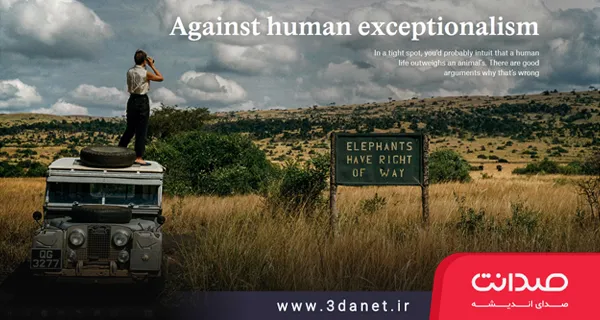
Photo by George Rodger. Source: Magnum. Elephants have right of way. Uganda, 1958
When in a bind, you probably consider a human life more valuable than an animal's life. There are good arguments for the wrongness of this way of thinking.
This past January, a 57-year-old man living in Baltimore received a heart transplant from a pig. The use of nonhuman animals as a source of organs for humans is called xenotransplantation[1]. Although using nonhuman animals for this purpose may seem a troubling idea, many humans think that if we can improve the technology more and more (the man died two months later), the sacrifices are worth it. As bioethicists like Arthur Caplan and Brendan Parent said last year:
Ethicists have also proposed relationship-based arguments for species hierarchy. For instance, in his essay In Defense of Animal Research (2001), Baruch Brody argues that we ought to give greater moral weight to human interests because we have special attachments and a sense of solidarity toward members of our own species. According to this view, we should "discount" the interests of nonhuman animals for the very same reason we "discount" the interests of future generations: we have duties within these groups that we do not have between them.
In response to these and other arguments of this kind, some ethicists maintain that we should reject the idea of species hierarchy entirely. For example, in the book Fellow Creatures[3] (2018), Christine Korsgaard argues that it makes no sense to ask whether a human or a sheep has a better life, because the nature of life for each animal species is different, and evaluating each species is only possible according to the standards of that species. That is, comparing a human and a sheep is truly like comparing apples and oranges.[4]
While I find this denial of species hierarchy worthy of consideration, I want to defend a different idea: even if we accept species hierarchy on capacity-based or relationship-based grounds, we still cannot conclude that our current stance of human exceptionalism is acceptable. Instead of merely insisting on our own priority, we need to think carefully about how much the moral weight of various animals differs. And when we do this, the result will surprise us.
In particular, if we take our arguments for human exceptionalism seriously, the outcome will not be that we should always prioritize ourselves, but merely that we should grant such priority only sometimes. And when we consider the scale of suffering and death among the world's nonhumans and the extent of our complicity in this suffering and death, we see that human exceptionalism turns the tables: on the contrary, we will likely have more and more capacity-based or relationship-based reasons to prioritize nonhuman animals.
To be clear, my argument is not against the strong form of human exceptionalism, the idea that humans are necessarily more important than nonhumans. If you imagine that any human interest, however trivial, takes precedence over any nonhuman interest, however serious and fundamental—for example, prioritizing scratching the itch of a single human over preventing the death of 100,000 elephants—then there are good arguments against your view, but my focus will not be on them.
Instead, my aim is to argue against the moderate form of human exceptionalism, which holds that humans are likely more important than nonhumans. If you are among the many people who think that because we have "higher" capacities and "stronger" relationships, we therefore have priority over other animals, you are guilty of wishful thinking.[5] Nonhumans are numerous, and our lives are far too intertwined with theirs for such a notion to be correct. This "moderate" view is not as ethical as you think.
Let us examine these kinds of arguments for human exceptionalism one by one, starting with the capacity-based arguments.
Yes, my capacity for agency (i.e., autonomy) is greater and higher than that of nonhuman animals. I can step back from my beliefs, desires, and actions, and ask whether I have reason to endorse them. As a result, I can use evidence and reason to determine and pursue long-term goals. In contrast, a worm can only do what seems natural to it moment by moment, without ever pausing to evaluate these choices.
Why does this difference matter? It is plausible that, in general, the range of interests of agents is broader than that of non-agents. Imprisoning me is bad because I need to be able to set and pursue my own goals in order to have a good life. In contrast, imprisoning a worm (provided it receives proper care) may not be bad, since all a worm needs for a good life is, presumably, air, moisture, darkness, warmth, food, and other worms.
I also have a higher capacity for welfare (which includes happiness, suffering, and other such states) relative to nonhuman animals. I can experience more happiness and suffering at any given moment because my brain is more complex than a worm's brain. Also, since my lifespan is longer than a worm's, I can experience more happiness and suffering over time, provided I live a relatively full life.
What is the significance of this? It is plausible that beings with a higher capacity for welfare generally have more to lose. Even if imprisoning a worm is bad, doing it to me is worse. Each day of imprisonment harms me more, and overall, I will also spend more days in confinement [since my lifespan is longer].
I think such capacity-based arguments are reasonable on their own terms. Prioritization requires considering how much each individual is at risk in a given situation, and our capacities play a role in determining how much at risk we are. But these arguments fail to ground even a moderate form of human exceptionalism. The overlap between the capacities of humans and nonhumans is striking, and prioritization also requires considering other factors.
First, it is not the case that our capacity for agency is always higher than that of other animals. Early in all our lives, we are devoid of rational reflection; some of us lose this capacity later on, and some of us never attain it.[6] Meanwhile, many nonhuman animals possess capacities for memory, emotion, self-awareness, social awareness, communication, instrumental reasoning, and more. Thus, human and nonhuman agency overlap considerably.
Even when we are certain that our capacity for agency is higher than that of other animals, the difference may be smaller than we think. Because we treat human agency as the benchmark for comparing all other forms of agency, our views on agency are anthropocentric. It is true that human agency is certainly remarkable, but nonhuman agency is as well. If we assess nonhuman agency on its own terms, we might find forms of autonomy that humans do not possess.
Similarly, it is not the case that our capacity for welfare is always higher than that of other animals. If our capacity for welfare is merely a function of brain complexity and lifespan, then the welfare capacity of some nonhuman animals will be higher than that of humans. For instance, the number of neurons in an African elephant is roughly three times that of humans, and their lifespan is comparable to ours. Therefore, according to such a comparative method, these animals have a higher capacity for welfare than we do.
Moreover, even when we are certain that our capacity for welfare is greater than that of other animals, this difference may still be smaller than we think. As far as we know, our capacity for welfare is probably not merely a function of brain complexity and lifespan. We are still at the beginning of studying animal minds. It might be that, say, twice as many neurons means twice the capacity for welfare, but the difference in welfare capacity could also be greater or smaller than that.
In short, capacity-based arguments fail to vindicate even moderate forms of human exceptionalism. If we think we have rich interests even when we lack the capacity for rational reflection (and of course we should), then we should think the same is true for nonhumans. Likewise, just as we exercise caution in cases of uncertainty about the degree to which humans experience pleasure or pain and assume that they do experience pleasure or pain (and again, of course we should), so too should we act toward nonhumans.
Other factors also bear on how we prioritize.
For instance, even if a human generally has more to lose compared to a sheep, in particular cases this may not be so. Suppose you can only do one of the following: save a human from a minor harm or save a sheep from a serious harm. In this case, you might need to act to save the sheep.
In the same vein, even if a single human has more to lose compared to a single nonhuman, what that human has to lose might not outweigh what a large number of nonhumans could lose. Suppose you can only do one of the following: save a human from a minor harm or save 1,000 sheep from minor harms. In this case too, you might need to act to save the sheep.
Finally, the meaning of morality, at least in practice, is about more than just harm and benefit. We never allow doctors to bring humans into existence for the purpose of harvesting their meat or organs, because the rights of the "donors" outweigh the rights of the recipients. Why should we not think the same is true for nonhumans?
All of this raises serious doubts about human exceptionalism. In exchange for minor benefits for humans, we routinely place nonhumans in dire straits and impose truly heavy burdens upon them. The "harm"[7] humans suffer from eating plants is nothing compared to the harm inflicted on animals in factory farms.
For every single human who benefits, we also routinely impose burdens on a great many nonhumans. We likely kill at least a billion farmed and wild animals annually for food, and that is without counting insects. This annual slaughter figure exceeds the total number of humans who have ever existed.
Furthermore, we routinely use nonhumans in ways we would never permit ourselves if humans were involved. The issue is not simply that we save ourselves instead of them (though we do that too); the issue is their global exploitation and destruction.
The conclusion is clear. Even if we think beings with a higher capacity for agency and welfare take priority over beings with a lower capacity for agency and welfare, we should generally doubt that such a difference justifies anything resembling our current behavior.
So what about relationship-based arguments for human exceptionalism? Those arguments that emphasize the relationships we have with humans and other animals?
Many people believe that, at least practically, we have a right and a duty to prioritize ourselves and our own communities. I should take care of myself before I take care of you, and I should take care of my own family before I take care of your family. If we can show such partiality within smaller groups like the family, then perhaps we can do the same within larger groups like the species.
In fact, some ethicists say this analogy holds not only for species but also for larger groups like generations. Their argument is that we can "discount" the interests of nonhuman animals and future generations, partly because we have closer relationships within these groups than outside them, and partly because complete impartiality toward all sentient beings, from now until eternity, is too demanding.
This kind of argument partly concerns our self-interest. If we allow morality to become too impartial, the relative weight of our own self-interest will be very slight. But our interests must have at least some relative weight; both because we have a right to take care of ourselves, and because taking care of ourselves is [usually] a prerequisite for taking care of others. So we must allow morality to be somewhat partial to make room for self-care.
This kind of argument also partly concerns our personal relationships. Within special relationships, we have special duties. I should take care of my own family before your family, because I have special attachments within my own family. The same could be true for larger groups like species and generations. So we must allow morality to be somewhat partial to make room for relational duties as well.
But even if we accept the truth of these claims—that the same holds for groups like species and generations—we should still reject our current position of human exceptionalism. The number of individuals across [all] species and generations is far greater than the number of individuals within a single species or generation. Our lives are also increasingly interconnected with diverse species and generations, in ways that have important implications for our personal interests and relationships.
Suppose, in general, I certainly have a duty to take care of my own family before your family. Does it follow that I am permitted to do whatever I want with your family? Certainly not. It would be wrong for me to deprive your family of food to feed my own family, especially when my family already has far more food than yours. It would also be wrong for me to kill your family so that I could feed my family human flesh instead of, say, rice and beans.
These points apply from species to species and from generation to generation as well. Humans are busy depriving nonhuman animals and future generations of resources, even though we already have far more resources than they do (in various ways). We also kill hundreds of billions of animals for food each year, which also poses threats to the environment and the health of future generations, all while having access to humane, healthy, and sustainable plant-based alternatives.
Moreover, many policies that benefit nonhuman animals and future generations also benefit us. As the World Health Organization's One Health framework reminds us, human, nonhuman, and environmental health are interconnected. We must dismantle industries such as deforestation, factory farming, and the wildlife trade, not only for nonhuman animals and future generations, but for our own sake as well: the waste, pollution, infectious diseases, and other threats arising from these activities are already harming us.
We should also not lose sight of the fact that we have relationship-based duties toward other species and generations. Many of us care about members of other species and generations: it is impossible for anyone to be more important to me than my dog Smoky, and many parents feel the same way about their children, grandchildren, and so on. When our actions harm nonhuman animals and future generations, we have a relationship-based duty to mitigate and remedy such harms, whether these individuals matter to us or not.
In short, relationship-based arguments fail to justify current forms of human exceptionalism and generational exceptionalism. Even if we have a right or duty to take care of ourselves and other present-day humans, we still need to treat nonhuman animals and future generations far better than this in order to achieve that goal. Especially when our activities harm them, we need to treat them much better for their own sake as well. Our relationship-based duties are far more extensive than previously thought.
When we weave together these capacities and relationships, we arrive at a surprising conclusion: not only should we prioritize ourselves less, but perhaps in some cases we should not prioritize ourselves at all. After all, even if we consider the interests of nonhuman animals and future generations to be negligible, their populations are so vast and numerous, and our actions still affect them so much, that the cumulative weight of their interests likely outweighs ours.
When we weave together biological and generational arguments, the conclusion awaiting us is even more surprising than the previous one: not only should we prioritize present-day nonhumans and future humans, but we should also do so especially for future nonhumans. For instance, when assessing the impacts of climate change, we must give significant moral weight to the effects it has on other species. Which populations will expand or decline, and what will happen to the welfare of these individual animals?
Granted, there is a limit to how much we can prioritize present and future nonhumans right now, because we currently lack the knowledge, power, and political will to help them on a large scale. So we may need to prioritize ourselves now so that we can prioritize them in the future.
So even if we accept this practical argument, we still need to prioritize nonhuman animals far more than we currently do. Even now, we are capable of harming animals far less and helping them far more. Often, it is in our own interest to make such changes. We should also not forget that the way history unfolds is bound to the path it takes. Whether we like it or not, our descendants will inherit the world we build. Therefore, if we want our successors' priorities to be more impartial, we must also take action to have impartial priorities ourselves.
The conclusion is that we need to fundamentally rethink our relationship with other animals. When we prioritize among species, we are responsible for seeking the best information and arguments, rather than reaching a conclusion in our own favor from the outset.
And when we lift our hand from the scale, a shift in the balance is not unexpected. Our treatment of nonhumans should have been far better than this long before now, and ultimately, we may even need to prioritize their interests and needs over our own. We must prepare ourselves for such a possibility right now.
.
.
Translator's Endnotes
[1] Xenotransplantation
[2] human exceptionalism
[3] Fellow Creatures
[4] Given Kant's importance, and the widespread reception of this philosopher's ideas in Iran, further clarification from Christine Korsgaard (one of Kant's renowned commentators) on why such an analogy is impossible seems necessary:
"I believe that nothing can matter unless it matters to someone (a being, whether human or animal). If this is correct, we must ask what exactly the claim of humanity's superior importance is supposed to mean. To whom are humans supposed to be more important? To the universe? In the eyes of God? To ourselves?... If everything that matters must matter to someone, to some being, then there is no place where we can stand and, from its height, coherently ask which beings or which kind of beings are absolutely more important. Things matter to beings; these beings themselves are not situated in an absolute order where they can be ranked by importance. Or in other words, there is almost no place where we can stand to make such a judgment... You might think I am saying that some things matter to me and some things matter to you, but nothing matters intrinsically or absolutely. But I actually have something else in mind; a view that all importance is tethered and dependent. Specifically, tethered and dependent on the being for whom the matter in question is important, and the tether cannot be severed from that being without its importance ceasing. Although this view that importance is tethered and dependent denies intrinsic and independent importance, it does not necessarily mean that nothing has absolute importance. For it is still entirely reasonable to say that there are things that matter to all of us—to all those for whom things can matter. Indeed, if you think about it, this is precisely what we want from the concept of absolute importance, and nothing more: that something matters to everyone for whom things can matter. There is no real difference between being absolute and being dependent on everyone. So there is logical space for these propositions:
The absolute importance of importance-for: It matters absolutely to all of us that all sentient beings obtain the good things that are important to them and avoid the bad things that it is important for them to avoid.
It can also be expressed in another way:
The absolute goodness of goodness-for: It is absolutely good (good for all of us) that every sentient being attains the things that are good for it and avoids the things that are bad for it."
[5] Wishful thinking is a type of logical fallacy in which an individual assumes what they wish to be true is actually true; the wishful thinking mindset says: I want A to be B, therefore A is B.
[6] In an essay titled “In Defense of Eating Meat,” Timothy Hsiao argues that membership in the moral community requires the “basic capacity for rational agency,” and thereby attempts to circumvent the criticism that “some humans, such as infants, the mentally disabled, and the elderly, lack agency yet are still considered to have moral status, and therefore agency cannot be the basis for granting moral status.” He writes, “Sentience is not sufficient for moral status. Thus, although animals suffer pain, which is a bad physical experience, their experience of it is not morally bad in itself. They are harmed by the experience of pain, but the kind of harm is not morally relevant… Since animals lack moral status, eating meat is not wrong, even if it is not necessary for nutrition.” In response to Hsiao, László Erdős argues that presupposing the mysterious existence of a “basic capacity for rational agency” is biologically meaningless and unprovable, and merely obscures reality. He writes: “…according to Hsiao, the foundation of rational agency is rooted in the species membership of each individual. He also says that all humans possess the ‘basic capacity for rational agency.’ The problem is that species membership (in this case, belonging to the species Homo sapiens) and the category of all humans (belonging to the genus Homo) are two different things. Did other human species (for example, Homo erectus), which are now extinct, also possess this mysterious ‘basic capacity’? Hsiao does not explore this issue, so we do not know whether this supposed ‘basic capacity’ is a characteristic of our species or of our genus. Although this question may seem trivial at first glance, its consequences are far-reaching. Theoretically, Hsiao has two possible answers. If he says that only members of the species Homo sapiens possess this ‘basic capacity,’ it would mean that if, hypothetically, we found a surviving population of Homo erectus, we could eat them (since they do not belong to the moral community). If Hsiao insists that all humans (i.e., all members of the genus Homo) possess the ‘basic capacity,’ this means he has linked this capacity to the genus. Then the question arises: how does he know? It is probably scientifically impossible to validate this capacity even in the recent species Homo sapiens, let alone an extinct species like Homo erectus. And a question even more important than the previous one: why should we consider the ‘basic capacity for rational agency’ to be linked to the genus and not to a family or any higher taxonomic category? The error above is linked to the fact that Hsiao did not realize that species (and other taxonomic categories) are mental constructs…” For other critiques of Hsiao’s device, see the essay “In Defense of a Vegan Diet,” and for a brief critical assessment of anthropocentrism, refer to the entry on “Speciesism.”
[7] The author deliberately placed the word harm in quotation marks to indicate his doubt about the existence of such harm. Scientific research indicates that eliminating animal products from the human diet can have significant positive effects on health and the environment. The Academy of Nutrition and Dietetics, the world’s largest nutrition association, stated in its official position on vegetarianism that “appropriately planned plant-based diets, including vegan diets, are healthful, nutritionally adequate, and may provide health benefits for the prevention and treatment of certain diseases. These diets are appropriate for all stages of the life cycle, including pregnancy, lactation, infancy, childhood, adolescence, older adulthood, and for athletes.” To learn about the environmental impacts of various dietary patterns, refer to the second chapter of the forthcoming book: Kolb, Sherry (2013). Twelve Questions for Ethical Vegetarians. Translated by: Mohammadrasoul Alizadeh Asli (1402). Kargadan Publishing.
.
.
Download the PDF of Jeff Sebo's essay, Against Human Exceptionalism
.
.



Discussion0 comments
No comments yet; let yours be the first voice.