Literature
An Iranian Hafez, or a Hafezian Iran?
Hafez is not a transmitter of Iranian culture but its serious critic; he is a critical mirror for our self-knowledge and cultural resurrection. A Hafezian Iran is one where the individuality and heterodoxy of its citizens are valued.
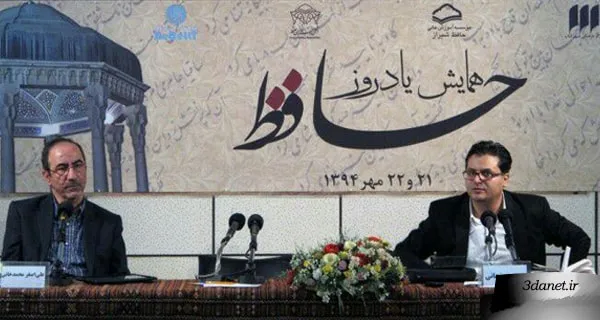
Which thought is more worthy of being a source of pride and honor for Iranians: “Hafez is Iranian” or “Iran is Hafezian”? It is good, first, to challenge and question the truth of “Hafez’s being Iranian”—a belief that is self-evident and certain to us—and then to weigh and examine its value in comparison with the value of the idea of “Iran’s being Hafezian.”
Is Hafez truly Iranian? If we consider being Iranian a “territorial and geographical” category, then of course Hafez is so, especially since, according to historical accounts, Hafez never resided in any city other than Shiraz and bade farewell to life there. But if we do not hold such a criterion and hypothesis, and our understanding of being Iranian is not merely a territorial and geographical category, then our answer to this question will no longer be so simple and straightforward.
For example, with a “value-based and cultural” interpretation of “Iranianness,” should we not say that “if we are Iranian, Hafez is not Iranian; and if Hafez is Iranian, then we will no longer be Iranian”? Is it not self-evident and certain to us that “our” attitudinal and value patterns are utterly different compared to the attitudinal and value system of “Hafez”? Is it not the case that Hafez no longer takes pride in a Shiraz that, despite its incomparable nature, has fallen into cultural decline and grown distant from its ideal state, and instead laments it?
From this perspective and with this criterion, one can say Hafez is not Iranian; he is a critic of Iranianness—a critic of the hypocrisy, duplicity, and mendacity latent and current in Iranian culture. For Hafez, Iran is a “prison,” just as Hamlet saw Denmark as his prison. Hafez explicitly says that from a city where “eloquence” and “melodious recitation” have packed their bags, one must pull up one’s own belongings and leave.
“Eloquence and melodious recitation are no longer practiced in Shiraz; Come, Hafez, so that we may cast ourselves into another realm.” “We have tested our fortune in this city; One must pull one’s belongings out of this whirlpool.” “There is no insight among these people—for God’s sake, a means So that I might bear my gem to another buyer.”
Some have called Hafez “our memory” and some “our articulator,” but it is better to say that Hafez is “our mirror.” Hafez is our intellectual and cultural reflection; and, of course, not merely a “passive reflection,” but a “critical reflection.”
Hafez is not for idle moods, fortune-telling, chatter, and discourse. Hafez is a necessity for “self-knowledge,” and without reflecting upon him and his reflections, we can never know the “self,” just as no “other” can know us without such reflection. The “self,” always, at its root, is a “tradition”; it is a cultural product and a historical phenomenon, and therefore, the problems and predicaments of this “self” can only be pathologized, traced to their roots, and treated with the aid of the thoughts of reflective and profound cultural critics within this tradition, such as Hafez; its pains diagnosed and analyzed, and perhaps remedies prescribed for their treatment.
Hafez’s critical attitude toward Iranian tradition and culture and the beliefs and values dominating it is profoundly deep and radical. Hafez openly unveils our flaws and has no fault-concealing gaze toward our life-negating and ruinous misperceptions. The irony is that one of the errors and misperceptions Hafez sees in our intellectual and cultural tradition is that, unlike his “Pir” (the ideal Hafezian human), we lack a fault-concealing gaze. Fault-finding is the great flaw of Iranians. For Hafez, fault-finding is proof of folly and evidence of artlessness. (Whoever falls into artlessness looks upon faults.) Thus, it is clear to what extent, in his view, individuals afflicted with this calamity who simultaneously claim that “art resides with them alone” are upon a vain opinion and a path of error! If, in Hafez’s view, the calamity of fault-finding were not a widespread affliction in his time, it would have been meaningless for him to take pride and boast of his own freedom from it, alongside his renown for love-making.
“I am the one renowned throughout the city for love-making; I am the one whose eye has not been tainted by seeing evil.”
Taking pride in love-making is also a source of honor for Hafez because, in his time, it is an exceedingly rare and scarce art. Hafez is renowned for love-making not in a city where love is abundant and plentiful, but in a city that, like Damascus, is in a famine of love. In his poetry, Hafez constantly, on the one hand, warns and cautions against self-conceit, and on the other hand, through encouragement and admonition, invites to love:
"Fall in love, or else one day the world's affair will end, unread, the design of purpose in the workshop of being" "O heart, you make no passage through the lane of love, you gather all the means, yet undertake no task"
Fault-finding, hypocrisy, dogmatism (pretentiousness), conceit, and comfort-seeking are among the most conspicuous cultural flaws that Hafez observed in the Iranians of his time. Flaws that, unfortunately, not only persist in full force to this day, but have also grown in intensity and severity.
It is for this reason that Hafez must be, for our society, beyond all forms of theoretical and practical diversions or literary and scholarly pastimes, a necessity for a historical self-awareness and a cultural resurrection.
Hafez's greatness is not due to his being a "transmitter" of Iranian culture; his greatness lies in his being a serious "critic" of this culture. Just as Hafez's greatness is not due to his being the inheritor of a general culture, his greatness lies in his creating his own cultural world from within his own blossomed individuality.
In general, it can be said that only if by the word "culture" we mean an "individual and critical culture" will this word be worthy of a positive concept and possess a valuable human meaning; otherwise, "collective and passive culture" is the herd culture—to use Nietzsche's term—which is, in fact, the very essence of barbarism. In other words, every human being has culture, but a person is only considered, in the strict sense of the word, a cultured individual when that culture is not an inherited and non-acquired trait. Culture is only valuable and esteemed when it is a hard-won product of a person's thought and individuation. It can be said that being the creation of a culture is the common fate of all human beings; a culture, of course, whose shadows and dark aspects may be more numerous than its bright aspects, whose destructive, erosive, and anti-individuality dimensions may outweigh its positive and flourishing dimensions. But being the creator of a culture, or having a culture of one's own, is an extraordinary contrivance and ability that is the art of geniuses like Hafez.
Of course, there is no doubt that one can disagree with some of Hafez's critiques and views, as with any critic and thinker. Essentially, one can and must view and assess some of the ideas of culture-shaping figures like Hafez as cultural pathologies, stemming from their individual and historical limitations. In other words, engaging with Hafez must also be with a critical approach and method, and his criticisms must also be evaluated and critiqued with perspicacity and enlightenment. Our culture has no shortage of idols and idol-houses, and therefore one must be careful not to make a new idol out of any iconoclast.
With these details, it can be said that a "Hafezian Iran" is an Iran in which, first and foremost, the individuation and heterodoxy of its citizens, regardless of any orientation or content, are valued. A "Hafezian Iran" is an Iran in which free-thinking, tolerance, respect for the other, and individuality are a pervasive cultural value. A "Hafezian Iran" is an Iran where the art of recitation and eloquence is so widespread and abundant that no one is forced to cast themselves into another realm because their thought and individuality are not tolerated.
In sum, the idea of an "Iranian Hafez" in the absence of a "Hafezian Iran" cannot be a source of any delight or pride for Iranians. For, firstly, this idea partakes of truth only by a climatic and geographical criterion, and secondly, sharing a homeland and a region, like sharing a language and a race, is not a virtue or a glorious human achievement, but belongs to the category of "given" and "non-acquired" matters arising from fortune and chance. The idea of an "Iranian Hafez" in the absence of a "Hafezian Iran" is a sign of "collective narcissism" that can transform into a destructive nationalist ideology, and therefore, is not a cause for cultural pride, but proof of cultural poverty. Schopenhauer rightly perceived that nationalism typically becomes a supreme and pride-inducing value for societies whose individuals lack individuality and the values derived from it. From this perspective, nationalism is the pride and honor of people without pride and honor.
Therefore, what matters is not whether Hafez is Iranian, but whether Iran is Hafezian; just as one might say what matters is not whether Khayyam is Iranian, but whether Iran is Khayyamian; what matters is not whether Rumi is Iranian, but whether Iran is Rumian. In hope of the day when the concern and pride of Iranians is not that Hafez is Iranian and possesses an Iranian nationality, but rather that Iran is Hafezian and Iranians possess a Hafezian culture.
Following Nietzsche's words on Heraclitus, one might say, "Iran will always need Hafez, for Iran will always need truth," just as, adapting Adorno's words on Hegel, one might say, "The question is not what Hafez has to say to us and our time, but rather what our time has to say to Hafez."
Footnote: Personality is far more important than nationality and deserves a thousand times more attention... The most vulgar kind of pride is national pride, for whoever takes pride in their nationality possesses no valuable quality within themselves to be proud of, otherwise they would not resort to something they share with thousands upon thousands of others. Conversely, one who possesses significant individual distinctions in their character sees the shortcomings and faults of their nation more clearly than others, because they constantly encounter them. But every base fool who has no pride whatsoever in the world resorts, as a last recourse, to the nation of which they are a part. Such a person is ready and happy to defend, tooth and nail, every fault and folly their nation has. (Arthur Schopenhauer, On the Wisdom of Life, translated by Mohammad Mobasheri)
.
.
An Iranian Hafez, or a Hafezian Iran?
(On the occasion of the 20th of Mehr, Hafez Commemoration Day)
Author: Masoud Zanjani
Author's Telegram Channel
.
.



Discussion0 comments
No comments yet; let yours be the first voice.