Philosophy
Book Introduction: The Roots of Romanticism by Isaiah Berlin
In The Roots of Romanticism, Isaiah Berlin calls Romanticism the greatest transformation of Western consciousness and a 'dictatorship of art' which, in opposition to the Enlightenment, advanced the plurality of values—a legacy that, like rationalism, cannot be abandoned.
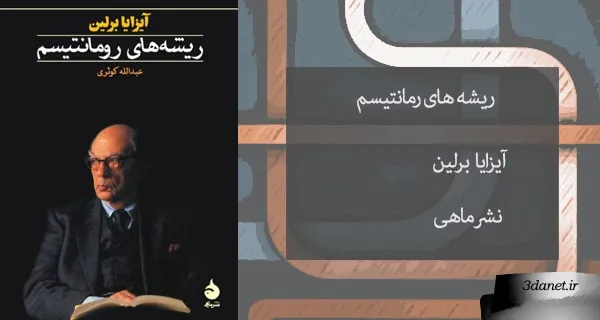
The book The Roots of Romanticism is, in fact, the edited version of several lectures by Isaiah Berlin on Romanticism, published in 2006 with a valuable translation by Abdollah Kowsari and an elegant edition by Nashr-e Māhī.
Isaiah Berlin, who calls the Romantic movement the greatest transformation that has ever occurred in the life and consciousness of Western man, traces the history of this intellectual and artistic movement from its earliest formative stages to the twentieth century in this book with precise and eloquent expression. He first examines the social and cultural developments of Europe, especially Germany, and then addresses the views and ideas of thinkers who were pioneers in this movement and influential in its evolution, and also explains the various tendencies within the movement. But Berlin is not merely a chronicler of the history of Romanticism; rather, he provides a clear picture of the influence of Romantic thought on all dimensions of Western life, from art and literature to philosophical and political tendencies, such as nationalism, fascism, and existentialism. And thus we become acquainted with the good and bad aspects of this great transformation from the perspective of a peerless judge like Isaiah Berlin. It is worth noting that Henry Hardy, a fellow of an Oxford college, has written a scholarly introduction as the editor of the book. In this foreword to the book we read:
"The Romantic movement is the first occasion in the history of the West where art dominates other aspects of life and exercises an undisputed sway over life, which is the essence of the Romantic movement." (1) "Enlightenment" and "Counter-Enlightenment"
A – Rationalism and the Enlightenment tradition:
In Isaiah Berlin's view, in a general overview, the entire tradition of Western rationalism, broadly speaking, and the Enlightenment tradition of late seventeenth- and early eighteenth-century Europe, specifically, rests on three fundamental propositions:
1 – All genuine questions can be answered
(All genuine questions can be answered, and if a question has no answer, it is not a question at all. We may not know the answer, but someone else will know it.)
2 – All these answers are knowable and teachable
(All these answers are knowable and teachable. All these answers can be discovered with the aid of tools and methods, and these methods are themselves teachable and can be taught to others.)
3 – All answers must be compatible with one another
(All answers must be compatible with one another; for if they are not compatible, the result will be chaos and confusion. The correct answer to one question cannot be incompatible with the correct answer to another question.)
The Enlightenment holds the belief that the fundamental questions of humanity cannot be answered with the aid of tradition and traditional methods. Through revelation and inspiration, we will not arrive at correct and compatible answers, because the inspirations of different individuals apparently contradict one another. Answers cannot be obtained by relying on doctrinal principles, nor by relying on the introspection of eminent men, for there have been charlatans who have usurped this position. There is only one way: rationalism.
(Rationalism is the correct use of reason, by the deductive method, as we see in mathematics, and by the inductive method, as in the natural sciences. Life or nature is like a puzzle made of pieces that the rational earthly creature can fit together.) B – Romanticism and the Counter-Enlightenment movement:
In Isaiah Berlin's view, the Romantic movement, as a movement in criticism of and protest against the European Enlightenment tradition (Counter-Enlightenment), taught us that a single answer to human problems may be a cause of ruin, and that if we believe there is only one solution to all human ills and that this solution must be imposed on people at any cost, then it is possible that we will turn into a despotic and oppressive tyrant, because our will to remove the obstacles in the way of realizing this solution will ultimately lead to the destruction of the very people for whose salvation that solution was offered.
There is no universal pattern, nor a comprehensive style... The idea that there exist diverse, incompatible values, and the whole concept of plurality, inexhaustibility, and the imperfection of all human answers and arrangements, is an achievement of Romanticism; likewise, the idea that a single answer claiming perfection and correctness, whether in art or in life, cannot be complete and correct. Indeed, all this we owe to the Romantics. (2)
1—Isaiah Berlin says the entire Romantic movement is an attempt to impose an aesthetic model upon reality, and to assert that everything must follow the rules of art. Indeed, we can say that Romanticism, in Berlin's view, in a word, is the "dictatorship of art." Such an interpretation has led Berlin, far from a passive reaction, whether in affirmation or denial of Romanticism, to adopt a "critical appropriation" of it. Now the question is whether this interpretation of Romanticism is fundamentally a praise of it that resembles blame, or a blame of it that resembles praise. In my opinion, this question is a very important one; it has no straightforward answer and requires much pause and reflection. Of course, it is clear to this extent that our answer depends, more than anything else, first on our interpretation of "art," and then on our interpretation of "dictatorship." If we say that art, in its nature and structure, is always non-ideological, averse to violence, and anti-dogmatic, then, in this interpretation, the dictatorship of art is not only not a cause for concern but promises peace and the freedom of tolerance; but if we say that art, in a historical and non-idealistic interpretation, will always have a degree of ideological tendencies, then, naturally and consequently, the dictatorship of art, like any other dictatorship, is catastrophic. But here another important question arises, and that is whether absolute dictatorship is fundamentally bad, or whether one can speak of a kind of good dictatorship. Is a dictatorship exercised by the good; or a dictatorship with good intentions, motives, and goals; or a dictatorship that has good results and consequences; or, most importantly, a dictatorship in which good things, such as freedom, justice, equality, security, etc., are imposed, still bad? In other words, can it not be said that the imposition of freedom is an instance of a good dictatorship? By the same analogy, one can ask about the dictatorship of art (the Romantics), or the dictatorship of reason (Plato), or the dictatorship of love (Augustine). Now it is entirely predictable that this other important question will arise: are categories such as freedom, reason, love, and art fundamentally imposable? In other words, can good things be imposed, or are only evils imposable? This question can also be asked thus: Does the imposition of goodness change its nature? And if so, can it not then be said that imposition is, indeed, the worst of evils?
2—It seems that neither the heritage of the "Enlightenment" tradition nor the heritage of its critical movement, the "Counter-Enlightenment," is dispensable or negligible. It is as if a reason beyond these two reasons, that is, rationalist reason and romanticist reason, calls us to scrutinize and reflect upon the limitations and achievements of both, and to a constant back-and-forth between them. Indeed, the condition for attaining any higher reason is a critical dialogue between rationalism and romanticism, and a historical dialectic between the Enlightenment and the Counter-Enlightenment.
.
.
Book Introduction: "The Roots of Romanticism" by "Isaiah Berlin"
Author: Masoud Zanjani
.
.




Discussion2 comments
تا جایی که متن به معرفی کتاب برلین می پرداخت، بسیار قابل استفاده بود. از جایی که به نظرات و تحلیل های آقای زنجانی پرداخت، هم جالب بود، اما کاش متن روی معرفی کتاب تمرکز می کرد و تحلیل ها در یادداشتی جداگانه می اومد.
البته مطلق دیکتاتوری، نامطلوب ست اما چارهای از حداقل قوانین اجتماعی نیست. درواقع محدوده های نظم و آزادی را اکثریت آرای آن جمع معین میکند. و هر کسی براخور عقاید و روحیاتش میتواند انتخاب کند که عضو چه گروهی گردد. بعبارتی حتی انتخاب دیکتاتوری هم بایستی آزادانه باشد. مثل تکلم به زبانهای مختلف و ....