Philosophy
Christian Meier in Conversation with Josef van Ess: The Origins of Islam
German Islamicist Josef van Ess views the emergence of Islam as distinct from the emergence of the Prophet Muhammad, regarding it as a historical construct. Christian Meier's conversation with him explores this perspective and its implications for contemporary Islamic theology.
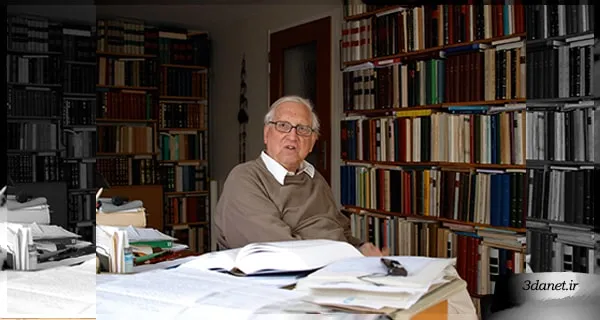
Yaser Mirdamadi — Several years ago, the publication of the Persian translation of the book Crisis and Consolidation in the Formative Period of Shi'ite Islam caused a stir in Iran. Modarressi Tabatabai, an Iranian scholar of Islam residing in America, had shown in this book that what is known as “Twelver Shi'ism” is a historically constructed phenomenon, meaning it took shape over time, in response to various disputes, actions and reactions, and from among the different possibilities that were historically available to people.
Josef van Ess (Josef van Ess), a leading specialist in the history of Islamic theology, says something similar about the origin of Islam itself. In his view, the emergence of Islam is historically distinct from the emergence of the Prophet Muhammad. What we know today as “Islam” is, in his view, a historically constructed phenomenon whose origins postdate the emergence of the Prophet Muhammad, and according to his opinion, Islam is entirely contingent in character; based on a counterfactual conditional, one could say that if the course of events had been arranged differently, Islam would also have taken a different form today (or perhaps would not have existed as a religion at all). His view on the origins of Islam, which rests on historical criticism, has significant consequences for contemporary Islamic theology. In the traditional view, the historicity of Islam is not recognized, and the role of natural factors in the Islamization of Islam is not taken into account.[1] The consequence of a perspective based on historical criticism of Islam can be formulated in the form of this question: Can a Muslim, from a theological standpoint, be committed to critical historical research on Islam?
The importance of this question can be demonstrated by recounting a historical incident: a German named Sven Kalisch converted from Protestantism to Islam (Zaydi Shi'ism) at the age of 15 because, in his view, Islam (and particularly Shi'ism) seemed more skeptical than Christianity and Judaism. He later became the first Muslim to obtain a chair in Islamic theology in Germany (specifically at the University of Münster). In 2008, he announced that, as a result of his historical studies, he had concluded that a historical figure named Muhammad most likely did not exist and that this figure is a fabrication, yet he still considered himself a Muslim because, in his view, what matters is the philosophy that took shape under the name of Muhammad, not his person. He expressed his view in an article titled “Islamic Theology without the Historical Muhammad: Remarks on the Challenges of the Historical-Critical Method for Islamic Thought.”[2] Although his view was not unprecedented among Western scholars of Islam, it provoked the anger of the Muslim community in Germany, and Kalisch faced the prospect of losing his academic position. Ultimately, in 2010, he announced that he no longer considered himself a Muslim and was transferred from the chair of Islam to another chair at the university.
This example is, of course, a radical one, because even among Western scholars of Islam, only a small number of individuals—regardless of whether their view is defensible or not—have doubted the historical existence of a person named Muhammad ibn Abdullah. But setting aside its radical nature, this example clearly illustrates one of the possible consequences of a historical perspective on Islam for Muslims. Kalisch, of course, did not remain a Muslim to develop an Islamic theology without Muhammad, but even those who believe in the historical existence of Muhammad may need to develop a similar theology; because, according to van Ess's view, Islam, in a decisive sense, underwent a post-Muhammadan development, as if it took shape in his historical absence as well.
In the Christian world, too, critical historical research led to the formation of theologies that sought to reconcile themselves with critical historical investigations into the origins of the Bible. For example, the German theologian and New Testament scholar Rudolf Bultmann (1884–1976) attempted, with the aid of historical research methods, to demythologize the language of the Gospel. In his view, this demythologizing frees the sacred text from the grip of the ancient worldview in which it grew and by which it is influenced, and allows the Word of God to appear meaningful to modern man.[3] In the Islamic world as well, a number of Muslim modernists, such as Mohammed Arkoun, Hassan Hanafi, and Nasr Hamid Abu Zayd, have sought to advance the historical criticism of Islam. Nevertheless, the cultivation of a theology that takes the historical criticism of Islam seriously and speaks of the possibility of its compatibility with being a Muslim remains a need that has not been adequately met.
Van Ess, born in 1934 in Aachen, Germany, is an Islamicist and professor emeritus at the University of Tübingen. Among his works, the six-volume “Theologie und Gesellschaft im 2. und 3. Jahrhundert Hidschra” (Theology and Society in the Second and Third Centuries of the Hijra) is of particular importance.
- Conversation with Josef van Ess
Was Islam a fully formed religion before Muhammad proclaimed the revelation? With what precision can we gain knowledge of earliest Islam, its early sects, and their religious tendencies? The German Islamicist, Josef van Ess, has spent his life seeking answers to these questions. The journalist Christian Meier, who himself belongs to the younger generation of Islamic studies scholars, spoke with him about this.
Christian Meier: When did Islam come into being?
Josef van Ess: It is impossible to answer this question. Let us begin this way: there are differing opinions regarding when the Quran came into existence. One thing, however, is certain: the Quran existed long before Islam did.
How should one understand this?
It takes several generations for a religion to find itself. I once used the term “options” to express this. Islam, as a revealed religion, just like Christianity, is built upon certain presuppositions: an image of God, on the one hand (and indeed the very existence of God, which is not self-evident), and a founder on the other. How the founder plays his role (in the form of a prophet or in the form of the Son of God) is ultimately irrelevant to the core of the matter. These are the preconditions for the formation of certain “options.” Every religion, at the outset, has multiple options before it, but the number of these options is not infinite. Conversely, the fact that the religion is revealed has already limited the available options from the start.
Nevertheless, decisions had to be made about these options, and this was something that took time. For instance, it took centuries for the decision to be made that the style of the Quran is a [inimitable] miracle. Today, people behave as if this belief was already decreed in the Quran—but that is not at all the case. With every decision that was made, the scope for subsequent decisions became narrower and narrower—until we arrive at modern fundamentalism, where everything seems immutable from the very beginning and there is almost no room for maneuver. Of course, even within the fundamentalist current, there are variations.
It is often said in the West that Islam needs a Reformation—it needs an “Islamic Luther” to prevent the religion from stagnating.
Oh, that is an old idea. It was already common among Muslims in the nineteenth century, and one hears it constantly today as well. Behind this idea lies a—somewhat vague—will to reform, because people are dissatisfied with the status quo. But that holds true for every period of history. That Luther’s name is invoked is naturally connected to the Protestant view of history, a view that was prevalent for a long time, not only in Germany.
Is it true that there has never been a religious reformation in Islam?
I consider the Qur’an itself to be a reformist text and see a reformist intention in it, to the extent that older religions are rejected in the Qur’an as misguided paths, and the fundamental aim of the book is to return to the roots, which is, of course, nothing more than an illusion. The Qur’an never returns to the roots; the entire story of Abraham is nothing more than a construct. But what lies behind this construct is, in all likelihood, the experience that Christianity had necessarily reached a dead end. For the Prophet’s contemporaries and the generation after him did not experience Christianity as a single religion, but saw a religion divided into three “churches” that were constantly at war and in conflict with one another.
Moreover, the central message of the Qur’an is very simple, namely its monotheism. This simple monotheism is an attempt to discard all superfluous accretions. One should not forget that the idea of a “covenant” with God also plays a role in the Qur’an, and just as Christianity understands itself as a “New Covenant” set against the Old Covenant of the Old Testament, the Qur’an fundamentally understands itself as a “Third Covenant.”
How did the earliest Muslims understand themselves? How did Islam become Islam?
van Ess: Fred Donner, a specialist in early Islam, begins his argument in his new book Muhammad and the Believers: At the Origins of Islam from the assumption that the formation of Islam as a religion was not the intention of Muhammad or the Qur’an. The matter was simply that a community formed with the goal of cultivating an ethical and pious way of life, and called itself the Believers (al-Mu’minun). According to Donner, “Believers” was the title that Muslims actually gave themselves.
The title “Muslim” came into use much later…
Yes, exactly. The term Muslimun is used in the Qur’an, but it refers only to specific people: the ancient, polytheistic worshippers of the Kaaba from the inhabitants of Mecca who had submitted to Islam or had themselves embraced it with open arms.[4] Meanwhile, Jews and Christians were also among the Believers in the earliest community. Later they were separated from this community; according to Donner, this separation occurred during the period of the Caliph Abd al-Malik. Thus, around the end of the first Islamic century, Islam became Islam. This is not the end of the discussion, of course, and I personally consider the becoming-Islam of Islam to be an event that occurred somewhat differently from Donner’s view… but that it took time for Islam to become Islam seems clear to me.
You said you have your own particular view on how Islam developed as a new religion.
When we speak of “Islam” as a unified identity, such a thing certainly does not apply to the Islam of our own day. The point here is that it does not apply to early Islam either. We always think of Islam this way: there was a group of people who gathered around some ideas, and a new religion began. But it was never like that. There were Believers, of course. But the wars of conquest scattered them to the four winds—Basra and Kufa in Iraq, Fustat in Egypt, and Homs in Syria. In these cities lived a few of the so-called Companions of the Prophet, who were later venerated, and around them a form of Islam was shaped. In my view, the Islam of Kufa was very different from the Islam of Homs or Fustat.
Why was it different? Were these regions completely unaware of one another?
van Ess: The connections between these centers were weak. People certainly traveled, and they undoubtedly possessed some kind of Qur’an (at least insofar as the Qur’an existed at that time) to which they adhered. But the decisive factor is interpretation, that is, the question of how an individual understands the text of the Qur’an. The question is whether the Qur’an held central importance for Islam at that time. In my view, no, it did not hold central importance. What united the community of believers was, rather, their manner of congregational prayer. The particular gymnastics they performed in this process—prostration (proskynesis)—was entirely unique. And any outside observer would notice it. At the same time, performing this act was a testimony to your submission to the one God. It certainly took time for these religious rituals to develop and evolve. But these rituals were something shared among the individual nuclei of this faith. The ruler of the age, or the commander, was, in a meaningful way, the imam of the congregational prayer—and congregational prayer was almost a military discipline. God knows what superstructures were later added to this act of worship—which we today count as part of Islam. Of course, it is possible—if someone makes the effort—to discover these superstructures, but that is much earlier than the time when we can say exactly what was happening in Kufa, for example.
Does this mean that each city cultivated its own Islam?
Yes. One should not even think that in cities like Kufa or Baghdad, a single Islam existed. Baghdad was too large for one Islam to grow and thrive there; at that time, a million people lived in this city. In my view, it is completely impossible that people in every mosque immediately grasped Islam. Regarding Kufa, for instance, we have reports of ecstatic Gnostics dating back to the earliest Islamic period. Ideas that were clearly and fundamentally Shi‘i blossomed in this city and produced the most bizarre fantasies. In some places, these ideas must have been propagated and attracted followers, otherwise they would not have been committed to writing. At least, this is how I have pictured the matter: in many mosques—if not necessarily every mosque—there was a different view of Islam, and of course, this was not the case in the congregational mosque. There, people went for Friday prayers, and the ruler told them what Islam was like.
Undoubtedly, this is a personal picture I have constructed for myself, but this visualization is a way of making sense of the formation of Islam. It is after such visualizations that one can, to some extent, refine the overall question of the emergence of Islam, because this question must be asked anew each time with regard to each new Islamic region.
You present an atomistic picture of Islam.
We could also put it this way: I am turning the established picture of Islam upside down: first there was multiplicity—unity formed later... Fundamentalists say exactly the opposite. [...]
What, apart from the gymnastics of worship, united all these local groups and varieties of Islam?
The Qur’an, of course, in the long term. Wherever you were, if you accepted the Qur’an as the basis of your life, you were a Muslim. It took some time for the Qur’an to be collected and for people to become aware of it. But from the time the Qur’an gained a public dimension as a reference point, from that time onward, Islam came into being. In all likelihood, such a process began from the time of Abd al-Malik ibn Marwan and the inscriptions in the Dome of the Rock, where verses from the Qur’an are carved—incidentally, the verses are not written there with exact precision. From this time on, people had something they could hold on to. Islamic jurisprudence also emerged later.
So if worship gave Muslims a social and ritual identity, the Qur’an gave them a spiritual identity?
Muslims did not regard the Quran as a “sacred text,” but rather saw it as a way or a “constitution” for life. Just as Americans believe in their Constitution, Muslims believe in the Quran, because in their view it shows them how to behave in specific situations, and how to live ethically and legally. In my opinion, this point was very important for the people, even though they never expressed it in this manner. The noteworthy point is that whenever resistance to Islam arose from atheists, it was not a resistance against Islamic jurisprudence. Our expectation is precisely the opposite: for if there is something in Islam that is repugnant to us, it is that if someone steals, their hand is cut off, and the like. But for those atheists, these things were never problematic. Whenever atheists or so-called skeptics appeared, they questioned the prophethood of Muhammad or cast doubt upon his character—very much like what Salman Rushdie depicted in The Satanic Verses.
I would like to draw this conclusion from the discussion: that the Quran was intensely venerated because it showed people a stable way to live. Essentially, this is the reason many people today change their religion and convert to Islam. The New Testament is very different in this respect. In the New Testament, you find metaphors and parables whose style is far more beautiful than the metaphors and parables of the Quran, but you must spend a long time interpreting them to grasp their precise meaning.
So you mean that Islam spread victoriously because it had objective laws at its disposal in the form of the Quran?
Often, the exclusive reason for the spread of Islam is considered to be the conquests. In my opinion, this is really not a sufficient reason. For Islam was in fact not a missionary movement—it has become so in our own time, and even now many Muslims have reservations about this. At that time, the Arabs living in Kufa or other places had no desire at all to bring the people of the conquered regions into their religious community; if they did, they might later become pious Muslims, but they would no longer have to pay the land tax—and it was also possible that if they became Muslims, they would spy on the Muslims. In the garrison towns, non-Muslims kept themselves completely separate from others so as not to endanger themselves. The conversion of followers of other religions to Islam was not something that was always warmly welcomed.
Leaving aside those who changed their religion and became Muslims, as well as the spies, the atheists were a different story. In your recent book “The One and the Other” (Der Eine und das Andere), you have dealt with Islamic sects and the fact that, in most cases, the primary source of our knowledge about these sects is the writings of their opponents.
van Ess: This book is, in the first instance, a history of a specific literary genre that we call “heresiography” (milal wa nihal). There are many texts of this kind in Islam in which what are called Islamic sects are listed. This literary genre was very enduring and persisted for over a thousand years, from the second to the nineteenth century AH. Nevertheless, there is a thesis behind my analysis: “sectarianism.” The basic idea of this analysis is that there has never been such a thing as religion. There have always only been individual communities. If this analysis is correct, it means that in the sense we intend, there were no atheists or infidels, but only different communities.
I am sure the books you have analyzed presented this subject in a different way...
It seems to me that these books have, above all, provided a catalogue of the sects existing within Islam. It is true that these books sometimes state that the teachings of this or that sect are incorrect, but this does not mean that the followers of that sect are infidels or heretics. The term "heresy" (kufr) is based on the assumption that an orthodoxy exists. This term works for Christianity because we have a Church, but it does not work for Islam. How would you define orthodoxy in Islam? There have always been those who have tried to determine the limits of orthodoxy, and there have always been orthodoxies (in the sense we use the word in Christianity), but they have always been local and short-lived. Whenever a ruler or theologian in a specific region deemed a particular interpretation of Islam binding, there were undoubtedly groups that were labeled deviant, and according to our Christian vocabulary, considered heretics. But there were very few groups that were universally reviled absolutely everywhere. The Ismailis, especially when they were active in the form of the Assassins, were one such group.
How were "deviant" groups dealt with?
van Ess: Even the Ismailis did not vanish from the pages of history; Ismailis still exist today. They were forced to flee to places where they could retreat and they survived. This point is even truer for the early groups that rebelled against the government (like the Iranian groups that gathered around the "Veiled Prophet" al-Muqanna' in the eighth century AD and were numerous). He and his community were persecuted, and al-Muqanna' committed suicide when he saw his movement was failing. But centuries later, followers of this man were found in the mountains of Turkestan, and when travelers who took a liking to them asked, "Are you Muslims or not?" they replied, "To be honest, we don't know. We pay the jizya." This payment of the jizya was the decisive factor. They no longer thought of rebellion; their numbers were no longer sufficient for such a thing. The situation only became complicated when these people appeared in the city and formed a community—because they were certainly strangers in the city. But as long as they lived somewhere outside the city, no one paid them any attention.
A similar story exists regarding the strange group of the Nusayris, who in Syria call themselves Alawites and are pure Gnostics who do not believe in the Quran. They still exist and even have a military presence. If we go back to the Middle Ages, had such a group existed among the Christians, the Christians would have sent them to the next world. Consider the Cathars[5]; they were ruthlessly persecuted and completely annihilated. Muslims acted differently, and that is why I am first interested in dissecting the word "heresy" and asking: What, in reality, is "orthodoxy"? And then I am interested in efforts that go beyond heresy and focus on the realm of praxis, that is, the manner in which individuals are treated.
That view seems a bit too coherent to be true.
van Ess: Of course, there were sometimes extremely brutal treatments. For instance, Sultan Mahmud of Ghazni beheaded many people—but he beheaded people who had politically risen up against him. But the rest of the time, people lived alongside one another in relative peace. In this sense, Islam has presented a more pluralistic image of itself compared to the Christian world—at least, this was the image until now, but now, due to the power of the media, this image is changing.
So the media does not promote plurality of opinion, but rather uniformity of content?
With the help of the media, it is much easier to present a definitive image of Islam and, backed by money, to enforce it. The antithesis of this trend occurred among the reformers of the late nineteenth century, among reformers like Muhammad Abduh, whom we remember with great respect. They too advocated a return to the Quran, and at the same time rejected mysticism—in the hope of uniting the Islamic Ummah. The irony of history is that this movement ultimately developed into modern fundamentalism.
In your view, does the plurality of different understandings of Islam today—such as the fundamentalist understanding or the progressive understanding—conflict with the idea of a single, unified, and authoritarian Islam?
When I say that Islam has fallen into stagnation, I am referring to developments that have taken place in regions like Saudi Arabia and have spread through modern capabilities. However, one must always add that what occurs under the label of so-called fundamentalism is a modern phenomenon. There are more elements of the modern age—the European modern age—in fundamentalism than we might think. The European modern age lies at the heart of Islamic terrorism because, as it happens, it was we Europeans who first employed terrorist tactics. Therefore, if we find traces of the modern views that fundamentalists represent in the Quran, we have certainly done them a favor, but we have gone astray historically. Fundamentally, I am not worried about the Islamic world. I am confident that even the fundamentalists will not be able to establish orthodoxy. In Islam, there is no orthodoxy.
.
.
Translator's Footnotes:
[1] For example, some scholars of Quranic studies have shown that the history of the Quran is a modern discipline, and no book titled "The History of the Quran" (much less with such content) was written among Muslims before the twentieth century. On this, see: Kariminia, Morteza; Before and After Theodor Nöldeke: Historiography of the Quran in the Islamic World, Sahifeh Mobin, No. 48, Fall and Winter 2010, pp. 7-42.
[2] The original German article can be found here and a summary of it in English here.
[3] Bultmann, Rudolf, Jesus Christ and Mythology, translated by Haleh Lajevardi, Arghanoun, 5 & 6, Spring and Summer 1997, pp. 128-9.
[4] Van Ess is probably referring to this Quranic verse: The Bedouins say, "We have believed." Say, "You have not [yet] believed; but say [instead], 'We have submitted' (Aslamna)." (Al-Hujurat, 14). However, the term "Muslimun" is not used in the above verse, and as it happens, in most cases where this term is used in the Quran—contrary to Van Ess's statement—it does not refer to specific people but to Christians, Jews, and Muslims in general (see, for example, Al Imran, 64).
[5] The Cathars were a Christian sect that formed in southern France in the eleventh century AD. Catharism spread in the 12th and 13th centuries and, due to its Gnostic and dualistic intellectual tendencies, was declared heretical by the Catholic Church and severely suppressed in the early decades of the 13th century. The suppression of this sect marked the beginning of the Inquisition in the Middle Ages.
.
.
Christian Meier in Conversation with Josef van Ess (German Islamicist) Titled The Origins of Islam
Translator: Yaser Mirdamadi
.
.


Discussion1 comments
آیا می توان علم را با تاریخ علم یکی دانست؟ آیا واقعیت های جهان از نظر دانشمندان پیروی میکنند ویا بالعکس، دانشمندان واقعیت ها را می شناسند و به دیگران آموزش می دهند؟ کدامیک از این دو درست است؟ همانطور که نمی توان واقعیت ها را انکار کرد ، به طریق اولی خالق و پدید آورنده پدیده ها با قانون های آنها ، انکار ناپذیر و تردید ناپذیر است . تاریخ دین داری مردم غیر از خود دین است. آیا می توان حقایق را با تاریخ آموزش آنها یکی دانست؟ آیا می توان حقایق را با رفتارها و ادعاهای مختلف مردم یکی دانست؟ اصول اعتقادی ، اخلاقی و رفتاری ، توسط بر گزیدگان خدا آموزش نظری و عملی داده می شوند.