Religion
Contemporary Exegetical Approaches and the Reading of the Holy Quran: A Panel with Shabestari, Beheshti, and Karimi-Nia
Beheshti considered hermeneutics an approach to human understanding, not a method, while Shabestari, from a phenomenological perspective, described the Quran as a narrative of God's acts and a product of revelation, not revelation itself; a report from the session on contemporary interpretive approaches.
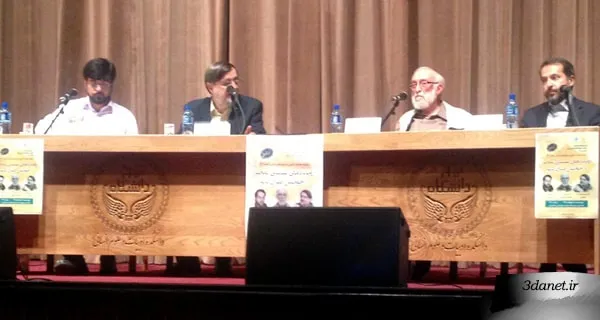
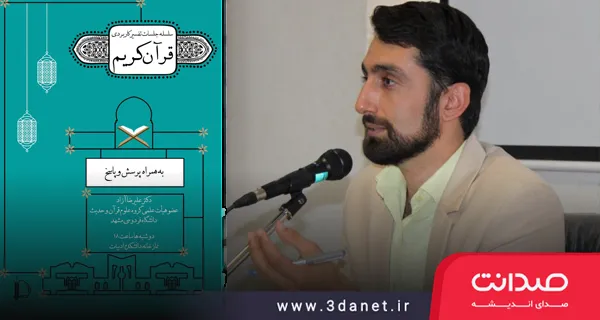
The Center for Culture and Thought of the Tehran University Jihad Organization held the third session of its series on familiarization with contemporary Islamic currents. The session, titled “Contemporary Exegetical Approaches and the Reading of the Holy Quran,” was held with Seyyed Mohammad Reza Beheshti, Mohammad Mojtahed Shabestari, and Morteza Karimi-Nia in attendance. Today’s session (May 26) began at 4:30 PM in the Bastani-Parizi Hall of the Faculty of Literature and Humanities at the University of Tehran.
.
Beheshti, Assistant Professor in the Department of Philosophy at the University of Tehran and Director of the Philosophy Department at the Academy of Arts, was the first speaker at the session and said: Many discussions have taken place on the subject of a hermeneutic approach to the Quran, in some of which the individual is not sufficiently familiar with the issues of hermeneutics. For this reason, we sometimes hear some say that the very discussion of hermeneutics regarding the Quran is vague and that a hermeneutic discussion cannot be undertaken about the Quran. Some time ago, on a television program, one of those presenters who comments on every subject was vehemently saying that hermeneutics is a Western discussion and does not fit within the Quran.
He added: An important point that I think needs to be mentioned is that when we speak of hermeneutics, especially philosophical hermeneutics, we are talking about understanding in a general sense. Such understanding is not specific to understanding the Quran and encompasses a wide range of subjects. Another point that is necessary to mention is that the Bible (the Old Testament and the New Testament) is a book clearly and obviously written by an author; in other words, the role of human creators is evident in it, whereas the Quran is divine revelation, and its words and expressions come from God. Of course, from the perspective of the followers of Judaism and Christianity, while it is accepted that humans wrote the books, the books are also sacred, meaning they believe that the Holy Spirit oversaw them.
The Assistant Professor of Philosophy at the University of Tehran continued: One of the incorrect perceptions about the hermeneutic approach is the notion that hermeneutics makes understanding subjective; in other words, it is presented as though hermeneutics is subject to the whim of the understander, whereas this is not the case. It is true that understanding takes shape with the understander, but this does not mean it is shaped solely by him; that is, the text is not merely subordinate. In other words, the text is not silent and lies in between. Gadamer, in his book Truth and Method, also emphasized that the eventful and occurrent nature of understanding is an important matter that is often neglected.
Beheshti continued: The problem that arises here is that a series of questions are raised, such as: By involving the role of the understander in understanding, do we not fall into relativism? With such a way of thinking, do we not fall into sophistry and skepticism? In such a case, does truth have meaning? My answer to such questions is that if we speak of relativity, it must be made clear what we are talking about; that is, we must define relativity precisely, clearly, and distinctly. Furthermore, in all these issues, the discussion is about human understanding, regardless of where the origin of the speech was.
Gadamer states somewhere: In hermeneutics, the discussion is not about God or gods; the discussion is about human understanding. Therefore, those who claim they can understand this subject from an absolute position should explain how they arrived at this subject.
He concluded by saying: An important point about hermeneutics is that hermeneutics is not a method; it is an approach. A method is not a tool we can hand to just anyone, but the hermeneutic approach is such that it does not accept the monopoly of method. Some seek a method in hermeneutic approaches, but a method does not emerge from it, because in such a case, we would be seeking something that hermeneutics cannot tolerate.

Following this, Mojtahed Shabestari, a researcher in Quranic sciences and a specialist in comparative theology, gave a speech. He said: My words in this session are not my religious belief about the Quran, but rather a kind of phenomenological view of the Quranic text with my hermeneutic background. I began this discussion in 2007 and published it in a series of articles titled “A Prophetic Reading of the World.”
He said: It is presented in such a way that what is in the text of the Quran was read word for word from God to the Prophet, and the Prophet transmitted and recounted what he heard; because some people could not come to terms with this matter and accept this mode of transmission, I turned to the phenomenological approach. The Prophet's claim was that although the Mushaf is his own speech, it has a divine origin and He is characterized by the attribute of speech, meaning he was sent by God and received a kind of unseen aid, something referred to as revelation. Now, in this context, anyone might claim that specific words are being recited to me; in that case, no intersubjective understanding would emerge. For this reason, the Quran's claim is that the Quran is the product of revelation, not revelation itself.
This theology professor continued: The truth is that something which everyone cannot understand cannot be understood in any other way either. A text that gives us knowledge is a text that can be shared with others, both believers and non-believers. The hermeneutical truth of the Quran differs from the truth of a proposition's correspondence with reality. The text of the Mushaf shows that the Quranic text formed dialogues and debates between the Prophet, believers, and non-believers. Note that my reference to the Quran is a kind of historical reference, not my personal religious or doctrinal opinion. The study of the Holy Quran as a religious text shows that the Quran is an interpretive religious understanding of all natural and historical events. In fact, it shows an understanding based on which all natural events, history, and human destiny are acts of God and are understood as events that are God's actions. Now, this text plays the role of creating religious meaning for the world and informs us of how the speaker of the text sees the world, not how it is. For this reason, the verses of the Quran are the speech act of the Prophet, not the speech act of God reporting something. A human who sees beings as manifestations of God, their understanding is identical to interpretation; in this position, understanding, manifestation, and interpretation have a single relationship.
The retired theology professor from the University of Tehran added: The Quran expresses the acts of God, not what God is or what attributes He has. In other words, the Quran discusses: What has God done? What does God do? What will God do? God has a continuous presence in the world and is constantly creating and destroying in the world. This continuous creation is both a manifestation of His power and the paradoxical characteristic of God, as we have in the verses: He is the First and the Last, the Manifest and the Hidden.
Mujtahid Shabestari, continuing by raising the discussion of narrative and story in the Holy Quran, said: In my opinion, the Quran is the story, narrative, and account of a hero, a hero who is ceaselessly engaged in activity. In my opinion, the outward form of the Quran is narrative because a narrative text is a text where there are neither natural causalities nor logical connections between its sentences, and it can also be cut off anywhere. For this reason, the narrator always keeps the listener waiting. Moreover, in a narrative, something is said that you did not know before. For this reason, the Quran can be considered a narrative.
He added: The primary and dominant language of this text is metaphorical language, though not the metaphor we all know and is common; metaphor in the sense that the text creates a new language. Metaphorical language gives form to the formless and makes the incomprehensible comprehensible. On this basis, words are no longer metaphorical; rather, sentences become metaphorical.
This Quranic sciences researcher concluded: After all this, you might ask me what my own belief is. My answer is: The emergence of Muhammad (PBUH) in history is the speech of God in the human world.
The final speaker of the event was Karimi-Nia, a faculty member of the Faculty of Theology and Philosophy at the Islamic Azad University, who focused more on the subject of exegetical approaches in the contemporary era—the main topic of the panel—and elaborated on the differences between exegetical approaches of the old and new eras. He stated: Exegesis in the contemporary period has undergone many changes compared to exegesis in past periods. The nature of the text of the Holy Quran in Islam has been such that various and numerous efforts to understand and interpret it have been undertaken from the very beginning, and these efforts have been so prolific that it is as if all the endeavors of Islamic civilization have been aimed at understanding this text. The difference in exegetical approaches in the contemporary era, that is, from a hundred years ago until now, has been such that it is as if we have become different human beings, distinct from the people of the 3rd and 4th centuries. The reason for this is that modern Muslims came into contact and connection with the new world, and this contact created a conflict between past and new beliefs.
He added: Another change that has occurred in the field of exegesis is that previously, only individuals who were educated in this field would enter the domain of exegesis, but in the contemporary era, any person from any stratum can enter this field and express an opinion. In other words, the monopoly of exegetes has been broken, and exegetical ideas can find their way into any domain. These changes between the new and old eras have been both in terms of content and in terms of method.
.
.
Download the audio of the lecture by Shabestari, Beheshti, and Karimi-Nia
Session title: (Contemporary Exegetical Approaches and the Reading of the Holy Quran)
Speakers: Dr. Mohammad Mojtahed Shabestari, Dr. Mohammad Reza Beheshti, Dr. Morteza Karimi-Nia
.
.
Wednesday, May 25, 2016 | 4:30 PM
Faculty of Literature and Humanities, University of Tehran
.
.

Discussion0 comments
No comments yet; let yours be the first voice.