Political Science
Do Sanctions Destroy Iran’s Economy?
Do sanctions destroy Iran’s economy, or are the country’s economic problems rooted primarily in domestic mismanagement and corruption? At a discussion and review of the book The Chokepoint, Rahman Ghahremanpour and Saeed Laylaz examine the impact of sanctions on development, democracy, class divisions, and the lives of ordinary Iranians from two contrasting perspectives. They also explore the relationship between foreign policy, domestic decision-making, and the future of Iran’s economy.
Rahman Ghahremanpour
یک طرف مناظره
Saeed Laylaz
یک طرف مناظرهA report on the book-review session on «The Chokepoint», with talks by Rahman Ghahremanpour and Saeed Laylaz
Monday, 13 Mehr 1405[1]
Introduction
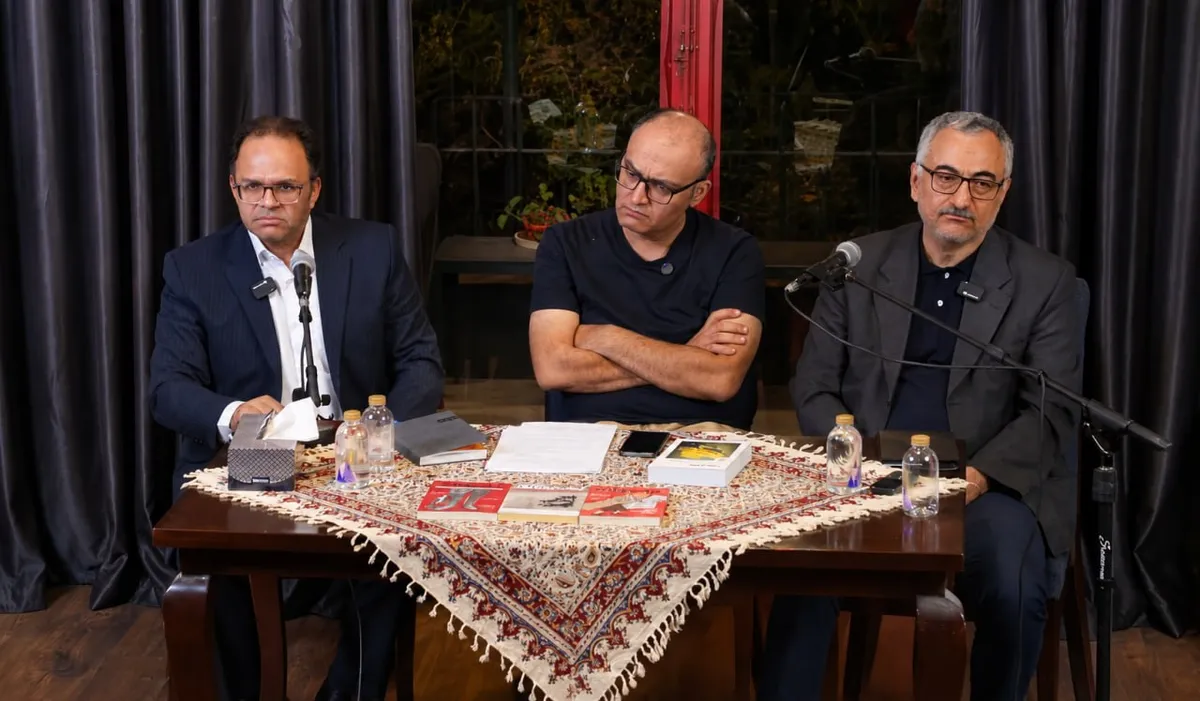
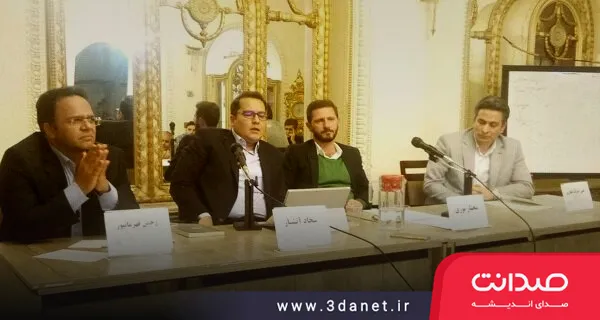
On Monday, 13 Mehr 1405, we gathered at the "Dar-ein-hal Space" in the Dey Bookstore to discuss «Chokepoints: Why the World Keeps Its Eyes on the Strait of Hormuz» by Edward Fishman, translated by Mohsen Ebrahimi. The session belonged to the series of events held by the magazine «Ketab-e Ruzaruz» on books through which we can reflect a little more on the present moment and our situation today.
First, Matin Ghaffarian, the magazine's managing editor, gave an account of the book. Then Rahman Ghahremanpour, a researcher and translator in international affairs, looked at the question of sanctions from several perspectives. He spoke about the effect of smart sanctions on the lives and livelihoods of Iranians and about the economic and human dimensions of sanctions, and asked what we could have done to avoid being sanctioned. In response, Saeed Laylaz, an analyst of political and economic affairs, argued that the issue is an "independent Iran" and that who rules in Iran or in America makes no difference to the heart of the matter. He said one of the major dangers of a narrative that attributes everything to sanctions is that domestic mismanagement and corruption are hidden behind them, and once the sanctions are lifted the same problems remain in place.
In the final part, in a collective conversation, attendees raised questions about the disagreements that had been voiced, our approach to the question of sanctions and its consequences, and also about the war and the problems facing the country in the current situation.
An Account of the Book
Ghaffarian said the book, titled in English «Chokepoints: American Power in the Age of Economic Warfare», was published in February 2025[2] and, in his view, has appeared in Persian at an opportune moment: after the "Twelve-Day War" and the "Forty-Day War," and in weeks when Iran has also faced a naval and air blockade. Its importance, in his view, is that the author was himself one of those who carried out these policies[3] and offers a first-hand account of events, a whole chapter of which concerns Iran.
The central idea of the book is that a country's power in the twenty-first century is not necessarily measured by the size of its army or the number of its warships. The global economy is an interconnected network, and every link in it, if within reach of American foreign policy and the American financial system, can become a "chokepoint": a place that can be seized and from which money, goods or services can be barred from passing. The book begins with one of the oldest chokepoints in history: a passage between Europe and Asia that Sparta, in the Peloponnesian War, seized in order to cut the Black Sea grain route and bring Athens to its knees.[4]
Fishman follows this story into the modern age in three parts.
The first part concerns Iran. According to Ghaffarian, after the revolution and the seizure of its embassy, America imposed sanctions on Iran that for some time merely barred Iran from trading with the American economy. With the emergence of the nuclear issue around the year 2000, America, which after Afghanistan and Iraq did not want to enter the Middle East again, turned to new tools. The dollar was the most important link in the network: every transaction conducted in dollars is connected to the American banking system. From there, secondary sanctions took shape layer by layer, so that anyone who did business with Iran would be cut off from this network.
In the part on Russia, after the annexation of Crimea and especially the war in Ukraine, the same mechanism was repeated in a more complex form. Because Russia is a larger rival and an energy holder, and because global energy security must not be endangered, Russian oil was not sanctioned; instead a "price cap" was set, and pressure was concentrated on networks including tanker insurance.[5] In the part on China, the main issue is technological competition and America's effort to limit China's access to the supply chain of advanced chips.
Ghaffarian summarized the book's final thesis this way: this strategy may turn against itself. If actors are repeatedly excluded from the network overseen by America, they will build parallel and alternative networks with the resources they have, and this could call American hegemony into question. He added that the published critiques of the book, including in «Foreign Policy», have likewise stressed this fragility of the sanctions tool. In his view, the book is useful for the ordinary reader, journalists and Iranian policymakers because it shows that what is happening to Iran is not an exception and that a more general mechanism lies behind it; and that the news we constantly hear about "trusties," shell companies, shipping with transponders off, and the struggle over the Strait of Hormuz are all Iran's efforts to break a network in which it is besieged.
Rahman Ghahremanpour's Talk
Ghahremanpour said that part of the book reminded him of the years when, during Hassan Rouhani's presidency, they worked on the structure of sanctions at the Strategic Research Center of the Expediency Discernment Council. According to him, Fishman writes in the book that when Bayidinejad and Araghchi entered the negotiations, the Americans were astonished at their knowledge of the structure of sanctions. He himself had written reports in those years on how sanctions were imposed and expanded, and, he said, the principal designer of the sanctions was Stuart Levey.[6]
The Gradual Expansion of the Sanctions Edifice
According to him, the edifice of sanctions has grown steadily since 2006: first individuals, then companies, and then banks. Bank Saderat was the first bank sanctioned, on charges of transferring money for Lebanon's Hezbollah, followed by Bank Melli and Bank Mellat, and finally the Central Bank. Along this path, the Treasury Department's Office of Foreign Assets Control, which until then had been a small unit, took on a serious role[7] and, in parallel, the financial fight against terrorism and the Financial Action Task Force also came to the fore.[8]
On the legal basis of these tools, Ghahremanpour said that in America there had been a serious debate over whether the country's domestic rulings and laws could have extraterritorial effects. According to him, even the international-law lawyers whom Iran had hired to free its assets in America argued that American domestic law cannot extend to the international level.[9]
He listed several angles of approach for his discussion.
1. International Politics: Imposing Will
From the standpoint of international politics, the great powers' main problem has always been how to impose their will on others. This imposition was at first through military force and then, with the Bretton Woods system, came to rely on economic tools. After America's defeat in Iraq, optimism about the sanctions tool grew. Donald Trump applied "maximum pressure" in his first term, but, in Ghahremanpour's view, his advisers in the second term have concluded that economic tools alone do not work, and for this reason they have turned to "coercive diplomacy," that is, the simultaneous combination of military and economic coercion.[10] In his view this itself shows that Iran has not bowed to economic pressure.
2. International Political Economy: Smart Sanctions and Artificial Intelligence
According to him, the globalization of the economy, the hegemony of the dollar and the smartening of the financial system enabled America to use the sanctions tool. His simple example is American Treasury bonds, which are printed and sold worldwide, whereas the printed money of other countries remains confined to their own borders. In the past, sanctions meant sanctioning a state in its entirety, as with Iraq and oil-for-food; today we face "smart sanctions," which remove this or that company or bank from the financial network.[11] Artificial intelligence has increased the speed and precision of this work: an analyst no longer needs to follow the money trail, and algorithms identify up to three layers of companies and entities that have in some way helped Iran. He said that even when names had been changed and no direct trace of transactions was visible, identification took place, and a complex network in Dubai working for Iran was uncovered a few months ago. As he put it, one British analyst had written that the pressure applied to Iran in the past month equals the accumulated pressure of the years before it.
3. International Law
International law takes no positive view of sanctions, because sanctions restrict people's fundamental rights, including access to food and medicine. Although after protests humanitarian sanctions were made an exception (the entry of corn, or pilgrimage and medical travel), international-law specialists remain the principal critics, because in the long run sanctions weaken society and impoverish the poorer strata further. Ghahremanpour pointed to the Iraqi experience in the late 1990s, when images of children's deaths and malnutrition were being published by Saddam. He added that in his new term Trump did not turn to the Security Council at all, and, quoting Stuart Levey, whenever the Security Council endorsed what they said they were happy, and whenever it did not they went to other mechanisms.
4. The Return of Geopolitics and the Danger of Determinism
In his view, the wave of "geographical determinism" in Iran is exaggerated. Such a view means that anyone in this geography is doomed to remain isolated and under sanctions and pressure, and in the same way it eliminates the place of "agency." What could we have done to avoid being sanctioned? This view opens the way for a politician to say: I tried, and it didn't work. He linked it to the narrative of "victim identity" and "exceptional identity," which is repeated even in textbooks and, in his view, spreads a kind of evasion of responsibility. The same narratives of exceptionalism can be found in other countries such as Japan, Germany and Egypt, and they fade with greater contact with the world.
5. Political Sociology: Oligarchy, the Middle Class and Democracy
One of the most important consequences of sanctions is class displacement. In Cuba, Iraq, Venezuela and Russia itself, foreign sanctions have produced an oligarchic, monopolistic class whose craft is circumventing sanctions, linking up with the apex of power, benefiting from windfall money and expanding patronage. Iran has experienced the same. Another effect is the weakening or destruction of the middle class, a class that, from the standpoint of political philosophy, is the anchor of social stability and democracy. In his view, in most sanctioned countries, even when governments such as Saddam's in Iraq or Bashar al-Assad's in Syria collapsed, the weakened middle classes lacked the capacity to steer a transition to democracy.
6. Development
According to him, besides democracy, sanctions also weaken the prospect of economic development: through the spread of corruption and bureaucratic inefficiency. In Iran there are those who say development is possible without the lifting of sanctions, but he has seen no literature showing how one can develop under sanctions. Weaker countries have less aptitude for democracy, and if a transition does occur, their democracy will be fragile.
7. The Human Dimension
The human dimension receives less attention. Millions of people need sensitive medicines, have special illnesses or disabilities, or are elderly people who want to see their children and grandchildren. Iran, like India and some other countries, has many emigrants, and families whose children are abroad need to travel and transfer money; sanctions sever this connection. He gave the example of the visa problem for elderly Iranians, which is not approved on the pretext of "sanctions risk."
In conclusion, Ghahremanpour said he does not claim that everything will be fine if sanctions are lifted. According to him, sanctions have built an edifice that will not disappear so easily.
Saeed Laylaz's Talk
Laylaz said that neither he nor the book has anything new to say, but that he finds the book worth reading for two reasons. One is that it goes into the details of events, details that matter for Iran because factional quarrels at home have produced false narratives of a single reality. The other is that its final thesis, in his view, is the ineffectiveness of these very policies.
His greatest worry about the discussion of sanctions is that sanctions, like inflation in the economic newspapers, become a concept to which everything is attributed. He stressed that he agrees with all the negative effects of sanctions, "and more," but warned that this narrative misleads us and leads to wrong decisions.
Sanctions Alone Do Not Bring About Change
Laylaz said that since Napoleon's time we do not see a single case in history where sanctions alone succeeded. From Cuba, an island of eleven million people about a hundred and fifty kilometers from America, to Iraq, sanctions did not bring the job to completion. He recounted that in Iraq the import of pencils was banned on the pretext of "dual use." Even so, Saddam was toppled only by military force, and a force backed by the entire Western world. For this reason, he said, the military attack on Iran also came from here: despite the West's entire focus on incompetence, mismanagement and internal plunder in Iran, sanctions did not finish the job. In the digital age the race also continues: he can set up a new company in place of "Mahan" and America will identify it again, and the computer still has no human intelligence.
Geopolitics Is Old and Still Works
According to him, the importance of the Strait of Hormuz has been known at least since the Safavid era and nobody invented it; among other things, he attributed the transfer of the capital from Qazvin to Isfahan to Persian Gulf considerations. The geopolitical debate is not new and is not the same as the sanctions debate. America's enmity toward Iran has geopolitical roots, not nuclear ones: he offered this as an answer to the illusion that the policies of America's two parties toward Iran are fundamentally different. According to his account, Stuart Levey had recounted that when Obama became president, he kept only two people from the previous team: the defense secretary and Levey himself, the specialist on sanctioning Iran, and the sanctions project advanced as far as it could under the Obama administration.
He also rejected the idea that war would not have occurred had Iran diluted its 60 percent enrichment sooner: Iran had earlier agreed in the JCPOA to a cap of 3.67 percent[12] and had even written the agreement, yet in the Twelve-Day War all of it was destroyed and America still did not leave Iran alone. "The quarrel is over an independent Iran"; and America's problem with Iran does not depend on who rules in Iran or in America. He regarded America as in hegemonic decline and pointed to its behavior toward its allies; but he believes the war in Ukraine has opened a window for Iran, and that in relation to China, too, Iran's status must be made clear to America. Laylaz said the White House's positions are now explicit: "Either surrender or bombing." He also recounted an account according to which one of the Islamic Republic's senior officials had told him, a month before the attack, that the Americans had asked for control of Iran's oil to be handed to them so that all issues could be resolved.[13]
Sanctions and Other Consequences: Democracy and the Class Gap
In reply to Ghahremanpour's claim about the effect of sanctions on democracy, Laylaz said that sanctioned dictatorships may be one-twentieth of all non-democratic countries; the number of such countries exceeds 150 and has nothing to do with sanctions. He defined democracy as the "balance of social forces among social classes" and said it is this balance that limits dictatorship, not sanctions. Under the Shah, too, when Iran was neither democratic nor suffering from sanctions, the class gap was unprecedented: according to him, the ratio of the income of the first decile to the tenth rose from one to twelve in 1351 to one to thirty-eight.[14] With an abundance of oil resources, the ruler has no listening ear, and this is the "abundance effect," not the effect of any particular government. An example, he said, was the wave of corruption from 1394 to 1396, the worst wave of corruption since the revolution, and that at the time of the greatest abundance of resources. He said corruption in Iran has nothing to do with sanctions at all and that he does not consider sanctions the "determining factor" of Iran's economy; relying on them is giving the wrong address.
Trade, Growth and Resilience
Laylaz stated that the greatest effect of sanctions on the economy, and the most immediate, is on foreign trade, and that statistics show the volume of Iran's foreign trade in 1403 exceeded that of the highest year of the JCPOA period. According to him, Iran's economy made up for the blow of sanctions, maximum pressure and COVID by the end of 1400, and gross domestic product returned to its highest level in its history, in 1396; and average growth in 1400 to 1403 was higher than Saudi Arabia's. He attributed the current negative growth to the stagnation of war and predicted that a great leap would occur once the shadow of war is lifted. He attributed high inflation and inefficiency to domestic factors and compared Iran's inflation with Russia's.[15][16] In his view the war in Ukraine and global problems have affected Germany's growth too, and Iran is not the only country in trouble.
He also said that America was never Iran's first trading partner, except when it was concluding arms contracts; because of distance and the nature of goods, even before the revolution Iran's first partner was Europe, and today it is China. Therefore those who think that by establishing economic relations with America that country will leave Iran alone have not paid attention to the history of relations. He pointed to the example of Conoco: in 1374, when Iran was one of the largest oil exporters to America, a law was passed in Congress as soon as the text of the contract with that company was ready.[17] Laylaz said that whenever a green light for talks was given from the highest level of the state, and the presidents of the time, from Rouhani to Raisi and Pezeshkian, were told to talk with America, they received no positive answer. According to him, the Boeings whose purchase contract was concluded were not delivered either.
Resistance Has Been Imposed on Iran
Laylaz said he rejects the dichotomy of "negotiation or capitulation" from the ground up and that he himself has never opposed negotiation; he also tells the state never to halt negotiation, but whoever thinks all the eggs are in the basket of negotiation is mistaken. According to him, the reformists say we should pay America a bribe so as to return to an oil economy, and the principlists say we should struggle against America so that they can continue plundering; whoever raises this dichotomy in fact does not want to address domestic relations. He stressed that the era of oil in Iran's economy has ended and that, with or without sanctions, we must turn inward: to corruption, to inefficiency and to society.
He added that resistance does not take only a military form: Iran must not lose its public relations in the world and must show its victimhood and rightfulness. He attributed Iran's sensitivity about missiles to its deprivation of an air force; Iran without missiles is like someone going to a bayonet fight with a fruit knife.
Describing the current situation, he said that what has befallen Iran today is a "military siege," not merely an economic one, and is America's last chance to bring Iran to its knees. There are only two paths ahead, "destruction and surrender" or "resistance," and these are proposed by America, not Iran. Even so, he said he thinks Iran has not yet reached the "singularity point," that is, the place from which there is no return; although he does not know whether that day will be a week from now or more.
Discussion and Controversy
The Weight of Sanctions Among the Factors
In reply, Ghahremanpour said he has never said sanctions are everything. The methodological principle is that the weight of each factor be determined, and each discipline has its own phenomenology; a sociologist cannot see everything from the standpoint of sociology, just as Foucault is criticized for precisely this reason, that he made everything subordinate to power. In his view even Trump himself has said sanctions remain an effective tool. He accepted that the research literature says sanctions can rarely force a country to change its will; but the point is what effect sanctions have. Some effects are "irreversible," such as a young person's deprivation of study in nuclear fields, which can no longer be made up after a few years.[18] The connection between sanctions and corruption, according to him, has been established in all sanctioned countries. He stressed that this does not mean denying domestic or bureaucratic corruption and that the two cannot be substituted for one another.
He said some friends see everything as political and some see everything as economic or geographic; and he stressed that he, too, does not say geopolitics is unimportant or that everything should be referred to it. His point is that what has happened in Iran should not be attributed entirely to "the position in which we have been placed."
Foreign Policy, Domestic Policy and Bureaucracy
A question was put to the audience: what exactly could Iran have done in the realm of foreign policy to avoid ending up here? Ghahremanpour replied that foreign policy is not separate from domestic policy, and each has effects on the other. He said that from the standpoint of democracy there are two kinds of equality: vertical equality, in which, in specialized fields, the expert's opinion takes precedence, and horizontal equality, in which everyone has the right to speak on matters touching the collective destiny. According to him, the first flaw lay at the level of the political elites who made decisions and who lacked precise, scholarly knowledge of American and global politics and were influenced by nativism and the literature of the 1360s. The second flaw is in the bureaucracy, which should be professional and independent so as to tell decision-makers the truth, but such a bureaucracy has no voice in Iran and, to protect its position, says whatever the "higher-ups" like to hear. He cited reports that years ago warned that entering Chapter VII of the United Nations Charter would make exit difficult, and that were met with the reply "Don't be afraid of the bogeyman of sanctions." In his view, another example was the assessments, made before the snapback mechanism was triggered, which said the Europeans would take fright at the last moment and not activate it.
Resistance or Surrender?
In another question, Laylaz was asked to clarify whether, in his analysis, the only options are surrender or resistance. Ghahremanpour continued the discussion with a principle from the science of international politics: the "scarcity of power" is the first thing this discipline teaches one, and a middle regional power whose military budget is a few billion dollars cannot bear the cost of every resistance against a power whose budget is 120 billion. He stressed that he does not mean accepting or approving of America, but that "prudence" must find the least costly path to the destination. In his view, the criterion for policymaking is the collective good that emerges from the ballot box and democratic public deliberation, not personal judgment. He asked from whose pocket we are paying the cost of resistance: from the pocket of a schoolchild who has not attended school for a year, a university student who has seen no classes for two years, or a patient who has no medicine. According to him, Iran is becoming the largest country sending its elites abroad. Ghahremanpour added that he sees the point of equilibrium in Iran in democracy: through recognizing and tolerating differences and through dialogue in the public sphere; and this point is not fixed.
In reply, Laylaz said that in 1392 Iran reached precisely this conclusion, that one cannot keep quarreling with America forever, and Hassan Rouhani and Mohammad Javad Zarif took on the mission of the JCPOA, but the JCPOA was not implemented from the very first second. His question to the other side was: if the other party does not accept, what are we to do? He said this experience has been tried not once but several times, and that the right policy is never to cut off negotiation but also not to pin all hopes on negotiation.
An Agreement with America and Domestic Balance
One of the attendees asked how an agreement between Iran and America could take shape, given that Israel is also a spoiler, and how one can find an optimal point at home among supporters, opponents, moderates and even those seeking to overthrow the system. Ghahremanpour said an agreement with Trump is very difficult, but Trump can control both Israel and his Arab allies; as was seen in the Gaza crisis, when Trump commits himself he certainly delivers, though Israel will certainly be a spoiler. He said the problem of 48 years of mistrust cannot be solved with a quick agreement and that one must proceed in small steps; and, in his view, the most important variable in the failure of the JCPOA was that in both countries the opponents of normalization were stronger than its supporters, and that stakeholders with media, money and resources have formed around "Iranophobia" and "Americaphobia." In Laylaz's view, in the 1380s an actor like Israel played no role in this matter, and the further we go, the harder the task becomes.
Resilience and the Rights of Future Generations
One of the attendees asked where our threshold of tolerance lies, that is, if electricity were available only two hours a day or hospitals had no power, would we still have to resist, and how far do we have the right to give up the rights of future generations. Laylaz answered that Iran has shown remarkable resilience in this war: according to him, despite the bombing of many sites, this summer's blackouts were fewer than last year's. He warned against underestimating Iran's resilience and added that the war has not trapped only Iran; Germany's economic growth since the start of the war in Ukraine has been almost zero. According to him, the Americans had been looking since the beginning of the revolution for an event that occurred in Esfand, and forty-seven years of the Islamic Republic's successful foreign policy prevented it.
In reply on the rights of future generations, Ghahremanpour said: just as we have no right to yield on certain things, we also have no right to impose poverty on the coming generation. According to him, politics means collective life, and the shared problem must be discovered in the public sphere, rather than someone continuing along a path on the basis of his own personal understanding.
Conclusion
The session had points of agreement and points of disagreement. Both speakers accepted that sanctions have negative effects and that Iran needs to reconsider its domestic relations. The disagreement was over the weight of sanctions among the factors: Ghahremanpour stressed the effects of sanctions on democracy, development and people's lives and wanted Iran to take its own agency seriously; Laylaz stressed the historical ineffectiveness of sanctions, the geopolitical root of America's enmity and the role of domestic factors in corruption and the class gap. Both, by two different routes, stressed the role of domestic relations: Ghahremanpour on democracy and public deliberation to determine the shared problem, and Laylaz on turning inward to address corruption and inefficiency.
[1]Link to the video of the session: https://www.youtube.com/watch?v=wk2lokMT2lo
[2]Edward Fishman, Chokepoints: American Power in the Age of Economic Warfare (New York: Portfolio, 2025). Persian translation: «Chokepoints: Why the World Keeps Its Eyes on the Strait of Hormuz», translated by Mohsen Ebrahimi, Tarh-e No Publishing, 1405.
[3]Edward Fishman is a senior research scholar at Columbia University and a former official of the U.S. State Department and Treasury Department, and has played a part in designing the country's sanctions policies, including the sanctions on Russia after the annexation of Crimea and the strategy of economic pressure alongside the Iran nuclear negotiations.
[4]In historical accounts, Sparta's blockade and the cutting of the Black Sea grain route to Athens at the end of the Peloponnesian War (around 405 BCE) is usually attributed to the Dardanelles (the Hellespont). At the session this passage was referred to as the Bosphorus Strait, and the event took place more than two thousand years ago.
[5]The price cap on Russian oil was imposed in December 2022 and made Western insurance and shipping services conditional on sales below the set cap.
[6]Stuart Levey served from 2004 to 2011 as the U.S. Treasury Under Secretary for Terrorism and Financial Intelligence and is regarded as one of the principal designers of financial pressure on Iran.
[7]The Office of Foreign Assets Control (OFAC) is a unit within the U.S. Treasury Department that compiles and enforces sanctions lists.
[8]The Financial Action Task Force (FATF) is an intergovernmental body that sets standards for combating money laundering and the financing of terrorism. According to Ghahremanpour, Iran has acceded to some of the relevant conventions, while accession to others remains a matter of dispute.
[9]To explain this point, Ghahremanpour referred to the Maduro case and the U.S. Department of Justice's indictment on drug trafficking, and asked whether the American government is obliged to enforce such rulings outside its own territory.
[10]"Coercive diplomacy" refers to the simultaneous combination of military threat or pressure with economic and diplomatic tools in order to compel the other side to change its behavior.
[11]The "oil-for-food" program (1995 to 2003) allowed Iraq to sell oil to meet humanitarian needs. "Smart sanctions," by contrast, rather than sanctioning a country's entire economy, target specific individuals, companies and banks.
[12]The JCPOA set the cap on uranium enrichment at 3.67 percent.
[13]This account rests on the speaker's personal hearsay, and no independent document for it was presented at the session.
[14]The ratio of the income of the first decile to the tenth in 1351 and afterward is given, as quoted from Laylaz and approximately, and no source for it was introduced at the session.
[15]The economic figures in this section, including the volume of foreign trade in 1403, the return of gross domestic product to its 1396 level by the end of 1400, and the average growth of 1400 to 1403, are given as quoted from Laylaz's remarks, and no specific source for them was presented at the session. Before being cited, they should be checked against data from the Central Bank and the Statistical Center.
[16]The comparison of Iran's economic growth with Saudi Arabia's and the UAE's, and of the inflation rates of Russia and Iran, is given as quoted from Laylaz and approximately, and no source for them was introduced at the session.
[17]In 1995 the company Conoco concluded a contract to develop Iranian oil fields, which was halted by an executive order of the Clinton administration. The following year, the Iran and Libya Sanctions Act (ILSA) was passed on the initiative of Senator Alfonse D'Amato, subjecting investment above a certain amount in Iran's energy sector to sanctions.
[18]Ghahremanpour referred to Security Council Resolution 1929 (2010), which calls on states to prevent the specialized training of Iranian nationals in disciplines that would contribute to sensitive nuclear activities.

Discussion0 comments
No comments yet; let yours be the first voice.