Philosophy
Hegel and the Problem of Skepticism: Lectures by Mostafa Zali
In his lecture series, Mostafa Zali reads Hegel's philosophy as a response to Kantian skepticism and a return to the absolute. Examining both metaphysical and non-metaphysical interpretations, he elucidates Hegel's relationship to Kant and the possibility of knowing the unconditioned within the tradition of German Idealism.

Mustafa Zali
InstructorThe subject of the “Hegel and the Problem of Skepticism Lectures” is a rereading and presentation of a comprehensive picture of the entirety of the German Idealism tradition, centered on Hegel’s philosophy. It is said that the central concept of Hegel’s philosophy, which is evident throughout his works, is the Absolute. Yet, despite the specific Kantian background of Hegel’s philosophy and the formation of its problems within the context of the German Idealism tradition, many have interpreted the concept of the Absolute based on a theological signification. Thus, the central question arises: how, after Kant’s critiques of metaphysics and the transcendental dialectic in the First Critique, which leads to the impossibility of making the unconditioned an object of metaphysics, has a return to the Absolute become possible, especially with a kind of theological or, more generally, metaphysical signification? For this reason, to precisely explain the signification of the Absolute in Hegel’s philosophy, it is necessary to clarify his relationship with Kant’s philosophy. Since the entire tradition of German Idealism can be considered a response to the problem of skepticism (the unknowability of the thing-in-itself and the denial of the possibility of knowing the unconditioned), this course endeavors to consider the whole project of Hegel’s theoretical philosophy as a response to skepticism as well. Therefore, to demonstrate the continuity of Hegel’s philosophical system and the German Idealism tradition, this course will proceed based on answering a philosophical question: What is Hegel’s understanding of the problem of skepticism, and what answer does he have for this question?
Hegel himself explicitly states that the unknowability of the thing-in-itself in Kant entails the denial of the possibility of knowledge and, consequently, skepticism. However, there is serious disagreement about Hegel’s response to Kant’s critical project and the manner of his revision of Kant’s project: first, a metaphysical understanding which holds that Hegel speaks of the Absolute as an unconditioned foundation for the totality of human and natural determinations. Second, a non-metaphysical interpretation which sees Hegel’s problem as the negation of the unknowability of the thing-in-itself, without positing the unconditioned. In this account, what is meant by the Absolute is the absoluteness of transcendental self-consciousness and the sufficiency of concepts for the formulation of the objects of experience.
Non-metaphysical interpretations, at first glance, do not have a clear relationship with the problem of Kantian skepticism and even seem to neglect the fundamental problem (the relationship between Kant and Hegel), emphasizing instead the relationship between Spinoza and Hegel. Nevertheless, one can still speak of Hegel’s metaphysical project under the rubric of the problem of Kantian skepticism; on this basis, Hegel’s problem in negating skepticism is not the negation of the unknowable thing-in-itself and the actuality of things not remaining outside the concepts of consciousness, but the proof of the totality of explicability through a renewed return to the unconditioned ground.
To evaluate Hegel’s reading of Kant’s philosophy and the proposal of the possibility of knowledge, first, Hegel’s specific understanding of Kant’s critical project is reread based on the Introduction to the Phenomenology, and the distinction between the transcendental approach and Hegel’s dialectical approach is articulated. Based on this reading, it becomes clear how, for Hegel, the critical project entails presupposing a kind of subjectivism condemned to skepticism, and the dialectical approach is a response to this predicament. Hence, and in order to achieve a comprehensive understanding of the entirety of Hegel’s project, selected passages from the Phenomenology are examined.
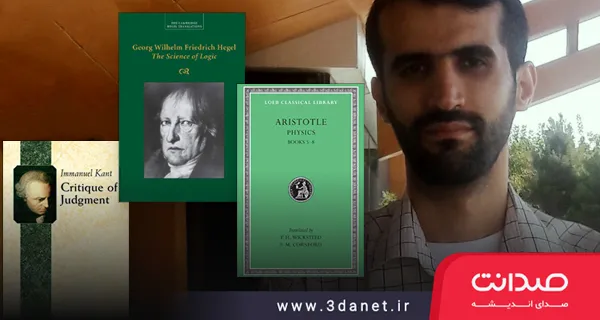
In the continuation of the discussion, Kant’s understanding of the nature of the unconditioned and its connection to teleology is discussed based on selected passages from the Transcendental Dialectic section of the Critique of Pure Reason and the Critique of the Power of Judgment. Finally, Hegel’s response to the issues in question and the determination of the Absolute in his thought is reconstructed based on the third part of the Science of Logic.
.
.
Course Sources:
Primary
1_ Kant, Critique of Pure Reason
Critique of Pure Reason, trans. by Paul Guyer and Allen W. Wood, Cambridge: Cambridge University Press, 1998.
Critique of Pure Reason, trans. by Mir Shamseddin Adib-Soltani, 3rd edition, Tehran: Amir Kabir Publications, 1380.
2_ Kant, Critique of the Power of Judgment
Critique of the Power of Judgment, trans. by Paul Guyer and Eric Matthews, Cambridge: Cambridge University Press, 2000.
Critique of the Power of Judgment, trans. by Abdolkarim Rashidian, Tehran: Ney Publishing, 1377 [1998].
3_ Hegel. Phenomenology
The Phenomenology of Spirit, trans. and ed. by Terry Pinkard, Cambridge: Cambridge University Press, 2018.
4_ Hegel, Encyclopedia of the Philosophical Sciences
Encyclopedia of the Philosophical Sciences in Basic Outline. Part 1: Logic, trans. and ed. by Klaus Brinkmann and Daniel O. Dahlstrom, Cambridge: Cambridge University Press, 2010.
Encyclopedia of the Philosophical Sciences (Part One: The Science of Logic), trans. by Hassan Mortazavi, Tehran: Lahita, 1392 [2013].
This book is considered an abridged version of the Science of Logic; consulting the Science of Logic is useful for resolving ambiguities in this book and for a detailed examination of its discussions, but it is not considered a course requirement.
Secondary
1_ Marcus Willaschek, Kant on the Sources of Metaphysics: The Dialectic of Pure Reason, Cambridge: Cambridge University Press, 2018.
2_ James Kreines, Reason in the World: Hegel's Metaphysics and Its Philosophical Appeal, Oxford: Oxford University Press, 2015.
.
.
Summary of Session One
Download Audio | Listen to Audio
14 Bahman 98 [February 3, 2020]
Hegel considers idealism to be the impossibility of explaining the empirical without recourse to a non-empirical principle. The finite, sensible thing depends on the infinite for its explanation, whether this principle is called water, Form, form, or the transcendental unity of self-consciousness. What Hegel terms skepticism, and whose overcoming he makes his project, is Kantian skepticism, which holds that concepts cannot be applied to the mind-independent thing (the thing-in-itself), and on this basis, neither does the transcendental unity of self-consciousness become the unconditioned ground of the object, nor is its truth knowable. In interpreting Hegel's conception of the absolute, two prominent interpretive currents exist: 1- The so-called non-metaphysical interpretation: according to this interpretation, Hegel, like Kant, still considers speaking of the unconditioned to be impossible, yet unlike Kant, he considers empirical reality to be entirely conceptual, resolving the problem of the phenomenon/thing-in-itself duality in Kant by considering all cognition to be conceptual; 2- The metaphysical interpretation: Hegel, in unity with pre-Kantian metaphysics, still speaks of the unconditioned in the realm of theoretical philosophy.
The problem with the first interpretation is that it cannot explain Hegel's explicit references to the absolute, and the problem with the second interpretation is that it cannot properly explain the link between Hegel and Kant. In this course, we seek a kind of metaphysical reading of Hegel according to which the Kantian problem of the possibility of knowledge and the explanation of experience is tied to the unconditioned.
.
.
Summary of Session Two
Download Audio | Listen to Audio
15 Bahman 98 [February 4, 2020]
The central concept of Hegel's philosophy is the "Absolute," which can be interpreted in two ways: metaphysically and non-metaphysically (or Kantian). The metaphysical interpretation means that a priori knowledge of the structure of the world is possible, and the rational structure of the world is explained by reference to the unconditioned. The non-metaphysical interpretation places Hegel entirely in line with Kant; like Kant, Hegel considers metaphysics to be the a priori knowledge of reason by itself, but unlike Kant, this a priori knowledge of reason by itself does not preclude knowledge of the thing-in-itself. Each of these interpretations has its problems; one does not clarify Hegel's relation to the Kantian problem, and the other encounters difficulty in interpreting Hegel's explicit references to the Absolute.
But what is Hegel's reception of Kant? He criticizes Kant in two respects: 1. The details of his conception of the thing-in-itself, purposiveness, etc. 2. Kant's transcendental method (in that he considers Kant guilty of begging the question in the subjectivism he concludes).
.
.
Summary of Session Three
Download Audio | Listen to Audio
10 February 2020
Kant begins the transcendental deduction from the distinction between two heterogeneous cognitive faculties: sensibility and understanding; we are affected by objects and we think objects. In what sense do we think? The understanding combines the manifold of intuition in a judgment (which is the unity of thought). The discovery of the conditions of possibility for thinking an object is Kant's main problem. He argues that for the synthesis of the manifold of intuition, it is necessary that the manifold be in a single subject, and if this single subject did not exist, establishing a connection between them and issuing a judgment (which is the unity of thought), and consequently knowledge of objects, would not be possible. Thus, the unity of self-consciousness is the necessary condition for consciousness of another. But Kant's main contribution is to show that the unity of the subject is the condition for the unity of the object, and the categories of consciousness are the laws by which the subject unifies the object. In this way, necessity and universality in the knowledge of the object (Kantian objectivity) are grounded in the transcendental unity of self-consciousness. Hegel considers Kant's philosophy subjective in precisely this sense: the constitution of the object depends on the subject, the thing-in-itself is unknowable, and appearances are the objects of knowledge.
.
.
Summary of Session Four
Download Audio | Listen to Audio
17 February 2020
From the very beginning, Kant distinguished the being that thinks conceptually from the being that has an intuitive encounter with the world. But it seems that in the deduction of the objectivity of concepts, Kant presupposes that the a priori knowledge of reason is possible only of itself, and thus examines the instrument of cognition in abstraction from the object of cognition. Hegel considers this Kantian critical procedure to be begging the question. He opposes the specific meaning of critique in Kant's philosophy, which is more the establishment of the laws of the tribunal than the conformity of reason to pre-existing standards. In the Introduction to the Phenomenology, Hegel says that examining consciousness before attending to the object leads us to no reliable result: the very attempt to test the instrument of cognition independently of objects and truth means we have separated subject and object and begun the examination from the subject; that is, we have placed the object outside the subject, and it is natural that at the end of our test we find that the subject remains confined within its own domain. In this sense, Kant's critical project begs the question. Hegel advances his own critique through the dialectical movement of the subject-object duality. Every conception of the subject presupposes a particular conception of the object, and in the dialectical path of phenomenology, these two, in connection with one another, are elevated to a richer conception.
.
.
Summary of the Fifth Session
Download Audio | Listen to Audio
February 18, 2020
Kant saw the solution to the problem of cognition in the Critique of Pure Reason as lying in the explanation of the possibility of synthetic a priori judgments. In the natural sciences, finding synthetic a priori judgments is possible, but not in metaphysics. Metaphysics is the result of reason's attempt to reach the unconditioned from conditioned things (which are the objects of ordinary experience). Hegel considers this gap between the conditioned and the unconditioned, the subjective and the objective, which began with Descartes, as a skeptical crisis: the fear of error has led philosophers to evaluate cognition as an instrument for reaching the object. Not only is this evaluation fruitless, but this very fear of error has arisen from separating the absolute and the conditioned. The path of phenomenology is not the proof of that in which we have doubted, but the proof of certainty through a higher-order certainty. Hegel does not want to presuppose the subject's certainty of itself or the appearance of the absolute to the unconditioned object. He doubts at the levels of consciousness to reach a level of consciousness upon which the certainty of all levels of consciousness is based, and the certainty of this level is not dependent on another level.
.
.
Summary of the Sixth Session
Download Audio | Listen to Audio
March 2, 2020
A review of eight terms: natural consciousness, absolute knowing or science, holism, purpose in phenomenology, the method of phenomenology, the meaning of sublate, the meaning of rationality, and the divisions of the Phenomenology book.
The beginning of the first chapter of the Phenomenology book: Sense-Certainty. Hegel always begins from the most immediate level, and the most immediate form of consciousness is sense-certainty.
.
.
Summary of the Seventh Session
Download Audio | Listen to Audio
March 3, 2020
In describing sense-certainty, Hegel says: we have a rich knowledge of things that never succumbs to abstraction. Richness here means that the details of the thing are entirely preserved in sense-certainty, in our encounter with things without the mediation of concepts. But Hegel first shows that this type of knowledge is not so rich, because if we remove concepts and universals, what remains is the demonstrative pronoun (which points to a specific time and place) and the personal pronoun 'I', which signifies the subject of consciousness. However, 'here' and 'now' and 'I' are also indicators that are not linked to a particular determinate thing. In this way, Hegel shows that universal concepts also lie behind sense-certainty.
.
.
Summary of the Eighth Session
Download Audio | Listen to Audio
March 9, 2020
We learned that sense-certainty pertains to the universal, and the object of sense-certainty is not a single particular thing, but a collection of observable properties or universals. The determination of each of these properties or universals is made possible through the negation of other universals from that property, and consequently, the determination of each thing is also made possible through the negation of other things. The fact that everything becomes possible in connection with other things is called holism. However, the thing's being a "collection of properties" also does not give us its individuality. The individuality or unity of the thing is not the result of the activity of consciousness, to be explained through it, but is something that exists in the external world/the thing. Nevertheless, it is the relation of opposition between the thing's properties and other properties that causes the thing to be what it is; that is, to have unity with itself. This contradiction in sense-consciousness can be resolved by setting aside observable universals and using inferential universals, and in this way, Hegel transitions to the next stage and uses the non-observable universal of force (which always means being-in-relation) to explain the individuality of things precisely in their being-in-relation. That is, a non-sensible, non-observable entity like force is considered the truth of the sensible world.
.
.
Summary of the Ninth Session
Download Audio | Listen to Audio
March 10, 2020
We transition from sense-consciousness, focused on non-inferential universals, to understanding, focused on inferential universals and specifically the concept of force. Hegel considers force to be the unconditioned (inferential) universal (as opposed to the conditioned universals of the sense-consciousness stage). Force is determined as the inner truth of sensible things; hence, this authentic essence of things is determined as something that does not exist in an immediately sensible way; this truth-essence of things is the play of forces. But since this inner realm, as the essence of the sensible, falls apart from it, it becomes an otherworldly entity and the negation of appearance. Thus, we arrive at the position that the truth of things will be unknowable. This failure in conceiving the essence of things leads to another understanding of the concept of force. Force must be explained somehow within the heart of this very sensible world in order to account for sense-consciousness and the individuality of the thing. Force, as the unity behind the sensible world, is law, and the sensible world is the appearance of this law. But law means presenting a static image of a sensible world that is non-static. Among the laws that explain force in the world, Hegel searches for a law that can be accepted as the unity behind multiplicity; but scientific laws are either abstract and incapable of explaining the concrete, or concrete and lacking the characteristic of being the single foundation of the manifold. In the laws of physics, even if, as in the law of universal gravitation, the distinctions of the sensible world are not ignored, the components of the law are indifferent to one another, and the unity of the law is not the unity of things. The discussion of the relation between law and the phenomenal world leads to the concept of the inverted world. The problem of the inverted world is to explain the relation between reality (the play of forces, i.e., the phenomenal realm accessible through inference) and the realm of laws. The reason for the expression "inverted world" is that Hegel defines every actual thing through its relation to properties opposed to it. Specifically, the laws of motion are in opposition to what they seek to represent. That is, the lawful expression of the sensible (actual) is the inversion of the actual. In discovering the principle of pure change in the laws of reality, understanding grasps the structure of self-consciousness. For in self-consciousness, consciousness posits itself as its own object, distinguishing itself from itself; hence, self-consciousness, in distinguishing and yet being in unity with itself, has a structure similar to the inverted world. Self-consciousness is the standpoint where certainty and truth achieve unity because subject and object finally come together. Kantian abstract self-consciousness, of course, has no multiplicity within itself, so Hegel explains self-consciousness as social and under the concept of "desire." Desire is the lowest level of encountering the world and is common to all beings. All consume the other to preserve their own life, but the difference here is that human life is realized in the individual, while animal life is realized in the species.
.
.
Summary of the Tenth Session
Download Audio | Listen to Audio
March 16, 2020
Hegel explains consciousness's encounter with the world through desire for life. All living beings, in encountering the other, negate the world and thereby make it meaningful: the surrounding world is divided into satisfying and unsatisfying categories (e.g., food and non-food, friend and enemy) and classification occurs. In humans, there exists the capacity for the practical encounter of consciousness with the world to be transferred to a level beyond that of desire. Furthermore, life for human individuals, unlike other species, is realized at the level of the individual, and human self-consciousness has the opportunity to take on a collective character. The satisfaction of self-consciousness lies in being recognized by another self-consciousness, and the dialectic of master and bondsman begins here. In the encounter of two self-consciousnesses, each seeks to be recognized without recognizing the other. In this struggle, one self-consciousness becomes dominant and the other subjugated, but ultimately each transforms into its opposite. The dominant self-consciousness realizes that to be recognized, it needs a self-conscious counterpart; thus, it loses its independence. The subjugated self-consciousness also realizes that by working for the master, it manifests its will upon nature and becomes an independent self-consciousness.
.
.
Summary of the Eleventh Session
Download Audio | Listen to Audio
March 17, 2020
Through the analysis of the bondsman's consciousness, Hegel arrives at the standpoint of Stoicism. In Stoic consciousness, the belief is that a single reason governs the world and can be accessed through thought. In attaining the rationality governing the world, being master or bondsman is irrelevant. Each person, through inner reflection, establishes a relation with the world and thus achieves freedom. In the Stoic view, there is a kind of indifference toward the world. An indifference in which the negation of the world is implicit, and in the next standpoint, that of skepticism, this negation moves from implicitness to explicitness. The negation of the world for the skeptic also entails a kind of contradiction: the skeptic itself is an empirical consciousness, lacking necessity and dependent on the world, yet by negating the world, it remains immune to any change and considers itself independent. This internal contradiction of skeptical consciousness is what becomes explicit in the unhappy consciousness. The unhappy consciousness consciously acknowledges the distinction between changeable human consciousness and the unchangeable consciousness that is alien to the world. It moves toward the unchangeable divine horizon while simultaneously being its own changeable self. After this final contradiction in the unhappy consciousness, Hegel examines the various forms present in the history of thought for resolving the eternal-changeable duality and ultimately arrives at the concept of reason. Reason is the certainty of consciousness that reality is consciousness itself. The external world and consciousness are both of the same kind and the manifestation of a single truth. The only difference is that one is for-itself and the other is in-itself; one lacks self-knowledge, and the other has knowledge of both itself and the other. Now Hegel's question is what that single truth, of which everything is a manifestation, is.
.
.
Summary of the Twelfth Session
Download Audio | Listen to Audio
April 6, 2019
We learned that, in Hegel's view, reason is all of reality. Reason does not appear uniformly in everything; rather, the greater the emergence of individuality, the greater the emergence of reason. Hegel begins the investigation anew from sensory cognition. The initial assumption was that we know the sensory object as sensory, but we saw that what reason knows is something of its own kind; that is, it "observes" through concepts. The first experience of conceptualizing the natural world is "classifying." But classifying does not give us universality and necessity in cognition, hence reason transitions to law. Law, too, is indifferent to the individuality of things, and mechanical laws fundamentally cannot explain the organic world. Once the organic world was placed outside of mechanical nature, we resorted to an external intelligent agent, or to a final cause, to explain it. But the efficient and final cause are external to the thing, whereas a proper explanation is one that explains the thing in itself. The organic world, like reason, is purposive, but it is not conscious of its own purposiveness. Thus we transition to a stage that can, as an individual, be conscious of and effective in this purposiveness; therefore, we transition from the natural world to the social world of humanity. Human consciousness of its own purposiveness and that of the world causes it to seek to realize itself as an end, and this is the gateway through which Hegel transitions from theoretical reason to practical reason.
.
.
Summary of the Thirteenth Session
Download Audio | Listen to Audio
8 April 2019
In the Phenomenology, Hegel begins with sensory consciousness, and ultimately, through his dialectical progression, the disparity between subject and object is dissolved, and a single reason makes possible the governance of unified laws over both. This result is the very concept of science that is examined in the Science of Logic. Thus, Hegel's Phenomenology can be said to be an argument for a monistic ontology, in the sense of the unity of the laws governing subject and object through the governance of a single ontological principle over both. Hegel's metaphysical idea is this: cognitive reference is impossible without there being an absolute truth. In proving this claim, Hegel can demonstrate the contradiction implicit in alternative answers, or, through a transcendental argument and without presupposing any monistic conception, arrive at the conclusion that, if knowledge is possible, a single truth must govern both subject and object. This metaphysical expression of Hegel, however, does not necessarily mean a return to classical metaphysics, the detailed explanation of which is deferred to the Science of Logic.
.
.
Summary of the Fourteenth Session
Download Audio | Listen to Audio
14 April 2019
To understand the necessity of positing the unconditioned in Hegel's philosophy, it is necessary to consider Kant's specific conception of the unconditioned in the Dialectic of the Critique of Pure Reason. This issue is of particular importance because the Dialectic of Pure Reason, in addition to its well-known negative aspect, also possesses a positive aspect that has received less attention. The Dialectic section focuses on a particular faculty referred to as the faculty of reason: the task of this faculty is deduction (bringing premises together and forming a syllogism). From Kant's perspective, our rational cognition of the world has three characteristics: 1. We cannot "intuit" the world all at once and as a whole. 2. We are always seeking to explain things (answering the question of why), and 3. The series of explicable matters must terminate at some point for us to reach the final point of cognition (unconditioned cognition). These three characteristics mean that for every conditioned cognition (a cognition deducible from more general propositions), we seek its condition (more general propositions). Thus, reason seeks the deductive premises for every conditioned proposition in order to arrive at an unconditioned cognition. This specific use of reason is called the logical use of reason. In contrast to this use, the search for the condition of conditioned entities in the external world is called the real use of reason. What binds experience to the unconditioned is that, for Kant, the logical use of reason presupposes the supreme use of reason; that is, attaining unconditioned cognition (a proposition from which other propositions can be deduced and which itself is not deduced from any more general proposition(s)) depends on the realization of an unconditioned entity upon which all other entities depend for their realization. Therefore, rational cognition is inextricably linked with the positing of the unconditioned; but the positing of the unconditioned is possible only in the form of the three ideas of the soul, God, and the world. Thus, reason, based on an inescapable impulse, moves from its logical use toward its real use, and hence the question of the unconditioned is not an incidental question but one rooted in reason itself.
.
.
Summary of the Fifteenth Session
Download Audio | Listen to Audio
April 15, 2019
According to Kant's conception, the logical use of reason is only possible through the supreme principle (=the real use of reason). This session is dedicated to explaining the content of the two logical principles and the supreme principle of reason. The logical use, by establishing inferential relations among propositions, creates a hierarchy among diverse cognitions and realizes the systematic unity of science. The definition of systematic unity is that a single idea precedes the diverse cognitions, from which single principle all cognitions can be deduced. According to this definition, this single principle is unconditioned in an inferential and epistemic sense. This meaning of the unconditioned is the logically unconditioned. According to the supreme principle, we know that when the conditioned is given, reason assumes that the unconditioned is also given.
.
.
Summary of the Sixteenth Session
Download Audio | Listen to Audio
April 21, 2019
Kant wants to prove that “the logical rule becomes a principle of pure reason only when we presuppose the supreme principle of reason.” The proposition that “every conditioned is dependent upon an unconditioned” is a synthetic proposition, and accepting objective validity for it in the strict sense leads to the formation of metaphysics (accepting the actualization of the unconditioned externally). The main issue we will address in the continuation of these sessions is the distinction between two modes of objective validity for the supreme principle of reason: regulative validity and constitutive validity. Both of these validities have a transcendental aspect; constitutive validity leads to transcendental illusion (Kant says at the beginning of the Transcendental Dialectic: transcendental illusion means taking subjective principles as objective, i.e., attributing something to reality that has no reality); because, on the basis of objective validity, this principle determines a specific object externally. However, regulative validity, since it lacks a constitutive aspect (it does not determine a specific object externally), does not lead to the acceptance of the unconditioned and transcendental illusion. Thus, the supreme principle of reason has legitimate objective validity in its regulative use and is illegitimate in the sense of its constitutive use. Therefore, we have one transition from the logical principle to the regulative aspect of the supreme principle (legitimate use) and another transition from the regulative aspect of the supreme principle to its constitutive aspect (illegitimate use).
.
.
Summary of the Seventeenth Session
Download Audio | Listen to Audio
22 April 2019
We have understood the meaning of the proposition that “if the logical rule is a principle of pure reason, the supreme principle of reason is presupposed as true.” But does Kant consider the antecedent true, or is this a counterfactual conditional? According to Kant, searching for something entails presupposing its existence. Thus, if our reason follows the logical rule, i.e., for every proposition it considers more general propositions from which it can be deduced, it also entails presupposing the existence of more general propositions. Therefore, the logical rule is a principle of pure reason, and the conditional is not counterfactual. But the statement of the implication between antecedent and consequent: the logical rule itself is separate from the content of cognition and cannot, by itself, order propositions from the general to the particular. Moreover, if it is applied alone, since it does not refer to objects and lacks objective validity, it leads to an incorrect picture of objects. Thus, the supreme principle must be the presupposition of the logical principle. Not because the supreme principle itself corresponds to objects, but because applying the supreme principle helps us find the condition of conditioned cognitions, since we have “presupposed” that its condition exists, not because we actually consider the condition to exist. Therefore, the positive aspect of the Transcendental Dialectic is that a path is opened for the regulative, and not constitutive, use of the unconditioned, and this transition from the logical principle to the regulative use of the supreme principle of reason is necessary, arising from the nature of reason, and legitimate. But we must also explain the manner of the transition from the regulative aspect to the constitutive aspect of this principle, which forms the basis of the negative aspect of the Transcendental Dialectic. This transition occurs through the assumption of transcendental realism. The commitment to transcendental realism explains why the actual use of reason leads to transcendental illusion.
.
.
Summary of the Eighteenth Session
Download Audio | Listen to Audio
29 April 2019
Thus the logical principle entails the regulative use of the supreme principle. The regulative use of the supreme principle means we presuppose the existence of the unconditioned object and pursue it. The logical principle means there are answers to questions of cognition (the most general methodological principle), and the supreme principle means there are answers to questions concerning the real conditions of objects (the most general material principle); these two principles share the feature that both answer ultimate questions; hence the logical principle and the supreme principle are two sides of the same coin. But the transition from the regulative aspect to the constitutive aspect gives rise to transcendental illusion. Kant distinguishes between logical illusion and transcendental illusion. Logical errors are those errors of reason that lie outside the nature of reason and disappear as soon as the error is noticed. Transcendental illusion, however, is of the kind of errors that reside in the nature of reason. What is meant by transcendental illusion in the Transcendental Dialectic is that we posit a correspondence in the external world for the unconditioned. Therefore, three characteristics can be stated for transcendental illusion: 1- This illusion arises from assuming a correspondence between mind and external world (by assuming transcendental realism); 2- It is rooted in the nature of reason; 3- Hence it is not accidental, nor is it of the kind of logical errors. Kant considers the solution for escaping this transcendental illusion to be the distinction between transcendental realism and transcendental idealism; unlike transcendental realism, idealism distinguishes between phenomenon and noumenon. On this basis, phenomenon and thing-in-itself are of two different kinds, and the phenomenon is considered a construct of the mind. Accordingly, the supreme principle of reason in its constitutive use concerns the noumenon and falls outside the domain of cognition. Whereas on the basis of transcendental realism, objects of cognition are assumed to be independent of the world, and this very assumption leads to the formation of transcendental illusions.
.
.
Summary of the Nineteenth Session:
Download Audio | Listen to Audio
April 29, 2019
In previous sessions, it was stated that transcendental realism is the basis for the transition from the regulative aspect to the constitutive aspect of the supreme principle of reason. What is meant by transcendental realism is that empirical objects are not dependent on our sensory representations of them. In regulative use, we estimate the ideal of the cognitive system and seek to achieve the desired rational order. But the supreme principle will be a constitutive principle if nature itself is represented in a rational system. Thus, if the desired rational order is the very order of reality, the supreme principle of reason becomes the constitutive principle of reality. Whereas Kant believes that the supreme principle of reason holds true only of the thing-in-itself and does not hold true of the objects of cognition.
.
.
Summary of the Twentieth Session:
Download Audio | Listen to Audio
May 5, 2019
The subject of this session is the manner of deducing the unconditioned ideas from the supreme principle of reason. The unconditioned ideas are inferential. This means that reason forms a series of syllogisms whose premises are a priori, and from these a priori premises, concepts are concluded that were not present in the premises. Kant deduces these ideas in ten general forms: four forms concerning philosophical psychology, four forms concerning philosophical cosmology, and one form concerning philosophical theology. The forms concerning the soul are discussed under the title of the Paralogisms of Pure Reason, and the forms concerning the world under the title of the Antinomies of Pure Reason; transcendental illusion is explained in two different ways under these two titles.
We will continue the discussion from the Critique of Judgment; the Critique of Judgment is important in two respects: 1- The problem of the positive aspect of the project of transcendental dialectic (the systematic unity of cognition) is tied to the specific principle of the power of judgment; 2- Hegel's picture of the absolute is linked to teleology. In the Critique of Judgment, we encounter the principle of purposiveness without purpose, which reveals itself in two kinds of judgment: 1- teleological judgments concerning living beings; 2- aesthetic judgments concerning natural beauties. The guiding principle in these two types of judgment is a principle that Kant calls purposiveness without purpose.
.
.
Summary of Session Twenty-One:
Download Audio | Listen to Audio
May 6, 2019
One of the important discussions in the introduction to the third Critique is the transcendental deduction of purposiveness without purpose. The power of judgment discussed in the third Critique, which is specifically the source of teleological judgments, is referred to as the reflective power of judgment, which stands in contrast to the determinative power of judgment. The determinative power of judgment subsumes a particular under a pre-given universal, whereas the reflective power of judgment seeks a universal for particular things. In this section, based on the necessity of unity in experience and the connection of this unity with purposiveness, Kant transcendentally deduces purposiveness without purpose; for, on the one hand, we seek systematic unity in the domain of knowledge, and this systematic unity is achieved by presupposing this principle.
.
.
Summary of Session Twenty-Two:
Download Audio | Listen to Audio
May 12, 2019
According to Kant, in our investigation of nature, merely mechanical laws are not sufficient, and we need another kind of investigation because we cannot explain the concept of life with matter and force. This investigation is one based on the principle of purposiveness. In the investigation of living beings, if we do not introduce internal purposiveness, the explanation of the thing becomes impossible. One of the most important features of Kant's conception of purposiveness, which has a decisive influence on his understanding of this judgment, is its connection to the "concept." We turn to purpose when the cause is, for the effect, as a concept. That is, the possibility of the effect is tied to its conceptual representation in the cause. According to Kant, such judgments do not possess an objectivity similar to the objectivity of judgments in mechanical physics.
.
.
Summary of Session Twenty-Three:
Download Audio | Listen to Audio
May 13, 2019
End is bound up with a causality of the concept’s own kind; hence, in the discussion of purposiveness, the concept leaves its abstract and subjective aspect behind and acquires an external aspect. Specifically, in teleological explanations, the whole as concept must be prior to the parts, and therefore organic unity (teleological unity) cannot be reduced to the multiplicity of parts. By contrast, in a mechanical whole, the whole can always be explained by reference to the parts and the result of those parts. Thus, material things possess no determinate unity and are merely parts placed alongside one another. But in purposive phenomena, whether artificial or natural, unity can be explained by reference to a concept that is prior to multiplicity; we therefore say that in purposive phenomena, the idea (concept) as effect is subsumed under the causality of the cause. In living beings, however, we speak of purposiveness as purposiveness without an end: purposiveness without an end has both a negative and a positive aspect; insofar as it depends on a concept and we cannot attribute the concept to nature, it has a negative meaning, and insofar as the end of nature is nothing external to itself, it is positive.
.
.
Summary of the Twenty-Fourth Session:
Download Audio | Listen to Audio
19 May 2019
According to Kant, in artificial products the end refers back to the idea of the maker, but in natural things the end is attributed to the things themselves, not to a maker. In order to pass judgment on purposive objects in the realm of nature, it is sufficient that there exist objects that can be explained solely according to natural laws; that is, objects that we conceive under the idea of ends as a regulative principle. However, the indeterminacy of these judgments stems from the fact that Kant, with a maximalist conception of purposiveness, ultimately makes the determinacy of purposiveness dependent on the determinacy of the concept and consequently its realization in a consciousness. Thus, in teleology, insofar as we connect it with physics, we speak of concepts such as wisdom, economy, foresight, and beneficence, which we attribute to nature “as if” without thereby turning it into an intelligent being or placing another intelligent being above it.
.
.
Summary of the Twenty-Fifth Session:
Download Audio | Listen to Audio
20 May 2019
According to the preceding explanations, Kant distinguishes between the determinative and the reflective power of judgment. The judgments of the former are objective, while those of the latter lack objectivity. If the lack of objectivity in the reflective power means that it does not refer to something mind-independent, then there is no distinction between the two powers. Likewise, if the distinction means that in the determinative power of judgment we appeal to principles and concepts that are necessary for empirical inquiry, again there is no distinction between them. That is, in neither power do we issue a mind-independent judgment, and both powers and their specific principles are necessary for empirical inquiry. The distinction between these two kinds of judgment lies in the fact that for the former there is an empirical temporal schema, whereas for the latter no such schema exists. Ends, therefore, relate to ideas for which no corresponding object can be given in nature, and they serve only as a regulative principle for the pursuit of experience, which, according to Kant’s specific conception of explanation, lacks explanatory value.
The final problem in the discussion of teleological judgments is the dialectic of the power of teleological judgment. This dialectic is the conflict between two regulative principles, namely the principle of mechanism and the principle of purposiveness. Kant presents the apparent conflict between these two and proposes a mechanism for resolving it. To judge about organisms, one must appeal to purposiveness without a purpose, but this conflicts with the principle of mechanism, since mechanism states that everything must be explained mechanically.
.
.
Summary of the Twenty-Sixth Session:
Download Audio | Listen to Audio
27 May 2019
The conflict of teleological judgment in Kant arises from the fact that, in his thought, mechanical explanation, unlike teleological explanation, holds a central position and is considered the only objective explanation; such that if something is not explained mechanically, there will be no proper cognition of it, and we are bound to it to reach an objective judgment. Therefore, although the mechanical principle is not sufficient to guide all cases of the power of judgment and another principle is needed, judging according to the principle of purposiveness sets aside the rigorous objectivity of universal mechanism. Kant's final solution to the dialectic of teleological judgment is to subsume mechanism under teleology. In this way, he considers organisms as effects of a God who acts according to purposes and uses mechanical laws to realize His purposes.
Next, we move to Hegel's specific reception of what metaphysical explanation is, based on the third part of the Science of Logic. In brief, it must be said that for Hegel, there are various spheres of explanation through the inner concept. Hegel explicitly states that although attributing the concept to the world initially entails a kind of consciousness and intentionality, we want to attribute a kind of concept to the world without attributing consciousness and intentionality to it. According to his view, a rational conceptual structure exists at various levels. Each of these spheres is a presentation of the absolute (the unconditioned). The mechanical world is an incomplete form of the absolute, and teleology is an image of the ideal of the absolute. For him, the absolute has metaphysical priority; such that the more incomplete spheres of the absolute's appearance are dependent on the more complete spheres of its appearance.
.
.
Summary of the Twenty-Seventh Session:
Download Audio | Listen to Audio
2 June 2019
According to Hegel, without the unconditioned, our knowledge will not be complete and we will remain in the abyss of skepticism. But what has made knowledge of the unconditioned impossible for us is the kind of conception we have of the determinations of the unconditioned in traditional metaphysics (specifically the classical reception of substance). However, Hegel, in line with traditional metaphysics, considers the absolute to have metaphysical priority. To understand how this priority is explained in Hegel, it is necessary to review the different levels of beings before the realization of the absolute. The first level is the level of mechanism. Hegel's claim at the level of mechanism is that even at this level, contrary to Kant's conception, explanation occurs by appealing to the inner concept. Hence, he argues that pure mechanism (explaining the world without appealing to the inner concept) is contradictory; because by denying an inner concept, the principle of explanation will be denied. So, in Hegel's view, in pure mechanism, nothing can become a real cause for something else; thus, pure mechanism begins with the claim of explanation (answering the question of why) but ends up negating this claim.
.
.
Summary of the Twenty-Eighth Session:
Download Audio | Listen to Audio
2 June 2019
Hegel's main claim in his critique of pure mechanism is that if we accept something as an explanation, pure mechanism (the negation of the inner concept) is contradictory. Based on Hegel's argument in the duality of pure mechanism and inner concept, mechanical laws have no explanatory value. In this duality, we accepted that something called a reason exists in the world. But this mode of argumentation is not responsive to another challenge: the Humean view, which denies the question of why—that is, the principle of explanation itself—because, according to the Humean view, reality is composed of discrete, mutually indifferent entities. Thus, nothing in the world is a reason for anything else. In this view, a law is merely the expression of an order among particular objects; Hegel's main problem with Hume is that if a law is only a redescription of events, then by invoking the law, we will have no generalization whatsoever regarding the future.
In the next stage, Hegel distinguishes the teleological forms of reason in the world from the law-governed forms of reason in the world and claims the objectivity of teleological forms. Hegel praises Kant for introducing the discussion of inner purposiveness, while also considering the distinction between inner and outer purposiveness a return to the Aristotelian view. Kant had realized that not everything can be explained through a mechanical view, and at certain levels, we must introduce the concept. Of course, in Hegel's view, the mechanical also possesses the concept, but in its weaker form. The highest form of the concept's appearance is in teleological domains. Hegel wants to defend the objectivity of teleological judgments and, at the same time, unlike Kant, show that attributing purpose and concept to the external world does not require accepting an intentional and conscious agent in the external world.
.
.
Summary of the Twenty-Ninth Session:
Download Audio | Listen to Audio
9 June 2019
Hegel believes that living beings display inner purposiveness. That is, we can know that the structure and formation of living beings are explicable within teleological frameworks, and thus he holds an optimistic view of the possibility of knowing ends. At the same time, it must be noted that, unlike Kant, he does not hold that purpose is tied to the representation of a concept. At teleological levels, we witness the universal, the particular, and the individual. The universal kind particularizes itself and gives substance and essence to individuals that have minor differences among themselves. On the other hand, the individuals themselves, in their struggle for survival and the relationship they establish with the environment, as instances of the universal kind, are connected to one another through reproduction and, through reproduction, contribute to the survival of the kind. Thus, the kind as a universal realized in individuals replaces the concept dependent on a conscious agent. However, in Hegel's view, in the relationship between the mechanical and teleological levels, there is a dependence in realization and an independence in explanation: biology depends on the lower chemical and mechanical levels for its realization, but the mechanical and chemical levels are, in terms of explanation, indifferent to the biological level. With these explanations, we have the necessary preliminaries for explaining Hegel's conception of the Absolute. The totality of explanation depends on the unconditioned. The completeness of explanation is reaching something that is self-sufficient in its explanation.
.
.
Summary of the Thirtieth Session:
Download Audio | Listen to Audio
10 June 2019
In this session, we will address the problem of the completeness of explanation and the determinacy of the unconditioned in Hegel. We want to discover at what point the concepts that serve as reasons for things and answer questions of the “why” variety come to a halt. In other words, where does the completeness of our explanation lie? To introduce the unconditioned, Hegel first replaces classical substance with the inner concept. He abandons the maximalist claim that a single, indeterminate substance subsists behind reality as the reason for all finite things, but he does not set aside the problem of complete explanation; instead, he replaces it with something that possesses conceptual determinacy. For Hegel, the unconditioned is a self-sufficient inner concept—that is, a concept that is realized within the thing itself and does not refer to anything else. For Hegel, the final stage of the concept’s emergence (the emergence of the absolute) is the point where the inner end is freedom. This idea is absolute insofar as it possesses metaphysical priority.
.
.
University of Tehran
Mostafa Zali
.
.



Discussion2 comments
باتشکر از جناب دکتر زالی درسگفتارها خیلی خوب و منسجم بود..
چند جلسه گوش دادم خوب بود. مزیت های این درسگفتار نسبت به درسگفتار مشابه: - تکیه به مباحث و تفسیرهای به روز - پرهیز از کلی گویی - مشخص کردن مفاهیم و اصطلاحات خاص - ارائه کامل تر و دقیق تر - داشتن خط و سیر مشخص