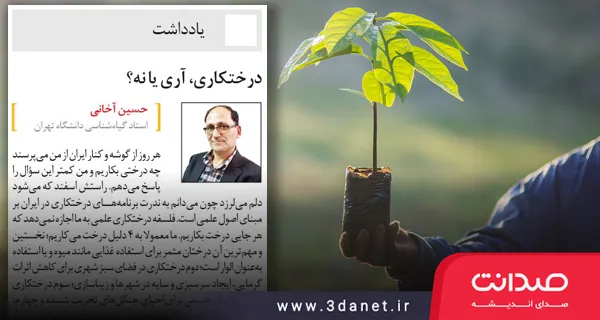
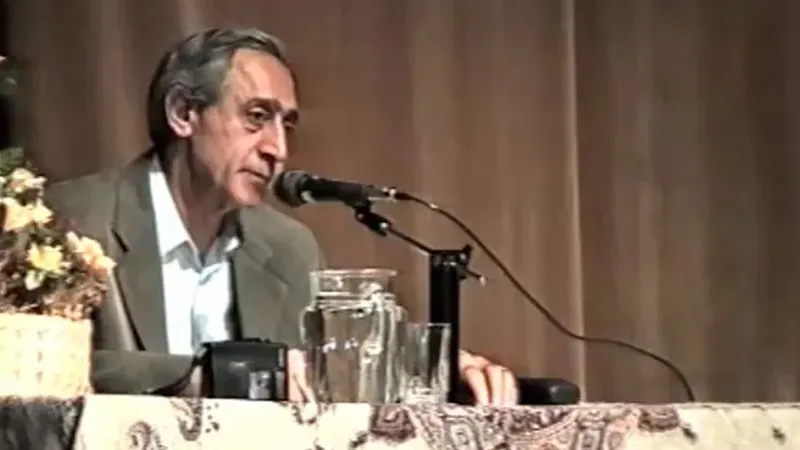
Hossein Akhani – Professor of Botany, University of Tehran
Hamshahri, Sunday, 15 Bahman 1399
Every day, from all corners of Iran, people ask me what tree to plant, and I rarely answer this question. To be honest, when Esfand arrives, my heart trembles because I know that tree-planting programs in Iran are rarely based on scientific principles. The philosophy of scientific tree planting does not allow us to plant a tree just anywhere. We usually plant trees for four reasons; the first and most important is fruit-bearing trees for food use, such as fruit, or for use as timber; second, tree planting in urban green spaces to reduce heat effects, create greenery and shade in cities, and for beautification; third, tree planting in natural environments to restore degraded forests; and fourth, tree planting to create research gardens, such as botanical gardens and the like. Recently, scientists at the Kew Botanical Gardens have announced 10 golden rules for tree planting: 1- Protect existing forests. 2- Collaborate with local people in tree-planting projects. 3- Maximize biodiversity recovery to meet multiple goals in tree-planting programs. 4- Choose the right location for restoring damaged forests. 5- Restore natural forest wherever possible. 6- Select trees that maximize biodiversity. 7- Select trees that are resilient to climate change. 8- Plan meticulously for every task beforehand. 9- Learn from your experience. 10- Evaluate your achievements; if the harm outweighs the benefit, do not continue. In this short piece, it is not possible to elaborate on each of the mentioned items in detail. But what we do in Iran as tree planting rarely takes one or more of these golden principles into consideration. For many, tree planting in Iran is more like performing a ritual that seemingly must be done. Whereas, except for the northern and western parts of the country, which have natural forests, planting trees in most parts of Iran in natural environments is an incorrect and destructive act, especially when non-native species are used. The "Irano-Turanian" vegetation, which covers a vast part of our country, is a center of diversity for many non-tree species that have adapted themselves to survive in such harsh conditions. In such an environment, the value of a Mir-Hassan's hat shrub or an Astragalus bush is not only not less than a tree, but is far greater. Planting a tree in such habitats means soil degradation, depriving native plants of water and soil resources, light, and enabling the entry of various pests and invasive species. Sometimes, non-native trees like conifers also destroy valuable genetic reserves and, by altering the vegetation cover in favor of annual grasses, intensify wildfires in years of heavy rainfall.


Discussion1 comments
سلام باتشکر از نظرات واقع گرایانه استاد حسین خانی و اقای ایرامنش که سخنان ایشان را نقل نمودن هر سیستم نیاز به ارزشیابی دارد تا بتواند هم خود را مورد ارزیابی قرار دهد و هم باز خورد عملکردش را مورد بررسی قرار دهد که متاسفانه سیستم فعلی حاکم بر جامعه به ارزشیابی عملکرد خود توجه ای ندارد و همین مهمترین مسئله ماست . با تشکر