Philosophy
Is There a Connection Between Mulla Sadra and Hegel? Mohammad Mansour Hashemi
Becoming is central to the philosophies of both Mulla Sadra and Hegel; neither treats substance as absolute, and both have mystical roots, yet their differences run deep. Mulla Sadra’s philosophy is oriented toward transcendence and the intelligible realm, whereas Hegel focuses on historical progress and human-centred development.
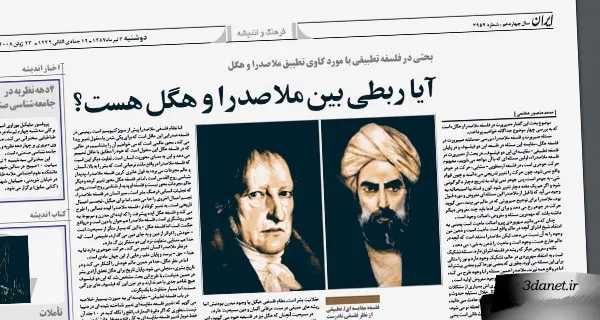
The subject of this discussion is “Becoming in the Philosophy of Mulla Sadra and Hegel,” in which we will examine four separate topics. The issue of becoming and the philosophy of Mulla Sadra, an examination of the issue of becoming in Hegel’s philosophy, a comparison of this issue in the philosophies of these two thinkers, and finally, the comparative philosophy of these two philosophers. In discussing “Becoming in the Philosophy of Mulla Sadra,” the first issue we encounter is the concept of substantial motion. In Aristotelian-Peripatetic philosophy, motion does not occur in substance, because motion is considered gradual change, and since the constitution of a thing is through substance, substance cannot undergo gradual transformation; and if it were to change all at once, generation and corruption or transmutation would occur—a notion that was assumed and accepted before Mulla Sadra. To justify the becoming he observes in the world, Mulla Sadra states that motion occurs in substance, and for this claim he must hold several other presuppositions, the most important of which is the primacy of existence. As we know, Suhrawardi adheres to the primacy of quiddity, meaning that, in the belief of the Master of Illumination, what is real in the world is quiddity, and my mind attributes existence to it. Mulla Sadra, however, believes that what exists in the external world is existence, and the mind gives quiddity to the thing. Another point and presupposition, rooted in Illuminationist philosophy, is the issue of gradation. Suhrawardi believed that gradation exists in the world and used light as an example for this issue, such that some lights are less and some are more, yet in reality all are light. Mulla Sadra posits this same issue with existence, meaning that more light is equivalent to more existence. Existence is the primary presupposition. With his famous theory of substantial motion, Mulla Sadra solves many of philosophy’s insoluble problems. For example, it resolves the problem of the origination and eternity of the world. In this way, Mulla Sadra considers the world to be originated at every instant. That is, in his view, the world is temporally eternal and is renewed at every moment; the creation of the world occurs continuously. But this world is essentially originated, meaning its existence is perpetually emanated to the world from God. The next problem solved by Mulla Sadra’s substantial motion is the issue of the union of the intellect and the intelligible: Mulla Sadra considered knowledge to be of the category of existence, and whatever the intellect perceives, he considered to be identical with existence, meaning that all of a person’s perceptions are in union with them. Interestingly, Ibn Sina considered both this view (the union of the intellect and the intelligible) and the discussion of the substantial motion of the world to be poetic, non-philosophical statements and does not discuss them. Mulla Sadra views the perpetual movement, change, and transformation of the world as being toward a world beyond space and time. In reality, all creatures are on a journey toward their Creator, and the world traverses this path. And philosophy is the endeavor to know this world, a knowledge that aligns our change with the world. The human soul is also constantly in a state of change and transformation, and as long as we are in the material world, this transformation continues. The motion present in the material world continues until we reach the immaterial realm, and upon reaching the immaterial—the world of death—we enter another world that departs from the arena of becoming.
Becoming in Hegel’s Philosophy
In fact, the whole of Hegel's philosophy is nothing other than an explanation of becoming. The theoretical foundations of the discussion of becoming are set out in the first part of Hegel's Science of Logic, concerning being, with the three concepts of being – thesis, nothingness – antithesis, and becoming as synthesis. Hegel's phrase on this matter is: pure being and pure nothingness are one; the truth is neither being nor nothingness. Rather, the truth is movement. For Hegel, the real world is known through becoming and movement. In fact, Hegel's logic is the logic of discovering the world. Hegel's discovery of the rules of thought accords no status to mathematical logic, and his science of logic is a theoretical preparation for the discussion of becoming. Even Hegel's Phenomenology of Spirit, which is his greatest and most important work, is a book about becoming. Hegel's phenomenology is the discovery of the historical developments of a phenomenon, and spirit in his philosophical system is the various manifestations of human culture, and of course this is a becoming that takes place in history; even concepts such as the Idea, the Absolute, and so on, which evoke stasis, also express becoming. For Hegel, the Absolute is not beyond the knowledge of the world; rather, the Absolute must also appear in history for humanity to know it. Hegel, as the heir of Kant – a Kant who demonstrated the limitations of reason – seeks, in order to go beyond the absolute knowledge of his philosophy, to propose historical knowledge. In Hegel's philosophy, the discussion is about the historicity of human rationality. Hegel's philosophical system, despite its modernity, has deep roots in the German mystical tradition and the Christian religion. In Christianity, as Hegel also says in his philosophy, the Absolute – the Truth – became human or was placed in history, and this is precisely the existence of the Absolute in the context of history according to Hegel. His philosophy is deeply influenced by Christianity, but this does not mean his philosophy is religious. Mulla Sadra's philosophy also has deep mystical-theological roots, just as it has taken much of the influence for the foundations of its philosophy from the mysticism of Ibn Arabi. Both philosophers speak about the becoming of the world and, in a way, do not consider substance to be absolute. Hegel considers substance to be the essence of becoming and change. Mulla Sadra's theory in epistemology also explains correspondence with the two concepts of the known-by-accident and the known-in-essence. But in reality, these similarities – between these two philosophers – are entirely superficial, and the philosophies of these two greats are profoundly different. I will now turn to expressing the differences between the thoughts of these two great philosophers of East and West: For example, in the field of epistemology, Mulla Sadra says: we know the external object – the known-by-accident – through the image it gives to our mind as the known-in-essence, and these two have an essential unity with each other. So Mulla Sadra explains his epistemological theory with the two terms known-by-accident and known-in-essence, and this is a classical theory but with a new expression. Hegel, although he tries to go beyond the separation of the boundaries of epistemology and ontology in Kant's philosophy, resolves this separation in favor of the human mind with his own epistemological system. Hegel brings Subjectivism to its peak, and the world is valuable insofar as it becomes known to me. But Mulla Sadra's philosophical system is pre-subjectivism. That is, in Sadrian philosophy, it is the knower who changes in order to become one with the known. The axis is the world that we want to know. Whereas in Hegel's philosophy, it is the known that changes itself to conform to the knower, and this means the centrality of the human being. Another difference is that Mulla Sadra's philosophy is in reality like a ladder that takes humanity upwards, to the heavens and the world of abstract entities; in the words of Henry Corbin, Mulla Sadra's philosophy is the phenomenology of the Holy Spirit. But in Hegel's philosophy, the axis has changed, and the world of abstract entities is no longer the axis, and his philosophy is the phenomenology of spirit. A spirit that is the human manifestations of human culture. The journey of the human being in Mulla Sadra's philosophy accommodates the embodiment of otherworldly deeds. But for Hegel, it is the embodiment of historical deeds. In a shorter expression: Mulla Sadra's philosophy proposes the idea of transcendence, and Hegel's philosophy proposes the idea of progress, which is a modern idea belonging to the Enlightenment era. Mulla Sadra's philosophy is consonant with religion and is in fact wisdom, but Hegel's philosophy – although it is very much influenced by Christianity – places itself beyond religion and in place of religion. It is natural that God also has a different meaning for these two great thinkers. In Mulla Sadra's view, the human being changes. It has substantial motion to reach God – the Truth – and the end of knowledge is liberation from this material world. But in Hegel's view, God reveals Himself in this very world and becomes manifest in human history. The end of history for Hegel is the realization of human freedom in this very world. By setting out this discussion, it has become clear that these two philosophers have no serious understanding with each other, and while they are both great philosophers, they are very different from one another.
On comparative philosophy, I will say very briefly: the term “comparative philosophy” is not a well-known term in the world. If you look at the Routledge Encyclopedia, in its 10 volumes the term “comparative philosophy” is used only twice and it is not an encyclopedia entry, and those two instances also refer to Eastern philosophies. The issue of comparative philosophy is the issue of civilizations that have found themselves on the margins of modern Western culture. This is why sometimes, in order to gain self-confidence, we compare a certain Eastern philosopher with a certain Western philosopher and say that the point this Western philosopher made was previously raised by our philosopher. In reality, this method is a low form of Westoxication. Mulla Sadra, with his profound thought and reflection, has no need to be compared with Hegel and is great without comparison. Finding superficial similarities between them gives us no proper philosophical understanding, and it is attention to differences and dissimilarities that can help us in accurately understanding, for example, the philosophy of Mulla Sadra and Hegel. In my opinion, we must first pay attention to the possibility of a dialogue between philosophies, whether the two philosophers we have chosen for comparison understand each other’s language or not, and the final word is this: discussion is posterior to the possibility of dialogue. We must first prove the conditions for the possibility of dialogue and then engage in a discussion between the two. Comparative philosophy is philosophically incorrect and fuels cultural misunderstandings more than it does dialogue.
.
.
Is There a Connection Between Mulla Sadra and Hegel? Author: Mohammad Mansour Hashemi Iran Newspaper, Issue 3959, dated 87/4/3, Page 10 (Culture and Thought)
.
.
Related Content:
Lecture on the Differences Between the Two Philosophical Systems of Mulla Sadra and Hegel, Mohammad Mansour Hashemi
.
.



Discussion0 comments
No comments yet; let yours be the first voice.