Philosophy
Markets, Merit, and the Dignity of Work
In his critique of Michael Sandel’s *The Tyranny of Merit*, Robert Sugden questions the claim that meritocracy is a product of market values and that markets erode the dignity of work. Examining the relationship between markets, merit, and contributive justice, he argues that Sandel’s proposed alternative—aligning rewards with people’s “true merit”—faces serious difficulties.


Robert Sugden
نویسنده
Michael Sandel
اندیشمند مورد بررسیAbstract
In The Tyranny of Merit, Sandel interprets the discontent expressed in populism as a rejection of market morality and an unarticulated desire to restore civic virtue. He argues that the “market-driven globalization project” has fostered meritocratic ideas that demean the project’s victims and diminish the dignity of work. I question Sandel’s claim that meritocracy is a market value while the dignity of work is not. I argue that his account of an ethical alternative to ordinary market institutions—an economy in which people’s rewards are somehow aligned with their true merits—is deeply incoherent and meaningless.[1]
1. Introduction
In June 2016, a majority of British voters chose for their country to leave the European Union. In November of the same year, Donald Trump won the US presidential election on a populist platform. One incidental consequence of those two events was the emergence of a new literary genre: Brexit/Trump anxiety literature. Its authors are journalists, political scientists, economists, and philosophers of liberal or left-wing persuasion. Their common presumption is that supporters of Brexit and Trump voted for programmes that conflicted with their own interests as well as the wider interests of their societies and nations—and that they ought to have known this.
For the authors of these books, two features of these votes are especially troubling. First, Brexit and Trump received disproportionate support from lower-income and less-educated voters, the very people whose interests centre-left political movements might be expected to defend. Second, those voters appeared deliberately to reject economic, political, and moral positions that had been accepted almost without challenge in the professional and intellectual communities to which these authors belong. Indeed, one of the half-concealed themes of the Brexit and Trump campaigns was resentment of—and even contempt for—the claims to expertise and moral authority made by those same communities, the “metropolitan elite.”
The typical response of an author is to offer an explanation of these phenomena that treats the Brexit and Trump votes as misguided expressions of understandable and at least partly justified discontent. Some try to find a way of reconciling the liberal-left consensus with that discontent without surrendering its most fundamental principles. In other cases, the argument is that voters have expressed attitudes which, properly understood, support positions the author has previously defended and which require no fundamental revision. In his new book The Tyranny of Merit, Michael Sandel contributes to this branch of the genre.[2]
Sandel has previously written two books in which he offers moral critiques of markets and of modes of thought that, in his view, arise from the excessive use of market mechanisms and from economic theories purporting to justify those mechanisms. In Justice: What’s the Right Thing to Do?, he says that justice is about “giving people what they deserve.” This requires judgments about “what virtues are worthy of honor and reward, and what way of life a good society should promote.” One of the book’s central themes is that markets generate incomes that are not properly aligned with the virtues of their recipients. In What Money Can’t Buy: The Moral Limits of Markets, Sandel argues that markets can corrode morality by cultivating “market values” that undermine the civic virtues of solidarity, “sharing in a common life,” and “caring for the common good.”[3]
Luigino Bruni and I have previously offered critiques of Sandel’s 2009 and 2012 discussions of market values. In this article, I focus on two new themes that are prominent in The Tyranny of Merit: first, the idea of meritocracy, which Sandel regards as a market value that sustains the hubris of the economically successful and humiliates those who fail; and second, the dignity of work, which he regards as a civic value that market forces can undermine. By making many traditional manufacturing industries unprofitable, globalization has deprived working-class people of opportunities for meaningful work. In Sandel’s words, the resentments that have fuelled populist politics “are not only economic but also moral and cultural; they are not only about wages and jobs but also about social esteem.”[4]
Sandel’s primary concern is with these moral and cultural resentments. Clearly, any comprehensive explanation of the growth of populism must also take account of profound changes in the British and American economies—changes that, independently of shifts in social values, have altered the prospects of working people. These include the increasing importance of services relative to manufacturing; advances in digital technology that displace many forms of skilled work, either directly or by making it possible to outsource them to low-wage countries; the effects of East Asian economic growth on patterns of international trade; and, partly as a consequence of these developments, increasing income inequality.
These effects are undoubtedly transmitted through markets, but it is much less obvious that markets cause them, or that they can be attributed to the ascendancy of market values in political discourse. At times, Sandel seems to conflate these three ideas; the clearest example is his repeated references to the “market-driven globalization project,” without defining it. This exemplifies a more general tendency in his view of economics, to which I will return later: a tendency to treat economists’ statements about the realities of economic life as judgments of moral approval—and of a very particular kind of approval at that. For now, it is enough to say that my article is an interpretation of Sandel’s moral and cultural analysis of market values, not a discussion of the economic causes underlying the discontents that fuel populism. I question his claim that meritocracy is a market value while the dignity of work is not; and I argue that his account of an ethical alternative to ordinary market institutions—an economy, briefly described, in which people’s economic rewards are aligned with their true merits—is deeply incoherent.[5]
2. The Meritocratic Sensibility
Sandel pays close attention to the language of public discourse, and especially to the speeches of recent US presidents and presidential candidates—with the striking exception of Donald Trump. He identifies a recurring theme: the “rhetoric of rising,” which expresses the “meritocratic sensibility.”[6]
Here are some of his examples:[7]
Ronald Reagan in 1984, addressing Black members of his administration: “All Americans have a right to be judged solely on individual merit and to go just as far as their dreams and hard work will take them.”
Bill Clinton in 1993: “The American dream that we were all raised on is a simple but powerful one: if you work hard and play by the rules, you should be given a chance to go as far as your God-given ability will take you.”
Tony Blair in 1996, speaking of the “New Labour” programme: “We believe that people should be able to rise by their talents, not by their birth or the advantages of privilege.”
Barack Obama during his 2012 re-election campaign: “What makes America so exceptional, what makes us so special, is this basic bargain, this basic idea: in this country, it doesn’t matter what you look like, where you come from, what your last name is, what setbacks you may have experienced; if you work hard, if you are responsible, you can make it; you can get ahead.”
Hillary Clinton during the 2016 campaign: “Our campaign is based on a fundamental belief that in America, every person, no matter what you look like, who you are, who you love, you should have the chance to go as far as your hard work and dreams can take you.”
Theresa May in 2016, after becoming prime minister and speaking about what her government would do for “ordinary working-class people”: “I want Britain to be a country where everyone has a fair chance to go as far as their talent and their hard work will allow ... I want Britain to be a place where advantage is based on merit not privilege; where it’s your talent and hard work that matter, not where you were born, who your parents are or what your accent sounds like.”
The similarity in the phrasing of these statements may tell us something about political speechwriters recycling one another’s material, but it is fair to assume that all six speakers are expressing genuine political beliefs in language intended to resonate with their audiences. Several common themes are evident. The American speakers—unlike the British ones—appeal to a principle of equality of opportunity that is apparently part of their audiences’ national identity. They implicitly acknowledge that, in reality, some people—variously defined by colour, country of origin, sexual orientation, and social class—are currently denied full equality of opportunity; but this is presented as an injustice the speaker is committed to remedying.
The “as far as ... will take you” clause is completed with varying combinations of “merit,” “ability,” “talent,” and “dreams”—the last of which might perhaps be translated as ambition or aspiration—and always with “hard work.” Exactly what the commitment to equality of opportunity promises is not entirely clear; I will return later to some of these ambiguities. My immediate concern, like Sandel’s, is with the rhetoric: to whom is this discourse likely to appeal?
It is easy to imagine its appeal to a talented individual trying to make their way in a competitive profession that rewards those who succeed well, but whose efforts to succeed are obstructed by unfair discrimination. Think of an aspiring athlete, artist, lawyer, or academic who finds the way barred because of skin colour, gender, social class, or the name of the university at which they were educated. One can also imagine its appeal to a newly arrived immigrant from a poor background, beginning a new life in a country where there are both disadvantages to overcome and opportunities to seize.
If we set aside the issue of discrimination, the rhetoric of rising may appeal to any energetic young person hoping to enter an occupation with learnable skills—from accountancy and hairdressing to medicine and truck driving—that offers opportunities for advancement. But, as Sandel rightly says, these fine words are not very inspiring to a working-class person in a declining industrial region whose efforts to find work repeatedly fail. His problem cannot be solved by working harder; nor can it be attributed to unfair discrimination against some characteristic that he can affirm as part of his identity. The problem is the state of the market: the skills he offers are no longer in demand.
Sandel draws on Arlie Russell Hochschild’s penetrating sociological study of the political attitudes of working people in rural Louisiana. Summarizing the “hopes, fears, pride, shame, resentment, and anxiety” of the people she interviewed, she describes their sense of “struggling to be seen and honored”: “To feel honored you have to feel—and feel seen to be—moving forward. But without your having done anything wrong, and in ways that are hidden, you’re slipping backward.” For someone in this position, the rhetoric of rising adds insult to injury. Sandel says that this rhetoric has fuelled the grievances and resentments that populist politicians can convert into votes. I think he is right.[8]
But what makes meritocracy a market value? Given Sandel’s thesis about market values, it is curious that he devotes two chapters to the competition for admission to elite American universities such as his own Harvard. He is right to treat this competition as a pathology of meritocracy, but in what sense is it a pathology of markets? From an economic perspective, Harvard is not a profit-seeking firm producing for a competitive market; it is a non-profit institution that both creates and exploits the scarcity of its own product. By using hyper-selective methods to choose the small fraction of eager customers with whom it actually trades, Harvard produces credentials that can be converted into material rewards and social esteem: Harvard is more a “sorting machine” than a seller of education.[9]
In his discussion of elite university admissions, Sandel says almost nothing to connect this case study of meritocracy with the moral values of markets. He says that increasing income inequality has increased the financial value of the sorting process for those admitted, but this is merely an economic fact. And he calls those admitted “the winners of the hyper-competitive admissions process against the backdrop of a hyper-competitive market society.” The implication seems to be that the meritocratic values manifest in the admissions process derive from, or at least resemble, the moral values elicited by markets; but the connection is not explained.
More fundamentally, what special connection is there between markets and the rhetoric of rising? The ability to go as far as your dreams, abilities, and hard work will take you is an attractive hope in any competition in which success is rewarded, whether the reward is material or esteem, and whether the mechanism for distributing rewards is market-based, political—as in winning an election—administrative—as in promotion in the military or civil service—athletic—as in an Olympic medal—or peer approval—as in a literary prize or publication in a prestigious journal. The same hope is possible even in an occupation in which workers do not compete with one another. Imagine a young woman who wants to become a truck driver; a confident girl with this ambition might hope that drivers who demonstrate hard work, responsibility, and resourcefulness will earn above-average wages and be entrusted with more difficult assignments. She will certainly hope that female drivers are not paid less than equally qualified men. These hopes do not require truck drivers to compete against one another as athletes do in a race, or sales staff to vie for the title of “salesperson of the month.”
Sandel begins his discussion of the rhetoric of rising by claiming that it emerged from the “triumph of the market in the 1980s” and that its subtext is a meritocratic justification of the market. He formulates that justification as follows: “Provided they operate within a fair system of equal opportunity, markets give people what they deserve. As long as everyone has an equal chance to compete, market outcomes reward merit.” But notice that none of the six quotations actually mentions markets; nor does any of them claim that, given equal opportunities to compete, ex post rewards will align with merit.[10]
The Clintons and May all speak of an opportunity or a fair chance to succeed. Blair’s formula—being “able to rise by their talents”—is ambiguous, but “able” can reasonably be read as “having a fair opportunity.” None of those four speakers says that fair competitions always result in victory for the most meritorious participants. Reagan’s reference to an American’s right to fulfil their dreams surely cannot be understood literally either; no form of social organization can make such a promise.
I take Obama’s “American bargain” to promise that people who work hard and take responsibility will enjoy a decent standard of living and share in the country’s expected economic growth. Since he cannot promise that every hard-working person will get ahead of everyone else, “getting ahead” must mean making one’s way in life. In the same election campaign, Obama said, “If you were successful, somebody along the line gave you some help”; you may think you succeeded because you were smart and hard-working, but there are “a lot of smart people” and “a whole bunch of hardworking people” who have been less successful than you. Thus, the American bargain does not promise that rewards will align with talent and effort.[11]
One might have expected Sandel to identify and engage with philosophers who defend markets and have actually claimed that market outcomes reward merit. Instead, he engages with Friedrich Hayek, whom he rightly describes as offering “perhaps the most influential defense of free-market liberalism.” Yet, as Sandel himself acknowledges, Hayek explicitly denies that markets reward merit or moral desert. Sandel says that this denial is “Hayek’s way of fending off demands for redistribution” by those who think hedge-fund managers do not deserve higher incomes than teachers. This is not a fair judgment: rightly or wrongly, Hayek argues that markets cannot reward merit, but that in the long run everyone can benefit from the wealth markets create.[12]
Hayek draws a clear distinction between market value—in the ordinary economic sense—and moral merit. The market value of a good or service is the price it commands in the market. Under competitive conditions, the market value of an individual’s work is what others are willing, at the margin, to pay for the product of that work. When Hayek speaks of merit and desert, he is referring to the individual’s efforts and sacrifices, not to their product. There is no reason to expect market value to align with merit of this kind, and Hayek makes no pretence that it does. A fundamental point in his justification of the market is that every system of economic organization faces the problem of the division of knowledge: if wealth is to be created through coordinated action, there must be a decentralized system for integrating fragments of knowledge dispersed among economic agents. The market solves this problem by rewarding individuals for discovering ways of trading with others that are beneficial to those others. The result is that each individual is rewarded according to the actual benefits their action creates for others; and that this mechanism may treat individuals unfairly is a price that must be paid for the market’s capacity to create wealth, a price morally analogous to the injustice of nature.
Hayek asks: “Do we not all constantly feel aggrieved at seeing how unjustly life treats different people, and how the deserving suffer and the undeserving prosper? ... And do we not, when we find a reward proportionate to effort or sacrifice, experience a sense of fitness with satisfaction? ... But we have the same feelings with regard to differences in human fate for which clearly no human agent is responsible and which it is therefore plainly absurd to call unjust. Nevertheless, when a succession of calamities befalls one family while another steadily prospers, or when a meritorious effort is frustrated by an unforeseeable accident, we cry out at the injustice ... even if we know no one to blame or no way in which those disappointments could have been prevented.”[13]
The unfairness of market rewards can be mitigated by redistributive taxation and social insurance schemes, but it cannot be eliminated without disabling the mechanisms by which the market operates.[14]
Sandel’s response is that Hayek’s disavowal of merit and desert “is less complete than it first appears,” because “if, as Hayek claims, economic value is a legitimate basis for inequality, it is unclear that demeaning attitudes toward success will disappear.” On Hayek’s account, each person’s reward in a market economy is aligned with the market value of their marginal contribution to society. Sandel says that the successful person can still take pride in the high value of their contribution, while the unsuccessful person may be humiliated by being reminded of the low value of theirs. He concludes that the distinction between merit and value is “very thin and blurred,” and that Hayek unquestioningly accepts the assumption that “a person’s market value is a good measure of his contribution to society.”[15]
But Sandel is conflating economic facts with moral values here. That an individual’s wage is a measure of the market value of the marginal product of their labour—in terms of the prices paid by buyers of that product—is an empirical proposition; it describes a broad tendency in competitive labour markets. Hayek is not responsible for this fact, and he has gone to considerable lengths to explain that market value is not moral merit. What more can Sandel ask of him? It may be a fact of human psychology that those who succeed in life regard their success as a deserved reward for their merits; but if so, that fact should hold for every form of success, not merely success in the market. In any case, Hayek is not responsible for human psychology.
At the most fundamental level, Hayek, Reagan, Bill Clinton, Blair, Obama, Hillary Clinton, and May are not advocates of meritocracy; Sandel is. It is Sandel who says that society should reward people according to moral merit. His criticism of the market is that it does not reward what he regards as moral merit. To complete his argument, he needs to show that the working-class Brexit and Trump voters were expressing something like this criticism. This is where the dignity of work enters the picture.
3. The Dignity of Work
Following Anne Case and Angus Deaton, Sandel sees the economic decline of American working-class communities as the loss of a way of life. Unemployment and economic insecurity have led to declining life expectancy, much of it due to suicide, drug overdoses, and alcoholism. Working-class people are “giving up on work” and even “giving up on life.” Sandel attributes much of this despair to an “insidious injury” inflicted by meritocratic and neoliberal thinking: the erosion of the dignity of work.[16]
To explain his conception of the dignity of work, Sandel turns to Catholic social thought, and in particular to the concept of contributive justice, formulated in a 1986 pastoral letter of the United States Conference of Catholic Bishops as follows:[17]
“Social justice implies that persons have an obligation to be active and productive participants in the life of society and that society has a duty to enable them to participate in this way. This form of justice can also be called ‘contributive,’ for it stresses the duty of all who are able to help create the goods, services, and other nonmaterial or spiritual values necessary for the welfare of the whole community ... The meaning of social justice also includes the duty to organize economic and social institutions in such a way that people can contribute to society in ways that respect the freedom and dignity of their labor ... Employment at adequate wages for all who seek it is the primary means of attaining basic justice in our society.”
As Sandel summarizes it, this conception of justice rests on the idea that “the fundamental human need is to be needed by those with whom we share a common life. The dignity of work consists in exercising our abilities to answer such needs.” Work is meaningful when it can be seen as an individual’s contribution to the common good of society, and wages as the return on that contribution. To express this idea, Sandel quotes from two political speeches given in 1968. Robert Kennedy spoke of “decent employment at decent pay,” a job that enables a person to say to the community, family, country, and most importantly to himself: “I helped to build this country. I am a participant in its great public ventures.” Martin Luther King Jr., addressing striking sanitation workers in Memphis, said: “If our society is to survive, it must one day respect the sanitation worker, for the person who picks up our garbage is, in the final analysis, as significant as the physician, for if he doesn’t do his job, disease is rampant. All labor has dignity.”[18]
The central idea in these statements is that the dignity of work is a form of mutual respect, grounded in recognizing one another as contributors to a common undertaking; and that possessing the dignity of work is an important form of self-respect. This seems right. It helps us understand the demoralization of unemployed jobseekers and of those whose formerly marketable skills have become obsolete, as well as the humiliating effect of the rhetoric of rising. But when Sandel explains what the common undertaking that gives work its dignity actually is, his argument loses its way.
Sandel treats “production” and “consumption” as morally separate domains. Production is portrayed as the realm of civic virtue, consumption as the realm of market values. The undefined globalization project focuses on “maximizing GDP” and “invites us to think of ourselves more as consumers than as producers.” When we think as consumers, we think in a morally empty way: “We want to get the most for our money, to buy goods and services as cheaply as possible, whether they are made by low-wage workers overseas or better-paid American workers.” From a civic standpoint, however, our most important role in the economy is not as consumers but as producers, because as producers we exercise our abilities to provide goods and services that meet the needs of our fellow citizens and earn social recognition. Work brings citizens “together in a scheme of contribution and mutual recognition.” From this perspective, Sandel rejects Adam Smith’s claim that consumption is the sole end and purpose of all production.[19]
Sandel fails to see the fundamental complementarity of production and consumption. He is right that what makes production meaningful—the feature that distinguishes it from play—is that it creates things that meet people’s needs independently of the production process itself. One aspect of the dignity of work, then, is the recognition that the worker’s work is needed by others. But the way those others’ needs are met is through consuming the product of that work. In a market economy, however many intermediaries there may be, paid work is ultimately an exchange relationship between people in their role as workers and people in their role as consumers. The basis of mutual respect is that each party benefits from the other’s participation. As a producer, the worker derives dignity from knowing that he is creating something that others value enough to consume. The steelworker can take pride in bridges that others want to cross; the sanitation worker can take pride in the cleanliness that protects others from disease. In a market economy, the worker’s wage is an acknowledgment that he has created something of value to someone else.
Consumption enters into the dignity of work in another way, one that may be even more important for self-respect. The worker’s wage is the means by which he can consume the products of other people’s work. As a consumer, he gains self-respect from knowing that he can pay for what he consumes and that he earned the money through his own work. When he shops at a department store, he can meet its owners on terms of equality: he wants their goods, and they want his custom. That mutually beneficial market relationships support this kind of self-respect is an important part of Adam Smith’s famous explanation of how we obtain our dinner without appealing to anyone’s benevolence. By contrast, consider someone who, because of unemployment or insufficient income, has to use a charitable food bank. However benevolent the charity’s intentions, dependence on it is humiliating. In traditional working-class communities, being a “good provider”—a man who reliably secured a decent standard of living for his family—was one of the principal virtues of a husband and father. Sandel pays surprisingly little attention to this dimension of the dignity of work, perhaps because it comes too close to consumption for his taste.[20]
Sandel’s morally disparaging attitude toward consumption rests on his “civic” conception of the common good. He connects the distinction between production and consumption to a distinction between two understandings of the common good. The “consumerist” understanding defines the common good as “the sum of everyone’s preferences and interests”; the civic understanding, by contrast, requires critical reflection on preferences and, ideally, their elevation and improvement so that we can lead worthwhile and flourishing lives. This understanding requires us to deliberate with our fellow citizens about how to bring about a just and good society, one that cultivates civic virtue and enables us to reason together about the worthy purposes of our political community.
What Sandel finds unacceptable in the consumerist understanding of the common good, then, is that it decomposes the common good into the separate goods of individual persons and allows each person to judge his own good without having to deliberate with others about the merit of that judgment. On the consumerist view, the common good of interacting individuals is whatever is common to their separate conceptions of their personal good. Since this way of thinking about the common good has no special connection with consumption, “consumerist” is a misleading label; “liberal” might be a better term.[21]
Sandel’s principal concern is not the value of the common good itself, but the assessment of the value of individual contributions to it. The underlying idea is that a person’s merit as a producer derives from the value of his contribution to the common good, and that work acquires dignity from social recognition of this merit. Sandel is looking for collective judgments that compare the “true value” of different contributions and thereby determine degrees of merit. His objection to “consumerism” is that, in his view, it produces unacceptable judgments of this kind: “If the common good consists simply in satisfying consumer preferences, market wages are a good measure of who has contributed what. Those who make the most money have presumably made the most valuable contribution to the common good, by producing the goods and services consumers want.” His response is: “The true value of our contribution cannot be measured by our paychecks ... It depends instead on the moral and civic importance of the ends our efforts serve.” What counts as a “truly valuable contribution” is a matter for democratic deliberation within a political community.[22]
But what exactly are citizens supposed to deliberate about, and to what end? Sandel does not seriously consider the kinds of arguments that might arise in such deliberation or its possible outcomes. He relies on simplistic assertions about true value, apparently expecting readers to find them so self-evident that they see no need to ask difficult questions about what they really mean. For example, he writes with apparent approval: “Some would say hedge fund managers do not deserve to make vastly more than teachers; managing money is far less admirable and important than teaching and inspiring young people.” He adds that a defender of the free market might regard the work of hedge fund managers in investing the “hard-earned pensions of teachers, firefighters, and, perhaps less compellingly, university endowments” as important, but implies that this consideration does not justify their enormous incomes. Or, comparing a casino owner who earns “thousands of times more than a nurse or doctor,” he says: “Caring for people’s health is morally more important than catering to their desire to play slot machines.”[23]
Even more striking is Sandel’s failure to say what this deliberation is supposed to lead to. Since it is democratic, it is natural to infer that the aim is to reach collective decisions, not merely to express and discuss differing judgments. But collective decisions about what? Although Sandel never says so explicitly, he must envisage decisions about the distribution of rewards, with the aim of bringing people’s rewards into closer alignment with their contributions to the common good and thereby conferring greater dignity on genuinely productive work. In his discussion of the dignity of work, he refers with apparent approval to Émile Durkheim’s argument that “the division of labor can be a source of social solidarity, provided everyone’s contribution is remunerated according to its real value to the community.” In his very brief discussion of concrete policies for honoring the dignity of work, he also favors tax changes intended to express society’s judgment about “what counts as a valuable contribution to the common good” and “activities worthy of honor and recognition.”[24]
But the idea of measuring the “true value” of an individual’s contribution to a common good defined in moral and civic terms is deeply problematic; and it is far from clear that trying to align wages with contributions in true value would enhance the dignity of work. Consider several difficulties.
Diamonds and water. Early economists wrestled with the diamond-water paradox: why is the price of diamonds so high and the price of water so low, when water is far more important to human life? Once we distinguish marginal value or utility from total value, the paradox disappears. Providing healthcare services is undoubtedly more important than providing slot machines, just as water is more valuable than diamonds; but is the product of a marginal day’s work in a hospital more important than the product of a marginal day’s work of the same kind in a casino? In Britain, most healthcare services are provided free of charge by the publicly funded National Health Service. The share of national income devoted to health—that is, the allocation of resources between socialized healthcare and private consumption—is continually a subject of public debate and is determined by democratic political processes, not markets. Is Sandel really sure that an additional pound for the National Health Service has greater civic value than an additional pound for individuals’ chosen forms of private consumption—which, for some, might be playing a slot machine?
Two cleaners. Suppose we accept that the marginal product of labour in the healthcare industry, measured in true value, is higher than in the gambling industry. Consider Rosie, who cleans the public areas of a hospital, and Sally, who cleans the public areas of a casino hotel. If healthcare really is much more valuable and admirable than slot machines, Rosie’s contribution to the common good must also be much more valuable and admirable than Sally’s. But how are we to imagine an economy in which jobs involving essentially identical skills and working conditions receive different wages on the basis of a collective judgment about the civic importance of the ends they serve? Quite apart from differences in pay, how does telling Sally that, although she is just as good a cleaner as Rosie, her work is less admirable enhance the dignity of her work?
The Uber driver. Consider Ahmed, an Uber driver. His job is to transport customers. He knows they value his service because they ask him to take them somewhere and pay him in return. He can take pride in being a careful and knowledgeable driver without making further inquiries into the purposes of their journeys. But according to Sandel, the true value of Ahmed’s contribution to the common good depends on the moral and civic importance of the ends those journeys serve. If he drives Rosie to work, his work has greater dignity than when he drives Sally. Should he be paid more for the journey with Rosie, and if so, who should pay the extra amount? I hope not Rosie. Even if we set aside the issue of payment, how does telling Ahmed that taking Sally where she wants to go is less admirable than taking Rosie enhance the dignity of his work? Moreover, even in this simple example we encounter the problem of the division of knowledge: in a complex economy, individuals cannot know the ultimate purposes served by their economic activities. In many cases, Ahmed cannot know what ultimate end his customers’ journeys serve; the only evidence that a need is being met is that the customers are willing to pay.[25]
Middlesbrough and the Sydney Harbour Bridge. I grew up in Middlesbrough, the principal town of an industrial region in north-east England. From the mid-nineteenth century, Middlesbrough had grown from nothing into a major centre of iron and steel production and heavy engineering, adopting the magnificent motto “Erimus”—“We shall be.” In my childhood, the town was still relatively prosperous and we took pride in our heavy industries; in outdoor art classes, we sketched the smoking blast furnaces. A particular source of local pride was that a Middlesbrough company had built the Sydney Harbour Bridge. Since then, the town’s principal industries have collapsed, and the region is now among the most deprived in Britain. As in the communities of America’s Rust Belt, the dignity of work that Robert Kennedy expressed in the phrase “I helped to build this country” has undoubtedly been lost.
But remember that building the Sydney Harbour Bridge was not part of building our country; the pride came from the fact that Middlesbrough had been chosen to build one of the world’s greatest bridges. The moral value created by Middlesbrough’s workers was not “civic” in Sandel’s political sense; it was conferred by the judgment of Australians. The point of the example is that the common good to which work contributes need not be the good of the worker’s own political community. This fact did not begin with the globalization project of the 1980s, or even with the Industrial Revolution: economic transactions across the boundaries of political communities predate recorded history. And the relationship works both ways. If the dignity of Middlesbrough steelworkers in the 1920s came from meeting the needs of Australian train passengers, American consumers who buy imported goods in the 2020s support the dignity of workers in other countries. The protectionism Sandel seems to endorse is not merely protectionism in the economy of goods; it is protectionism in the economy of dignity as well.
Bill Gates and his gardener. In responding to Hayek, Sandel says that a person whose work has low market value may be humiliated by comparing his wage with the income of someone whose work has a much higher market value. He chooses examples in which he believes the difference in market value does not correspond to a difference in the true value of the contributions—for example, a casino owner earning thousands of times more than a nurse. But if we take seriously the measurement of the value of individual contributions to the common good, there are many cases in which, by any reasonable measure of “true value,” some people genuinely contribute far more than others. Imagine Bill Gates and a man called Joe who works in his garden. Joe’s work produces a very small increase in the individual consumption of an extremely wealthy person. Even setting aside the enormous value of Gates’s philanthropic activities, it is plausible that Gates’s contribution to the common good is thousands of times greater than his gardener’s. So if large differences in the true value of contributions humiliate those whose contributions are small, we face an insoluble problem in a modern economy.
But how does the difference between their contributions to the common good undermine the dignity of Joe’s work? That difference plays no part in Bill and Joe’s economic relationship. Like Smith’s shopkeeper and customers, Bill and Joe can interact with mutual respect: Bill values having a well-kept garden, and Joe values the income he earns from his work. Both understand that the purpose of their interaction is to produce a set of outcomes—Bill’s well-kept garden and the consumption paid for by Joe’s wages—that is common good relative to their separate conceptions of individual good.[26]
4. Implications
If there is any truth in my arguments, the assumption that, in a complex modern economy, rewards could be aligned with any plausible conception of civic merit is fanciful. Sandel avoids confronting this fact by devoting fewer than eight of his book’s 227 pages to concrete policy proposals and restricting himself to three proposals that are only marginally related to the project of rewarding civic merit.[27]
His first proposal is a wage subsidy for low-paid workers, so that “low-wage workers can make a decent living even if they lack the skills to command a substantial market wage.” This proposal has an obvious justification in terms of contributive justice: recall that the US Catholic bishops said that government has a duty to organize economic and social institutions so that people can contribute to society in ways that respect the freedom and dignity of their work. A wage subsidy is an effective way of ensuring that people who are able to work can attain a minimum standard of living through productive work. But if the real aim is to align reward with civic merit, this is a blunt instrument. For example, if the market wage for cleaners is sufficiently low, the policy gives Sally the same subsidy as Rosie. If we accept that cleaning a hospital and cleaning a casino both make positive contributions to society, contributive justice has been satisfied; but merits—as Sandel assesses them—have not received their appropriate rewards.[28]
Moreover, this is not a new proposal. A wage subsidy is essentially the same system of tax credits currently operating in the United States and Britain. The US Earned Income Tax Credit was introduced under Gerald Ford, expanded under Reagan—who enthusiastically supported it—and expanded again under Bill Clinton. Britain’s tax-credit system was introduced by Margaret Thatcher’s government and extended by Blair. The Blair government also introduced a complementary policy with a similar aim: a legally binding minimum wage. The names of these presidents and prime ministers matter. In Sandel’s ideological classification, Thatcher and Reagan are two of the principal architects of the globalization project, while Blair and Clinton—together with Gerhard Schröder—are centre-left politicians who “moderated but consolidated the market faith.” There is no evidence here of any fundamental conflict between the globalization project—whatever that may be—and contributive justice.[29]
Sandel’s other proposals are to equalize the tax rates on capital gains and income from work, and to impose a tax on financial transactions. These proposals are presented as contributions to a “public debate about what counts as a valuable contribution to the common good.” Sandel sees the current low rate of capital gains tax and the absence of taxes on many financial transactions as expressing a civic judgment that investors are more deserving of honor than workers—a judgment that affronts the dignity of work and ought to be reversed. But the same proposals can be justified without making any judgment about the relationship between merit and reward. Most economists would probably support equalizing tax rates on different forms of income on grounds of efficiency, fairness, and reducing tax avoidance. There is less agreement about the advantages and disadvantages of a financial transactions tax, but since Tobin’s original proposal for a tax on currency transactions, economic discussion has focused on the effects of such taxes on the efficiency and volatility of markets.[30]
It is natural to ask why Sandel focuses on such indirect policies as a means of achieving his civic objectives. The immediate answer might be that he is a moral philosopher, not an economist; reasonably enough, he considers proposals already on the political agenda to see which are most consistent with the moral principles he defends. But even then, one has to ask why he has been unable to find practical proposals that directly address the rewarding of merit and thereby restore some of the dignity of work that the globalization project has supposedly undermined. Perhaps no practical proposal has been offered because what Sandel is seeking is not, after all, a practical proposition.
My own conclusion is that Sandel’s project of aligning economic rewards with civic merit is a dead end. I return to the quotations from Reagan, Bill Clinton, Blair, Obama, Hillary Clinton, and Theresa May that Sandel regards as meritocratic, and to the statements by Robert Kennedy, Martin Luther King, and the Catholic bishops that he takes to express civic solidarity. To varying degrees, these statements appeal to three fundamental principles that do not align with Sandel’s project. First, the principle of fair opportunity: the economic opportunities open to a person should not depend on characteristics such as gender, ethnicity, social class, religion, or sexual orientation, although they may depend on natural ability. Second, the principle of participatory justice: for every person capable of working, there should be a way to secure a decent standard of living through productive work. Third, the principle of social insurance: for every person, regardless of their past choices and even if they are unable to work, there should be a way to attain a decent standard of living.
This combination of principles can be grounded in different moral foundations—for example, in the idea of mutually beneficial cooperation or in relational—or democratic—equality. If we think in these terms, we can respect one another’s contributions to the overall scheme of economic cooperation without trying to rank them on a scale of merit.[31]
Endnotes
Acknowledgments: This article is an expanded version of the keynote lecture delivered at the HEIRS (Happiness, Economics and Interpersonal Relations) workshop entitled “The Illusion of Merit” at Cardiff University, April 2021. I am grateful to the participants in that workshop for their constructive comments.
Funding: This project has received funding from the European Research Council under the European Union’s Horizon 2020 research and innovation programme, under grant agreement No. 670103.
Conflict of interest: The author declares that he has no conflict of interest.
References
Anderson, E. (1993). Value in Ethics and Economics. Harvard University Press.
Anderson, E. (1999). What is the point of equality? Ethics, 109, 287–337.
Bruni, L., & Santori, P. (2021). The illusion of merit and the demons of economic meritocracy: which are the legitimate expectations of the market? Forthcoming in Journal of Business Ethics.
Bruni, L., & Sugden, R. (2013). Reclaiming virtue ethics for economics. Journal of Economic Perspectives, 27, 141–164.
Case, A., & Deaton, A. (2020). Deaths of Despair and the Future of Capitalism. Princeton University Press.
Hayek, F. A. (1976). Law, Legislation and Liberty, Vol. 2: The Mirage of Social Justice. University of Chicago Press.
Hochschild, A. R. (2016). Strangers in Their Own Land: Anger and Mourning on the American Right. The New Press.
Mandeville, B. (1714). The Fable of the Bees: or Private Vices, Publick Benefits, Vol. 1.
Matheson, T. (2011). Taxing financial transactions: issues and evidence. IMF Working Paper 11/54.
Moffitt, R. (2003). The negative income tax and the evolution of U.S. welfare policy. Journal of Economic Perspectives, 17, 119–140.
Sandel, M. (2009). Justice: What’s the Right Thing to Do? Penguin.
Sandel, M. (2012). What Money Can’t Buy: The Moral Limits of Markets. Farrar, Straus and Giroux.
Sandel, M. (2020). The Tyranny of Merit: What’s Become of the Common Good? Penguin, London.
Smith, A. (1976). An Inquiry into the Nature and Causes of the Wealth of Nations. Clarendon Press.
Sugden, R. (1993). Normative judgements and spontaneous order: the contractarian element in Hayek’s thought. Constitutional Political Economy, 4, 393–424.
Sugden, R. (2004). Living with unfairness: the limits of equality of opportunity in a market economy. Social Choice and Welfare, 22, 211–236.
Sugden, R. (2018). The Community of Advantage: A Behavioural Economist’s Defence of the Market. Oxford University Press.
Sugden, R., & Wang, M. (2020). Equality of opportunity and the acceptability of outcome inequality. European Economic Review, 130, 103597.
Tobin, J. (1978). A proposal for international monetary reform. Eastern Economic Journal, 4, 153–159.
United States Conference of Catholic Bishops. (1986). Economic Justice for All: Pastoral Letter on Catholic Social Teaching and the US Economy.
[1]Sugden, Robert (2022), “Markets, merit and the dignity of labour”, International Review of Economics, 69: 323–338. https://doi.org/10.1007/s12232-022-00402-7
[2]Sandel, Michael J. (2020), The Tyranny of Merit: What’s Become of the Common Good?, London: Penguin.
[3]Sandel (2009), p. 9; Sandel (2012), pp. 128, 203. Many of the arguments in the latter book are close to Elizabeth Anderson’s earlier arguments (1993); see Sandel (2012), p. 208, note 18.
[4]Bruni and Sugden (2013); Sandel (2020), p. 18.
[5]Sandel (2020), pp. 5, 19, 184, 202, 213, 222.
[6]From this point onward, unnamed page references are to Sandel (2020), p. 61.
[7]The quotations are from Sandel (2020), pp. 67–71. Sandel provides full references in his footnotes.
[8]Hochschild (2016), pp. 135, 144.
[9]Sandel (2020), p. 177.
[10]Sandel (2020), p. 62.
[11]Sandel (2020), p. 131.
[12]Sandel (2020), pp. 126, 128.
[13]Hayek, Friedrich A. (1976), Law, Legislation and Liberty, vol. 2: The Mirage of Social Justice, Chicago: University of Chicago Press, pp. 68–69.
[14]For a defence of this reading of Hayek, see Sugden (1993, 2004). The concept of a “Hayekian procedure”—a rule-governed procedure in which individuals’ interactions can generate outcomes that no participant has consciously chosen—is developed in Sugden and Wang (2020). Markets are paradigmatic examples of such procedures, and their outcomes cannot be expected to conform to predetermined principles of fairness.
[15]Sandel (2020), pp. 134–136.
[16]Case and Deaton (2020); Sandel (2020), pp. 198–202.
[17]United States Conference of Catholic Bishops (1986), Economic Justice for All: Pastoral Letter on Catholic Social Teaching and the US Economy.
[18]Sandel (2020), pp. 210, 212.
[19]Sandel (2020), pp. 207–209.
[20]Smith (1776/1976), p. 45. For further discussion of this reading of Smith, see Bruni and Sugden (2013).
[21]Sandel (2020), pp. 208–209.
[22]Sandel (2020), pp. 208–209, 214.
[23]Sandel (2020), pp. 127, 139.
[24]Sandel (2020), pp. 211, 218–219.
[25]Bernard Mandeville (1714, Remark G) had observed that the social merit or demerit of an action diminishes as its effects ripple through the economy. In his example, the money stolen by a pickpocket becomes more respectable as it passes successively to the publican, the brewer’s agent, and the wealthy brewer himself.
[26]The idea that market relationships can express mutually beneficial intentions is developed in Bruni and Sugden (2013), Sugden (2018), and Bruni and Santori (2021).
[27]Sandel (2020), pp. 214–221.
[28]Sandel (2020), p. 214.
[29]Family Credit was introduced in 1986 and was subsequently expanded into Working Families Tax Credit (from 1999) and Working Tax Credit (from 2003). National Minimum Wage was introduced in 1998. On the origins of the US tax credit, see Moffitt (2003). See also Sandel (2020), pp. 20–21.
[30]Sandel (2020), pp. 219–221; Tobin (1978). For a review of the relevant arguments and evidence, see Matheson (2011).
[31]Sugden (2018); Anderson (1999).

Related articles
All articles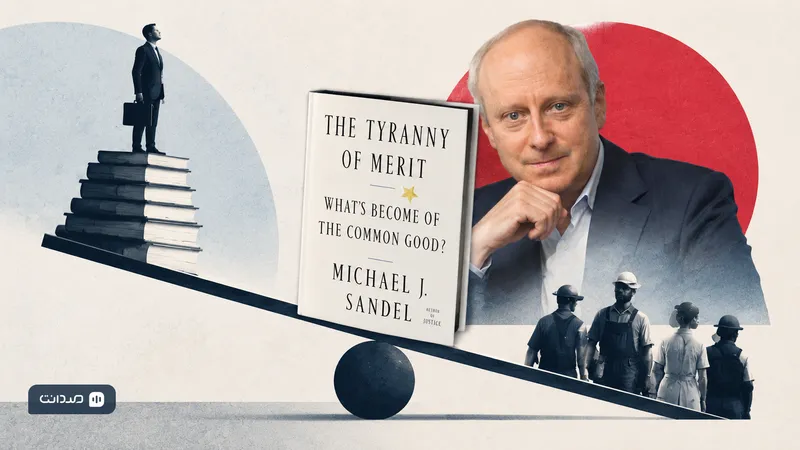 Philosophy
How Meritocracy Reinforces Inequality: Michael Sandel
 Philosophy
Michael Sandel's Justice lectures at Harvard University with Persian subtitles
 Philosophy
Lectures on Moral Philosophy by Shirzad Peik Herfeh
 Philosophy
Assessing the Legacy of John Rawls in the Effort to Reconcile Liberalism and Social Justice: A Conversation with Mousa Akrami on the Centenary of John Rawls's Birth
 Political Science
Discussion0 comments
No comments yet; let yours be the first voice.