Religion
Numerical Miracles and Mathematical Order in the Quran, Abbas Yazdani
Rashad Khalifa's claim about numerical patterns and the code of 19 in the Quran sparked a wave of excitement among Muslims; but Abbas Yazdani seeks to demonstrate that this is a deviation, and that the Quran is for guidance and reflection, not numerical and verbal puzzles.
Twenty-three years ago, an Egyptian chemist named Dr. Rashad Khalifa, who resided in America, claimed after three years of continuous work and using a computer! that he had discovered an astonishing order in the Quran. He said that the frequency of letters and words in the Quran is entirely measured and calculated, and bespeaks a wondrous proportion and order, and concluded that since no author or writer can, while composing a book, observe the frequency of their letters and words and embed a specific order among them, this feature is therefore unique to the Quran and constitutes one of the aspects of its miraculousness. .
Numerical Miracles and Mathematical Order in the Quran
Abbas Yazdani
23 years ago, an Egyptian chemist named Dr. Rashad Khalifa, who resided in America, claimed after three years of continuous work and using a computer! that he had discovered an astonishing order in the Quran. He said that the number of repetitions of letters and words in the Quran is completely measured and calculated, and indicates a wondrous proportion and order, and concluded that since no author or writer can, while composing a book, observe the number of repetitions of their letters and words and embed a specific order among them, this is therefore a special feature of the Quran and is considered one of the aspects of its miraculousness.
His first example to prove his claim was the disjointed letters (al-ḥurūf al-muqaṭṭaʿa) of the Quran, the secret and mystery of which he claimed to have discovered.
He said that the repetition of the disjointed letters in the relevant surah is greater than the repetition of other letters, and also the average repetition of these letters relative to the total letters of that specific surah is greater than the average repetition of these letters in other surahs. Also, in each of the 29 surahs that begin with disjointed letters, the total number of that letter or letters in that surah is exactly and without exception a multiple of 19, and other such matters which we will address later in this article.
With the announcement of this news and its dissemination by the mass media and newspapers of the day, this matter resonated everywhere in an unexpected way and stirred a wave of joy and delight among Muslims. The writer of these lines was also among those who, that day, could not contain their happiness and thought that Muslims had opened a very strong fortress against the atheists.
The spread of this news among the intellectuals of Islamic countries not only caused joy and delight but also prompted many of them to enter the field themselves and, by counting the number of letters and words of the Quran, unveil other layers of the secrets and mysteries of this heavenly book! Of course, from this group, some, after a period of wandering and getting nowhere, gave up the work. But another group, who had a firmer belief in the miraculousness of the Quran, continued this exploration and also published articles and writings, which we are not in a position to critique one by one; rather, in this article, we seek to prove that this current was a deviation, and those who fell into this valley gained nothing but wandering and failure, and numerous refuting and counter-arguments apply to their claims. Let us first note that he was not the first person in this valley, and traces of this idea can be seen in the book "Al-Itqan fi Ulum al-Quran" by al-Suyuti. (2/112)
Fundamentally, we must see how the Quran has introduced itself, how our infallible leaders have introduced the Quran? Have they described it as a mysterious, enigmatic, strange, and wondrous book, or have they called it a clear and content-rich book?
The truth is that the Quran considers itself a book of guidance and salvation and constantly invites us to recite and reflect upon it. The Quran does not invite us to gaze at its letters and words, but always calls us to read, reflect, and pay attention to its warnings. The Quran calls itself the best of discourses (aḥsan al-ḥadīth), where again its semantic aspect is intended, not its verbal structure, after which it says:
....the skins of those who fear their Lord shiver from it, then their skins and their hearts soften to the remembrance of Allah. That is the guidance of Allah by which He guides whom He wills... (39:23)
Introducing the Quran through the Quran
We draw your attention to a portion of the Quranic verses from which the nature of the Quran can be understood:
This is the Book about which there is no doubt, a guidance for the righteous. (2:2)
The month of Ramadan in which the Quran was revealed, a guidance for mankind and clear proofs of guidance and criterion. (2:185)
Indeed, this Quran guides to that which is most upright. (17:9)
And We have certainly diversified [the contents] in this Quran that they may be reminded, but it does not increase them except in aversion. (17:41)
And We send down of the Quran that which is healing and mercy for the believers, but it does not increase the wrongdoers except in loss. (17:82)
And indeed, you receive the Quran from One Wise and Knowing. (27:6)
As you observe, the Quran considers itself wisdom, knowledge, light, remembrance, guidance, admonition, a clear message, a means of separating truth from falsehood, a healing for heart diseases, a clarification of all things, and a means of exiting from darkness into light, and all these titles are made possible in light of paying attention to the content of the Quran and following its guidelines, not through scrutinizing the verbal structure and discovering the proportion and balance of the letters and words of this heavenly book.
We never encounter a description or title for the Quran that considers its verbal aspect from this particular angle. Of course, one of the dimensions of the Quran's miraculousness is its eloquence and rhetoric, but those too are a means of drawing ever greater attention to the content and substance of this heavenly book. The Arabic nature of the Quran is also in line with this; the Quran considers the philosophy of its being in Arabic to be so that servants may reflect and be more precise. As we know, the Arabic language possesses very high flexibility, and the subtleties and nuances of meaning cannot be conveyed to the audience in the mold of any language like the Arabic language:
انا انزلنا قرانا عربیا لعلکم تعقلون.
Therefore, nowhere in the Quran, not even implicitly, are we invited to such investigations.
Rather, it can be said we are encouraged against it.
As we know, one of the instructive and fascinating stories of the Quran is the story of the Companions of the Cave. After recounting their story, the Quran expresses regret that instead of paying attention to the message of this tale, following the path of the Companions of the Cave, and concluding from their awakening after a three-hundred-year sleep that God is capable of reviving human beings after the heavy sleep of death on the Day of Resurrection, people occupy themselves with the peripheral matters of the story and dispute over the number of the Companions of the Cave. Some say 4, some say 6, and a group considers them to be 8. The Quran says: O Prophet, do not dispute with them about this, do not ask them anything, and do not rely on their fables.
Consider another instance: Regarding the number of the guardians of Hell, the Quran says We have set their number as 19, not because We have considered secrets and mysteries in this number, but solely for the purpose of provoking the questioning of the sick-hearted and the disbelievers, and also to strengthen the faith of the believers:
و ما جعلنا اصحاب النار الا ملائکة و ما جعلنا عدتهم الا فتنة للذین کفروا لیستیقن الذین او توا الکتاب و یزداد الذین امنوا ایمانا و لا یرتاب الذین اوتوا الکتاب و المؤمنون و لیقول الذین فی قلوبهم مرض و الکافرون ماذا اراد الله بهذا مثلا کذلک یضل الله من یشاء و یهدی من یشاء....(31/74)
The Introduction of the Quran in Hadiths
Now let us see how the Quran is introduced in the hadiths. Has any hadith reached us from an Infallible that introduces the Quran as a mysterious, enigmatic book containing mathematical formulas and belonging to the category of geomancy and prognostication? The answer is negative. In the hadiths too, the Quran is called knowledge, wisdom, and light, and it is emphatically recommended that we make it the lamp of our actions and the torch of our lives.
In Nahj al-Balagha, it is stated: «الله الله فیالقرآن لا یسبقنکم بالعمل به غیرکم.»
In the noble book Al-Kafi, it is narrated from the Holy Prophet: «القرآن هدی من الضلالة و تبیان من العمی و استقالة من العثرة و نور من الظلمة و ضیاء من الاجداث و عصمة من الهلکة و رشد من الغواید و بیان من الفتن و بلاغ من الدنیا الی الاخرة و فیه کمال دینکم و ما عدل احد عن القرآن الا الی النار.»
In the book Faqih, from the Commander of the Faithful in his testament to his son, it is stated: «و علیک بتلاوة القرآن و العمل به و لزوم فرائضه و شرایعه و حلاله و حرامه و امره و نهیه و التهجد به و تلاوته فی لیلک و نهارک فانه عهد من الله تبارک و تعالی الی خلقه فهو واجب علی کل مسلم اینینظر کل یوم فی عهده و لو خمسین ایه و اعلم ان درجات الجنة علی قدر ایات القرآن فاذا کان یوم القیمة یقال لقاری القرآن اقرا و ارق فلا یکون فی الجنة بعد النبیین و الصدیقین ارفع درجة منه.»
It has never been observed in the statements of the Imams or their practical conduct that they viewed the Quran from this perspective, or that they expressed anything, even implicitly or allusively, about the number of letters and words of the Quran and the mathematical relationships between them, or at least provided a clue in this matter, so that we could spend time in this field with peace of mind and be pleased that if we have not reached a conclusion so far, there is hope of achieving interesting results in the future. It has also not been reported from the great scholars, even mathematicians such as Khajeh Nasir al-Din Tusi and Sheikh Bahai, that they demonstrated such an exploration and journey within the Quran.
Critique of Rashad Khalifa's Theory
Now let us see to what extent the gentlemen who believe they have discovered a mind-boggling order in the Quran are correct?
We said that Rashad Khalifa, regarding the disconnected letters, concluded that the average frequency of the disconnected letters in a specific surah always surpasses the average frequency of other letters. As in Surah Qaf, the letter "Qaf" has a higher average than other letters in this surah and other surahs of the Quran, or the letter "Nun" in Surah "Nun wa al-Qalam" has the greatest relative figure in the 113 surahs of the Quran.
If the statistics did not encounter counterexamples, perhaps we too would agree with him and the other followers of the theory of the mathematical order of the Quran, but despite our and his heartfelt desire, we encounter numerous exceptions. For example, the frequency of the letter "Qāf" in the Surahs Ash-Shams, Al-Qiyamah, and Al-Falaq is such that its average frequency exceeds the average frequency of "Qāf" [in the Qāf-initiated Surahs], or in the case of Surah Ṭā Hā, we face five exceptions: Surah Al-Ḥajj, An-Nūr, Al-Fatḥ, Al-Mujādilah, and At-Tawbah, or in the case of Surah "Yā Sīn," the result is completely reversed; that is, Yā and Sīn have the lowest frequency. Also, regarding the letter "Nūn," we see that its frequency in Surah Al-Ḥijr is greater than its frequency in Surah "Nūn wa-l-Qalam." It is here that Mr. Rashad Khalifa resorts to justification and concocts things that do not seem reasonable at all. For instance, regarding Surah Yā Sīn and why the result is completely reversed, he says: Because "Yā Sīn," unlike the other disconnected letters, is in reverse alphabetical order, so the result must also be reversed and inverted. Or if the average frequency of the letter "Ṣād" in Surah Al-Aʿrāf is less than its average frequency in some Surahs, such as Surah Wa-l-ʿAṣr, we must consider the four letters "Alif Lām Mīm Ṣād" that appear at the beginning of Surah Al-Aʿrāf together, and compare the average of the set of these four letters with the average of their set in other Surahs!! Or to answer the exception of Surah Al-Ḥijr, he says: We should consider Surah Al-Ḥijr, which begins with "Alif Lām Rā," as one Surah. And regarding the exception of the five aforementioned Surahs, he says: These five Surahs are Medinan, and since Surah Ṭā Hā is Meccan, we must compare it with other Meccan Surahs.
As you can observe, he goes through fire and water to open a place for his theory at any cost, while these exceptions are very numerous and his justifications are very flimsy and cold.
The repair of a theory must be in a manner agreeable to common understanding. Just as in reconciling the various statements of a wise individual, we must reconcile them in a way that is acceptable to common sense and is not, technically speaking, a forced reconciliation. Whereas his reconciliations lack a logical and conventional order and proportion, and he answers every exception with a specific style. Undoubtedly, with this method, one can find a mathematical order for any book!
We turn to other parts of his claims:
1- The phrase "Bismillāh al-Raḥmān al-Raḥīm," which is the first verse of the Quran, has 19 letters. Each individual word of this phrase is used in the Quran a number of times divisible by 19. Such that in the entire Quran, "Bismillāh" appears 19 times. The word "Allāh" appears 2698 times, "Raḥmān" 57 times, "Raḥīm" 114 times, all of which are integer multiples of the number 19. Of these 4 statistics, only the number 57 is correct, and that too on the condition that we count "Ar-Raḥmān" in the Bismillāh of Surah Al-Fātiḥah and do not count it in the rest of the Bismillāhs of the Quran; unless we resort to those same cold justifications. For example, for the count of "Allāh" to reach the desired quorum, we must count "billāh," "tallāh," "lillāh," and "fallāh," but exclude "Allāhumma" from the count. Or the word "ism" appears 22 times in the Quran, and if he means "bism," it is repeated only 7 times.
2- Surah An-Nās, which is the last Surah of the Quran, has 114 letters, which is a multiple of 19.
We do not know how he calculated this? But this Surah, without counting its opening Bismillāh, has 80 letters, and counting the Bismillāh, it becomes 99 letters, which in no case is a multiple of 19.
3- Surah Al-ʿAlaq, according to computer counting, has 285 letters, meaning 15 × 19.
We checked again; with Qurans in the ʿUthmān Ṭāhā script, it does not reach this number, and with Qurans in the Iranian script, it exceeds this number.
4- In each of the 29 Surahs that open with disconnected letters, the total number of that letter or letters is exactly and without exception a multiple of 19.
This claim is also incomplete. For example, the letter "Nūn" in Surah Nūn wa-l-Qalam appears 131 times, not 133 times to be a multiple of 19. Or in Surah Ṭā Hā, the total of these two letters is 239, not 342 to be a multiple of 19. It is interesting to know that although he emphasizes that the ʿUthmān Ṭāhā script is the criterion and standard everywhere, he has clichéd Surah Nūn wa-l-Qalam in his book and distorted its beginning. That is, instead of writing the first letter as "Nūn," he wrote it as "Nūn" [spelled out] so that one extra Nūn is added, and then he borrowed another Nūn from the Bismillāh at the beginning of the Surah, and in this way compensated for the deficiency of Nūn and reached the number 133.
In Surah Taha as well, he has counted the round tāʼ as hāʼ, while everyone knows that the round tāʼ is in reality a tāʼ, even though it is pronounced as hāʼ when pausing; that is, words like: zīnah, khīfah, saḥarah, ṣalāh, qīmah, kalimah, bayyinah, sāʿah, ḥabbah, maḥabbah and their like end in tāʼ, as they are pronounced with the sound of tāʼ. But the narrowness of the rhyme has forced him to include these cases in the count as well, in order to reach the required quorum.
5- If we calculate the number of times each individual word of the phrase "Bismillāh al-Raḥmān al-Raḥīm" appears in the Quran after dividing by the number 19, we again arrive at a multiple of 19. This matter is also incorrect, as mentioned in the first paragraph.
6- Surah Al-Naṣr, which is said to be the last surah, has exactly 19 words. The first verse of this surah also has 19 letters.
We do not know how he calculated it to be 19 words, unless the term "word" has a special technical meaning for him. He has stereotyped this surah in his book and numbered the words below them. He has counted the phrase "wa istaghfirhu" as one word, although it is not one word and is at least three words. He has also counted "wa al-fatḥ" as one word, whereas it is two words. If he says that letters should not be counted separately, we ask, then why has he counted "fī" as a separate word?
7- Bismillāh, in this specific form, appears 3 times in the Quran, and if we add the sum of the verse numbers and the surah numbers to the number of repetitions of Bismillāh, we reach a multiple of 19.
His intention is not Bismillāh in the entire Quran, but rather the Bismillāh whose verse has a number, which is only the Bismillāh of Surah Al-Fātiḥah, the Bismillāh in verse 41 of Surah Hūd, and the Bismillāh in verse 30 of Surah Al-Naml.
After he wrote the numbers of the verses and surahs under each other and did not reach a multiple of 19, he devised another solution and said that since we have 3 Bismillāhs, we also add the number 3 to the sum of these figures, in order to reach the number 114:
In my opinion, the worst example he has presented is this very example. Because the work of montage-making and patching up of numbers is clearly evident in it.
8- If we calculate the figures related to the common letters in the disconnected letters (al-ḥurūf al-muqaṭṭaʿah), we reach a multiple of 19. He has drawn such a table.
What prevented him from adding the word "Yā Sīn" to this set as well? Because "Yā Sīn" shares commonality with four surahs from the above set through Sīn and Yāʼ. Or if we were to include "ʿAyn Sīn Qāf," which appears at the beginning of Surah Al-Shūrā, in this table, it would share commonality with Surah Maryam, Al-Shuʿarāʼ, Al-Naml, and Al-Qaṣaṣ through ʿAyn and Sīn. If you ask what caused his table to possess specific disconnected letters? The answer is that if he had not acted according to his own taste and not a logical and fixed method, he would not have reached the required quorum.
9- In the seventh, nineteenth, and thirty-eighth surahs, the letter "Ṣād" is common among their disconnected letters, and if we count the number of "Ṣād" in these surahs and add them together, we reach the number 152, which is a multiple of 19.
Observe that in Surah Qāf, he counted the letter Qāf independently and it became a multiple of 19; but because he did not reach a result in Surah Ṣād, he changed the method and counted all the surahs that have "Ṣād" at the beginning together.
He might say that whether we count Qāf independently or as a sum, we reach a multiple of 19. Because in Surah Al-Shūrā as well, Qāf is repeated 133 times, which is a multiple of 19. So where repetition is seen, we must count all of them together, like Ṣād or Qāf. But where it is unique, like the letter Nūn in Surah "Nūn wa al-Qalam," we must count it separately.
Again, we see this answer is not complete because in Surah Maryam, among the disconnected letters, we have Kāf, which we do not have elsewhere, and if we consider its number independently, it does not reach the required quorum.
In any case, as we have repeatedly pointed out, he does not adopt a single procedure in his counts and only seeks to piece together the required quorum.
Dr. Muḥammad Ḥasan Hītū, one of the critics of the numerical
miracle of the Quran, says in the book "al-Muʿjizah al-Qurʼānīyah": One of the first people to critique Rashād Khalīfah's theory was Professor "Ḥusayn Nājī Muḥammad" in his book titled "al-Tisʿata ʿAshara Malakan" (The Nineteen Angels). He invented seven sentences, all of which consist of 19 letters and each contains 3 Lām letters, and the total number of letters in these sentences is also 133, which is a multiple of 19, and the total number of Lāms in all seven sentences is also 19. Then he says: Is the mere existence of these numerical correspondences proof of the truthfulness of the content of these sentences?
1- Lā baʿth wa lā ḥisāb wa lā jahannam.
2- Lā ṣirāṭ wa lā jannah wa lā naʿīm.
3- Muhandis al-kawn al-rabb Iblīs.
4- Al-Bahāʼīyah hiya al-dīn al-ḥaqq.
5- Bahāʼ Allāh ākhir al-anbiyāʼ.
6- Al-Jannah wa al-nār ukdhūbatān.
7- Raqm tisʿat ʿashar ramz li-Iblīs.
Critique of the Book al-Muʿjiza
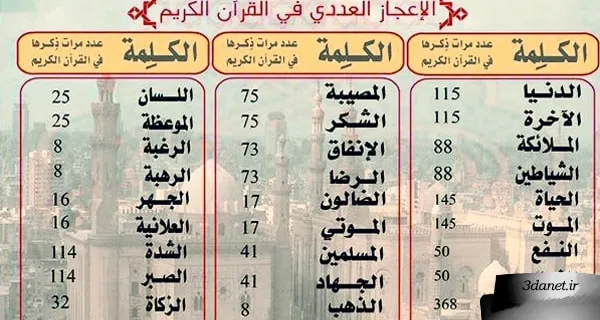
Another follower of Mr. Rashad Khalifa’s path is Mr. Engineer Adnan al-Rifaʿi. He, too, has compiled statistics on the words of the Quran and authored a book called al-Muʿjiza. Consider a portion of its contents.
The word yawm (day) appears in the singular 365 times in the Quran.
The word shahr (month) appears in the singular 12 times in the Quran.
The word jahannam (hell) appears 77 times, and the word jannāt (gardens/paradise) and its derivatives are also repeated 77 times.
The word rajul (man) and the word imraʾa (woman) each appear 24 times.
The word al-ḥayāh (life) and the word al-mawt (death), with their derivatives, each appear 145 times.
The word al-malāʾika (angels) and the word al-shayṭān (Satan) each appear 68 times.
The word al-malāʾika and its derivatives appear 88 times; the word al-shayṭān and its derivatives also appear 88 times.
The word yufsid (he corrupts) and its derivatives, like the word yanfaʿ (he benefits) and its derivatives, each appear 50 times.
The word al-raghba (desire) and its derivatives, with the word al-rahba (fear) and its derivatives, each appear 8 times.
The word muṣība (calamity) and its derivatives, with the word al-shukr (gratitude) and its derivatives, each appear 75 times.
The word shakk (doubt) and the word ẓann (conjecture) each appear 15 times.
The word halaka (he perished) and its derivatives, with the word najāh (salvation) and its derivatives, each appear 66 times.
The word al-nūr (light) appears 24 times; the word aẓlam (darker) and its derivatives also appear 24 times.
The word al-dunyā (the world) and the word al-ākhira (the Hereafter) each appear 115 times.
The word thaqulat (it became heavy) and its derivatives, with the word khaffat (it became light) and its derivatives, each appear 17 times.
The word al-ʿizz (might) and its derivatives, with the word al-dhull (humiliation) and its derivatives, each appear 21 times.
The word qabl (before) and qablak (before you), with the word baʿd (after) and baʿdak (after you), each appear 149 times.
The total of aqsamtum (you swore) and aqsamū (they swore) equals the number of aqsim (I swear), i.e., 8 times.
The word qālū (they said) equals the word qul (say) at 332 times.
The word qultum (you said) and aqūl (I say) each appear 9 times.
The word taqūlūn (you say) and naqūl (we say) each appear 11 times.
The total of the two words taqūlū (you say) and taqūlūn equals the word qulnā (we said), i.e., 27 times.
The word al-barr (land) appears 12 times, which, if combined with the word yabasan (dry land), which is synonymous with it, becomes 13 times. The word al-baḥr (sea) appears 32 times.
Their total is 45 = 32 + 13; thus, land and water, a ratio that precisely corresponds with external reality.
Many of these statistics are incorrect upon calculation, and even assuming their accuracy, they require extensive justifications and contrivances. For example, to reach the number 365 in counting yawm, he says we must consider yawm in the singular form. Because if we count ayyām (days) and yawmayn (two days), we do not reach the desired number. But still, his purpose is not fulfilled, because yawmaʾidhin (that day), yawmakum (your day), and yawmahum (their day) must also be excluded from our list, even though these are also singular. If by singular he means that no letter is attached to yawm, then bi-al-yawm (in the day), li-yawm (for a day), and fa-al-yawm (so today) must also be excluded from the list, which would make our count far less than 365. In short, he has followed no logical method to achieve the number 365, and with such arbitrary selections, one can find mathematical order in the vocabulary of most books.
In cases where his count does not reach the required threshold, he resorts to the derivatives of that specific word and tries to achieve the necessary threshold by adding derivatives. The unanswered question remains: why, in some cases, must we count derivatives, while in other cases, we suffice with the count of the singular form of that word? Even stranger is that for some words, like jahannam and jannāt, he says that for one we must achieve the desired result in the singular form, and for the other by including derivatives.
Elsewhere, he counts the word yufsid and its derivatives, and because he does not find it equal to the number of the word yuṣliḥ (he reforms), he turns to the word yanfaʿ. Yet it is clear to those familiar with the Arabic language that yufsid is the opposite of yuṣliḥ, not yanfaʿ.
For the two words qabl and baʿd, when he does not reach the required threshold, he says we must also add qablak and baʿdak to our list. The answer to this question remains unclear: why should we not include qablakum (before you all), or qablanā (before us), or qablahā (before her)?
The words qālū and qul are also not exactly equal; that is, qul appears 333 times and qālū 332 times in the Quran.
Instead of comparing qultum with qulnā, he has compared it with aqūl. Also, instead of placing taqūlū and taqūlūn alongside taqūl (you say), he has compared them with qulnā.
Strangest and most bizarre of all is the calculation of the proportion of water and land on the Earth. When he compares barr and baḥr and does not achieve the desired fraction, he resorts to the word yabasan and says: if we also include it, which is synonymous with barr, the repetition of the word for land becomes 13 and the repetition of sea 32, yielding the fraction ????, which is very astonishing and among the miracles of the Quran.
One must ask him: how is it that we must involve yabasan, which is synonymous with barr, in the count, but not involve the word yamm (sea), which is synonymous with baḥr? Furthermore, the ratio of water to land on the Earth is never a constant ratio; two thousand years ago it was very different from today, and a thousand years from now, the extent of the seas will also diminish.
Critique of the Book Āyat-e Kobrā
Another victim of Rashad Khalifa's path is the author of the book Āyat-e Kobrā.
This entire one-hundred-and-fifty-page book is devoted to calculating the disconnected letters of the Quran, and in all the calculations and tables drawn in the book, he arrives at a number that is a multiple of 19, and he considers this very fact to be the eternal miracle of the Quran.
His difference from others who have followed the same path lies in adding dotted letters to undotted letters. Early in the book, he writes, "...what is established and certain is that at the time of revelation, there was not the slightest trace of dotting, and for one or two centuries, the Quran was written in a bare form, without dots or diacritical marks, and iʿjām, which means dotting, became common one or two centuries after the revelation of the Quran. Hence, in openings such as: Ḥā Mīm, Yā Sīn, Ṭā Sīn, and their like, which altogether appear in fourteen different forms at the beginning of twenty-nine surahs, one cannot and should not, for example, consider the form 'ح' to be specific only to the letter Ḥāʾ; rather, according to the explanation above, its indication of two letters and two sounds, Ḥ and Kh, is also certain and clear, and this rule holds true for all the undotted letters of the openings for which a dotted form is also conceivable. It was based on this view that we began our research on the undotted and dotted letters of the surah openings, and this work, over several years with continuous effort and with divine confirmation and guidance, reached very important and interesting results, and conjecture and supposition were transformed into reality and certainty."
As you can see, he believes that to calculate the number of repetitions of the disconnected letters of the Ḥawāmīm surahs, we should not suffice with counting the letters Ḥāʾ and Mīm; rather, we must count four letters: Ḥ, Kh, J, M, because J and Kh were also written in the form of Ḥ in early Islam. Or, if we are counting the disconnected letters of the blessed surahs of Al-Shuʿarāʾ, Al-Naml, and Al-Qaṣaṣ, we should not count only Ṭāʾ, Sīn, and Mīm, but we must also count Ẓāʾ and Shīn and add them to the total, because Ẓāʾ and Shīn were also written in the form of Ṭāʾ and Sīn at the time of the Quran's revelation.
In response to him, it must be said: We accept that the writing and transcription of the Quran at the time of revelation was very primitive and simple, and dotted letters were written like undotted letters, but how did you come to realize that dotted letters were pronounced like undotted letters? Certainly, this deficiency was limited to writing and did not extend to recitation and pronunciation. For if, in recitation, Sīn and Shīn were also one, then the alphabet and structure of the Arabic language would be completely different from what we know of the Arabic language.
Writing and transcription are not so important; what is important is recitation, and in the era of revelation, Ḥāʾ, Khāʾ, and Jīm certainly differed in pronunciation, and the criterion in the Quran is what was recited to the Prophet through revelation, and the Holy Prophet also recited whatever was revealed to him to the people, and the Muslims learned and quickly memorized it. Thousands of memorizers of the Quran existed during his time, and the Quran was present in every aspect of people's lives, and the Muslims were diligent in teaching it, and apart from prayers, they became accustomed to reciting and listening to it during the hours of night and day.
The situation was such that the deficiency in writing never extended to the recitation and reading of the Quran.
Therefore, it is not at all logical, due to the existence of a deficiency in writing and the fact that dotting was not customary in those days and Ḥāʾ and Khāʾ were identical in writing, to consider "Ḥā Mīm" as four letters. We are only permitted to consider "Ḥā Mīm," which appears at the beginning of seven surahs of the Quran, as four letters if all reciters of the Quran pronounce Ḥā Mīm with four letters. We are only permitted to consider "Yā Sīn" as representing 6 letters (Yāʾ, Bāʾ, Thāʾ, Nūn, Sīn, and Shīn) if the form "Yā Sīn" is pronounced by the reciters of the Quran and Muslims as 6 letters, whereas both "Ḥā Mīm" and "Yā Sīn" have been recited as two letters from the time of revelation until now.
As you can see, his entire book is based on a false foundation, and with the invalidation of the basis of the claim, there is no need to strive to invalidate the applications of this theory, although he, like his like-minded peers, has in many instances made left turns and changed tactics, and has gone through fire and water to reach multiples of 19.
For example, when he does not reach the desired result in calculating "Alif Lām Mīm" and "Alif Lām Rā," he attributes this failure to the change in the orthography of "Alif." He writes about this:
"Alif is the only letter that has undergone indiscriminate transformation, omission, and substitution. Therefore, performing an accurate and reliable calculation is not possible.
مدتی طولانی همچنان با تأسفی عمیق از این خطای نگارش و سهل انگاری گذشتگان سپری شد.تا اینکه یک روز طرح تازهای درباره این فواتح، به نظرم رسید که بتدریج پس از محاسبات عدیده و آزمایشهای گوناگون به مرحله ثبوت رسید و معلوم گردید که حروف دیگر این فواتح سیزده گانه مستقلا و بدون«الف»نیز دارای همان نقش شگفت ریاضی است».
در جای دیگر در مورد«کهیعص»مینویسد: «از سه حرف باء و ثاء و نون کهدر فاتحه سوره مریم و یس به دلیل همشکلی و شباهت هم ردیف با«باء» میتوان در نظر گرفت، «ب»و«ث»از لحاظ تحریر همواره یکسان بوده و فرقشان فقط در نقطهگذاری است.ولی«نون»با آن دو، فرق بارزی دارد.لذا ما بر مبنای همین اختلاف«نون»را موقتا کنارگذاشته و فرض میکنیم حروف هم شکل یاء در ه ردو مورد فقط«ب»و«ث»باشد».
همانطور که ملاحظه میکنید، ایشان تغییر تاکتیک میدهد تا به رقم مورد نظر برسد.باید از ایشان بپرسیم چرا«نون»را فقط در شمارش حروف مقطعه سوره مریم از دور خارج ولی در جاهای دیگر مثل سوره«یس»، «نون»را منظور کردید؟
نقد جزوه«اعجاز ریاضی قرآن در خصوص اعداد زوج و فرد»
شخص دیگری به نام کوروش جم نشان، از ونکور کانادا، با توجه به آیه سوم سوره و الفجر که خداوند متعال به زوج و فرد سوگند یاد کرده است، به فکر افتاده است که شاید یک نظام عددی بر مبنای زوج و فرد در قرآن باشد و بعد از تحقیقات به این نتیجه رسیده است که اگر اعدادی را که از حاصل جمع شماره سورهها و تعداد آیات سورهها به دست میآید، در یک ستون بنویسیم، بعد زوجها را با هم و فردها را با هم جمع کنیم، جمع اعداد زوج دقیقا مساوی با جمع تعداد آیات قرآن یعنی 2636 و جمع اعداد فرد مساوی با 6555 است که حاصل جمع شماره سورهها میباشد.سپس تکبیر گویان مینویسد:
«دبن ترتیب نمونه دیگری از اعجاز عددی قرآن کشف شده و نشان میدهد که ترتیب قرار گرفتن سورهها و تعداد آیات هر سوره، مبتنی بر یک نظام مخصوص و حساب شدهای است.اللّه اکبر.»
باید در پاسخ گفت:اگر در زوج و فرد بودن آیات قرآن نکتهای باشد، باید میان سورههای فرد و سورههای زوج یا آیههای دارای شماره فرد و آیههای دارای شماره زوج به وضوح دیده شود.امّا اثبات، بلکه احداث نکته آنهم با طی کردن این راه پیچ در پیچ ربطی به مفاد آیه ندارد.ایشان بعد از آنکه بین آیات دارای شماره فرد و عدد حاصل از مجموع آیات زوج و عدد حاصل از این دو مجموعه هیچ نکتهای نیافته است، شماره سوره را به تعداد آیات سوره اضافه کرده و ستونی از این اعداد تشکیل دده است.آنها را با هم جمع کرده و باز به نکتهای نرسیده است.در مرتبه آخر، اعداد زوج این ستون را جداگانه و اعداد فرد را جداگانه با هم جمع کرده است و به دو عدد جدید رسیده است 6236 و 6555 عدد دوم مضرب 19 میباشد سراغ عدد اول رفته ولی آن را مضرب 19 نیافته است.
(ایشان نیز از کسانی است که به عدد 19 در قرآن عنایت خاصی دارد چنانکه در جزوههای دیگری از یافتههای آقای عبد اللّه اریک تجلیل کرده است)اگر هر دو مضرب 19 میبود خیلی به اعجاب ایشان میافزود امها متاسفانه یکی مضرب 19 بوده و دیگری مضرب 19 نیست.ولی در لابلای همین محاسبات ناگاه متوجه میشوند که عدد اول معادل تعداد آیات قرآن و عدد دوم مساوی با حاصل جمع شماره سورههاست.اینجاست که تکبیر گویان اعلان موفقیت میکنند.
ما میگوئیم خدای حکیم بسیار بعید است با مخاطبین خود از چنین طریقی ارتباط برقرار نماید.
خداوند نیز در تفهیم و تفاهم با بندگانش همان راهی را طی میکند که بین عقلاء جاری و مرسوم است و معما و لغز به کار نمیبرد و اگر بخواهد امری را مماگونه بیان کند، معمّای او باید به گونهای باشد که تا قیامت معمّا بماند.چه، اگر بشر بتواند چیزی را که مشیت خدا آن را معمّا خواسته است کشف کند این نوعی نقص و ضعف برای خداوند خواهد بود چنانکه به نظر ما حروف مقطعه قرآن از این مقولهاند.یعنی شواهد و قرائن نشان میدهد که خداوند میخواهد اینها در قالب رمز و معمّا باقی بمانند و یا تاریخ دقیق قیامت به تصریح خود قرآن از این مقوله است.
این نکته که خداوند در تفهیم مقاصد خود از سیره عقلانیه تبعیت میکند، در یکی از فرمایشات امامصادق(ع)به آن تصریح شده است:
«قیل لابی عبد اللّه علیه السلام روی عنکم ان الخمر و المیسر و الانصاب و الازلام رجال فقال ما کان اللّه لیخاطب خلقه بما لا یعقولن.(وسائل الشیعه جلد 12، ص 243)
بر اساس این حدیث، تفسیرهای باطنی همه مردود است و اثبات تناسبهای عددی و نظم ریاضی در قرآن آن هم با عبور از راههای مارپیچ، یکی از شاخههای تفسیر باطنی است.بنابراین بسیار بعید است خداوند از آیه شریفه«والشفع و الوتر»چیزی را بخواهد به ما تفهیم نماید که آقای کورش جم نشان، کشف کردهاند.زیرا ادعای ایشان بسیار غریب و از فهم عرفی دور است و مخاطب، بعد از فهمیدن راه طی شده، باز در هالهای از شک و تردید باقی میماند و شاید یکی از علل آن جمع شماره سوره با تعداد آیات سوره باشد.جمع این دو پارامتر جمع دو چیز غیر متجانس است؛مثل آنکه تعداد ستونهای مسجد جامع اصفهان را با تعداد روزهای هفته جمع نموده باشیم.
اشکال اساسیتر این است که چنین چیزی اثبات اعجاز قرآن نیست، زیرا به راحتی میتوان کتابی نوشت و از آغاز بین ابواب و فصول و تعداد جملات آن چنین نظمی را جاسازی نمود.بنابراین این کشفیات ذرهای موجب گرایش منکران قرآن به قرآن نخواهد بود بلکه اینگونه دفاعیات غیر منطقی و ضعیف خود موجر اعراض و اشمئزاز بیگانگان میشود.
نقد کتاب«ماوراء احتمال»
نویسنده دیگری از کانادا با استفاده از کتاب«ماوراء احتمال»تألیف عبد اللّه اریک، مقالهای تحت عنوان «بسم اللّه مفقوده»!نوشته و مدعی شده است، نبودن بسم الله در صدر سوره توبه و تکرار آن در سوره نمل بسیار حکیمانه و از معجزات قرآن است.ما اصل کتاب را که به زبان انگلیسی است به دست آوردیم.در آنجا ایشان میگوید:«اگر برای هر بسم الله کدی مرکب از شماره سوره و شماره آیه قرار دهیم و مجموع این اعداد را جمع کنیم به عدد 68191 میرسیم که دقیقا مضرب صحیحی از عدد 19 میباشد.»ایشان میگوید:«در سوره حمد، بسم الله شماره 1 را به خود اختصاص داده، ولی در سورههای دیگر بسم الله شماره آیه ندارد لذا عدد صفر با به عنوان شماره آیه این قبیل بسم اللهها در نظر میگیریم.»
بر این اساس اولین بسم الله قرآن در آیه اول سوره اول است پس کد آن 11 میشود و دومین بسم الله کد 20 را به خود اختصاص میدهد.زیرا شماره آیه آن صفر است به همین ترتیب به جلو میرویم به سوره توبه میرسیم که چون بسم الله ندارد از ان عبور میکنیم و بعد در سوره نمل بسم الله اول کد 270 و بسم الله آیه سیام کد 2730 را به خود اختصاص میدهد.بعد مجموع این اعدا را زیر هم نوشته جمع میکنیم دقیقا میشود 68191.
باید عرض کنیم اسلوب نویسنده کتاب«ماوراء احتمال»نیز منطقی نیست ایشان اگر همچون شیعیان معتقدند که بسم الله جزء سوره است، باید برای همی بسم اللههای آغاز سورهها رقم یک را منظور کنند و اگر همچون سنّیان معتقدند که بسم الله جزء سوره نیست، باید در سوره حمد نیز کد 10 را انتخاب کنند، نه یازده را.زیرا اهل تسنّن بسم الله سوره حمد را نیز جزء سوره نمیدانند.هر چند در رسم الخط عثمان طه شماره یک را به خود اختصاص داده است.وانگهی در جایی که بسم الله جزء سوره نیست به چه علت رقم صفر را به جای شماره آیه انتخاب میکنند؟چه آنکه صفر به عنوان رقم یکان در کل عدد تاثیر میگذارد، باید برای مثال کد بسم الله سوره 59، عدد 59 باشد نه 590.
پیچیدهترین محاسبات در موضوع اعجاز عددی قرآن به همین آقای عبد اللّه اریک اختصاص دارد.
ایشان با استفاده از تعداد کلمات و حروف و ارزش ابجدی بسم اللّه الرحمن الرحیم و جابجا کردن ارقام به اعداد بزرگی که گاه تا 73 رقم دارند، دست یافته و اعلام میکند همه این اعدا مضرب 19 میباشند.ایشان مینویسد:«بسیار شگفتانگیز است که چهار کلمه و 19 حرف آیه بسم اللّه الرحمن ارلرحیم دارای این تعداد ترکیبات عدیی مبنای 19 باشند.تصور تصادفی بودن این ترکیبات غیر معقول است، زیرا سازگاری عجیبی بین آنها وجود دارد.»
ایشان مینویسد:«فورمت خاص این اعداد به این شکل است:n-...5؟4؟3؟2؟1؟
ثانیا بر فرض که چنین روابط پیچیده ریاضی در حروف و کلمات«بسم اللّه الرحمن الرحیم» مستتر باشد، این ارتباطی به قرآن ندارد.زیرا بسم اللّه الرحمن الرحیم قبل از قرآن نیز ترکیبی آشنا و شناخته شده بوده است.خود قرآن میفرماید: حضرت سلیمان که قرنها قبل از نزول قرآن میزسته است، نامه خود را با بسم اللّه الرحمن الرحیم شروع کرده است.
نقد کتاب«الاعجاز العددی فی القران الکریم»
از دیگر کسانیکه در این زمینه دست یه تألیف زدهاند، استاد بعد الرزاق نوفل است.عنوان کتاب ایشان«الاعجاز العددی فی القران الکریم»میباشد.
The bulk of his work also involves discovering proportionality in the repetition of Quranic words. Consider a portion of his findings:
The word “Iblis” and “seeking refuge” from Iblis each occur 11 times.
The word “calamity” and its derivatives, and the word “gratitude” and its derivatives, each occur 75 times.
The word “excess” and its derivatives, along with the word “haste” and its derivatives, each occur 23 times.
The word “authority” and its derivatives, along with the word “hypocrisy” and its derivatives, each occur 37 times.
The word “war” and its derivatives, along with the word “captives” and its derivatives, each occur 6 times.
The word “evil deeds” and the word “righteous deeds” occur 180 times.
The word “benefit” and the word “the messengers” occur 50 times.
The word “the people” and the word “the messengers” occur 368 times.
The word “the tribes” and the word “the disciples” occur 5 times.
The word “misguidance” and its derivatives occur 191 times, and the word “verses” occurs twice that, 382 times.
The word “distress” and its derivatives, and the word “tranquility” and its derivatives, each occur 13 times.
The word “religion” and its derivatives, along with the word “mosques” and its derivatives, each occur 92 times.
The word “wonder” with its derivatives, and the word “vanity” and its derivatives, each occur 27 times.
The word “recitation” with all its derivatives occurs as many times as the word “righteous deeds,” 62 times.
The word “peace” and “good things” with their derivatives each occur 50 times.
The word “benevolence” and all its derivatives, together with the word “good deeds” and all its derivatives, total 382 times, the same number as the word “verses” and its derivatives.
The word “bowing” and the word “devout obedience,” counting their derivatives, each occur 13 times.
The objection raised against him is that many of these figures are optimistic.
That is, when we carefully count, we do not arrive at his numbers.
For example, the word “Iblis” appears eleven times in the Quran, but “seeking refuge” appears more than this number. To remove any doubt, observe the relevant verses:
1- Indeed, I seek refuge in my Lord and your Lord from every arrogant one who does not believe in the Day of Account. (27/40)
2- And indeed, I have sought refuge in my Lord and your Lord, lest you stone me. (20/44)
3- They said, “Do you take us in mockery?” He said, “I seek refuge in Allah from being among the ignorant.”
4- He said, “My Lord, indeed I seek refuge in You from asking You that of which I have no knowledge.”
5- She said, “Indeed, I seek refuge in the Most Merciful from you, if you should be fearing of Allah.”
6- And say, “My Lord, I seek refuge in You from the incitements of the devils.”
7- And I seek refuge in You, my Lord, lest they be present with me.
8- Say, “I seek refuge in the Lord of daybreak.”
9- Say, “I seek refuge in the Lord of mankind.”
10- And I seek refuge for her in You and her descendants from Satan, the expelled.
11- And if an evil suggestion comes to you from Satan, then seek refuge in Allah.
12- So when you recite the Quran, seek refuge in Allah from Satan, the expelled.
13- Indeed, within their breasts is arrogance, which they will not attain. So seek refuge in Allah.
14- And if an evil suggestion comes to you from Satan, then seek refuge in Allah.
15- He said, “I seek refuge in Allah! Indeed, he is my master, who has made good my residence.”
16- He said, “I seek refuge in Allah that we take anyone except him with whom we found our property.”
As you can see, all these instances are seeking refuge in God. If one were to separate from among them the cases that are explicitly seeking refuge in God from Iblis, they would only find 7 instances, and moreover, these are instances of seeking refuge from Satan/devils, not Iblis.
Another objection is that for some words, there is no clear conceptual connection between the two terms. For example, what connection is there between calamity and gratitude? Should one practice “patience” in the face of calamity, or should one be “grateful”? Does the Quran not say: “And be patient over what befalls you. Indeed, that is of the matters requiring resolve”? Most likely, when Mr. Abd al-Razzaq Nawfal saw that the number of the word patience and its derivatives (103) did not equal the number of the word calamity, he turned to the word gratitude. The word gratitude should also not be placed alongside calamity, because from the Quran’s perspective, “gratitude” is always accompanied by increase and growth.
He must have then looked at the word increase and its other derivatives, and since he saw its number (62) was less than the number of the word gratitude, he equated gratitude with “calamity.”
Another case is the words tribes and disciples.
The Asbat were twelve tribes of the Children of Israel, each descended from one of the sons of Jacob, and the Hawariyyun are the name of the special companions of Jesus Christ, whom Christians consider to be twelve. If the frequency of each in the Quran were twelve times, it would be fitting for him to say, therefore the number of the tribes and the disciples is also twelve. In response to him, we would say there is no need for this contrivance, because the Quran itself considers the tribes to be twelve: “And We divided them into twelve tribes as communities...” In any case, it is unclear what conclusion he intends to draw from the fivefold repetition of these two words.
Another case is the words “excess” and “haste.” It is unclear what the 23-time repetition of these two words proves.
Does the author want to say that excess is accompanied by haste? Or that one should not be hasty in excess? Or that excess leads to swift destruction? Or that the excessive will face the swift in punishment? The first two possibilities are not reasonable, and the latter two would require measuring excess against the words “punishment” and “destruction,” not against the word “haste.” Again, the connection between “peace” and “good things”—“recitation” and “righteous deeds”—“religion” and “mosques” is unclear, and we are forced to fabricate something ourselves.
Another problem is their contrived rhyming. Regarding the two words sayyiʾāt (evil deeds) and ṣāliḥāt (righteous deeds), he says: if we count both with all their derivatives, we reach the number 167, provided, of course, that we delete the name of Prophet Ṣāliḥ, and aṣlaḥ, aṣlaḥnā, yuṣliḥ, and aṣliḥ from the derivatives of “ṣāliḥāt.” It would have been reasonable for him to measure sayyiʾāt against ḥasanāt (good deeds), not ṣāliḥāt.
You observe in this example that he brings up ṣāliḥāt with its derivatives and does not reach a result.
He deletes a number of derivatives so that the rhyme fits. Elsewhere, he measures “tilāwah” (recitation) against “ṣāliḥāt,” provided that we do not involve derivatives, and in this way the count of ṣāliḥāt reaches 62, which is the number of the word tilāwah and all its derivatives—meaning that on one side of the equation derivatives are involved, and on the other side they are not, and all of this is to establish the mathematical order of the Quran.
Such lapses are abundant in Mr. Abd al-Razzāq Nawfal’s book, to the extent that even the translator of his book criticizes him in footnotes in many instances.
A Critique of the Book Min al-Iʿjāz al-Balāghī wa al-ʿAdadī lil-Qurʾān al-Karīm
Another person who continued the works of Abd al-Razzāq Nawfal and Dr. Rashād Khalīfah and greatly praised them is Dr. Abū Zahrā al-Najdī. He writes: I, too, pursued their work, and through much effort and staying up at night, the doors of divine mercy were opened to me, and I attained important truths about the inimitability of the Quran.
He says: I said to myself, if the number of the word “shahr” (month) is twelve times and the number of the word “yawm” (day) is 365 times, then the word sāʿah (hour) must also appear 24 times in the Quran. I opened the book al-Muʿjam al-Mufahras li-Alfāẓ al-Qurʾān and began counting, but I reached the number 47. I was about to despair, but I continued the work and suddenly realized that in 24 of these 48 instances, the word “sāʿah” is preceded by a particle, meaning there is a word before it that is neither a noun nor a verb. So I became happy, and my worry about this matter was resolved.
The question is: what role does the precedence of a particle before the word “sāʿah” play in this affair? In any case, the word “sāʿah” appears 48 times in the Quran, and if we are to separate instances preceded by a particle from those preceded by a verb and a noun in the count, we must do this everywhere, not resort to such measures wherever the rhyme becomes strained.
Another point is that “sāʿah” in the language of the Quran and traditions means a period of time in which one can complete a customary task, not the technical meaning of 60 minutes. For example, in the noble verse laqad tāba Allāhu ʿalā al-nabīyi wa al-muhājirīna wa al-anṣāri alladhīna ittabaʿūhu fī sāʿati al-ʿusrah (Indeed, Allah has turned in mercy to the Prophet, and the Emigrants and the Helpers who followed him in the hour of difficulty), “sāʿah” does not mean the technical hour.
Another problem is that in most cases, “sāʿah” means the Resurrection, not a period of time.
Dr. Abū Zahrā al-Najdī says: In the course of this series of investigations, I realized that the word sajdah (prostration) appears 34 times in the Quran, which refers to the 34 prostrations incorporated in the seventeen units (rakʿahs) of the daily prayer.
Of course, he encountered 35 instances, but he does not count one instance, which is the verse wa al-najmu wa al-shajaru yasjudān (And the stars and the trees prostrate). He says: This verse should not be counted because this verse refers to the prostration of non-rational beings. His effort, like that of his like-minded colleagues, lacks a logical method, because the discussion is about the concept of sajdah, and this concept is the same in all thirty-five instances. Moreover, in the verse wa lillāhi yasjudu mā fī al-samāwāti wa mā fī al-arḍ (And to Allah prostrates whatever is in the heavens and whatever is on the earth), the word “mā” (whatever) encompasses all earthly and heavenly beings and is not specific to rational beings, and the prostration of non-rational beings is a reasonable matter from the Quran’s perspective, just as the Quran affirms prayer and glorification for all beings and says: You humans do not understand their prayer and glorification.
Among his other examples related to the issue of the caliphate of the Ahl al-Bayt are the following examples:
The number of repetitions of the word “Imām” and its derivatives, “Khalīfah” and its derivatives, “Waṣīyah” and its derivatives, “Shahādah” and its derivatives, “Yaʿṣim” and its derivatives, “Shīʿah” and its derivatives, “Ijtabā” and its derivatives, “Ruhbān” and its derivatives, and “Najm” in singular and plural forms, all is 12, and this is proof of the truthfulness of the followers of the Twelve Imams.
The verses in which the word Imām appears are twelve verses.
But including the verse fa-intaqamnā minhum wa innahumā la-bi-imāmin mubīn (So We took retribution from them, and indeed, both [cities] are on a clear highway)—in this verse, imām means a road; meaning the two cities of the people of Lot and the people of Shuʿayb are on a clear highway, because the road that went from the Hijaz to Syria passed by the ruins of these two cities.
Undoubtedly, if the total number of verses were 13, he would not count this verse because imām has another meaning, just as in counting the words najm and sajdah, he did not count the verse wa al-najmu wa al-shajaru yasjudān.
The verses in which the word Shīʿah appears are 12 verses, but including the verse inna alladhīna yuḥibbūna an tashīʿa al-fāḥishatu fī alladhīna āmanū lahum ʿadhābun alīm (Indeed, those who like that immorality should spread among those who believe will have a painful punishment).در مورد خلیفه و مشتقات آن چون به عددی بسیار بیشتر از نصاب لازم رسیدهاند مینویسد:
«ورد لفظخلیفه مشتقاتها من الاسماء فی حالة المدح، 12 مرة.»
قید«در حال مدح»کار را خراب کرده است.
د رمورد واژه«وصیة»مینویسد:«و مما یوکد وصیة رسول اللّه صلی الله علیه و اله و سلم بان الائمة من بعده اثنا عشر ورود«الوصیة»من اللّه تعالی الی المخلوقین 12 مرة حیث وردت مادة «الوصیة»و مشتقاتها من الخالق الی المخلوقین 12 مرة.»
واژه وصیة و مشتقات آن در قرآن 32 مرتبه آمده است.ایشان با تکلّفاتی نظیر«من الله الی المخلوقین»میکوشد به عدد 12 برسد، که باز با ندیده گرفتن یوصیکم الله فی اولادکم(11/4) میباشد.چون در این مورد نیز فاعل ایصاء خداوند است و ایشان باید این آیه را هم به حساب آورد، چنانکه آیه دوازدهم همین سوره را به حساب آورده است.
در مورد«نجم»با سیزده آیه روبرو هستیم که اگر به فرمایش ایشان آیه«و النجم ولاشجر یسجدان»را که اکثر مفسرین نجم را به معنای گیاه بدون ساقه گرفتهاند از حساب خارج کنیم، به نصاب لازم میرسیم.
نمیدانیم چرا در اینجا واژه«النجوم»را باید در شمارش منظور کنیم، ولی در شمارش واژه«یوم» برای آنکه به نصاب لازم برسیم«ایام»را باید از حساب خارج کنیم؟
چنانکه ملاحظه نمودید، اکثر این آمارها باطل است و صغرای آن دعاوی کذائی محقق نیستو جای بسی تعجب و شگفتی است که چگونه این تئوری تا این حد مورد استقبال عام و خاص قرار گرفته تا جایی که علماء ما نیز تحت تأثیر واقع شده و آن را در تألیفات نفیسی مثل تفسیر نمونه مطرح کردهاند.
اینک فرض را بر آن میگذاریم که این آمارها صحیح باشد.آیا نتیجهگیریها صحیح است؟دو گونه نتیجه قابل تصور است:نتیجه خاص، مثل اینکه بگوئیم چون لفظ زکات و برکت در قرآن به تعداد مساوی تکرار شده است، س زکت همیشه توأم با برکت بودهو از موجبات ازدیاد اموال است و یا چون لفظ دنیا و آخرت به تعداد مساوی در قرآن آمدهاند، پس میفهمیم که باید به هر دو به یک اندازه عنایت داشته باشیم نا دنیا را فدای آخرت و نه آخرت را فدای دنیا کنیم؛و یا چون 3 مرتبهدر قران آمده است که ان مع العسر یسری نتیجه بگیریم که پس در پی هردشواری 3 راحتی نهفته است و از این قبیل استنتاجهای خاص.
واقعیت این است که هیچ ارتباط منطقی بین مقدمه و نتیجه وجود ندارد.چنانکه میدانیم، ممکن است نتیجهای صحیح را بر مقدماتی خطا مترتب سازیم.امّا با این کار قیاس منتجی بنا نکردهایم.مثل اینکه من بگویم چون قد این دو نفر یک اندازه است پس سنّ آنها هم یکی است و وزن آنها هم با هم برابر استو تصادفا هم سنّ آنها و هم وزن آنها یکی باشد.
گویند شخصی عامی از شیعیان برای یکی از سنّیان استدلال میکرد که حق با امیر المؤمنین، علی بن ابیطالب است و باید آن حضرت جانشین بلافصل پیامبر باشد.او در مقام استدلا لمیگفت انگشت شصت نماینده شخص پیامبر و 3 انگشت بعد سمبول ابو بکر و عمر و عثمان و انگشت کوچک نیز جای حضرت علی به حساب میآید.
(آن حضرت از رقبای خود کوچکتر بودند)بعد میگفت انصاف دهید وقتی در مقام وجب کردن هستیم کدام انگشت جای انگشت شصت قرار میگیرد!؟فرد سنی مذهب که سخت به انگشتهای وی خیره شده بود و وجب کردنهای او را مینگریست، لب به تحسین گشود و گفت از تو بسیار متشکرم.عمری در ضلالت و گمراهی بودم و اینکه به برکت این برهان قوی و دلیل قاطع هدایت شدم و به مذهب تشیع تشرف حاصل نمود.
میبینیم که هم نتیجه صحیح است(حقانیت خلافت بلافصل حضرت علی ع)و هم این استدلال موجب استبصار و هدایت مخاطب شده است.امّا این استدلال در جمع صاحبنظران و اندیشمندان هیچ بهائی ندارد و به عنوان فکاهی و طنز با آن برخورد میشود.
نتیجه عامّی که بر اینگونه آمارها، بر فرض سحت، بار است، این است که بگوئیم:چون مؤلفین و نویسندگان در حین کار توجه به آمار کلمات خود ندارند، پس چنین پدیدهای در قرآن حاکی از خارق العاده بودن قرآن و وجهی از وجوه اعجاز آن است.
در پاسخ میگوئیم:بر فرض که چنین تناسبت و توازنهایی در حدی از کثرت باشند که اتفاقی بودن این آمار و ارقام عادة محال باشد، باز غیر بشری بودن قرآن را نمیتوان نتیجه گرفت.زیرا عقلا و عادة محال نیست، کسی کتابی تدوین کند و در عین حال چنین معادلاتی را در آن بگنجاند.
چنانکه نوابغی پیدا میشوند و کتابهایی مینویسند که اینگونه هنرمنمائیها در آن به چشم میخورد.در بعضی موزهها تفسیری از قران مجید مشاهده نمودم که تمام آن بینقطه بود.یا بعضی خطاطها قرآنی نوشتهاند که نظمی شگفتانگیز در میان حروف اول خطوط ان تعبیه شده است و این امر هنر و نبوغ نویسنده و خطاط را میرساند، نه چیزی بیشتر را.البته اگر آمار و ارقام ارائه شده از سوی رشاد خلیفه و همفکران وی درست از آب در میآمد، برای ما مسلمانان تأکیدی بر اعجاز قرآن و موجب ازدیاد ایمان ما بود امّا برای کسانی که قرآن و رسول اکرم را به رسمیت نمیشناسند، صرف آمار و ارقام و تناسب و تناظر بعضی از واژهها چیزی را اثبات نمیکند.
پیش فرض اینگونه کنجکاویها از سوی روشنفکران، نظریهای باطل است و آن نظریه این است که چون خداوند جامع همه کمالات است، باید اثر وی نیز حاوی همه کمالات و از جمله نظم ریاضی باشد.به ویژه اینکه خود قرآن میفرماید: «لا رطب و لا یابس الا فی کتاب مبین»(همه چیز در کتاب مبین وجود دارد).
بطلان این نظریه نیازمند شرح و بسط نیست.
مخلوق و مصنوع خداوند نمیتواند در آن واحد همه کمالات را دارا باشد و این قصور از ناحیه خود مخلوق است.اگر قرار باشد، سیب خواص همه میوهها را دارا باشد و هر عنصری به علت آنکه مخلوق خدای نامتناهی است، خواص نامتناهی داشته باشد، بساط عالم ماده برچیده میشود و اصلا چیزی پا به عرصه وجود نخواهد گذارد.کثرات در پرتو همین تفاوتها بر جای میمانند.چگونه ممکن است عناصر مختلف که هویت آنها به آثار خاص آنهاست حاوی خواص یکدیگر باشند؟در بحث خودمان نیز باید بگوئیم، اگر چه قرآن کلام خداوند و معجزه جاودان است.امّا توقع نظم ریاضی توقع بیجایی از قرآن است.این توقع مثل توقع آشنایی به موسیقی از کسی است که بزرگترین نقاش یا معمار جهان شناخته شده است.قرآن نیز خود را بزرگترین کتاب هدایت و سعادت معرفی میکند و از قرآن نیز همین مقدار باید توقع داشت، نه آنکه توقع داشته باشیم همه مجهولات حوزههای مختلف معارف بشری به کمک قرآن حل شود و یا اسامی همه شهرها و روستاها و رجال سیاسی و علمی در قرآن وجود داشته باشد.جمله«لا رطب و لا یابس الا فی کتاب مبین»نیز نباید ما را به اشتباه بیندازد زیرا معلوم نیست منظور از«کتاب مبین» قرآن باشد و ثانیا این جمله به این معناست که هر چه مربوط به سعادت و هدایت انسان است در قرآن پیدا میشود.نظیر آنکه شخصی کتاب بزرگی در پزشکی تألیف کند و به ما بگوید«هر چه بخواهید در این کتاب پیدا میکنید»که قطعا منظورش این خواهد بود که هر چه از مقوله پزشکی بخواهید در این کتاب ثبت شده است، نه آنکه راجع به فن تعبیر خواب هم این کتاب جوابگوست و اگر چیزی از فن تعبیر خواب در آن پیدا نکردیم، روا باشد، به او اعتراض کنیم که تو گفتی هر چه بخواهید در این کتاب پیدا میکنید.
ممکن است کسی که طرفدار تئوری نظم ریاضی باشد، بگوید این مطالب چیزی را اثبات نمیکند.شما در نهایت میتوانید بگوئید رشاد خلیفه امثال وی نتوانستهاند نظم ریاضی قرآن را کشف کنند، ولی حق ندارید به کلی منکر نظم ریاضی قرآن بشوید.شاید انسانها در قرون آینده چنین نظمی را کشف کنند.
در پاسخ میگوئیم:با شما در این نظر موافقیم کهشاید صدها سال بعد چنین نظمی کشف شود ما نیز عدم الوجدان را معادل عدم وجود نمیدانیم.امّا این مطلب صرف احتمال عقلی است و این مقدار کافی نیست تا انگیزه تحقیق و صرف عمر باشد.با احتمال عقلی در هر بیابانی اگر کاوش کنیم، شاید به نج برسیم.ولی این مقادر انگیزه، عقلا را برای کند و کاو تحریک نمیکند.آری، اگر دستگاههای گنجیاب علائمی دال بر وجود گنج یا فلز دیگر نشان دهند، عقلا به کاوش و جستجو مشغول میشوند.
Our point is that the treasure-detecting devices—that is, the Quran itself and the infallible leaders—have shown us no trace of mathematical order in the Quran; rather, they have continually drawn our attention to the content of the Quran, rather than its verbal structure. The Quran and the traditions have called this heavenly book a physician's prescription and have recognized it as a remedy for our spiritual ailments. A person who, instead of acting upon the Quran, engages in statistical searches of the words and letters of the Quran is like a sick person who, after returning from the doctor's office, instead of obtaining the medicine and following the prescription, sits in a corner, stares at the writings on the prescription, and suddenly notices that the first line of the prescription consists of exactly ten words, the second line of nine words, the third of eight, the fourth of seven, and the fifth of six, and that the number of letters in each line is, respectively, an integer multiple of the numbers 10, 9, 8, 7, and 6. Or that if you read the first line of the prescription from left to right, you arrive at the doctor's first and last name, and if you read the last line from left to right, you arrive at the patient's first and last name. Upon discovering these radiant truths, he becomes so astonished and delighted that he forgets his illness and spends days and weeks taking statistics of the letters and words of the prescription from various angles, until the illness brings him down.
Proponents of the numerical miracle of the Quran might say: Suppose you dissuade us from taking statistics of the Quran's words, but what do you do with the disconnected letters (ḥurūf muqaṭṭaʿa) of the Quran? The disconnected letters of the Quran are themselves proof of the mysterious nature of these letters, and perhaps there are individuals who have understood their truth and secret. We reply: It is possible that some of God's saints are aware of the secrets and mysteries of these letters, but they are undoubtedly not these gentlemen. These gentlemen, after several years of investigation—and according to one of them at the third Quran exhibition, after 32 years of searching in the number of letters and words of the Quran—deliver such incoherent material that no matter how much one tries to connect the beginning and end of their claims, one is left helpless!
In our view, these letters are shrouded in a halo of ambiguity and an insoluble mystery, and to this day, no one has been able to definitively and certainly unveil the secrets of these letters. The late Allameh Tabatabai, in his Tafsir al-Mizan, after citing the eleven opinions of the commentators, states:
"These letters are symbols between God and His Messenger, may God bless him and his family, hidden from us. Our ordinary understandings have no way to access them, except to the extent that we sense that there is a special connection between them and the contents embedded in the surahs. And perhaps, if a contemplator were to reflect on the commonalities of these letters and compare the contents of the surahs in which some of them occur with one another, the matter would become clearer to him than that."
As you can see, he too expresses helplessness and says: Ordinary human understandings find no way to definitively uncover the secret and mystery of these letters. The only thing that can be understood is that there is a special connection between these letters and the contents of the relevant surahs. But what this connection is has not been revealed to anyone. Then, using the word "perhaps," he says: Perhaps if someone compares the common letters and the contents of their surahs, they might find similarities in the themes of the surahs that have similar disconnected letters. So, from his perspective as well, the matter is mysterious and an enigma.
Regarding the disconnected letters, some traditions have also been narrated. In the margin of Tabari's Tafsir, Ibn Abbas narrates that:
When the Prophet recited Surah al-Baqarah to the Jewish scholars, they took "Alif Lam Meem" according to the abjad numerical system and said:
"Shall we enter the religion of a prophet whose duration of rule and the end of his community is 71 years?" The Noble Prophet smiled in response. Huyayy ibn Akhtab said, "Are there other letters as well?" The Noble Messenger said, "Yes, Alif Lam Meem Sad." Then he asked several more times, "Are there other letters as well?" and each time the Noble Prophet named specific letters. Finally, the Jewish scholars said, "The matter has become confused for us." At this point, the seventh verse of Surah Al Imran was revealed, which forbids us from pursuing ambiguous verses.
The Prophet's response accompanied by a smile and the end of the hadith show that the work of the Jewish scholars was not approved by him. It seems as if the Prophet wants to say that such deductions are completely off track. (The Prophet's smile is evidence of this point.) Secondly, if it is not off track, you must consider all aspects, not just take 3 out of the 14 disconnected letters into account in your reasoning. Thirdly, this act is a search into ambiguous verses, which the Quran forbids.
It seems that the question of the reality of the disconnected letters (al-ḥurūf al-muqaṭṭaʿa) is among those questions whose answer we should not seek. As we know, some questions are wrongly posed, either because there is no way to answer them—such as questions about the reality of the soul, the reality of death, the reality of revelation, the reality of the ascension (miʿrāj), and the like—or because their answer does not solve any of humanity's problems. Some questions arise from whim, immaturity, and laziness in action. Religion and the Quran are for action, and those who wish to flee from action turn it into purely theoretical, strange, and wondrous matters and occupy themselves with discussing them.
It is strange that those who are still uninformed about the necessities of life, the etiquette of raising a family and children, and socializing with relatives and strangers, and who are not equipped with the necessary preliminaries for understanding the meanings of the Quran, such as vocabulary and literature, spend years of their useful life trying to discover the mathematical relationships governing the letters and words of the Quran, or expect to understand the secret of the ascension, divine decree and predestination, and the disconnected letters. Yes, such questions arise from whim, immaturity, and laziness in action, not from a sense of curiosity and the pursuit of truth.
Such individuals, after a while, lose their intellectual method and steadfastness, and like a body afflicted with an itch, the more they scratch it, the more it itches. They do not think that the Quran and religion are a program of action, not a mathematical pastime. And not every question necessarily has an answer, and not every answer is always useful. How many things there are whose knowledge is harmful.
As it is stated in the Quran: "...And they learn from them that by which they cause separation between a man and his wife. But they do not harm anyone through it except by permission of Allah."
"And they learn that which harms them and does not benefit them..." From this verse, it becomes clear that there are formulas for creating discord and division between husband and wife, which, although considered a kind of knowledge and science, are harmful.
Truly, what is wrong with us that we deal with religion and the Quran in this way? We have unreasonable expectations of the Quran and, instead of acting upon it, we show concern for other things! The Quran is present at celebrations, funerals, and the opening of ceremonies, but it has a faint presence, or is completely absent, in our business, offices, and individual and social lives. We value the interpretation and concepts of the Quran far less than its recitation, tajwid, and Quranic competitions. In short, we always have an unreasonable approach to religion. In the Quran's expression, we want to enter the house through the wall, whereas we are commanded to enter the house through its door: "And enter houses from their doors."
In conclusion, we state that perhaps the mental atmosphere of Rashad Khalifa, which was filled with molecular chain formulas and mathematical rules, led him to such research. However, it is not unlikely that the initial idea of this theory was introduced to the Islamic world by biased individuals, and that after a period of commotion and uproar, the biased ones intend to change course and say that since no proportion or balance is seen among the Quran's words, this itself indicates that the Quran has been distorted. If parts of the Quran had not been removed or changed, harmonious statistics and figures would have been found in the Quran's words.
Another piece of evidence is the attribution of these incorrect statistics to a computer, and it is highly unlikely that a computer program of the Quran was prepared 23 years ago and that no one other than him was informed of it.
In the end, we advise those who are eager to discover the miraculous nature of the Quran: First, learn the Arabic language, which is the language of the Quran. Imam Sadiq, peace be upon him, said: "Learn Arabic, for it is the speech of God with which He addresses His creation." Second, read the Quran abundantly. And third, read the Quran with deliberation and reflection. Without a doubt, if someone acts upon these three recommendations, they will discover and witness the miraculous nature of the Quran with their entire being, and there will be no need for taking statistics of the Quran's words.
Human moods are in constant flux. The passage of days, months, and years transforms the language, thought, culture, and speech of people. If we look carefully, the writings of a single author are never identical; indeed, the beginning and the end of a single book are also different. Especially if someone is caught up in the whirlwind of great events—events that lay the foundation for an intellectual and social revolution—no matter how much he wishes to present his words as uniform, consistent, and linked to the past, he is unable to do so. This is particularly true if he is uneducated and raised in a thoroughly backward environment. Given these characteristics, the Quran ordinarily could not be free of contradiction, inconsistency, and glaring fluctuations; yet, despite all these aspects, all the verses of the Quran are harmonious and devoid of any discord or unevenness, and it has always preserved its freshness, and no matter how much we read it, it never becomes stale. Its verses contain allusions, subtleties, and nuances that plunge thinkers and scholars into wonder and admiration, such that thousands of insights are born from them, and there is no subject whatsoever for which one cannot cite a verse or verses from the Quran in support. And this is one facet of the Quran’s inimitability. To perceive and witness this point, one must act upon those counsels. Otherwise, one will derive no benefit from the Quran and will inevitably be led astray in attempting to discover its miraculous nature.
Detours whose harm is in no way compensable, for they entail the loss of the gem of a lifetime. As we have said, in this wilderness of wandering, some have spent thirty years of their lives and achieved no result. Whereas if they had spent that amount of time memorizing, understanding, and interpreting the Quran, they would have attained lofty stations. Recently, I saw another person who was saying with particular fervor and delight: “I am pursuing a project which, if I succeed in completing it, will result in such and such.” I asked, “What is that project?” He said, “I am seeking to discover the governing relationships between musical notes and the letters of the Quran. In my view, if we make each letter a symbol for a specific musical note, and then write the surahs of the Quran based on these notes, we will arrive at very, very beautiful and enchanting symphonies.”
Observe! They conceive a project on their own and, without consultation or dialogue with experts and scholars of Quranic sciences, sit in a corner and spend years piecing together their theory and project, and in the end, a concoction emerges that has no scientific value and cannot be explained in any gathering of discerning people. Many of those who fall into this realm have difficulty even reading the Quran aloud, let alone understanding its verses, its exegesis, and its esoteric interpretation. Truly, it must be said: “Woe to one who has no sage to guide him.”
May God perfume our souls with the nectar and fragrance of the Quran, and may we outstrip others in the arena of acting upon the Quran.
Alas, if on the Day of Resurrection we are among those of whom the Noble Messenger complained, saying: “O Lord, my people took this Quran as a forsaken thing.”
We summarize what we have presented in this article, with some additions:
1- The issue of the numerical miracle of the Quran was raised by Rashad Khalifa, and after him, many enthusiasts of the Quran continued his work, which gained greater momentum with the spread of computers. However, traces of this idea go back to Suyuti, the author of the book "Al-Itqan fi Ulum al-Quran."
2- This trend has been a deviant and inauspicious one and has rendered no service to the dissemination of Quranic culture to date. Rashad Khalifa himself, by proposing destructive matters, including determining the exact time of the establishment of the Resurrection (the year 1709 AH) and claiming apostleship and prophethood, ultimately met his death.
3- The statistics and figures announced by believers in the mathematical order of the Quran are often incorrect; that is, the minor premises of their claims are not complete.
4- In counting words and letters, they do not observe a single method and fixed format, but rather seek to contrive the required quota.
5- Even assuming there is balance and proportion in the repetition of the Quran's words, this alone does not prove the Quran to be a miracle, because similar things exist in human works.
6- There is no logical relationship between the specific conclusions drawn from the balance and proportion of words and such balances and proportions. For example, if the number of the word "shukr" (gratitude) and its derivatives equals the number of the word "qalil" (few) and its derivatives, we cannot conclude that: therefore, grateful individuals are few (even though they are indeed few). Or if the word "tafriqa" (division) appears in 72 verses, we cannot conclude that the Prophet's nation will divide into 72 sects and that the famous hadith is an authentic hadith. Furthermore, these discoveries come after the matter has become clear, not before it, so as to be useful. Thirdly, some of these deductions suffer from the fallacy of "is and ought."
7- This deviant trend, apart from wasting thousands of hours of the lives of Quranic researchers and scholars, is a pretext for believers in the distortion of the Quran, because after observing a few instances of order and balance, if they do not reach the required quota in other instances, it occurs to their minds that the Quran must therefore have been distorted.
8- The poetic, non-demonstrative use of some discovered proportions is unproblematic. Just as poets say: from the fact that God has given us two ears and one tongue, we conclude that we should listen twice as much as we speak. But we must note that this is a rhetorical and poetic expression, not a scientific and demonstrative one.
9- In the Book and the Sunnah, there is no allusion or reference to the existence of a mathematical order in the Quran; on the contrary, the Quran has been introduced as a book of guidance and action, and we have been asked to approach the Quran as a patient approaches a prescription, and not to preoccupy ourselves with such deviant matters.
10- The way to understand the miraculous nature of the Quran is through mastery of the techniques of Arabic literature, frequent recitation, and reflection on the Quran, not the deviant path taken by Rashad Khalifa.
11- We consider such critiques necessary, because with the spread of computers, many individuals are searching for the mathematical order of the Quran via computer!! Our reference for the material we quoted from Dr. Rashad Khalifa was the book:
quran visual presentation of the miracle.
which is the original version in English and was published in America. The material we quoted from Mr. Engineer Adnan al-Rifai is from the book "Al-Mu'jiza." The material we quoted from Mr. Abdullah Arik is from the booklet:
beyond probability god''s message in mathematics
The material we quoted from Mr. Abd al-Razzaq Nawfal was from the book "Al-I'jaz al-Adadi fi al-Quran al-Karim."
.
.
The Article "Numerical Miracles and Mathematical Order in the Quran" by Abbas Yazdani
Sources (Journal): Kayhan-e Andisheh, Mordad and Shahrivar 1375 - Issue 67 (23 pages - from 62 to 84)
.
.

Discussion12 comments
درود بر شما که در جهت اگاه سازی جامعه و فاصله گرفتن از باورهای اشتباه گام بر میدارید
اعجاز ریاضی قرآن چیزی غیر از مواردی است که در این مقاله نقد شده است. اگر هر یک از کلمات بسم الله الرحمن الرحیم در قرآن مضرب 19 نباشد اشکالی به اصل این اعجاز وارد نمی کند. مضربهای 19 زیادی در قرآن هست بخصوص در مورد حروف مقطعه که اعجاز آن را نشان می دهد. مضربهایی که بر اساس نظم است نه این که بگوییم در هر متن و کتابی، مضربهایی وجود دارد. میتوانید به سایت من مراجعه کنید. http://mquran.net
اینکه قرآن چند کلمه و حرف و مضرب دارد اصلا نه مهم است نه اهمیت دارد و نه قاعدتا مد نظر خداوند بوده است. تامل به آبات به فکر فرورفتن در مورد آنها و سعی در رعایت و بکار بستن آنها برای ایجاد روحی وارسته تر و انسانیت کامل تر است که دارای اهمیت است وقت خودتون رو با کاوشهای ریاضی در ظاهر کلمات و تعداد حروف مجموع و مضروب از بین نبرید. قرآن را با تفکر و تامل و با نگرش و بصیرت و نگاه فلسفی و معنوی بخوانید و در مورد آن تامل کنید
خیلی دوست دارم با اقای عمادالدین هم صحبت شوم، با فرد دانا و کنجکاو در پاسخ سینا خان: هر حرف قران و هر اعراب معجزه داره از همه جنبه ها، ریاضیات و پزشکی و نجوم و فلسفه و اجتماعی و ... کع بعضی دوس دارند از این قسمت خدایشان رابهتر بشناسند، در ضمن خدا قران را و جهان را بر پایه دانایی و ریاضیات افریده و نه بر پایه اعتقاد و ... . همانطور که در اولین کلمه وحی شده میفرماید: اقرا: بخوان، یعنی علم طلب کن و بجو، و هیج نهانی نیست مگر اینکه تو قران هست، اگر میخواست همه قوانین و قضایا را داخل این کتاب به صورت سطحی بگه، خدای توانا و دانایی نبود و برای اون کتاب انداره کهکشان راه شیری برگه لازم میبود. امیدوارم نظرم رو به شما فهمونده باشم
ادرس 2 وبلاگ دیگر http://qruanmath1.blogfa.com http://qruanmath2.blogfa.com ادرس دو کتاب بنده بصورت pDf سم الله الرحمن الرحیم ادرس دانلود کتابها quranmath.blogfa.com/post/12 quranmath.blogfa.com/post/13
نمونه دیگر از کار ریاضی بنده در قران بسم الله الرحمن الرحیم مهندسی ریاضی 1 کلام الله یا قران تا جاویدان حی وزنده است زیرا صاحب کلامش زنده است در ایه ۶ سوره التوبه قران را کلام الله خوانده شده است سوره الحجر به شماره 15 در فهرست قران کتابت شده است و به شماره 54 در فهرست نزول وحی می باشد ایه 9 انا(3)نحن (3) نزلنا (5) الذکر(5) و (1)انا (3) له(2) لحافظون (7) تعداد حرف29 15+9+29=53 احمد 53 و سوره 54 در فهرست نزول وحی ایه 9 تعداد حروف 29 54+9+29=92 محمد 92 تنها پیامبر که در شریعت اخر انتخاب شد حضرت احمد ص 53 یا حضرت محمد ص 92هستند کل قران بصورت بسته های 9 تایی از عدد 1الی 9 بدون تکرار نازل شده است که این بسته ها در تنها یک قالب بصورت مستطر است که به قلب حضرت محمد ص نازل شده است . ایه 9 سوره الحجر یک DNA است یعنی قران حی و زنده است وهرگز قابل شبیه سازی نیست . زیرا خداوندتنها یک DNAاز نسخه قران را بیشتر نازل نکرده است . وانهم در جوف قلب حضرت احمد ص قرار دارد . مهندسی ریاضی2 عدد 29در ایه 9 سوره الحجر همان نزول ذکر توسط رو ح القدس از طرف الله بر قلب مبارک حضرت محمد ص است که معراج ان حضرت را در بردارد. 1زمین و7 اسمان 1+1+2+3+45+6+7=29 سوره الفاتحة یا خلاصه قران سوره 1 با 7 ایه 1+1+2+3+4+5+6+7=29 مقدار عددی الفاتحة 920* مقدار عددی ذکر 920*
بسیار ممنون از توضیحات روشنگرانه شما آقای یزدانی
با سلام رشاد خلیفه اشتباه کرد اما خواهش می کنم به ریاضیات وقران سید عمادالدین موسوی رجوع فرماید برداشت ریاضی از قران را در وبلاگها ی بنده مطالعه فرمایید اولین سوره قران الفاتحة سوره 1 دارای 7 ایه 1+7=8 اخرین سوره قران الناس سوره 114 دارای 6 ایه 1+6+114+6=128 مقدار عددی حسین 128 است اول واخر قران امام حسین ع کلمه وسط قران ولیطف در ایه 19 سوره الکهف است سوره الکهف سوره 18 دارای 110 ایه است 110+18=128 حسین 128 است اول ووسط واخر قران امام حسین ع است
اگر مطلب فوق را تایید کردید اماده ام در سایر موارد نیز توضیح دهم که تمامی حروف مقطعه بدون استثنا مضربی از عدد19 است بدون اینکه کسی بتواند ان را رد نماید
بسیار ممنون از مطالب روشنگرانه شما آقای یزدانی
با سلام عدد19 شاه کلید حروف مقطعه قران است اما رشاد خلیفه یک اشتباه بزرگ داشت که اغلب محاسبات او را خدشه دار کردوانهم نادیده گرفتن حروف تشدید دار بود شما بعنوان نمونه سوره قلم که دارای حرف مقطعه ن است را با دقت وبا احتساب حروف مشدد بشمارید عدد بدست امده دقیقا152 خواهد بود که بر 19 قابل قسمت است حال 7 سوره که با حم شروع میشودرا با احتساب حروف تشدید دار وشمارش عسق سوره شوری با احتساب خود حروف مقطعه بشمارید قطعا وبدون هیچ تردیدی حاصل جمع کل هفت سوره بر 19 قابل قسمت است تردید نکنید
اگه چیزی که میفرمایید درست باشه پس باید حروف تشدید دار بسم الله الرحمن الرحیم رو هم حساب کرد که میشه 22 حرف که کلا همه محاسبات رو به هم میزنه