.
Mythical Thought
In mythical thought, the structuredness of the subject of space and time is absent. Subject, space, and time can easily change, evade, or slow down; whereas in realist thought, we do not encounter such phenomena.

For example, we have an image in the Timurid Miraj Nama that discusses the Prophet Muhammad (PBUH) meeting Abraham (AS) and Ishmael (AS) in the second heaven. Here, we encounter a religious belief about the Miraj. As Muslims, we are familiar with the idea that such a supernatural event could occur in the realm of existence and possibility. In the Miraj Nama image, a kind of confusion between mythical logic and realist logic is observed. In this meeting, there is a time gap of several thousand years between those two noble figures and the Prophet. Supernaturally, these several thousand years can manifest as a simultaneous meeting in the place we know as the second heaven.
The interesting thing in this image is that Abraham (AS) is an old man and Ishmael (AS) is young. You become confused as to which logic this image was drawn with? In today's logic, a person's child is younger than them, and if you were to show both at the age of forty, the viewer would be bewildered; therefore, that painter drew the image of these two noble figures based on the logic of the real world in such a way that they have an age difference, but how is it that in a world where a difference of several thousand years is unimportant, a thirty-year age difference becomes significant?
Note that the Prophet Muhammad (PBUH) is a descendant of these two noble figures and is separated from them by a thousand years in time, yet you do not see a noticeable age difference between the Prophet (PBUH) and Ishmael (AS). Here we encounter a double standard.
In fact, we can say that mythical thought resembles dreaming and realist thought resembles wakefulness. In this respect, they are very similar.
The Mythical Understanding of Sequence

Here, the meaning is the sequential relationship that exists between cause and effect. We always expect that if A is the cause of B, B cannot precede A; because the effect does not precede its cause. In mythical understanding, this reversal is possible, and one of the ways to distinguish mythical logic from realist logic is whether the sequence of the chain of causes is disrupted or not. In narratives, we sometimes encounter primitive myths; that is, myths that lack a coded structure and originate intensely from an undeveloped mind.
For example, in the creation story famous among the Japanese, it is said that in the beginning, the world was water, and they began to stir this water, and they stirred it so much that it thickened and the world came into being from it. No one asks where this water was when the world had not yet been created, and who was stirring it? In Islamic hadiths, we see something similar; for instance, the Hadith of the Sweat of Horses, which appears in some Sunni sources, is not very different from the Japanese myth. It relates that when neither earth nor sky had yet been created, God created horses and set them running. Those horses sweated, and God created Himself from that sweat. With a realist logic, one cannot comprehend such a thing: how is it possible that the Cause of causes is itself created?
This is a good example of where you encounter a mythical structure in which the cause-and-effect relationship is disrupted, and it is not even clear how the cause itself came into being. Here we are dealing with a primitive myth, but sometimes we encounter myths that are encoded; that is, you may be dealing with a myth in structure, but in fact, its purpose is not to express matters through its surface appearance; rather, it is an esoteric language and seeks to lead people to a deeper understanding.
When I was preparing this discussion, I consulted with friends about what to say instead of myth, so that it would not be thought that we are speaking of false matters. Ultimately, we concluded to say myth, but a myth that pertains to the truths of existence and is more hidden than can be spoken of in ordinary language.
I will explain this subject with a simple example. Suppose Pilot Smith was captured in a German detention camp during World War II. He wants to write a letter and convey his information about Germany to the British army. But all letters are read; therefore, two things are necessary here:
1- He must choose a method to convey information to the recipient using a code;
2- He must find a technique so that the recipient understands this letter contains important information and must be read with special care.
Suppose Pilot Smith never had an aunt in his life, but in a letter he writes to his wife, he asks about his aunt's health. The Gestapo officer who sees the letter does not pay attention, but when it reaches his wife, a question arises for her, and she immediately delivers the letter to army officers to read it; because she realizes this is not an ordinary letter.
This example is for approximation to the mind. Sometimes a discourse wants to express a matter deeper than what appears on the surface, but it needs a ladder to convince the audience that it is an important matter. This method and technique used in the construction of texts to lead the audience to subsequent layers is called kharq, as opposed to the term "deviation," whose translation is 'enheraf' but does not have a good meaning in Persian. When you read the text, you feel that in some places the text has holes and there is a deviation from the whole, just like sending regards to the aunt in that previous example; therefore, if we read the text quickly and hastily and do not notice the instances of kharq, we gain a superficial understanding of it, but when we pay attention, we realize it has something to say and must be read more carefully. The discussion we had this morning about the layers of the text can find meaning here.
The first part of the first sermon of Nahj al-Balagha, under the title “The Creation of the World,” can serve as a good example. When you read this part of the sermon, you feel that something akin to the ‘araq al-khayl (sweat of the horse) is taking place. “Then He, Glory be to Him, originated the cleaving of the atmospheres, the splitting of the horizons, and the strata of the air, and He caused to flow therein a water whose waves were in violent collision, whose billows were piling up.” He says this at a time when the heavens and the earth had not yet been created. So where are these waters? At first glance, the audience gets the feeling that we are dealing with a mythical logic, similar to what occurred in the hadith of ‘araq al-khayl. But here, its nature seems different; because here you encounter instances of rupture that take you to the underlying layers, and there it has things to say that may have no direct connection with the surface layer.
Dr. Safari: A mythical understanding does not necessarily mean what came before it.
Mythical thought is, in some places, generative, creative, and positive; because it allows us to think about things that everyday logic does not permit us to think about.
In various sciences, a mythical understanding may occur:
Mythical Understanding in Theology

Many books of the Ismailis and the Shia ghulat, such as the Ahl-e Haqq, are engaged in mythical understanding. Ancient myths, such as the myth of “the first thing God created,” have entered the Islamic sciences, and you see it said: “The first thing God created was the spirit,” “The first thing God created was the intellect,” “The first thing God created was the tablet,” and so on. When you want to take a realist view, you say, after all, which one was first? So we go looking for which of these is correct and which is wrong. In mythical understanding, the issue of “the first thing God created” is not exactly a matter of temporal sequence, and it does not intend to say that God first created one thing and then, in the next step, other things; therefore, one must see what the underlying layer of this expression is, and what it wants to convey to the audience with this message.
Perhaps, by mentioning the Tablet and the Pen, it wants to give an ontological value to the act of writing, and it is for this reason that, to give an ontological value to writing as the first creation, the issue of the Tablet and the Pen is raised; but when the issue of the intellect is raised, it pursues another perspective and wants to show the status of the intellect. Paying attention to the sequence of the creation of things will distance us from this primary space.
The Mythical View in Jurisprudence

Considering that myth is concerned with the real, we move toward presenting a jurisprudential theory to serve as an example of the boundary between myth and the real world. The example I have chosen in this regard is the subject of the flowing of waters from north to south, which manifests itself in the story of the well and the cesspit.
In the book Tahdhib al-Ahkam by Shaykh Tusi, we have a narration in which Imam al-Sadiq (peace be upon him) was asked about a water well beside which there is a cesspit. Could this water well become impure due to its proximity to these impurities? The Imam replied: “The course of all springs is along the path of the north wind.”
You immediately extract a general rule from this statement: wherever water springs from the earth on the globe, it must necessarily flow from north to south. You think this must always happen everywhere on Earth, whereas the springing of water from the ground depends entirely on the terrain's topography. Many mountain ranges run east-west and north-south, and every mountain range has a northern slope and a southern slope; the waters that spring from the southern slope flow south to north. One of the best examples on Earth is the Nile River, which flows from south to north.
This matter appears as a narration in Shaykh Tusi's al-Tahdhib, and jurists have expressed various opinions on it. One of the interesting opinions, which dealt with this issue very logically!, is that of Ibn Fahd al-Hilli in his book al-Muhadhdhab al-Bari' fi Sharh Mukhtasar al-Nafi'. He discusses the north-south and east-west directions, considers the different states of the land and distances, and based on direction, tells you whether this water becomes impure or not. After examining all of this, he writes: "Fa'lam dhalika fa-innahu min khawass hadha al-kitab" — this is among the matters you cannot find in any other book. Thus, Ibn Fahd took the issue completely seriously, derived a rule from this narration, and explained it accordingly.
Later, we see something similar in al-Shahid al-Thani's Sharh al-Lum'ah.
A teaching very close to this matter is found in Tawhid al-Mufaddal. As you know, the text is accompanied by many debates regarding who essentially wrote it and which religious current it belongs to. There, without the matter having a jurisprudential aspect, it is written: "Wa min tadbir al-hakim jalla wa 'ala fi khalqihi al-ard anna mahabb al-shimal arfa' min mahabb al-janub." He holds the perception that the north wind's course is always loftier than the south wind's course, whereas this is not a realist proposition but a mythological one.
Where did this mythological proposition come from? It has a folkloric basis and entered the narrations from there. I do not believe that this statement was issued from the tongue of Imam al-Sadiq; rather, it was a piece of popular culture that someone inserted into a narration and attributed to the Imam.
We see reflections of this elsewhere. Among them, in Hanbali jurisprudence books, in Ibn Muflih's al-Furu', it is discussed in a different chapter. The discussion concerns the great rivers of the world, and he writes: "Fa-kulluha bi-khilqatihi al-asl tajri min mahabb al-shimal min yaminati al-musalli ila yasratihi 'ala inhiraf qalil ... illa nahran bi-Khurasan wa nahran bi-l-Sham." He says there are two rivers in the world that do not follow this rule. He continues: "Fa-li-hadha summiya al-awwal al-maqlub wa al-thani al-'asi." The first, which flows north-south, is named the Inverted River, and the second, which flows east-west, is called the Rebellious River. The 'Asi (Orontes) River exists by this very name, and the "Wakhsh" River in the Central Asian region is that same Inverted River, which flows into several other rivers to form the Oxus. One of the meanings of Wakhsh is "inverted." This shows that the author conducted field research and constructed a neat myth from its results. This is despite the fact that there are hundreds of rivers and streams in the world whose courses are not north-south at all, and those who conducted field research in Khurasan did not notice that the largest river, the Nile, flows south-north.
This folkloric myth was taken as reality and was formulated by individuals like Ibn Fahd al-Hilli, and legal rulings were issued based on it. I draw your attention to an interesting discussion by 'Allamah Tabataba'i. In his al-Mizan exegesis, when discussing the authority of a solitary report (khabar al-wahid), he writes that a solitary report is legally authoritative, and in matters that report on reality, the issue of authority is not relevant. The validity of a solitary report depends on its legal authority, not on its uncovering of reality. Whereas when we talk about geography, we are speaking about matters of fact, and no one can rely on a solitary report for a factual report. This matter is also cited in al-Mardawi's al-Insaf.
Dr. Safari: The interesting point is that the extremists (ghulat) usually show interest in these things.
The Ismailis and the Ghulat are groups with a strong interest in myth.
The Mythical Outlook in Quranic and Hadith Sciences

In the field of Quranic sciences, we encounter mythical thought on a broad scale. The reason for this is, firstly, that we face a massive volume of Israʼiliyyat, and also a huge amount of popular beliefs have entered this domain. In his book al-Idah, Fadl ibn Shadhan points to a spectrum of popular information that has entered the exegeses. Among other things, he refers to the issue of hadiths concerning the metamorphosis of Venus in the story of Harut and Marut. In the interpretation of the verse “And that which was sent down to the two angels at Babylon, Harut and Marut,” a collection of narrations relates that when Harut and Marut came to earth, they were seduced by a corrupt woman named Venus and were punished. Venus’s punishment was that God metamorphosed her and sent her to the sky, and the planet Venus is that very woman who was metamorphosed in this way. The author of al-Idah severely criticizes this matter and considers it a superstitious belief. Even in the third century [AH], attention was paid to the fact that these are superstitious beliefs.
Also, within our own narrations, we have a tradition that holds that copper ore is metamorphosed. This ore was gold and was turned into copper as a result of sinning against God.
These narrations originate from popular belief.
Dr. Safari: Regarding stones, we also have [traditions] about which stones are good and which are bad. Does this fall into the same category?
Yes. Even concerning metamorphosed animals, in the Quranic verses we only have mention of pigs and monkeys, but in the narrations two things happened that steered the discourse toward mythical logic. Firstly, the list of metamorphosed animals was expanded, and secondly, the Holy Quran’s discussion is that a group of the Children of Israel who were afflicted with sin were metamorphosed into pigs and monkeys, and it does not intend to say that every pig and monkey are those very metamorphosed humans; contrary to the narrations, which consider these animals to be metamorphosed.
Methodological Approach

One of the important discussions regarding the methodological approach in mythical logic is that, due to its reductionist logic, mythical logic issues universal judgments for matters that are expected to have different judgments; therefore, issuing universal judgments for matters that require differentiation is one of the ways that helps us distinguish realist logic from mythical logic.
As an example, we refer to this hadith:

Muhammad ibn Muslim narrates from Imam al-Sadiq (AS), from Imam Ali (AS): Licking honey is a cure for every disease.
Today, some traditional physicians have taken this as a medical proposition and, based on it, have launched a movement called honey therapy, considering honey to be the cure for all diseases.
When we speak of propositions whose subject is matters of fact in themselves, yet we issue universal judgments about matters that require differentiation, that is mythical logic. The topic is so contentious that even Ibn Babawayh noticed it and writes in his book al-I‘tiqadat: “And what is narrated about honey, that it is a cure for every disease, is correct, and its meaning is that it is a cure for every cold [disease].” If a person is afflicted with a hot disease and eats honey, their illness worsens. This is the mythical outlook that views honey as a magical substance.
You have probably encountered some doctors of herbal medicine who give you a piece of rock candy and cure you. That kind of view of illnesses is a mythological view; that is, you think you are dealing with a single key that can open all locks. This matter is so mythological in the case of honey that someone like Ibn Babawayh objects to it; therefore, even he, as an Akhbari, pays attention to the point that one cannot prescribe a single remedy for all illnesses.
It is your natural right for them to ask whether you want to issue a general ruling or not. One part of these cases are myths that practically do not guide us to other layers. A part of them guide us to other layers that possess an inner meaning. The only part that remains is the method. Our goal is to arrive at this method, based on which we understand in which places they guide us to subsequent layers and in which places they do not? Otherwise, the fact that we have both types in general is not a matter of dispute. Of course, some of these reports are fabricated, and we are not so optimistic as to say that all narrations are issued from the Infallibles. In any case, we must typologize these narrations and find their chains of transmission so that we can arrive at a suitable method and enter the other layers as well.
I cannot do a great work here either, and to the extent of my ability and time, I will open up the discussions, and the rest you must pursue yourselves.
Dr. Safari: Do you not consider myth to mean superstition and legend?
Not necessarily. Superstitions and legends sometimes use mythical language and sometimes they do not. There are some superstitions whose language is the language of reality; for example, dozens of times a day we hear that so-and-so had cancer and we gave them thyme and they got well. This statement is expressed in a realistic space, but it is a superstition.
Some myths are completely valuable, and we can make scientific and cultural uses of them.
Question: Can it also be used in the format of the virtues of the Ahl al-Bayt?
In general, this occurrence can happen anywhere, and in particular, one must study and examine each case individually; for example, we have a rule in mythology that says the actors in a scene are not aware of subsequent events. If the story is narrated in such a way that the actor is considered omniscient and knows what will happen, the story is a myth. You say that a Jew entered Medina and said he had questions and was looking for the most learned among you to ask him. They point out Abu Bakr to him. He asks Abu Bakr and sees that he does not receive his answer from him. He looks for another person again, and they point out Umar to him. Umar also cannot satisfy him, and once again he looks for another person. They point out Uthman to him, and he, like the two previous individuals, leaves this Jew unanswered. For the fourth time, they introduce Imam Ali (AS) to him, and he asks the Imam and receives the answers to all his questions from him.
As one of the devotees of Imam Ali (AS), I have no doubt that the Jewish rabbi certainly would not have left his presence without an answer, but this story is a myth. It is as if the people of Medina in this story knew that these four individuals were going to become caliphs one after another, and that is why they thought this caliphate should be based on superiority and did not go to Imam Ali (AS) the first or second time. It is completely clear that the structure of this story is mythological; because how did the people know that after Abu Bakr, Umar would become caliph, and after Umar, Uthman? It was possible that in that six-member council, Talha would become caliph. How did they know Zubayr would not become caliph?
Logical analysis of texts, of which kind?

One of the questions we face is: when encountering certain texts, which type of logical analysis should we employ? One of the most interesting cases in this regard is the story of Adam, his expulsion from Paradise, and his descent to Earth. I draw your attention to a hadith text on this subject from Sahih al-Bukhari.
The story is fascinating.
Narrated from the Prophet (PBUH), he said: "Adam and Moses argued. Moses said to him, 'Are you the Adam whose sin caused you to be expelled from Paradise?' ... Adam replied, 'Are you the Moses whom God chose for His messages and His words, yet you blame me for a matter that was decreed for me before I was created?' The Messenger of God (PBUH) said: 'Adam argued with Moses twice.'"
Moses says to Adam: Are you the Adam who committed a sin and was driven out of Paradise? Adam replies: Are you the Moses whom God chose and bestowed so many blessings upon; yet you blame me for an act that was destined for me to perform before my creation? In the continuation of the hadith, the Prophet says: Adam prevailed over Moses twice. There remains no room for this conversation to continue.
How should we analyze this subject? On one hand, it says: "And when your Lord said to the angels, 'Indeed, I will make upon the earth a vicegerent,' they said..." God announces the project, saying He wants to place a vicegerent on Earth, and when He creates them, He sends them to Paradise; even though they were not supposed to come to Paradise. Now, in Paradise, He tells them to eat from this tree. For whatever reason, they are tempted, and He expels them, and after much weeping and lamentation, He accepts their repentance, but now Adam is on Earth, building a life away from his homeland with sorrow. Away from which homeland? He is exactly where he was supposed to live from the beginning. By which logic should we answer this?
This logic has one level, and that is the level of the Omniscient, who can create a human being just as He can create a scenario for him, but another level is what happens to Adam. When he is told not to eat from this tree, he truly thinks he is doing something wrong. Eventually, he eats and is driven from Paradise, and his repentance is accepted after weeping and lamentation. These are all events that happen to Adam. Adam has no idea that such a conversation between God and the angels about the creation of humankind had previously taken place; therefore, events unfold for him in a different way. God speaks about this matter using two logics. At one point, it is from His own divine position, treating the human as a third person. At another point, He speaks with the logic of the human himself and within the limits of his knowledge.
The exact same story occurs regarding the World of Pre-existence (Alam al-Dharr). We always ask ourselves, when was the covenant taken from us? No matter how much we think, we cannot remember anything. Do you truly know anyone who remembers the event of "Am I not your Lord?" (Alast)? This conversation takes place on a logical level where the Omniscient God speaks about us, but when we speak on our own level, on the level of our own memory, we only speak of what we remember. These are two separate logics, and God precisely shifts between these two logics. Some matters are stated on that first level, and some matters are stated on the second level. When matters are expressed on the level of human logic, they are very realistic, and the reason is that they relate to our limited capacity; but when matters are stated on a higher level, they cannot be realistic; the reason is that many of them do not fit within the level of human understanding and imagination. For us, who always see that a child comes into existence after the father, it is incomprehensible that all humans, from the first to the last, were present at one time and a covenant was taken from them. Precisely for this reason, because this logic does not follow the rules of everyday thinking, the conversation about the World of Alast becomes a symbolic conversation.
Dr. Safari: Meaning that through decoding, these truths might be revealed?
Yes; this may occur through decoding. After all, the story of the World of Pre-existence is meant to convey a message to us, and God did not express this story in vain; when we do not understand it in the ordinary way, we must decode it.

The story of Moses and the Righteous Servant serves as a final example and conclusion to the discussion, a story that is entirely technical and about which one could write a book. No story in the Quran is as complex as this one. The story of Pilot Smith that I mentioned at the beginning can help us here. Suppose that, beyond the surface layer, a series of ruptures guides us to subsequent layers. If we do not notice these ruptures, we can read this story quickly and fail to understand it.
For instance, in this verse, the verb "nasiyā" is in the dual form, meaning that both Moses and the youth forgot the fish together. A few verses later, when the matter of forgetting is brought up, the youth says: "fā innī nasītu al-ḥūt wa mā ansānīhu illā al-shayṭān" — I forgot the fish, and none made me forget it except Satan. Moses, for his part, does not let on that he too forgot. The youth says that Satan caused him to forget. I ask you, did Satan play a role in this part for the youth to say such a thing? Satan had no role whatsoever in the youth's forgetting; this forgetting was God's own doing. That is why Moses subsequently says: This is what we were waiting for.
Question: Of course, Satan did not know God's scenario, and perhaps this forgetting was the work of Satan.
Let me take this opportunity to mention a point. Let us try not to go beyond the text in our textual analyses. Assigning roles to individuals who have been given no role in the text, or adding parts to the story that are not in the story, is not story analysis; that is, for someone to say that perhaps the part about Satan was omitted from the story. If Satan were meant to have a role in this part, the Quran would certainly have mentioned it. If Moses were meant to shoulder half the blame for the forgetting, the story would have had to say so, but Moses did no such thing. These details hold meaning for us, and we want to open up the path, but conjectures close the path for us; that is, we wrap up the matter with a series of conventional conjectures and say, how could Moses disregard friendship and not say that we forgot together? What matters to us is the text.
This scenario was arranged by God, and Moses is aware of it. He knows this is a divine sign, but his companion does not know this and deals with the matter very ordinarily, thinking that they really left the fish behind and it is a pity their lunch is lost. Whereas, in exchange for this lost lunch, they have gained something infinitely greater. He thinks that forgetting the fish was a bad event. He deals with the matter at the level of everyday logic, while Moses, at a higher level of logic, says: This is what we were waiting for.
In this part, we encounter a rupture; that is, at first glance it seems to us, why are their statements inconsistent with each other? This part is our entry point to the next layer, and our message lies hidden behind this very layer.
Another example in this same story is: “And when Moses said to his lad, ‘I will not give up until I reach the meeting place of the two seas, or I will go on for ages’ (60). So when they reached the meeting place between them, they forgot their fish, and it took its way into the sea, burrowing.” That is, the place where the fish fell into the water is the meeting place of the two seas; but when Moses says to the lad, bring the fish so we may eat, he says: “He said, ‘Did you see? When we took shelter at the rock, I forgot the fish—and none made me forget it but Satan, that I should mention it—and it took its way into the sea, wondrously’ (63).” Do you remember when we took shelter at the rock? There I forgot the fish. Both speak of the same event. Both the previous verse, which God reports, and this verse, which the lad reports. Yet God says the fish fell into the water at the meeting place of the two seas, and the lad says the fish went when we were beside the rock. Why do they give two different addresses?
There are two kinds of answers to this:
1- One kind of answer is like the answers we all give: beside the meeting place of the two seas there was a rock.
2- Our logical analysis based on patterns is that these spatial designations must carry meaning. If the presence of a rock beside the meeting place of the two seas were an important matter, it should have been stated in the story. If the meeting place of the two seas is important in the address, both should name it, and likewise, if the rock is important, both should report the rock. But this duality shows that for one, the meeting place of the two seas predominates, and for the other, the rock. One sees the meeting place of the two seas as important, and the other gives importance to the rock. This is like our own way of giving addresses. If a place is opposite a cinema and a school, one person might say opposite the cinema and another might say opposite the school. This shows that for one the cinema is important and for the other the school.
At the lad’s level of thinking, the rock predominates over the meeting place of the two seas; he either does not see the meeting place of the two seas, or it is so insignificant that the rock gains importance. For God, the meeting place of the two seas is important.
These two were supposed to go to the meeting place of the two seas, and Moses had announced it from the very beginning. It is interesting that when they reached the meeting place of the two seas, they even rested, yet neither of them noticed this matter. Afterwards, too, when the lad gives the address, he does not mention the meeting place of the two seas. How do these two understand that the meeting place of the two seas is the same as the rock? From the fish leaping into the water. That is, if the fish had not leaped into the water, they would not have realized at all that this was it. What kind of meeting place of the two seas is this that when they reach it, they do not notice at all? If you look at the matter at the level of conventional, realist logic, you would have to say that they simply were not paying attention to their surroundings. Interesting events happen there; for instance, a cooked fish leaps into the water. This is not an ordinary thing, and anyone who saw it would be amazed, but they were not amazed. They are in a state of forgetfulness, and God knows that the fish has taken its way, but when, midway, Moses grows tired and asks for lunch, the lad says in his explanation, I forgot the fish, “and it took its way into the sea, wondrously.”
That God saw it, we are not amazed, but how is it that the lad sees it and is not amazed? He does not even say a single word to Moses. He treats the matter as entirely ordinary.
In encountering such instances, we realize that the logic with which the story is constructed is not the logic of everyday life, and events do not occur as they do in ordinary life. It is precisely in these cases that we enter the next layer. The next layer is that this matter of forgetfulness and the fish leaping into the water must be connected; because both in the upper part and in the lower part, these two matters become linked.
What is understood here is that the meeting place of the two seas was not a very clear location; for if it were, there would not be so much ambiguity surrounding it. The fact that when we speak of forgetting, from the youth’s perspective it is an ordinary, everyday matter, while from the perspective of Moses it is a sign. And many other instances that turn this story into a highly meaningful one. If we read this story too quickly or fill in these gaps with a series of conjectures, we will not reach the underlying layer.
This thread has a long tail, and there are many points regarding the subject of Moses and the righteous servant.

We have read this verse a thousand times, but not in this way. The question is legal, and it precisely states that there are two kinds of killing: in retribution and out of injustice. At one point, you kill in return for a soul this child has killed—this was permissible—but you kill this child for other than a soul. His perspective is entirely criminological. It is interesting that the answer the righteous servant gives is this:

We feared that this boy would lead those good parents astray. The phrase says: “We feared.” He could have said: “We knew.” He continues: “So we intended that their Lord should replace him with one better in purity and nearer to mercy,” meaning this child also had a certain purity and nearness to mercy, but we wanted another child to come whose benefits would be greater than his. He does not want to say that this child had no positive qualities whatsoever. Place this alongside “We feared,” which says we were not certain this child would definitely turn out bad. In “We feared,” the plural speaker includes God alongside himself, but in “We intended,” God becomes the third person.
I want to compare the two tones of Moses and the righteous servant. Moses argues in a legal manner, and the answer he receives is by no means a court-admissible reason. Not even a scholar of jurisprudence has considered this verse among the legal verses, and no jurisprudential ruling has been extracted from it; because it is very clear that the logic of this verse is not the logic of everyday affairs.
So what point does this verse want to make? We must be able to have a rule that we can use for cases that are not as reliable for us as this one. Are the instances we have extracted as a ruling necessarily a ruling?

For the logical analysis of this story, I have compared three subjects: the ship, the child, and the wall. In the story of the ship, Moses’ question is based on legal logic, and the righteous servant’s answer is also legal. In the story of the child, the question is legal, but the answer is based on calculative logic, transformation into the best, and the logic of reward. In the story of the wall, both the question and the answer are based on commercial and calculative logic; for Moses asks why we should do such a thing for a people who did not even give us food? Whereas Moses’ objection in this case is very different from his objection to the killing of the child. Here, the righteous servant could have said, you came to terms with the matter of murder, so why do you object so strongly here, where we merely performed a free task? Moses’ question arises because the servant’s action is incompatible with the logic of commerce and exchange. Performing a task for a group is contingent upon them having done something in return, and the servant’s answer is also based on that same calculative logic. He says the matter is that they had righteous parents who left behind an inheritance, and this deed of ours is a reward for the parents’ good deeds. So the story here is a story of give-and-take; albeit on a level that Moses perceives, and on a higher level, it is a give-and-take that the righteous servant perceives. In the story of the ship, the issue of damaging the ship is the surface level that Moses perceives, and saving the ship from the usurper king is the level that the righteous servant perceives. In the story of Moses and the child, Moses’ question is at the level of murder, seeing this anomaly, but the reward that the parents of that child are to be given is an arrangement that the righteous servant perceives.
Therefore, we have two types of stratification here: both the level of awareness of these two individuals differs, and the kind of awareness differs. In the first and third stories, the kind of awareness in the two persons is similar, and only its depth differs, but in the second story, the kind of awareness also differs from one another; the question is about one thing, and the answer is about another.
This itself is a breach for us; meaning, from here we again realize that if this story is to enter further depths and we try to move along the path of this story as a decipherment, we must again invest in this part of the narrative; that is, to consider the relationship between the two logics (calculative logic and legal logic). Legal logic is a logic that follows a system, and calculative logic is the logic of bilateral exchange. In legal logic, you speak of overall equilibrium; that is, a society where collective security is to be established through law, and calculative logic is the logic between the two transacting parties, and we deal with no other individuals besides those two. Here you observe how, in the second story, the answer of legal logic is, at a deeper level, more compatible with calculative logic, and legal logic is presented as the first story, while the story’s outcome at its final point is based on calculative logic; therefore, this story is the story of the triumph of calculative logic over legal logic. After this matter is clarified, we will return to each part of the story and begin hunting for the various parts of the phrase that help us see what step to take next in the relationship between calculative logic and legal logic.
We cannot do everything here. I have promised to hold a four- or six-hour workshop at the Institute for Humanities and Cultural Studies solely to explain the story of Moses and the righteous servant, but I have tried to briefly explain some dimensions, and the conclusion I wanted to draw from this story is that in many cases, we may encounter a structure and logic that does not follow our everyday structure and logic. Such structures can sometimes entangle us in a mental world cut off from the objective world, which we discussed an hour ago under the title of mythomania; if we wish to approach it, we view it as distortion and fabrication and consider them Israelite traditions. Here, we do not seek esoteric interpretations, and our only aim is to see who fabricated them? From which culture were they transferred into the domain of our narrations? Naturally, this issue is ruled out for narrations of certain issuance.
At other times, we deal with the type of texts that have an unconventional, complex structure, and these have a guiding function; that is, we are supposed to uncover the underlying layers and analyze them. We are not talking about imaginary layers either. If I have time, we will follow all the methods step by step and examine exactly what it says. We do not engage in storytelling or arbitrary interpretation.
As a final remark to complete the discussion, I would say that in all these types of studies, the text has the primary say for us; that is, we do not try to use our own imagination, which is external to the text, to fill in the gaps and block our own path. This issue is not only relevant to Quranic narratives but applies in other cases as well; for example, the noble verse "The likeness of His light is as a niche" and so on, is among the complex verses where one is left bewildered as to what the Quran is talking about. We have examples of this kind that can also be raised in theological domains. When we speak of unconventional structures and special logics, it does not necessarily mean we are talking about stories.
.
Click to download the following files:
Audio File
Text File
Presentation Slides
.
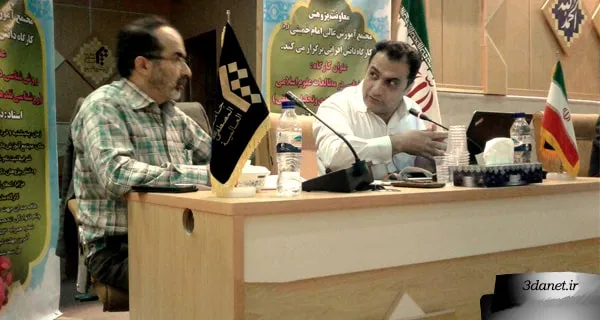
Session Four of the Workshop on the Methodology of Intellectual Critique and Logical Analysis, Dr. Ahmad Pakatchi
Source: Muslim Woman Encyclopedia Website
.
.
Related Content:
Session One of the Workshop on the Methodology of Intellectual Critique and Logical Analysis
Session Two of the Workshop on the Methodology of Intellectual Critique and Logical Analysis
Session Three of the Workshop on the Methodology of Intellectual Critique and Logical Analysis
Session Four of the Workshop on the Methodology of Intellectual Critique and Logical Analysis
.
.



Discussion0 comments
No comments yet; let yours be the first voice.