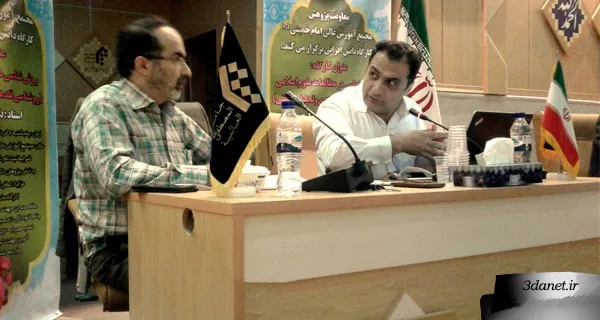
Critique of Reasoning Intelligence criticism
At the beginning of this session, I intend to familiarize you with some common terms in the field of the critique of reasoning and logical analysis.
We live in a world where there are tens of thousands of universities and hundreds of thousands of scholars, and the relation of our subject matter to the subjects already raised must be specified; it should not be, so to speak, a separate, unprecedented thread. My aim, when reviewing the foundations, is to emphasize that this discussion does not claim to have something new to say. Parts of this material may have been said before, but codifying, formulating, and indigenizing it within the field of Islamic studies is a new undertaking.

Here, I have used “هوشورزی” as the equivalent for “Intelligence”. This word, in its nominal sense, means intelligence, which is not within our domain of work; it has another usage meaning the use of intelligence and attention to the active aspect of the matter; that is, paying attention to what is happening. An individual tries to use their intelligence to understand issues. This is the meaning I intend. Our discussion is precisely about the quality of utilizing and using intelligence.
In using this ability, the issue of research methodology arises, and this meaning is not used in the domain of psychologists. Because an action is taking place, we can critique and evaluate it.
Russians refer to this concept with the term “Intelligentia” and have conducted many very useful studies on this subject, and I will present the results of those studies in this session.
Logic

In this session, we use the term logic in a much more expanded sense than what exists in old books of logic. In Aristotle’s time, logic was the “laws of truth” based on which we could conclude which syllogism is productive and that such a conclusion follows from these premises. “Kant” and “Frege” defined logic as the science of judgment and adjudication. In this way, logic entered a new domain. This time, besides the laws of the logic of truth, the discussion of the laws of thought was also raised.
Our jurists, when they wanted to issue a fatwa, used “al-aqwā” (the stronger), “al-ashbah” (the more similar), and similar expressions which are superlative adjectives. The meaning of this phrase is that there is another fatwa that could be strong, but this fatwa is stronger. When this issue is raised, it shows that we are at the stage of adjudication and judgment between two or more rulings, and it does not mean that the other rulings are false and only this ruling is true. This comes very close to Kant’s definition and shows that logic is approaching a new meaning.
In the new definition, logic is considered the laws of thought and is not considered pure logic, although pure logic has retained its value to this day.
Dr. Safari: Did they deny the noumenon (nafs al-amr)?
They did not deny it, but they did not consider the noumenon to be confined to noumenal truth. A part of logic can relate to noumenal truth, and a part of it may deal with preferences. Especially where we have no way at all to reach the noumenon. If the matter is of the type of the Lawgiver’s stipulations, and the way to reach the Lawgiver’s stipulations is through these very paths, and we can reach a preference through detailed proofs, then speaking of noumenal truth may not be an interesting discussion.
Many jurists who have categorically issued a fatwa on a subject do not hold the view that the fatwa of a jurist opposing them is false; rather, their discussion is that what they have seen in the evidence is preferable (arjah) to the opposing fatwa. This does not mean opposition to truth in the thing itself (sidq nafs al-amri), but rather signifies the generalization of the laws of thought. The laws of thought have a broad scope, and in many cases we deal with matters that are of a conventional (iʿtibārī) nature, not real (ḥaqīqī) ones. So perhaps it is better, when speaking of logic, to use the term “laws of thought” instead of the laws of truth.
The laws of thought are more general than the laws of truth; they do not negate them but rather broaden the scope of logic. The laws of thought do not reduce a proposition to the two paths of true and false. In ancient logic, there was a law called the law of excluded middle; that is, in the middle ground between a true proposition and a false one, no proposition existed, and we dealt with two contradictory propositions. Based on the laws of thought, the domain of logic became broader and transformed into the logic of judgment and thought.
I consider logic to be the laws of thought.
Types of Logic:

At this stage, I only want to point to the various stages of logic. The founder of ancient logic was Aristotle. Aristotle did not create logic but rather codified it; because we, as humans, are capable of distinguishing correct from incorrect thought, but codifying them in the form of a series of rules, creating terminology, and turning logic into a specialized convention helps us more in analyzing issues. Regarding the developments that have occurred in logic over the past few centuries, if we review the history of Islamic sciences, we might fully acknowledge that we have had these things but have not proceeded to formulate them. For example, our teacher Ayatollah Ardakani used to say that there is no page in Sharh al-Lumʿa that does not contain tanqīḥ al-manāṭ (refinement of the basis of the ruling). From the period of ʿAllāma Ḥillī onwards, tanqīḥ al-manāṭ has been used extensively in Imami jurisprudence, but this use has been practical, and a chapter with this title has not been opened in the discussion of proofs. When we look at the books of Hanafi legal theory (uṣūl), we see forty pages discussing the methods of inferring rulings. We have not codified tanqīḥ al-manāṭ; therefore, our discussion is about the codification of knowledge.
The same applies to this discussion. In many Islamic sciences, we have had discussions on the development of logic in practice, but we have not independently opened chapters for it in our own books; for instance, we have not independently discussed the logic of truth and its degrees, types of thought that are not of the category of truth, judgment, and the conditions of preference. In legal theory (uṣūl), we have the topic of taʿādul wa tarājīḥ (balancing and preponderance), but we do not have it in logic.
From the time of Hegel, developments occurred until the Polish logician Łukasiewicz raised the discussion that in the middle ground between two propositions, true and false, a proposition can be probable. This was precisely entering the stage of judgment.
Subsequently, we encounter an Iranian scholar who has received little attention in the field of logic. Dr. Lotfi Zadeh presented a theory that became famous as “fuzzy logic.” This logic introduced a discussion such as degrees of truth, which did not exist in ancient logic. He introduced this discussion into global logic and has made a significant contribution to the world of science.

In addition to expressions like aqwā (stronger), there are also expressions such as “the good deeds of the righteous are the evil deeds of those brought near (ḥasanāt al-abrār sayyiʾāt al-muqarrabīn)” which represent a formulation in the development of logic. When you judge, is an act good (ḥasana) or evil (sayyiʾa)? In this view, there is no kind of grading, but in another view, we may have different considerations (iʿtibārāt) in judgment. An act may be good from the perspective of the “people of righteousness (ahl al-birr),” but if considered in terms of the individual’s state of being brought near (muqarrab), it may be evil.
This is precisely the crystallization of considerations of judgment (iʿtibārāt al-dāwarī); for example, if a respected lady asks her husband for payment in return for breastfeeding their child, if you want to judge this act, in a jurisprudential context you would grant her the right, but from an ethical and customary perspective, you would consider it the beginning of family separation and strife; therefore, in two different contexts, we make two different judgments.
Some topics that there is no time to address, I will merely point out their clues so that anyone interested may research them.

The archaeology and genealogy of knowledge and deconstruction, which have been raised in global discussions over the last half-century, greatly aid the development of this discussion.
For today's discussion, a great many sources have been seen, and the fact that we consider this discussion new does not mean sources have not been seen. From about four hundred years ago (around 1620 CE), serious discussions have been raised. Francis Bacon has a book in this field titled "The New Logic." Since that time, thinkers have sought to find a developed logic and have concluded that problems cannot be solved with the logic of truth and it must be expanded. Humans think about subjects that are not all of the nature of truth and falsehood. Although some after them said that even the logic of truth needs expansion.
Charles Sanders Peirce is another philosopher whose works were published in 1883 under the title "Studies in Logic," and in his work, the logic of truth was the main discussion, but he also readily declares that the logic of truth in its traditional sense does not meet many of our needs and we need to develop the discussions of logic. He practically did this in his book Studies in Logic.
There are many other individuals who have worked in this field. What I did was organize them. No one has the patience to read so many sources and implement them in the field of Islamic sciences.

In the past, when people paid attention to logic, it was mostly of interest to philosophers, but today it is also of interest in mathematics and other sciences.
Continuation of the Types of Logic and Intellection

A serious question before us is whether we are dealing with logic or logics? We must accept that for different applications, there are different logics.
In today's discussion, I want us to focus on where logic is used as a tool of analysis in understanding text; otherwise, many of those who have spoken about logic have been concerned with mathematics and scientific discovery, which is not our issue, and our discussion is speech and its objectives; because in Islamic discussions, we deal with the speech of the Lawgiver, and in some areas, we also deal with the expressions of jurists, theologians, and historians; therefore, the issue of text and speech is intensely relevant for us, and we pursue the subject of logic with a focus on the objectives of speech.
The first discussion in the development of logic is that speech pursues two types of objectives: informative and motivational. The informative objective is where speech conveys information, and the motivational objective is where speech creates a state in the human being.
When the Quran says: "Has not the time come for those who have believed that their hearts should become humbly submissive at the remembrance of Allah?" it does not want to give us new information but rather wants to say: create a transformation within yourselves. In daily communication, we also use these two objectives and sometimes combine them. Someone who begins preaching only provides information in a part of their work, but an important part of it is admonition and has a motivational objective, wanting to compel people to observe morality.
In our discussion, both objectives have their own logic; for example, the motivational discussion also has its own logic: if you want to create motivation in the audience, how should you express the speech? Given the abundance of motivational discussions, if in our analysis we only consider informative and informational analysis, we have mutilated the discourse. We must seek a logic that can analyze the entire matter.
The Holy Qur'an says: "O you who have believed, believe in Allah and His Messenger". If we look at this verse with classical logic, we face the question: if we have already believed, what does it mean to be told to believe again? And if we have not believed, then are we not the addressees of this address? The Holy Qur'an here seeks to increase motivation in individuals. Classical logic has not dealt with the logic of motivations and has not discussed it; they have merely mentioned it in passing. Figures like Aristotle, in the discussions of the five arts, especially regarding rhetoric and poetry, talk about motivation in the discussion of the art of poetry; because poetry seeks to motivate the audience.
Regarding the cognitive part, there are also points to consider. Cognition, when it enters the depths of the world of existence, requires more complex logics; for example, if I am thinking about how water turns into steam when heated and turns back into water when exposed to something cold, and I try to consider cause-and-effect relationships, I use a certain logic. But when I talk about predestination and free will, I cannot use that same logic; therefore, each has its own specific logic.
When I talk about the laws of thought, in some cases, because they are accessible, experienceable, and repeatable, they follow laws that are easy for us to understand and about which we make fewer errors; and when we talk about truths from the depths of the world, they do not follow our habits of thought and are of a different nature. It is conceivable for us that a husband and wife have a child, but it is not conceivable how Lady Mary had a child without a husband. We cannot properly understand the cause-and-effect relationships; because it is not an event that happens every day in human life.
There are many such instances. We may have seen an animal give birth, but imagine a mountain splitting open and a large she-camel emerging and giving birth, and we do not know how it became pregnant. We cannot understand it with ordinary reason. At the same time, the sacred text speaks to us. This means we must think about this subject. With which model can we think? With the conventional and ordinary model? When we think about the She-Camel of Salih, are we really thinking? Or are we just arranging a series of disconnected events side by side?
Because we do not understand the cause-and-effect relationships, the known rule of this relationship does not apply here. To think about this subject, we need a different rule.
Perhaps you might say we have these rules and call them miracles and breaches of habit, but I say we must think more about this subject.
Dr. Safari: Can we think? That is, does our thought have that much reach?
As long as we talk about habit, laws govern it that we have discovered. Will Durant, in his "The Story of Civilization," talks about tribes in the archipelagos of the Indian Ocean who thought women became pregnant by sitting in water and attributed it to metaphysical beings. These people are few, and generally, everyone has discovered these cause-and-effect relationships.
A breach of habit has a negative meaning; that is, this event does not follow the ordinary rules we know, but it does not have a positive meaning; that is, we never say what rules it does follow. Some refer its positive meaning to the generalities of God's power, oblivious to the fact that what we talk about in matters of habit is also not outside the generalities of God's power. In any case, these matters also have a logic of thought, and it is impossible for a breach of habit not to follow a rule.
In many cases, when we depart from habits, logic becomes complicated and logic turns into non-logic. For example, suppose a student asks a professor a question, and the professor answers. We understand the question and answer precisely. Mulla Nasreddin once said that in a gathering, he could answer a thousand questions with one answer, and that is "I don't know." "I don't know" is also an answer, but in reality, it is a "non-answer." From your perspective, he has answered no question, but from his own perspective, he has answered all of them. This is where the discussion of logic and non-logic arises; that is, we reach a point where we declare that there are no rules of understanding here, and this declaration is non-logic. Yet, in another sense, we deceive ourselves that this statement of ours is a rule and that we have presented a logic, while in reality, we have presented no logic and have merely issued a declaration. Analyzing the absence of rules of understanding is incompatible with generalities such as God's omnipotence and is a kind of evasion of rule-making.
Dr. Safari: Are these rules even subject to regulation in the first place?
That is an important question, and we will answer it today. The reality is that if something has been told to us, it is so that we may understand. Sometimes, someone speaks to us to fool us, but at other times, they speak to us so that we may understand. When we are meant to understand, we have no escape from the rules of understanding, and if they are unable to explain the speech, we must search for where the deficiency in our rules of understanding lies. This does not mean we are capable of grasping the essence of the universe. Due to our limited power, we humans do not have the possibility of grasping the essence of the Almighty, but we must have the power to grasp the logic of what has been told to us so that we may understand.
The Wise God has told us something so that we may understand, and if we were not meant to understand, He would not have told us at all. Even we, who are not absolutely wise and constantly make mistakes with our children, do not say things to a child that he does not understand. Therefore, if He has spoken to us, it was so that we may understand, and we must seek a developed logic that shows us the rules of logic.
Of course, the Achilles' heel of my discussions is the disconnected letters (al-huruf al-muqatta'ah), and you might ask: if the Quran is meant to tell us something so that we understand, do rules of thought exist in this case as well? And I must answer that.
Question: Your points resemble the discussions on the language of religion.
We will address this matter today until the end of the session. The language of religion pursues questions that overlap partially with our discussion; that is, there are some shared concerns, and some concerns are not held by the other field.
Question: A miracle is not outside the realm of cause and effect.
Regarding this point you make, that a miracle is not outside the realm of cause and effect, everything is resolved with the issue of the Cause of causes. We, like Jesus and Adam, are creations of God, and in this respect, we are no different from them, and we understand how we were created. When we say humans are born through reproduction, these are also laws that God has established. Let us agree together to look at the matter from another perspective for the remaining eight hours. Let us look from the perspective of the text and the speech and examine what has been told to us. Just as God speaks of the creation of Adam from clay, He also says that He created you from a sperm-drop and describes the stages of human development. Therefore, we cannot easily shrug off this issue and say that one matter is a miracle and the other is an ordinary occurrence. In the universe, there is no such distinction, and what separates them from each other is our habits; that is, in the matter of the sperm-drop, we think God's hand is not at work, and after understanding the principles of belief, we understand it is from God, while in the matter of the creation of man from clay, we say it originates from none but God. We will continue the discussion on habits of thought and their relationship with logic, and perhaps we can better answer this question.
Question: Is fuzzy logic not closer to analogical logic or the Quran's logic regarding the degrees of faith and piety? Or God's attributes, such as He is the First and at the same time He is the Last. These matters do not conform to Aristotelian logic but are more consistent with fuzzy logic.
Professor Lotfi Zadeh was an Iranian Muslim, familiar with Islamic culture and logic, and it is very natural that this background suggested such a view to him. At the same time, note that we look at him and at fuzzy logic as a stage in the evolution of logic. We are not supposed to take the entire Quran and Islam into fuzzy logic; rather, we must look more broadly. If someone were to say that fuzzy logic is more compatible with the statements of the Quran and the scriptures, I agree with them, and this greater compatibility is due to the innovator of this logic being more familiar with Islamic issues, but we will talk more about certain cases, such as “He is the First and the Last.”
Question: Can we say that it was after the introduction of probability, as opposed to truth and falsehood, that the world entered the modern era, which distanced itself from certainty and looked at everything as probability?
There are two claims in this question with which I have a problem. I do not accept “modern” because until about 150 years ago, when half of the modern era had already passed, these discussions had not been raised, and all of these discussions cannot be attributed to the modern world; rather, they are a stage of it. Furthermore, modern thought does not look at everything as probability either; on the contrary, one of the currents that grew excessively and disastrously in the modern era was positivism, which had a reformist outlook. Therefore, I insist that you apply such issues in a particular affirmative form.
Question: Regarding your statement that every utterance in religious texts is for understanding: 1- Sometimes God wants to convey our incapacity, and its evidence is the disconnected letters (al-ḥurūf al-muqaṭṭaʿa). 2- An utterance may have different layers, and we may not understand some of them. 3- The utterance is for understanding, but its addressees are not all of humanity, and some humans, like the Imams, may understand it.
Regarding the first point you raised, I must say that the verse “You have not been given of knowledge except a little” is a good example. This issue can be seen on two levels: 1- Rendering incapable within the framework of the fact-of-the-matter (nafs al-amr) 2- Rendering incapable within the framework of conversation. The fact that the Quran states such a thing is exactly like a child asking their parents a question and them answering, “You cannot understand it now.” Here, a conversation has taken shape, and if there is any rendering incapable, it is fact-of-the-matter and not in the context of conversation. The question is asked, “What is the spirit?” and the answer comes that you cannot understand it.
If we want to discuss a case where rendering incapable is the basis of the conversation, it is the disconnected letters, but in this verse, a conversation has occurred and there is no rendering incapable; rather, it is a human epistemological problem. That is, you do not have the tools of understanding, but I am talking to you now. With these examples, I do not accept that there is a rendering incapable in understanding.
Declaring the addressee’s incapacity differs from rendering the addressee incapable through speech, and here, rendering the addressee incapable through speech has not occurred. We must discuss this topic, and if I say in a single word that I do not accept it, I have exposed myself to errors, and if I say I accept it, I have undone all my disciplines. Here, I subscribe to a detailed view, meaning that we must discuss and have a logical analysis of certain cases, such as the disconnected letters and the challenge (taḥaddī). I ask permission to set this part aside from our discussion and talk about it on another occasion. In the rest of these cases, I say that everything that has been told to us is so that we may understand.
The discussion of layers is also important; that is, it is precisely the issue of degrees of thought. Sometimes an utterance is not conceptual in nature, and sometimes it is conceptual but not for everyone. Many scientific discussions are like this; for example, there is a phrase in the Kifāyah that only outstanding instructors can explain. Such a thing happens even in human speech. Avicenna says, “I read Aristotle’s Metaphysics forty times and did not understand it until I read al-Farabi’s The Aims of the Metaphysics.”
The discussion of “The Qurʾān is only known by those it addresses” must also be examined from two angles. One view is that there are expressions in the Qurʾān that are, by nature, like the disconnected letters (al-ḥurūf al-muqaṭṭaʿa), and understanding them requires another kind of knowledge—that is, another revelation to explain them. The implication of this view is that the speech is not comprehensible except through another revelation. However, there is another view, which is that every verse has an apparent meaning and can possess inner, esoteric layers. According to this, there are layers in the speech that some people grasp. If this is the interpretation, it does not render the discourse devoid of benefit. I have preferences that support the second view, but for now, the subject of our discussion could be that someone who adheres to the first view would include it among the exceptions to the discussion—temporary exceptions, of course, because we must talk about these later.
Question: Our minds are accustomed to words denoting sensory and conventional matters, and God speaks to us using these very words, which is problematic. The Tablet, the Throne, the Footstool, the Pen, and the like have one meaning in customary usage and entail another meaning when applied to God. How do we resolve this?
As it happens, we will address this very issue under the title of the veil of language in the upcoming sessions.
The Critique of Reasoning

Sometimes we judge an individual by saying, for instance, that they are insane. We hear this word often; that is, we accuse them of madness. The stigma of insanity differs from being dangerous or deviant.
In the early centuries, at one point, a group of Ḥanbalīs were intensely engaged in conflict with the Muʿtazila. When the Ḥanbalīs spoke about the Muʿtazila, they considered them heretical and used various expressions, but I have not seen them accuse the Muʿtazila of insanity.
This discussion is important because a person whose brain does not function properly and cannot piece things together is different from someone whose brain functions correctly but pursues wrong objectives. Hishām ibn al-Ḥakam (an Imāmī scholar) and ʿAbd Allāh ibn Yazīd al-Ibāḍī (a theologian of the Khawārij) had a shop in the market and were business partners. It is reported that after finishing work, they would engage in theological debate with one another. These two individuals held divergent theological positions; how could they work together? They can do so when they share a common logic, even if they do not share common positions.
There are also two people who cannot share a common logic; for example, we share no common ground with someone who does not accept the Qurʾān or the principle of prophethood. The laws of thought for these individuals are not the same, and they cannot continue a discussion. This is how, when one does not understand the laws governing another’s understanding, one calls them insane—meaning no law governs their thinking.
In a scientific group, there may be individuals who differ greatly from one another intellectually, yet they work together in that group. In society, some people may have a particular eccentricity; for instance, they might think one should eat with one’s feet, and a restaurant might be established where this is done. The people who go there have their own logic, and the guests must be provided with tools to eat their food with their feet. In this way, rules spontaneously emerge, and a person entering that restaurant recognizes this rule.
I gave this example to address the following subject. We encounter a phenomenon called the mental asylum, where there are people with aberrations, but it differs from that restaurant because in this mental hospital, no rules prevail; everyone does their own thing and displays a different state at every moment. One person might attack you, and another might smother you with kisses. Why is anyone who enters this hospital afraid? Because nothing is predictable. Therefore, two mental patients cannot be business partners.
A group falls outside the logic of reasoning, and no laws govern their reasoning, but there are individuals whose reasoning has laws, and only differences in perspective and positions exist among them.
There are behaviors that exist on one level as intelligence and on another as madness, which are referred to as “the wise fools” (ʿuqalāʾ al-majānīn). One example of such individuals is Bohlool, who on one level does not follow rules and behaves like a madman, yet he is a madman who teaches and awakens people; because if we look at the same behavior on another level, we see that it follows a rule, and if someone knows Bohlool, they can completely predict what he will do in front of Harun al-Rashid. He breaks one law so that a higher law may prevail.
.


Discussion0 comments
No comments yet; let yours be the first voice.