Sociology
Stephen Davies's article 'The Great Horse Manure Crisis of 1894'
Doomsday predictions built by extrapolating current trends often overlook human creativity and incentives. The 'Great Manure Crisis' of the 19th century is a case that was resolved not by constraint, but by innovation and market mechanisms.
Every day we encounter reports and analyses that claim, “If such-and-such a trend continues, such-and-such a catastrophe will occur.” The subject can be almost anything, but the form is always the same; these reports take a current trend, extrapolate its growth into the future, and use it as the basis for apocalyptic predictions. Their conclusion is that, as a famous comedic character from a British sitcom put it, “We’re doomed, we’re doomed!” unless we correct our course using the prescription the author has concocted (and no other solution). And this prescription invariably prescribes ever-greater restrictions on personal freedoms.
These prophets of doom count on one thing: that their audience will not examine the track record of such predictions. For history testifies to the erroneous and absurd nature of these prophecies. Many of these (usually apocalyptic) predictions have never come to pass. On the other hand, many events have occurred that no one predicted. Even a cursory examination reveals dozens of examples of this kind.
For instance, dozens of predictions in the 1930s indicated that Western countries were on the verge of collapse due to declining population growth rates. About a decade later, it turned out that population growth rates had, in fact, increased dramatically.
In other instances, people have made predictions that later proved ridiculous; for example, the excessively modest prediction of nineteenth-century journalists who believed that by the mid-twentieth century, technology would have advanced so much that every city in America would have a telephone (by the mid-twentieth century, every American citizen had a telephone in their home), or that famous prediction by Bill Gates just a few years ago that 64 kilobytes of memory would be sufficient for all users. (The translator’s home computer today has 1,000 times that amount of memory.)
The fundamental problem with most of these predictions, and especially the more pessimistic ones, is that they wrongly take it as a given that everything will continue exactly as it is now. This presupposition stems from ignoring one of the basic insights of economics: the effect of incentives on people’s behavior. In a system of free exchange, people receive all sorts of signals to solve their problems (or meet their needs).
The prophets of doom arrive at those gloomy predictions because, in their world, people lack creativity and independent thought, and only these (so-called) thinkers themselves possess the power of thought.
A classic example of this kind, which grew more critical by the day in its time, occurred nearly a hundred years ago. Eventually, things reached a point where nothing remained but despair and hopelessness, and many had prepared themselves for the destruction of humanity. That crisis was none other than “The Great Horse Manure Crisis.”
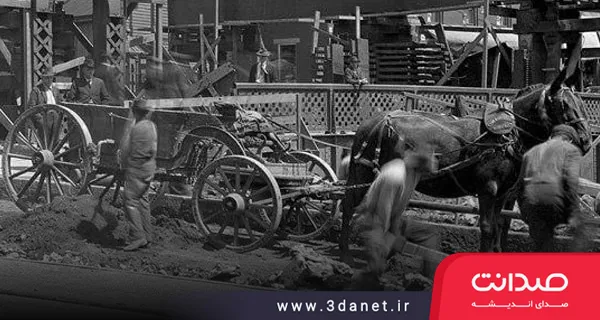
The issue was that the economy and daily life of nineteenth-century cities revolved around the horse. In London in 1900, eleven thousand cabs moved about. Similarly, several thousand buses were in operation, each pulled by 12 horses. In total, London had over 50,000 horses. In addition to these, in London, which was then one of the largest cities in the world, countless carts transported goods throughout the city. This was not limited to London, and similar statistics exist for most major cities of that era.
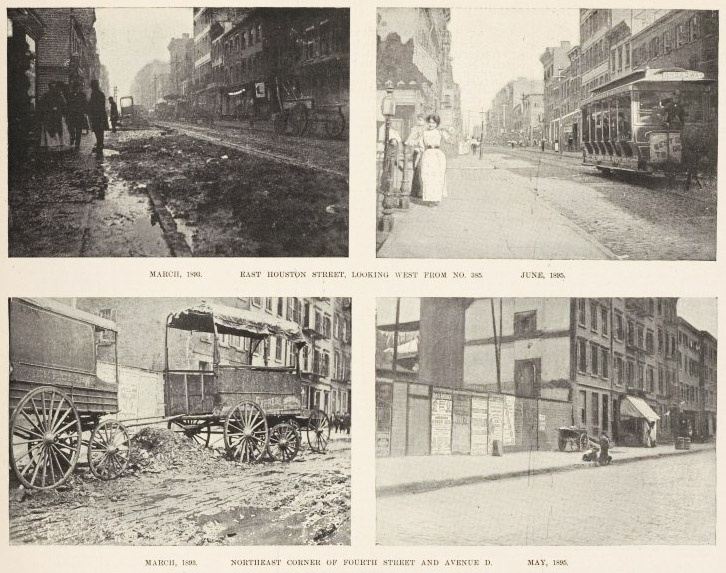
The problem was that each horse produced, on average, between 15 and 35 pounds of manure daily. As a result, major cities in the nineteenth century were covered in manure. Naturally, this attracted flies and other insects, and the dried manure, pulverized under horses’ hooves, became airborne and dispersed everywhere. (Take note, those who imagine the air was clean before the automobile age!) New York in 1900, with a population of 100,000, produced two and a half million pounds of horse manure daily, which had to be collected and disposed of. (See Edwin Burrows and Mike Wallace, Gotham: A History of New York City to 1898, New York: Oxford University Press, 1999).
In 1898, the first international urban planning conference was held in New York, but instead of the planned ten days, it reached an impasse after three, because none of the specialist delegates could conceive of a solution to the growing crisis of horse manure.
The problem seemed irreversible. The larger and wealthier cities became, the more horses they needed to keep things running. And the more horses there were, the more the manure problem intensified.
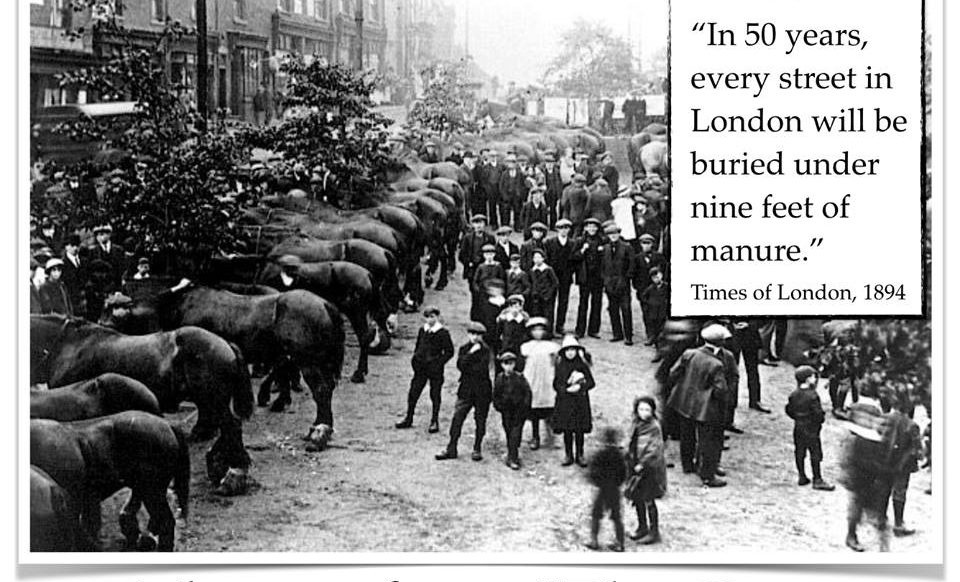
A commentator in the London Times, in 1894, estimated that within fifty years, every street in London would be buried under nine feet of manure (nine feet being the height of a domestic refrigerator).
But the problem with horses was not limited to the manure they produced. All city horses needed stables, and as the city grew and land values increased, the need for this ever-growing space was itself a major problem. Correspondingly, as the number of horses increased, more land went under fodder cultivation. Not to mention that this fodder had to be brought into the city and distributed (which, with the logistical means of the time, was a saga in itself). But the increase in fodder production meant that land under cultivation for human needs decreased, and the production of other agricultural products fell.
In short, it seemed that human civilization was on the verge of destruction.
The Crisis Disappears!
Of course, human civilization was not buried under mounds of manure. The great crisis disappeared with the replacement of the horse by the automobile. This crucial development was realized through the ingenuity of inventors and entrepreneurs like Gottlieb Daimler (later Daimler-Benz) and Henry Ford, and, of course, a system that provided the necessary freedom to put their ideas into practice.
Even more important than these was the availability of the market pricing system. The crisis described in the first part of this article caused the price of horse-drawn transport to rise steadily, as the costs of keeping and feeding horses increased for the reasons mentioned. This price increase created an incentive for people to seek an alternative to the status quo.
There is no doubt that in the Stone Age, there was growing concern about the depletion of flint resources, yet the flint crisis, just like the manure crisis, never materialized as predicted.
The closest contemporary example to the nineteenth-century crises of the manure variety is the concern over the future of oil…
(The discussion of oil resources running out was first raised just a few years after oil was discovered. Since then, this topic has been brought up every few years, and many articles are produced about it. The oil depletion crisis has come and gone many times, with articles, books, and films made about it. The most recent example is the film Mad Max. The story of this series begins after the black gold runs out, resulting in the collapse of human civilization and the outbreak of war, rebellion, and misery. Of course, in the latest film, a water crisis was added to the oil crisis. Guessing the reason is not difficult; after California's recent problems, the water crisis has caught the attention of the prophets of doom and given them a new scenario for the imminent destruction of humanity. Translator)
What these predictions fail to consider is that in a competitive market, as the price of a resource rises, human ingenuity turns to finding a substitute.
We must learn two lessons from history:
First, that if humans are left to their own devices, they will find ingenious solutions to their problems. But this only happens when they are not prevented from doing so. To realize this, we need a set of economic institutions, including property rights and the right to free trade, which provide the necessary incentive and freedom. If these prerequisites are not met, or are replaced by political mechanisms, problems will not be solved.
Second, the issue of the difficulty or impossibility of predicting the future, especially predicting the outcomes of human creativity. Another major reason for rejecting the planning and control of people's choices. Above all, we must avoid the precautionary principle, which prohibits the use of any technology unless it is proven to be absolutely safe.
Our ancestors, when left to their own devices, solved the great manure crisis. If the problem had been handed over to urban planners at the time, the crisis would certainly have worsened.
.
.
The Great Horse-Manure Crisis of 1894
The problem solved itself
Stephen Davies
we commonly read or hear reports to the effect that “If trend X continues, the result will be disaster.” The subject can be almost anything, but the pattern of these stories is identical. These reports take a current trend and extrapolate it into the future as the basis for their gloomy prognostications. The conclusion is, to quote a character from a famous British sitcom, “We’re doomed, I tell you. We’re doomed!” Unless, that is, we mend our ways according to the author’s prescription. This almost invariably involves restrictions on personal liberty.
These prophets of doom rely on one thing—that their audience will not check the record of such predictions. In fact, the history of prophecy is one of failure and oversight. Many predictions (usually of doom) have not come to pass, while other things have happened that nobody foresaw. Even brief research will turn up numerous examples of both, such as the many predictions in the 1930s—about a decade before the baby boom began—that the populations of most Western countries were about to enter a terminal decline. In other cases, people have made predictions that have turned out to be laughably overmodest, such as the nineteenth-century editor’s much-ridiculed forecast that by 1950 every town in America would have a telephone, or Bill Gates’s remark a few years ago that 64 kilobytes of memory is enough for anyone.
The fundamental problem with most predictions of this kind, and particularly the gloomy ones, is that they make a critical, false assumption: that things will go on as they are. This assumption in turn comes from overlooking one of the basic insights of economics: that people respond to incentives. In a system of free exchange, people receive all kinds of signals that lead them to solve problems. The prophets of doom come to their despondent conclusions because in their world, nobody has any kind of creativity or independence of thought—except for themselves of course.
A classic example of this is a problem that was getting steadily worse about a hundred years ago, so much so that it drove most observers to despair. This was the great horse-manure crisis.
Nineteenth-century cities depended on thousands of horses for their daily functioning. All transport, whether of goods or people, was drawn by horses. London in 1900 had 11,000 cabs, all horse-powered. There were also several thousand buses, each of which required 12 horses per day, a total of more than 50,000 horses. In addition, there were countless carts, drays, and wains, all working constantly to deliver the goods needed by the rapidly growing population of what was then the largest city in the world. Similar figures could be produced for any great city of the time.*
The problem of course was that all these horses produced huge amounts of manure. A horse will on average produce between 15 and 35 pounds of manure per day. Consequently, the streets of nineteenth-century cities were covered by horse manure. This in turn attracted huge numbers of flies, and the dried and ground-up manure was blown everywhere. In New York in 1900, the population of 100,000 horses produced 2.5 million pounds of horse manure per day, which all had to be swept up and disposed of. (See Edwin G. Burrows and Mike Wallace, Gotham: A History of New York City to 1898 [New York: Oxford University Press, 1999]).
In 1898 the first international urban-planning conference convened in New York. It was abandoned after three days, instead of the scheduled ten, because none of the delegates could see any solution to the growing crisis posed by urban horses and their output.
The problem did indeed seem intractable. The larger and richer that cities became, the more horses they needed to function. The more horses, the more manure. Writing in the Times of London in 1894, one writer estimated that in 50 years every street in London would be buried under nine feet of manure. Moreover, all these horses had to be stabled, which used up ever-larger areas of increasingly valuable land. And as the number of horses grew, ever-more land had to be devoted to producing hay to feed them (rather than producing food for people), and this had to be brought into cities and distributed—by horse-drawn vehicles. It seemed that urban civilization was doomed.
Crisis Vanished
Of course, urban civilization was not buried in manure. The great crisis vanished when millions of horses were replaced by motor vehicles. This was possible because of the ingenuity of inventors and entrepreneurs such as Gottlieb Daimler and Henry Ford, and a system that gave them the freedom to put their ideas into practice. Even more important, however, was the existence of the price mechanism. The problems described earlier meant that the price of horse-drawn transport rose steadily as the cost of feeding and housing horses increased. This created strong incentives for people to find alternatives.
No doubt in the Paleolithic era there was panic about the growing exhaustion of flint supplies. Somehow the great flint crisis, like the great horse-manure crisis, never came to pass.
The closest modern counterpart to the late nineteenth-century panic about horse manure is agitation about the future course of oil prices. The price of crude oil is rising, partly due to political uncertainty, but primarily because of rapid growth in China and India. This has led to a spate of articles predicting that oil production will soon peak, that prices will rise, and that, given the central part played by oil products in the modern economy, we are facing intractable problems. We’re doomed!
What this misses is that in a competitive market economy, as any resource becomes more costly, human ingenuity will find alternatives.
We should draw two lessons from this. First, human beings, left to their own devices, will usually find solutions to problems, but only if they are allowed to; that is, if they have economic institutions, such as property rights and free exchange, that create the right incentives and give them the freedom to respond. If these are absent or are replaced by political mechanisms, problems will not be solved.
Second, the sheer difficulty of predicting the future, and in particular of foreseeing the outcome of human creativity, is yet another reason for rejecting the planning or controlling of people’s choices. Above all, we should reject the currently fashionable “precautionary principle,” which would forbid the use of any technology until proved absolutely harmless.
Left to themselves, our grandparents solved the great horse-manure problem. If things had been left to the urban planners, they would almost certainly have turned out worse.
*See Joel Tarr and Clay McShane, “The Centrality of the Horse to the Nineteenth Century American City,” in Raymond Mohl, ed., The Making of Urban America (New York: SR Publishers, 1997), pp. 105–30. See also Ralph Turvey, “Work Horses in Victorian London” at www.turvey.demon.co.uk.
.
.
The Great Horse Manure Crisis of 1894
Author: Stephen Davies
Translator: Mohammad Mashinchian
Persian source: Bourgeois website
Original source: The Great Horse-Manure Crisis of 1894
.
.






Discussion2 comments
اتومبیل درون سوز با سوخت فسیلی شهرها را از پهن نجات داد اما اکنون منشاء آلودگی شهرها به شمار می رود . خودروی الکترومغناطیس که امروزه نجات بخش به نظر می رسد ، منشاء آلودگی از نوع دیگر خواهد بود : میدان الکترومغناطیسی از انواع امواج مؤثر بر تکثیر سلول و ژن ...
قرار نیست که هر نفر یک قالیچه حضرت سلیمان داشته باشه تا تمام مشکلات حل بشه(هر چند که اونم مسئله ترافیک هوایی و.. را خواهد داشت !) رمز و راز دنیا و زندگی همینه امروز که یک مسئله رو حل می کنی فردا باید ده مسئله رو حل کنی