Philosophy
The Article “Hegel and Freud” by Mladen Dolar
Despite their apparent opposition, Hegel and Freud both inhabit a position of excess that challenges knowledge—one through the claim of absolute knowing, the other through the unconscious. Their intersection is examined at the limits of knowledge and in their differing conceptions of science and theory.
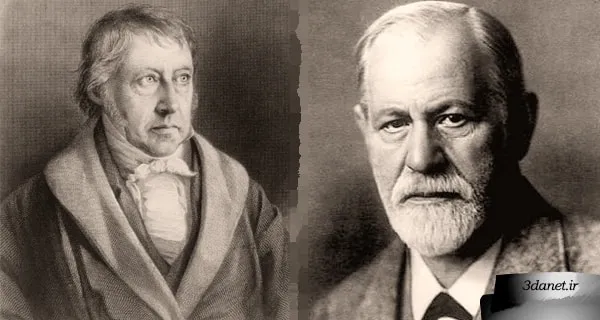
Hegel and Freud
Mladen Dolar / Translated by: Arsalan Reyhanzadeh
Arsalan Reyhanzadeh: In addition to other intentions that can be enumerated for the translation of the article “Hegel and Freud,” a sympathetic intervention in the discussions of the article “Notes on the Dialectic of the Whole and the Part*” is also worth mentioning.
It seems that Hegel and Freud have nothing in common; everything conspires to place them in opposition. On one side: the theoretical philosopher of the Absolute Spirit, whose system encompassed all realms of existence – logic, nature, and spirit – and who was renowned as the most complex and difficult philosopher in the entire grand philosophical tradition; on the other side: a man of the medical establishment, a therapist who throughout his work adopted the clinical method as his strategy and only gradually extended certain psychological insights into the broader domains of culture, civilization, and history. On one side, not just a philosopher, but a philosopher par excellence, the exemplary instance of a philosopher who succeeded in incorporating all the themes and achievements of the metaphysical tradition into his system; on the other side, a man of the natural sciences who staunchly opposed philosophy in the strict sense of the word and even considered the temptations of turning psychoanalysis into a new philosophical current as one of the greatest dangers to his discipline. On one side, not just a German, but apparently a German par excellence, a model of the German spirit, or indeed the philosopher of the Prussian state, which has become proverbial; on the other side: a Jew who, from early on, in his youth, experienced the pressure of anti-Semitism and ultimately, despite his fame, spent the final days of his life in exile, and whose books were burned by a regime that, ironically, invoked Hegel. And finally, on one side, a philosopher who, more than anyone else in the history of philosophy, relied on the powers of reason, concepts, and cognition; on the other side, someone who, more than anyone else, took his paradigm from something that inherently eludes those powers or something that reveals the gap in those powers – this gap precisely constitutes the subject matter of psychoanalysis, namely, entities such as the unconscious and the drives.
In this last point, there is something that strangely links Hegel and Freud. Both of them are in a position of excess, such that when one cites their names, a convulsion is created; it seems impossible to speak from a neutral, impartial position, based on dispassionate cognition, about one or the other, and to assign them a proper place in the gallery of great minds, as if both, albeit with opposing arguments, represent something that official knowledge – what Lacan succinctly called university discourse – cannot fully grasp. Both of them are prone to creating either passionate devotees or, to an equal degree, passionate enemies; they still retain the capacity to provoke passions and rages, even though the nature of their excess stands in opposition. Hegel, the distinguished university professor—if ever there were a right person to hold such a title—retained this capacity with a kind of excess of cognition best summed up by his claim to absolute knowing – the moment a form of cognition claims right over the absolute is a neuralgic moment that university discourse, if it wishes to maintain its neutral and impartial gestures, cannot comprehend. Freud, too, with his opposing claim to a perverse truth lacking the usual guarantees and proofs, a claim that denies him academic credentials, has retained this capacity. In short, [they have retained this capacity with] absolute knowing and the unconscious, the two limits of cognition, the upper limit and the lower limit – on one side, a cognition that, with its claim to the absolute, strives to transcend its own limitations; on the other side, a hole in cognition, a kind of slippage of cognition, where desires, drives, symptoms, and fantasies begin their infiltration. If absolute knowing and the unconscious still function as unplaceable excesses, what could the link between the two be?
At first glance, one might say that what Freud and Hegel have in common is that both have a firm belief in science. In Hegel’s case, we need not look far: he published his first book, Phenomenology of Spirit, as the first part of a more comprehensive work entitled System of Science; his second book was called Science of Logic; and his third was the Encyclopedia of the Philosophical Sciences. Thus, “science” is clearly his key word. There is a thesis here: any science worthy of its name must have a philosophical foundation, and any philosophy worthy of its name must lay claim to science, so that ultimately, philosophy and science must be synonymous. In Freud’s case, the science he seeks in no way turns into philosophy and will only be able to maintain its scientific claims by keeping its distance from philosophy. He emphatically saw himself as a scientific figure, but a science that was as far removed as possible from Hegel’s conception of science.
Their conception of science can be further elucidated with two anecdotal sayings. Hegel openly claimed that if the facts contradict the theory, then so much the worse for the facts (um so schlimmer für die Fakten). This statement can be understood as an indicator of the immense arrogance of a philosophy that pays no heed to such trifling matters as empirical data. But from Hegel’s perspective, facts cannot contradict theory not because of their lowly nature, but because they are always only facts insofar as they have been appropriated by a concept; a fact can only attain the status of a fact by virtue of the concept that has selected and appropriately represented it, to the extent that there is no common ground or level between facts and concepts where they could meet, and if a confrontation truly occurs, it is always only a confrontation between concepts and concepts. Freud’s conception is summed up by a saying of his psychiatry teacher, Charcot: theory is quite correct, but that doesn’t prevent something from existing (la théorie, c’est bon, mais ça n’empêche pas d’exister). Thus, something exists in spite of theory, something that stubbornly persists against the concept; this conception means: make way for what manifests and re-manifests itself in spite of the basis of prevailing theories (including Freud’s own theory, for he was not afraid of endangering his theories if something existed in spite of them), something that amounts to the insignificance of a slip of the tongue or the disturbing illegibility of a trauma and symptom. And is the unconscious anything other than that which manifests itself in spite of all the spontaneous theories that shape our understanding? For instance, is the death drive anything other than the surge of a pure persistence that can never be fully linked to facts? But how can one construct a theory out of that which exists in spite of theory, out of that which rebels against theory? What kind of totality can be built upon this fragile and evanescent factuality, something that vanishes at the very moment of its manifestation?
There is a reverse path for tracing [their point of view]: Hegel places himself from the outset in the realm of totality, but this initial totality can only be an empty totality that must immediately divest itself of this form of totality; if it wants to be truly universal, it must pass over into its other, must sustain and encompass all the actuality present in its movement of self-othering, and can only become a concept if it has the power to fully embrace its other, in other words, through the process of its mediation – there is no concept outside the mediation of totality with its other. On the other side, Freud places himself in the gaps of totality, in its strange phenomena, in that which totality cannot encompass through any conceptual effort, something which is nevertheless not outside the concept but is, as it were, its inner edge. To arrive at this conception of science one must insist upon it, but in order to extend the scope of the audacious undertaking of Galilean science to such small gaps as dreams, slips, and jokes, yet another effort is necessary. Can there be a kind of Galilean science at work in relation to these small things? To arrive at a totality from the standpoint of [these small gaps] requires a theoretical effort no less than Hegel's theoretical effort.
Ludwig Sebbers, Hegel at Age Fifty-Eight, 1828. Lithograph.
Hegel and Freud share no common ground, yet there is a point of contingent encounter [between them]. Nearly six portraits of Hegel exist, depicting him at various ages. All of them are famous; they do what portraits were obliged to do: they present his public image, in poses that are somewhat serious, poses one inevitably assumes when exposed to the public gaze. All of them except one portrait, that is, one prominent exception: a lithographic portrait by Ludwig Sebbers, which shows Hegel at home, seated at his writing desk, dressed in a housecoat and something resembling a nightcap. This portrait is a very compelling image due to the ironic incongruity, undoubtedly deliberate, between the grand claims of the philosopher of the universal world-spirit and his domestic attire.1 It was with this image in mind that Heinrich Heine composed a poem (in the late 1820s, while Hegel was still alive) which is undoubtedly the best poem ever dedicated to Hegel; there was not much competition among poets for the title of the best poem about Hegel, for Hegel was not very inspiring to the poetic art.
To me life and the world seem utterly fragmented!
A German philosopher can give me the solution.
He orders life with masterful skill,
Whether we like it or not, he builds a rational system;
With his nightcap and the tatters of his housecoat serving as materials
He provisionally patches the holes of the universe.2
Heine, somewhat torn between his admiration for Hegel and his sharp critiques of him, created a short circuit between the rational system of Hegel's philosophy, renowned for its ability to place life in a rational and meaningful order, and Hegel's personal, vulgar, and particular attire, so far removed from concepts, yet the provisional fabric of this attire nonetheless has a philosophical function; even more: its secret mission is to lend coherence to the philosophical edifice by filling its cracks. The point is that the housecoat can emerge as the hidden truth of this system, or one might even say there is a balance, in the form of a mocking imitation of the Hegelian infinite judgment, between the two: Hegel, as is well known, held that
Freud was deeply interested in Heine and never missed an opportunity to quote his witticisms or a verse in his own works. He was particularly fond of the last two lines of this very poem, although he referred them not to Hegel specifically but to philosophy in general. In the New Introductory Lectures (1932), continuing the discussion on the question of Weltanschauung and the arguments that psychoanalysis can in no way provide a worldview while philosophy inevitably must be a kind of worldview, Freud says:
[Philosophy] parts company with [science] by clinging to the illusion that it can present a seamless and coherent picture of the universe [...]. Philosophy goes astray in its method by overestimating the epistemological value of our logical operations [...]. And most of the time, the poet's mocking remark when speaking of the philosopher seems not unwarranted: With his nightcaps and the tatters of his dressing-gown / He patches up the gaps in the structure of the universe “[Mit seinen Nachtmützen und Schlafrockfetzen / Stopft er die Lücken des Weltenbaus.]”3
Thus the philosopher – and here the target is Hegel, as the typical example of the philosopher, although Freud was unaware of this intention – does two things that are apparently in opposition but in practice confirm each other: he overvalues logic and epistemology, relies on the activities of reason and cognition, has an excessive and self-deceptive confidence in their power, and on the other hand, temporarily patches up the cracks in this edifice with makeshift means, with trivial, domestic rags, with odds and ends that are, in the strict sense, improvised and temporary – partial objects? A kind of intersection of the sublime and the lowly is at work, the intersection of lofty logical and epistemological preoccupations and the superficial and trivial that must compensate for and complete the deficiency of its opposite pole. The epistemological construction of the universe cannot be accomplished without creating gaps, and the philosopher must then set about filling these gaps with far more insignificant means. To push this paradox of [spirit and nightcap] further, one might pose the question: how can we reconcile Hegel's claim to absolute knowledge with the nightcap and tatters of a dressing-gown? Does the secret of reason ultimately lie in the ill-fitting nightcap?
Freud also uses these same lines of Heine's poem, in a different but entirely telling way, in The Interpretation of Dreams (1900). Here the discussion relates to a more complex topic in the theory of dreams, what Freud calls secondary revision. The dream proceeds haphazardly from one element to another (this is what constitutes the primary process in Freud's view), and is entirely a jumble, but as it proceeds it continues to revise and correct itself, maintaining its effort to adapt the emerging elements to a narrative, to a sequence that more or less possesses logic and meaning. The paradox is that this process occurs while dreaming, as a part and parcel of the dream-work itself, has submitted to secondary adaptation and modification within the dream itself, such that we never encounter a pure and simple dream, but rather a version that has been “always already” corrected and revised. Interpretation happens in the course of the dream, on the part of the dream, and prior to any conscious interpretation. Dreams (some, not all of them) “may be said to have been interpreted once, before they submit to waking interpretation.”4 This is where Freud makes use of Heine's lines:
This function [of the dream] works in the way that the poet spitefully attributes to philosophers: it fills the gaps in the structure of the dream with shreds and patches. Consequently, the dream's efforts result in its appearance as an incoherent jumble failing and approaching the model of an intelligible experience.5
In the course of the dream there is a philosopher lying in wait, a dreaming philosopher hidden in the primary process, transforming this process into the secondary process – and, in short, there is no primary process without the secondary process. The pure unconscious, the pristine unconscious, never manifests itself in the strict sense of the word; its gaps and incoherences are almost always already, “in person,” at least partially filled, and it is thereby that it becomes manifest. However, this unconscious philosopher, who blocks the gaps and provides meaning, is usually less successful than his conscious counterpart. The unconscious philosopher is a bad philosopher who cannot cover his tracks; he always gives the game away, at least in part. Secondary revision can never completely cover the signs and remnants of the primary process – and if, in very rare cases, it does so, if it manages to present a narrative that is “perfectly logical and rational,” then Freud tells us that these are the most difficult cases to interpret:
Dreams of this kind have been subjected to an extensive revision by this psychical function, a function that resembles waking thought; they appear to have a meaning, but this meaning is as far removed as possible from their true significance.6
There are dreams that seem completely meaningful because they have been shaped and interpreted by a complete meaning-making instance within the dream itself, but this is the very reason for the deceptiveness of their apparent meaning. They seem to require no interpretation at all, but this demands the greatest effort on the part of the interpreter to reveal the nullity of what is hidden behind the dream’s façade (so that the greatest illusion pertains to that which is ostensibly meaningful and apparently needs no interpretation). If the unconscious philosopher were a proper philosopher and left no trace, then this is the greatest mirage; apparent transparency is the greatest opacity. Philosophy can be considered a dream of this type: a dream that has been successfully and completely revised, that has apparently managed to cover all traces, to fill all cracks, and thus presents the most difficult things for analytic interpretation.
In short, following the picture Freud presents, the unconscious is a gap, and meaning is the hatch that blocks this gap. Meaning provides a kind of narrative, a narrative that already begins in the work of the “unconscious philosopher”; the work of meaning is the counterpart to the workings of the unconscious. The unconscious and the philosopher are a pair in a particular division of labor: one creates holes, and the other fills them. If there is a kind of diagnosis of the philosophical endeavor at stake, the philosophical endeavor that is our subject in the strict sense, then it must be said that this philosophical endeavor and work already begins in the unconscious – the philosopher is an accomplice of the unconscious, who begins to block the gaps even before philosophy begins to fill them. The unconscious is erased at the very moment of its construction, and the one who erases it is the unconscious philosopher, striving to make it meaningful and to present a narrative account free of gaps. The philosophical illusion is structural; erasure is the foundation of this illusion, and this foundation lies in the unconscious itself.
Freud never truly engages with Hegel, and never thinks of using his concepts, as he does, whether we like it or not, with many other philosophers. Nevertheless, through Heine's malice, there is this unexpected scene of an unwitting encounter [between them], where what is at stake is by no means Hegel, but the nature of philosophical endeavor, and Hegel's function is once again that of the exemplary philosopher. Symptomatology: there is a blind spot in philosophy, namely, its inability to come to terms with the unconscious, its captivity to the fantasy that philosophy cannot cease [its striving and work] as long as it remains philosophy. But this work of philosophy is not something that happens in the transcendent realms of spirit; rather, it is already taking place in the unconscious, a work that can only proceed through the very act of erasure, and this erasure can serve no purpose other than meaning-making. The gap is already the internal gap of the unconscious, the philosophical fantasy intervenes in the dreamwork, in the gap between the primary process and the secondary process; the search for makeshift, temporary solutions always begins beforehand.
Undoubtedly, this image of the nightcap and the cracks in the structure of the universe, besides being beautiful and entertaining in its own right, is a naive image that relies on a blind judgment about philosophy as a whole, and Hegel in particular. My use of this image is not to endorse it, but because it leads us to something essential. By following this image, one could say that Hegel's great achievement lies in introducing the exact opposite pole of this image of philosophy, an opposite pole which, if I may adopt a sweeping language to speak, is not about patching up the cracks in the universe, but about accepting these very cracks as the true principle of the universe. If there is a perplexing and fascinating point in Hegel, then this point lies in his lofty endeavor to pursue the gap not as a deficiency, a malfunction, but as an empowering principle, in accepting this gap as the power of producing the negative. Hegel saw his mission not as filling the cracks, but as making a cut that seemed to be nothing, a cut that enables every positive being. But here the edge of this cut comes into question: are Hegel and Freud talking about the same crack? If there is a cut, then this cut is the cut between what?7
Let me continue with a singular quotation. Hegel, in the Preface to the Phenomenology, exceptionally, for once, violates his own principle that every foundational principle of philosophy is undermined in the very reality of being a foundational principle. The value of a philosophy cannot be determined by any foundational plan or claim; a principle can only prove its worth through its own mediation, by overcoming and thereby negating the foundational moment through genesis, preparation, production; three things that can only explicate what this principle was supposed to be. Nevertheless, exceptionally, for once, Hegel offers a foundational precept in the sense that everything [in his philosophical system] rests on a single proposition, namely, the proposition that the true cannot be grasped merely as a substance but is grasped to an equal degree as a subject – in short, that substance is subject. This precept functions as a meta-principle that disqualifies and invalidates all principles. I do not intend to interpret this foundational precept here – books have been written about this single proposition (notably by Slavoj Žižek) – I intend to take this precept somewhat for granted. I will try to shed some light on the matters from a specific angle, immediately after the passage I intend to quote here:
The incongruity that occurs in consciousness between the I and the substance that is its object is their distinction, the negative itself. This distinction can be seen as the lack [Mangel] of the two, but this lack is precisely their soul, that is, what sets them in motion. This is the reason why the ancients understood what moves things as the void [das Leer], for they regarded what moved things as the negative, yet despite this they did not understand the negative as the self [das Selbst].8
Hence, what links the two terms of this notorious proposition, substance and subject? Substance as the single hypothetical principle upon which existence is founded, and subjectivity? Hegel’s proposition rests on the claim that both terms, substance and subject, are affected by a lack, a void, and a negativity. The very essence of each of them is a lack, their essence is a lack in this essence that sets them in motion. Substance and subject coincide in lack as the only point they share – but how are we to understand this proposition? Hegel, in order to clarify this proposition with an example and to provide a kind of genealogy for this viewpoint stretching back to the very beginnings of the history of philosophy, links it to ancient atomism. Hegel, the great idealist, always saw in atomism a very important speculative turn. Hegel writes in his Logic,
The atomistic principle, among these first thinkers, did not lie outside, but apart from its abstract [quality] it contained a kind of speculative determination, insofar as the void was acknowledged as the source of motion. This implies a completely different relation between atoms and the void than the relation of mere juxtaposition and mutual indifference of the two. The view that the cause of motion lies in the void is equivalent to the deeper thought that the cause of development and becoming rests on the negative.9
From Hegel’s perspective, the greatness of atomism lies in what this tradition introduced as the object of thought, the way in which the minimal element always splits into the form of itself and the void. Atomization is a simple and radical method for submitting matter to counting, reducing it to indivisible, countable elements (which can be counted as one), but in this very movement, this atomic element, this fundamental particle, introduces the void, from which atoms derive their motion, and indeed this void is the real principle of their motion, das Bewegende. It is by no means a matter of the element and the void existing side by side; they belong together at the point of the formation of a singular dual being, a combination of atom and void, one and lack. Yet everywhere we search for the minimal element, and we never arrive at a minimal, indivisible element, but rather, more or less, at division as the irreducible. The minimal element is this division itself, and not any positive being. The void, in other words, is the lost Platonic half of the element as one, and indeed, by being lost, it conforms to this Platonic description. Hence Hegel’s atom, his fundamental particle, is the atom in this precise sense: what cannot be divided again is division, the gap upon which every unity is founded.
But, Hegel continues the discussion in this passage, while the ancients clearly saw the principle of negativity in the void, the splitting of every element at its own foundation, they were incapable of understanding that the real place of the self, the subject, lies in this negativity. They realized that substance is surrounded by the void, and has embraced lack within itself, but they had not the slightest inkling that this had any relation to the place of the subject. This is the point where Hegel is speaking of his own most minimal – the place of the subject, in the dictum “substance is subject,” is nothing other than this gap itself, this cut in being introduced by the void as the principle that causes motion. It is in the void that being and thought intersect. As he says in the History of Philosophy,
This break [interruption, Unterbrechung] is the other side of atoms, the void. The movement of thought is such a movement that has this break within itself (thought in man is precisely what atoms and the void are in things, their inner being [Das Denken ist im Menschen eben das, was die Atome und das Leere in den Dingen, sein Inneres]).10
Hence, thinking is the break of being, its interruption, and what thought and its objects share is a break that, through the void, ruptures objectivity. Thought and the world intersect in this void. The question here is neither whether atomism is a complete theory—Hegel will not endorse this theory in his own account of being—nor whether what has been said is a correct interpretation of atomism; the main point is that atomism contains an insight that Hegel finds valid and far-reaching, that there is a principle of negativity that sets both thought and being in motion, that this principle forms the inner aspect of both at their very core, sein Inneres, and that the way in which substance and subject are joined must be attached to this principle.
The subject, as Hegel understands this entity, is not a positive being and has no existence; the subject is to be situated in this break, and this is what compels every being into unrest (eben diese Unruhe ist das Selbst)—the self is nothing but the unrest of a being, its gap, and resides in the impossibility of any being's equality with itself. The subject is what compels this being beyond itself, and is nothing but this inequality, the invisible part that causes inequality (Ungleichheit). If one wanted to explain Hegel's project in a single phrase, to give it an atomic form, and to arrive at that indivisible particle of Hegel's thought, one could say: from the atom to the cogito. In this phrase, there is a kind of short circuit that directly links the introduction of the void by the atomists, the speculative unity of the One and the void, with the figure of subjectivity as it emerged with the Cartesian cogito. The novelty of the cogito lay precisely in the fact that it abandoned previous ways of thinking about subjectivity (soul, consciousness, individuality) and introduced the subject at the point of rupture in the great chain of being. (Žižek has expressed this [characterization of the cogito] more than once, “the cogito is a crack in the edifice of being.”) Although Descartes himself, in the very next stage of his thought process, connects the cogito to the thinking thing (res cogitans), the cogito is nevertheless not a substance, but is entirely opposed to it; at least in Hegel's radical understanding of it, the cogito is what prevents any substance, any fundamental principle of unity, from ever insisting on its self-equality. There is a crack in being, which was already succinctly expressed by ancient atomism through the void, that is, as a place that awaited the subject. To absolutely simplify the matters discussed: if substance was the key word of philosophy, the guiding idea that elevates multiplicity, beyond appearances and change, to the rank of a fundamental principle, then one can say that the subject, for Hegel, is the name for the One that splits into the figure of Two, the name for the impossibility of any substance being one. But which two? Are the atom and the void sufficient for this split?
Hegel examines the notion of swerve (clinamen) with indifference and a touch of contempt. He says in the History of Philosophy that Epicurus posits the equality of atoms in weight and therefore, until the straightforward movement of atoms is deflected into a curved path, a path that deviates somewhat from this straight orientation, posits their movement in a single direction, so that atoms collide with one another and consequently form a kind of merely superficial unity that is not rooted in their substance.11
In a way, all the ambiguity and obscurity of Hegel is contained in this passage. One can pose the following question: does the clinamen belong to substance? Or is it merely an external addition? Is it the substantial destiny of the atom or its external destiny? Let us make use of Deleuze, who is by no means a Hegelian but gives a thoroughly Hegelian answer to this question, one that is even more Hegelian than Hegel himself. This answer is taken from an appendix on Lucretius in The Logic of Sense:
The clinamen or swerve has nothing to do with an oblique movement which would come accidentally to modify a vertical fall. It has always been present: it is not a secondary movement, nor a secondary determination of a movement, which would occur at a given moment in a given place. The clinamen is the original determination of the direction of the movement of the atom.12
Thus the clinamen always already takes place, and is a non-conformity inscribed from the outset in the definition of the atom, the non-conformity of the atom with itself. The atom is this very deviation and clinamen, the divided unity of not only the one and the void, but also, because of and by virtue of this, the unity of a being with its own deviation, with its deviating from itself. The clinamen is not a secondary destiny that befalls the atom in itself on its hypothetical straight path – as soon as an atom deviates from this path, it presupposes this straight direction, but a direction that does not exist in itself. Deviating creates this in-itself in a retroactive manner, and this is where the subject enters. In short, and linking the discussions together, one can say that the subject is the clinamen of substance, the direction that necessarily always deviates from itself.13
Hence, the clinamen cannot be isolated in itself; it is the clinamen of the "in-itself," a clinamen that is always effaced in its effects in a retroactive manner, the vanishing mediator. The clinamen is neither the atom nor the void nor a third thing, but the very going-astray that conditions them. Therefore, to understand the singular notion of the clinamen, one can say that a single thread gathers together various other threads such as the one, the void, substance, the subject, and negativity.
Now we come to the fundamental question: how does this understanding of Hegelian negativity relate to psychoanalysis? What became of negativity and the gap between Hegel and Freud? Let us take the clinamen as a simple red thread. The way of understanding what is at stake in the clinamen may well be the distinguishing factor.
Freudian negativity is a vocabulary of six words that begin with Ver: negation (Verneinung), repression (Verdrängung), foreclosure (Verwerfung), disavowal (Verleugnung), condensation (Verdichtung), displacement (Verschiebung). At first glance, what these six words share is the prefix Ver-, which the Wahrig dictionary first defines as Abweichen, or clinamen, deviation, going astray. From Ver- to clinamen there is only a step, a wandering step, a step off the path. What is at stake here is the deviation of negation, and if Hegelian negation is already a deviation, that is, one that deviates from its own path and splits into the figure of two gaps, then what is at stake here can be described as a deviation within deviation, a clinamen within the clinamen, a kind of double clinamen. Ver- is like the clinamen of the no (nein), something at the heart and within the negation of the negation in Hegel, yet slightly off track. Freud, who was very interested in puns and chance encounters of words, never spent time reflecting on this Ver-, the prefix that gathers his key terms together as we see in the dream-work of condensation.
But beyond the contingent link that Ver- establishes among these six concepts, they are also connected through a common intention. They name various modes of negativity, but a negativity that fails. Negativity does not succeed in performing its function of negating an entity. They summon something that persists despite negation and through negation, or more precisely, something that negation produces in the first place. In all of them, negation produces something that cannot itself be negated. There is a kind of negative persistence in the very failure of negativity.
The failure of negation in its first form, the case of the patient presented in the essay Negation (Verneinung, 1925), is the clearest example of this failure, where Freud, in a single stunning move, completes a trajectory that stretches from the grammatical form of negation to the death drive. Freud begins with the famous, fundamental case of the patient who says,
“You ask me who this person in my dream can be. She is not my mother.” In interpreting this dream, we have the right to disregard this negation [...]. It is as if the patient had said: “It is true that when I thought of this person, my mother came to mind, but I do not want to accept this association.”14
This is the exemplary instance of negation that has become a proverb, “It is not my mother,” a negation that misses its target and fails to negate the mother. But is the reason Freud’s interpretation provides for this patient’s negation sufficient for a reading based on affirmation? Is the truth of “It is not my mother” the affirmative expression of its opposite pole, namely “It is my mother”? Freud posits this negation as a sign of repression, Verdrängung, the next item on our list of six.
Consequently, the content of a repressed image or idea can make its way into consciousness, on condition that this image or idea is negated. Negation is a way of taking cognizance of what is repressed [...]. The outcome of this negation is the intellectual acceptance of the repressed, while at the same time what is essential to repression remains in place.15
Thus “It is not my mother” can be translated into “It is my mother,” and the patient might possibly accept this translation as the truthful content of his statement, but this acceptance does not affect the very form of repression. Negation may well enable the acceptance of the content, but what remains in defiance of this negation and the negation’s attempt to abolish it is the very gap in which this content resides. This gap is not filled by the alternatives “It is not my mother” and “It is my mother.” Negation and affirmation stand on the same level without affecting the form of repression, which is irreducible to the content of this form.16
Negating something in a judgment is, essentially, expressed thus: “This is something I would have preferred to repress.” A negative judgment is the intellectual substitute for repression; its “no” is the hallmark of repression, acting as a kind of certificate of origin—like, let us say, “Made in Germany” [which indicates the origin and provenance of, for instance, an object upon which this phrase is inscribed]. With the help of the symbol of negation, thinking frees itself from the restrictions of repression.17
Negation is like a kind of certificate of origin, testifying to the origin of repression, and if there is indeed a kind of negation that, among all nations, is a German construct, this negation must be Hegelian negation. One might say, with all the ambiguity of the following proposition and based on the model of “this is not my mother”: “This negation is not Hegelian.” Hence, is Hegelian negation accepted or rejected? Must we decide between “This is Hegelian negation” and “This is not Hegelian negation”? Perhaps, in agreement with Freud’s reading, both propositions fail in that form of negation that emerges from these alternatives and is not defeated by them. There is a gap in Hegelian negation (in negation), lurking at this very point, and nowhere else.
Negation in the essay Verneinung, as Freud reads it, is a special example of repression, the second concept in the list above. Repression, even at first glance, presents a simple example of the path I have been following, the path of the failure of negation. Repression means this: something is negated and rejected, but only at the cost of its return. And it is repression insofar as negation does not succeed, insofar as negation fails. Certainly, one can discover all sorts of reasons for repression, one can invoke a repressive sexual morality that seeks to prevent a certain content, determined by prohibitions and taboos, from being admitted into consciousness, but in this way one focuses on the content of repression and ignores its form. (There is a widespread fact that most of the moral prohibitions and interdictions with which Freud was engaged have lost their validity and effect over the past century, but this fact has not led to an escape from the predicament, which has remained in a way more insoluble. Psychoanalysis, which has contributed greatly to sexual liberation, has always been suspicious of this fact as an effective solution.) If we focus on the form of repression, then Freud’s primary term is precisely not repression, but primal, primary repression (Urverdrängung), a repression that is not related to this or that particular content, nor is it reducible to specific reasons of social repression, but rather posits precisely the form of repression that can later be filled with specific contents and justifications. Repression precedes sufficient reasons for repression.
The concept of repression entails two other concepts bearing the prefix Ver-, the concepts of condensation (Verdichtung) and displacement (Verschiebung), which in Freud’s view name the fundamental mechanism of the dream-work (Traumarbeit). If dreams appear as a jumble, this is due to the fact that each element of the dream displays a kind of condensation and displacement of various elements. One can add a very important point that determines the fate of Freudian negation, a point Freud repeatedly emphasizes: the dream does not know “no,” “no” does not exist in the dream’s vocabulary.
The manner in which dreams deal with the categorization of contradictions and contraries is quite remarkable. The manner that completely sets aside “no.” As far as dreams are concerned, “no” seems not to exist. Dreams show a particular preference for combining contradictions into a unity or for representing them as one and the same thing. Moreover, dreams allow themselves to represent any element by its contradictory opposite; so that at first glance it is by no means possible to decide whether, in the dream-thought, the manner of manifestation of any element that permits a contradiction is positive or negative.18
Dreams have an immense vocabulary, but it seems that one word is to be conspicuously absent from this vocabulary, the word “no.” Negation, contrariety, contradiction – all of these exist in dreams either through simple juxtaposition, where contradictory or opposing entities appear side by side, or through immediate coincidence, in the fusion of opposite poles in a single element, so that one cannot say whether the mode of appearance of this element has a positive or a negative signification. Every positive element enjoys the gift of reversibility, such that negation cannot exist in isolation, and exists only in a network of substitutions, fusions, and displacements. This network of omnipresent negativity is paradoxically based on the omission, the elision of the “no” as the singular sign of negation. This very precise “negation of negation” makes negation present everywhere; the “no” is present precisely in its absence in every word. In the unconscious, this “negation of negation” sets to work something that is apparently too childish for dialectics: accidental resemblances, puns, homophonic echoes, temporary slips. Compared to the unlimited slippage of the flow of homophonic words, resemblances, and parapraxes, could anything be further from the tenacity of the chain-like conceptual link in Hegel’s Logic, where each stage is intrinsically linked to the previous one through self-reflective negativity? This conceptual link, at each stage, is determined through the “no,” and this unlimited slippage utterly disregards the “no.”
If there is a kind of subject of the unconscious – something that Lacan, against the grain of a restrictive structuralism, emphatically insisted upon throughout his entire work – then this subject is, strictly speaking, correlative to the omission of the “no.” But the “no” is not a word like any other; the “no” embodies a fundamental quality of language. One could preferably say, simply and on a grand scale, that the “no” lies precisely at the very core of language; in other words, this “no” is something that exists only in language and has no counterpart in “nature.” By means of this “no,” language names that which is not, and this ability to name the non-existent is what makes language language. The greatest testimony to this is Plato’s Sophist, which is precisely concerned with the capacity of language to fill being with the non-existent. (After all, the production of holes and gaps had already begun with Plato.) Language creates negation, which is not merely [the creation of] an opposition or contrariety, a conflict or tension, but the possibility of creating the non-existent. The symbolic itself, by extension, is like a “no” in the great chain of being, the very possibility of negativity, something that presents a kind of gap, crack, and rupture, a gap upon which, from Hegel’s view, the very capacity of language depends – yet for all that, this was something that constantly preoccupied philosophy in its pre-Socratic beginnings, in the guise of the question of whether negative entities are merely creations of language or have an ontological counterpart in being (see Plato’s Parmenides). It was with this question that philosophy began.
To conclude properly, regarding the brief glance I have so far cast at Freud’s other Ver- words, I can only make hasty allusions to the two remaining terms. Foreclosure, Verwerfung, is the mechanism that, in Freud’s view, defines psychosis. If psychosis is based on foreclosure, it cannot be based on the foreclosure of the word “no,” because psychosis completely jettisons the lexicon and lacks the no – in other words, psychosis precisely lacks the no. Psychosis is not lacking the “no,” but rather almost lacks its symbolic impact, lacks that gap which can keep reality at a distance from itself and from the real. [In psychosis] what was foreclosed later returns as the real made-manifest-in-reality, but a real that is in conformity with reality and not with the gap within it – hallucinations, voices, conspiracies, tormentors, divine lights, miracles. Psychosis literally carries out the negation of the negation, putting an end to the powers of negativity; psychosis not only carries out the negation of the negation, but its setting aside and abolition. If we follow the path of the failure of negation, then in psychosis negation fails through a spectacular success; in psychosis, the success of negation in destroying itself is such that reality itself appears as the embodiment of negativity, with no possibility of escape from it. The foreclosed negation materializes itself precisely in positive reality. The success of the negation of the negation in psychosis is its greatest failure; it is in psychosis, more than anywhere else, that the negation of the negation affirms itself in its most bombastic forms.
The last word in the Freudian vocabulary is disavowal, Verleugnung. Freud posits this word as the fundamental mechanism of perversion, in its technical sense, and one should note from the outset that per-verto is the Latin translation of Ver-. There is a constitutive Ver- (perversion) in the very nature of human sexuality, a deviance in the nature of sexuality and its perversion. Freud begins his argument in Three Essays on the Theory of Sexuality (1905) by considering psychical deviations (Abirrungen), and then moves on to the sexual deviations (Abweichungen) in relation to the sexual object and the sexual aim. Starting from this very point, one could say that for Freud, sexuality in the strict sense is defined by Abirrungen and Abweichungen, in a word, by a deviation from the path of natural causality and the satisfaction of physiological needs. There is a deviance at work in the very concept of sexuality, in the very concept of the drive, which is a drive only because of its deviation and cannot be understood independently of this deviation. There is a famous example from Brecht's Threepenny Opera: Is robbing a bank comparable to founding a new bank? Are all these petty thefts comparable to the systematic, legal, and long-term robbery by banks? By analogy, one could say that Freud's treatment of perversion in the Three Essays poses the following question: Are all perversions, deviations from the conventional sexual object or aim, comparable to sexuality in the strict sense, which in itself is nothing but a widespread perversion? As far as perversion is concerned, in a more technical and restricted sense, disavowal can be understood in Freud's account of fetishism; the fetish, in Freud's famous scenario, as something that fills the void with its fascinating presence, disavows castration and lack by clinging to the object that covers the void. Negativity is disavowed by clinging to an object that veils it in the glamour of its positive existence, by clinging to a belief that stands in opposition to fuller knowledge (“I know very well, but all the same...”). Here we practically arrive at a view that embodies Heine's and Freud's conception of philosophy as a filler of cracks – the pervert is someone who uses the nightcap not merely as a handy means to fill cracks, but even turns it into an object of adoration and veneration. The nightcap is not an inefficient and accidental means of filling a crack unless it is also an object of jouissance, a partial object that creates the whole. (And here one can cite the unique example of the Marquis de Sade, the greatest philosopher among perverts – in this category of people, for structural reasons, there was not much competition – whose book Philosophy in the Boudoir is a thoroughly serious and rigorous demonstration of patching up the gap.)
Three words beginning with Ver-, repression (Verdrängung), foreclosure (Verwerfung), and disavowal (Verleugnung), function as the basis of the three clinical structures proposed by Freud – neurosis, psychosis, and perversion – as the basis of his clinical classification. One could say that these words present three ways of dealing with negation, three ways in which negation fails and affirms itself, or works through its specific deviations. They stand as Freud's versions of what Hegel, at the beginning of the Encyclopaedia, calls the three positions of thought with respect to objectivity: “drei Stellungen des Gedanken zur Objektivität.”
Now, if we attempt to gather all the threads of the discussion together and arrive at a provisional conclusion, one could say that the distance between Hegel and Freud might perhaps be most succinctly summarized through the distance between two words, or to some extent a word and a partial word, nein and Ver-. These two words, akin to what we see in the dream-work, merge into one another in the form of a single German word, Verneinung (negation). Strangely, this German word actually has no place in Hegel's vocabulary; he prefers the Latin word Negation (negation). Ver- and nein: the negation of nein in immediate proximity to a Ver- that diverts this nein. Ver- is nothing else – Ver-, in complete difference from nein, is the internal inhabitant of negation and transforms negation. If, from Hegel's perspective, every positive being is always already marked by negativity, always in discordance with itself, a kind of deviation from itself, then the Freudian procedure can be understood as a deviation within this deviation, a kind of perversion of its perversion. Ver- deconstructs the "no," yet it only operates within the heart of this "no." (Hegelian) negation is the necessary condition for Ver-. In this sense, Hegel, by bringing the question of negativity to its peak, is the necessary condition for the Freudian conception of negativity. Or, to alter it: there is a Hegelian negation that is already a Ver-, the deviation of understanding and reason (the Ver- of Verstand and Vernunft), which are nothing but the realms of the expansion of Hegelian negativity, and the Freudian Ver- is merely its extension, which changes everything.
In the same sense, the unconscious can be understood as the perversion of the cogito. Lacan caused a scandal with his claim that the cogito is the subject of the unconscious, a claim that stands in direct opposition to the general view that no two things could be further apart than the rational Cartesian subject and the vagaries of the unconscious. Yet one of Lacan's key assertions is that the subject of the unconscious can only be understood on the basis of the cogito, within the framework of the cogito and modern subjectivity, and not as its irrational counterpart. One could say that the subject of the unconscious is the deviation (Ver-) of the cogito, representing precisely the same turn that Ver- performs in relation to Hegelian negation. And if Hegelian absolute knowing is to be understood not as the ultimate filler of the crack – the internal gap in the structure of the world – but rather as the way in which this crack is ultimately preserved, in a state where the crack self-reflexively manifests itself, then the Freudian unconscious is a crack within this very crack.
Freud, following Charcot, says: [negation] does not prevent the existence of something that, despite negation, through negation, and in the heart of negation, resists, something that is not reducible to positive factuality and ultimately has no existence – but this thing cannot be understood without negation, and moreover, without the perversion of negation within negation. One can slightly alter this sentence: existence does not prevent the being and resistance of something. The Hegelian concept of existence is entirely based on negativity and the cut, and the gesture indicated by Ver- is a cut within the cut itself. It is through this cut that thought adheres to existence, in the dual form of absolute knowing and the unconscious, a dual form that signifies a surplus and a lack, or deficiency, of knowledge. More significantly: the subject of psychoanalysis is not only the deviation of the cogito, but the deviation of that understanding of the cogito that culminated in absolute knowing, at the end of the grand philosophical tradition.
.
.
Notes:
Morad Farhadpour, Fragments of Thought (2): Philosophy and Politics, Tarh-e No Publications, Tehran, 1388, pp. 165-216.
1_
Heinrich Heine, Heimkehr LVIII. That the appropriate time for wearing this garment is at night also points to a hidden meaning. Hegel, in a famous passage from the preface to the Philosophy of Right, describes night as the proper time for the realization of philosophy. “The owl of Minerva begins its flight at dusk.” Hence this description, from the pinnacle of philosophy’s moment, in the interval between dusk and preparing for sleep, befits only Hegel.
2_
Heinrich Heine, The Complete Poems of Heinrich Heine: A Modern English Version, trans. Hal Draper (Boston: Suhrkamp / Insel, 1982), 99. ”Zu fragmentarisch ist Welt und Leben! / Ich will mich zum deutschen Professor begeben. / Der weiss das Leben zusammenzusetzen, / Und er macht ein verständlich System daraus; / Mit seinen Nachtmützen und Schlafrockfetzen / Stopft er die Lücken des Weltenbaus.“
3_
Sigmund Freud, New Introductory Lectures on Psychoanalysis, (Penguin Freud Library, vol. 2), 196.
4_
Sigmund Freud, The Interpretation of Dreams, (Penguin Freud Library, vol. 4), 631.
5_
Ibid., 630.
6_
Ibid., 630-1.
7_
Badiou begins his book Theory of the Subject with the claim that “at the heart of the Hegelian dialectic, one must distinguish two processes, two concepts of movement, and not only consider that insight worthy of the process of becoming which is confused/obscured by the subjective system of cognition. Let me say, for example: a) a dialectical matrix reported by the word alienation, by the idea of that simple term which, in order to return to itself in the form of a realized concept, unfolds itself through the movement of becoming-other; and b) a dialectical matrix whose operator is the cut, and whose theme is that ‘there is no unity except a split unity.’ Without the slightest return to itself, without a link between the final and the initial (inaugural).” Alain Badiou, Théorie du sujet (Paris : Seuil, 1982), 21-2. The true Hegel is the Hegel of the cut, the Hegel of an asymmetrical contradiction that cannot be transformed into a higher unity.
8_
Modified from G. W. F. Hegel, Phenomenology of Spirit, trans. Terry Pinkard (2010), 32 .
See http://web.mac.com/titpaul/Site/Phenomenology_of_Spirit_page.html. “Die Ungleichheit, die im Bewußtsein zwischen dem Ich und der Substanz, die sein Gegenstand ist, stattfindet, ist ihr Unterschied, das Negative überhaupt. Es kann als der Mangel beider angesehen werden, ist aber ihre Seele oder das Bewegende derselben; weswegen einige Alte das Leere als das Bewegende begriffen, indem sie das Bewegende zwar als das Negative, aber dieses noch nicht als das Selbst erfaßten.“
9_
W. F. Hegel,Science of Logic(TWA 5), 185-6.
10_
W. F. Hegel,History ofPhilosophy (TWA 19), str. 311.
11_
Ibid., 313.
12_
Gilles Deleuze, The Logic of Sense, trans. Mark Lester and Charles Stivale (New York: Columbia UP, 1990), 311.
13_
Here one can read Deleuze alongside Badiou, who is aware of the Hegelian turn: “[The clinamen] is not related to the void, nor to the atoms, nor to the causal effect of one on the other. Nor is it a third constituting element, a third principle. [...] The clinamen is the atom as the misplacement of the void. Let us say, in a general view, a view at a distance where the Greeks are situated, that the clinamen is the subject, or more precisely, subjectivation.” Alain Badiou, Théorie du sujet, 77.. “It is entirely necessary that the clinamen abolish itself in its own turn. [...] Every particular explanation of any particular thing must not entail the clinamen, even though, in general, the existence of a thing is unthinkable without the clinamen.” Ibid., 79. “The atom affected by the deviation produces the Whole without any residue or remainder of this affection. Better still: this affection and effect is the erasure oriented towards the after of the cause [...] The deviation, which is neither the atom, nor the void, nor the effect of the void, nor the system of atoms, is unintelligible.” Ibid., 80.
14_
Sigmund Freud, ”Negation,” in On Metapsychology, The Pelican Freud Library, vol. 11 (Harmondsworth: Penguin Books, 1977), 437.
15_
Ibid., 437-8.
16_
I owe the outline of this argument to Alenka Zupančič. See also Jean-François Lyotard, Discours, Figure.
17_
Sigmund Freud, ”Negation,” 438-9.
18_
Sigmund Freud, The Interpretation of Dreams, 429-30. Cf. Sigmund Freud, Jokes and their Relation to the Unconscious(Penguin Freud Library, vol. 6), 233.
This article is a translation of:
Mladen Dolar, Hegel and Freud, e-flux journal, #34, April.
.
.

Discussion0 comments
No comments yet; let yours be the first voice.