Psychology
The Child and Violence
Violence threatens humanity's future and steals the joy of children. Karl Popper once warned of television's influence; today, in addition to media, children are also exposed to the naked violence of terrorists. An examination of this relationship in the modern era.

Violence, that most inauspicious of human acts, the ill-omened offspring of the union of the irascible and concupiscent faculties in man, is these days swallowing humanity whole, sinking its bloody claws not only into people’s lives and property but into the future of humanity itself, tearing the delicate silk of children’s tender minds with the blade of ignorance and cruelty, and leaving a heap of ashes in place of their rainbow-hued imaginings. Violence snatches laughter from children’s lips and renders joy meaningless to them, and this is the greatest betrayal one can commit against a child.
Karl Raimund Popper1, the renowned Austrian philosopher, known in Iran chiefly for his political views and the book “The Open Society and Its Enemies2,” has a book titled “The Lesson of This Century3.” As some accounts have it, the head of the reformist government recommended that his ministers read this book. One of the subjects Popper addresses in this book is violence and its impact on the future generation. In an essay in this book titled “Television Has Corrupted the Human Race4,” he recounts a memory from his time working as a teacher. Popper relates that during his teaching days, a quarrel broke out between the school janitor and his wife, and he raised a knife against his wife, an incident that ended without bloodshed when Popper and others intervened. He then points out the very important fact that this scene of a knife being brandished in the midst of a conflict was the most violent scene his students had witnessed up to that time. After recounting this memory, Popper takes issue with certain television programs that, by broadcasting violent scenes, corrupt the tender souls of children whose eyes are fixed on the television. This year marks the twenty-fourth year since Karl Popper drew the mask of earth over his face. I sometimes wonder to myself, if Karl Popper were to rise from the earth today, what he would say and write about the relationship between violence and children and the current state of the world. Perhaps he would subject politicians to a storm of criticism, and perhaps he would call today’s human society the result of the corruption of the human generation that, at the time of writing his book, had been brought about by television. In this article, I have endeavored to examine the relationship between children and violence in three areas belonging to the present era, and will finally offer my conclusion on these three subjects.
Part One – Children in the Shadow of Terrorist Violence
The first type of children’s encounter with violence in the modern era is direct and unmediated presence. Whether the child himself appears in the guise of a terrorist or soldier, or whether the presence of terrorists and soldiers acquaints him with violence of the close-contact variety; the role of terrorists is, of course, more prominent in this section.
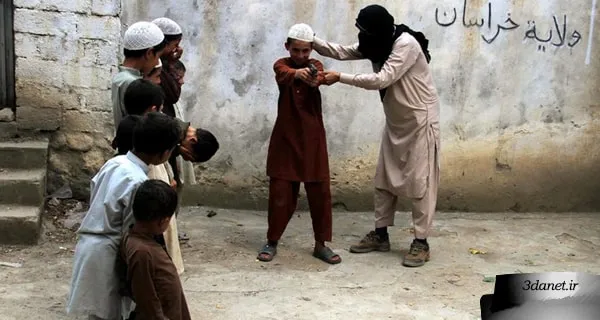
Terrorists (especially terrorists on the African continent and ISIS) have a strange fondness for recruiting children and involving them in their dark and sinister organizations and acts. Some time ago, news reports and images were published in the media that plunged me into deep thought. The image of a child, not yet having reached puberty, executioner-like, firing a coup de grâce into the head of a captive of the ISIS terrorist group in Iraq. Some time later in Libya, an ISIS terrorist beheads an army soldier before the eyes of children, and children are spectators to this scene. And a more painful image, the image of very young girls, veiled, holding Kalashnikovs as tall as themselves, and children drilling for war, learning murder and bloodshed, and having taken the title “Lion Cubs of the Caliphate.” Such images are also found in abundance amidst the civil wars of Africa. Perhaps some eighty years ago, we could have seen similar scenes in the throes of the Second World War in Europe and East Asia, but today they manifest solely in the Middle East and Africa. These scenes are the most painful scenes a person can witness. What effect will these scenes have in the future on children who see violence in its most naked and primitive form, live, every day before their eyes?
Boys who take up real weapons of war instead of books and toys, and girls who do the same instead of books and dolls, and whose pastime becomes shedding the blood of others (even if they are true criminals deserving of death), will be psychologically far more violence-prone than their peers who have grown up in a natural environment; and thus, murder and crime will become institutionalized in them. Each of these children, if they do not receive psychological treatment and therapy, could potentially form their own terrorist group or faction in the future, initiating further bloodshed and washing blood with blood.
Since terrorist groups do not operate under the banner of any government or organization, direct political pressure can hardly be exerted upon them, nor can international commitments be extracted from them. Therefore, the only possible way to solve this problem is to pressure the financial and arms sponsors of these terrorists to cut off support, as well as to completely eliminate the terrorist groups, and, of course, to engage in ideological and doctrinal confrontation to destroy the roots of extremist and violence-seeking thought (in all areas).
Although this type of children's exposure to violence has a horrific effect on them, one should not think that merely the direct presence of children in war is the factor destroying and corrupting the human race—even though it is the most obvious and tangible one—and overlook the remaining cases, naively contenting ourselves that such violence does not exist in society. In the next two sections, I will address two other factors in the institutionalization of violence in children.
Part Two – The Child Under the Sway of Media Violence
The point Karl Popper makes about violence and the child, which was mentioned in the introduction to this essay, has in today's world, with the advancement of technology and its accessibility, increased (and indeed surged) both in terms of abundance (quantity) and undergone fundamental transformations in terms of quality. The increase in mass communication devices and their accessibility has made it more difficult for parents to control inputs to children than before, an issue whose intensity has been greatly amplified by the growth of cyberspace and the internet.
Alongside this comprehensive growth of communication and audio-visual technologies in the contemporary world, the nature of children's programming has also undergone a transformation. Until a few years ago, television and media programs specifically for children possessed certain characteristics that are not given much consideration today in the production of programs targeting a child audience. Characteristics that, although not paid much attention at first glance, have nonetheless exerted their influence indirectly. For example, one of these characteristics was the naturalness or closeness to reality of cartoon characters. Natural (or real), of course, in the sense that similar instances of that character could be found in the real world. That is, the characters were either human or animal—animals whose most unnatural state, perhaps, was walking on two legs—but there was no sign of monsters and extraterrestrial beings belonging to the realm of imagination. In other words, the overall visual atmosphere for children in the past was closer to reality than it is now. In addition to this characteristic, a feature more relevant to the discussion of this article is the absence of violence in animations and children's programs. In none of the children's cartoons, even when a wolf chases an ostrich, or a cat chases a mouse, despite enduring the worst blows, is any blood seen, nor does any death5 occur. The third characteristic in cartoons was the natural depiction of problems in life and the effort to resolve that problem with all its human aspects. A problem that was sometimes accompanied by humor and sometimes presented itself seriously, but was resolved by the story's characters. More importantly, animations and media products targeting a child audience were generally adapted from books and works by the world's great authors, in which the writer had an approach with moral and cultural themes.6
A look at children's animations and programs these days reveals a clear difference compared to the past. Cartoons featuring imaginary creatures with strange faces, whose goal is to kill and destroy a space or earthly enemy. On the other hand, it is unclear what the ultimate goal and theme of this film or cartoon, made for a children's age group, is. After watching hours of children's films and animations, one perceives no message (let alone a moral one) from them, and time has simply been wasted. Such a change has also occurred to some extent in programs for adults, but for children, this issue has a more profound effect. Alongside all these issues, given the growth of technology and the employment of new techniques, the visual and emotional appeal of today's cartoons has greatly increased compared to older cartoons, but this creation of excitement, which in my opinion is the most false type of excitement, has been placed solely in the service of promoting violence (and not even negating it, but rather, in a way, legitimizing it).
Part Three - Housebound Warlords
With the entry of computer technology into homes and the emergence of personal computers, and consequently the growth of hardware and software technology and the entry of capitalists and wealthy companies into the computer game business, another portal alongside the living environment and television opened up to children, called computer games (the virtual world). These games, due to their high graphic appeal and because the user places themselves in a situation they might not be able to experience in the real world with those capabilities, have garnered much attention from various segments of society, especially children. Furthermore, realistic world-building and the combination of the real and virtual worlds have added to this appeal, to the extent that it has captivated not only children but also adults. The situation is so dire that addiction to computer games has become one of the factors in the dissolution of shared lives, and some news reports have even stated that in some East and Southeast Asian countries, several people have lost their lives over computer games.
The phenomenology of computer games (the virtual world), examining its positive and negative effects, and discussing the relationship between the virtual and real worlds are beyond the scope of this text. However, the promotion of violence through computer games must be a concern for parents and a top priority for cultural authorities and game developers.
The effects of computer games on children from the perspective of merging the virtual and real worlds and making it difficult to distinguish between them, especially with the growth of 3D technologies and increased image processing quality, is an issue that must be considered and contemplated, both for violent games and for other games. But regarding games where violence rages and bloodshed and playing with blood are the main backdrop of the game's story, this effect is much more dangerous, as it leads to the internalization of violence, and at the very least, the normalization of bloodshed in children's minds. This danger intensifies with the increase in technological quality, because in recent years' games, the virtual space is exactly like reality, and in some games, 3D communication devices are even used, and the individual literally sees themselves in the same game conditions and so departs from the real environment that distinguishing between virtual and real environments becomes difficult for them.
The impact of violent games is far greater than that of violent films, because in these games the individual, in the first person, experiences bloodshed, warmongering, and belligerence firsthand. The child sees himself not in his room in front of the television, but as a warrior commander who, with martial tactics (whether in strategy games or first-person war games), attacks the enemy, sheds blood, and sees his comrades fall to the ground. Sometimes he is in the past, during World War II, fighting for the American or German army; sometimes he goes to the future and battles in a war between Earthlings and aliens; sometimes he fights in an imaginary land against imaginary creatures; sometimes he participates in an unreal event like a war between the Soviet Union and America; and sometimes, at the end of time, he must flee the clutches of the living dead (zombies). And of course, in some cases, within a span of a few hours, he traverses all these worlds, advancing in each one, and even at night, instead of hearing or reading "good stories," he hears the sound of bullets, guns, and missiles, and witnesses killing and being killed, each time growing more avid to kill more and shed more blood in order to advance and win a hypothetical medal. At school, too, he talks with his friends about the latest techniques, codes, and methods for defeating that hypothetical enemy.
The result is that this child wakes up thinking about shedding blood, learns methods of bloodshed from his classmates at school, and sheds blood at night until he falls asleep (if he does, indeed!). The parents, meanwhile, are pleased that their beloved child is busy with his own affairs in his room and has remained safe from the polluted atmosphere of the city, unaware that they have allowed violence into their own home without realizing it. Given the problems that plague families today, the lack of attention parents show toward their children, and their view of their child's success solely in terms of food, clothing, and expensive multilingual schools, neglect of this issue has become very widespread in society, which will pose a great danger to the next generation. A generation that has spent its childhood engaged in violence, for whom, in the best-case scenario, violence is a normal matter. One might even claim it has so deeply penetrated their subconscious that it is normal for them to use others as stepping stones to achieve their goals, and even to shed the blood of others if necessary. More terrifyingly, sometimes this killing is accompanied by joy; that is, the individual is not only not upset by killing another (even if in a virtual world) but takes pleasure in it, and for his own success, attacks another land, plunders it, puts its inhabitants to the sword of his soldiers, adds to his own stockpile, and absolutely does not hold himself morally accountable. Thus it happens that those known among their neighbors as the most demure, modest, and reserved individuals suddenly, under the influence of a spark, turn into a killing machine like a powder keg, showing no mercy to man, woman, or child.
Conclusion
It is strange that the present century, having experienced two world wars, is so entangled in violence. A violence that began in the early years of this century and whose fire has not yet subsided. A violence that has penetrated into the homes and dwellings of people, which should be places of safety and tranquility. In the midst of this, children are highly vulnerable to this unpleasant phenomenon, and from this perspective, the child is besieged by three sources of the proliferation of violence. However they may be influenced by these sources—whether they are directly caught in the midst of violence, or indirectly placed in the line of fire of violence and aggression by mass media or the virtual world—an effective and appropriate solution must be found and implemented for each of these cases.
In the first case, the groups perpetrating violence must be confronted severely, with collective and international power, and without any leniency. One cannot engage in calm, rational dialogue with someone who lacks the capacity for a rational response to criticism and who, when addressed with reason, prefers to draw a weapon on you and shed your blood; rather, one must act with great force to suppress them. One cannot approach extremist Salafist (Takfiri) groups with logic and rationality—groups that view killing opponents and critics as a ticket to paradise. Of course, there is a complex situation in this battle. Takfiri groups are like a seven-headed dragon: with every head you cut off, seven more grow back, becoming even more ferocious. And one must remember that a purely military response increases violence. It was thus that with the destruction of Al-Qaeda, ISIS emerged, outdoing its predecessor in violence and crimes against humanity. Alongside military actions, one must also engage in ideological and rational efforts to prevent the growth and advancement of these cancerous tumors, and to cultivate minds with logic and train people's intellects so that they do not fall into the trap of the fallacies of these bloodthirsty ideologies.
In the second case, media moguls and community leaders must exercise greater care in selecting programs specifically for children, considering every detail with attention to native and national culture. Parents, too, must supervise the programs their children watch more closely. This task is even more essential for parents who, out of necessity, both work and leave their child alone at home for hours. One should not assume that only the space outside the home is dangerous for a child. The space inside the home can also bring an experience of violence for the child, akin to a battlefield.
It is in the third case that the family's role becomes much more prominent. Parents must not, in order to keep their children indoors, push them into a virtual battlefield and cast them out of the frying pan into the fire. However, this must be done with psychological finesse, which is where child psychology and education specialists should step in and offer a practical, localized solution.
In the end, I consider attention to one point essential: avoiding falling into the vortex of conspiracy theory. One must not think that Western and Eastern countries—the colonizing West and the encroaching East—have created such programs and games specifically for us, for the destruction and cultural transformation of Iran and Islam, or based on colonialist agendas. This is not the case, for the primary market for these games is their own countries, and many of these games and animations are distributed in our country illegally and without the creator's permission. What they do, and we do not, is that in those countries, more attention is paid to the appropriate age for the audience, whereas in our country, it seems that sellers, parents, and even the children themselves pay absolutely no attention to the appropriate age for cartoons and games written on them, and they do not heed the age rating labels on virtual products, films, and animations—a trend that must be corrected. If violence becomes institutionalized among the children of a nation, it will shape an unsuitable future. Instead of these things, it is better to reconcile children with books, to spend time with them, and to recount the tales of the Bustan, Golestan, Masnavi, Shahnameh, and other valuable books, which contain many ethical points that open one's eyes to the truth of the world. These are books that have emerged triumphant through the centuries, and everyone has affirmed their distinction. One must remember that perhaps a generation may err, perhaps a society may err, but human society, in the long run, does not err in its choices. And if certain books are held in honor and respect throughout the world, it is not without reason. It is truly unfortunate that a culture which has nurtured such writers should become empty of the sublime meanings they valued and fall into the abyss of immorality and violence.
.
.
Notes:
1- Sir Karl Raimund Popper
2- Open Society and Its Enemies
3- The Lesson of This Century
4- Television corrupts mankind, It is like war
5- Death in the sense of the deaths shown in current mass media, especially in computer games.
6- Such as the animation Daddy-Long-Legs written by Jean Webster, Huckleberry Finn written by Mark Twain, Anne Shirley written by Lucy Maud Montgomery, Little Women written by Louisa May Alcott
.
.
The Child and Violence
Hamed Farnaghizad
Source: Niloufar Cultural Site
.
.


Discussion0 comments
No comments yet; let yours be the first voice.