Philosophy
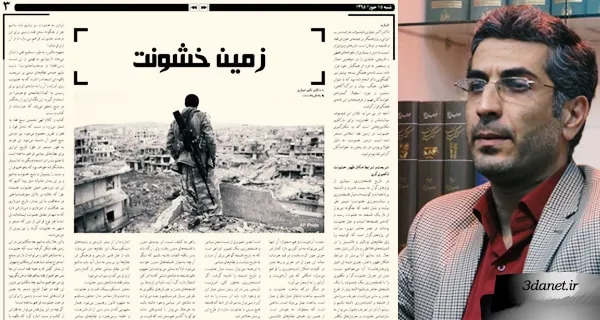
The Essay “The Ground of Violence” by Akbar Jabbari
Philosophy is freedom itself and cannot be the cause of fascist systems, yet the relationship between violence and the history of thought cannot be ignored; we must see words as the soil in which the tree of violence has taken root and flourished.
In the history of philosophizing, many researchers have addressed the relationship between power and thought, striving to find a causal link between philosophizing and violence-generating politics, and to show how one can arrive at violence from within a philosophy, and which philosophies have been the instruments and causes of violence. In the present era, “Popper” is the foremost of these researchers, who has tried to trace the footprints of totalitarian and fascist systems in the thoughts of Plato and Marx.
Now we must know whether the question of the conditions of possibility for the emergence of ISIS is something similar to this kind of research? Do we want to understand the relationship between this violent and takfiri current and the philosophizing of a particular philosopher or a specific philosophy? Of course, before posing such a question, we must have a straightforward definition of philosophy and thinking, and see whether, within this accepted definition, one can arrive at a genealogy of violence and takfiri currents? It is quite clear that one who considers philosophy to be identical with freedom and thought to be identical with liberation can never find a relationship between a fascist and violent current or system, and philosophy. In such a realm, philosophy, even where it seeks to expound an idea in which it “places a crown of honor upon the poets’ heads and banishes them from the city,” cannot be the “cause” of a political system and a justifier of fascism. For two simple reasons. First, that philosophy deals with “ideas” and the “universal.” This engagement with the universal and journeying in “universals” is both the “cause” of freedom and its “effect.” Only one who has transcended the particular and is not bound by particulars can engage with the universal. This transcendence of the particular and liberation into universals provides the possibility for thinking. A possibility that is identical with freedom and brings freedom.
Secondly, the realm of violence and fascism is the realm of the schism between theory and practice. It is the realm of groundless practice. It is a realm that is self-referential. For this reason, all fascist systems are “self-founded.” This self-foundation tolerates no philosophy or thought. It is for this reason that fascist systems turn to “anti-thought.” They turn to the promotion of a speech (Discourse) that is anti-thought. A speech that is no longer philosophy; because it is not free and is in the service of a “practice.” This pseudo-philosophical speech is more an ideology than a philosophy.
That a researcher seeks the roots of violence and fascism in the philosophy or philosophizing of a philosopher has a clear implication: that they have taken philosophy as ideology. For them, philosophy is neither the realm of universals nor the realm of wonder. They consider the philosopher to be the prescription-writer for the political man, and imagine that the political man’s eyes and ears are on the philosopher’s prescription, and that political action is contingent upon this philosophical view! Such an image of the relationship between political action and philosophizing is an abstract image for which neither the history of philosophy nor the history of politics and political systems bears witness.
Nevertheless, the relationship between violence and the history of thought cannot be ignored. If thinking, in general, is a historical matter, then on this ground a relationship exists between the two. This relationship must be brought into view. One cannot be rid of posing this question merely by claiming that philosophy has no relationship with violence.
If we do not limit thinking to “philosophical speech,” then posing the question of the relationship between violence and thought finds a place. Thus, we must consider thought in general as “speech” (Discourse) within which these relations are formed. Therefore, we must first bring existing speeches into view and understand within what mechanism these speeches could have fueled violence; for here, each speech is like a ground in which the tree of violence and violent systems has taken root and flourished.
Undoubtedly, Takfiri currents and the political systems arising from them, such as ISIS, bear no relation to philosophical discourse. Although one can view the emergence of this phenomenon in the modern age as a modern phenomenon in relation to the modern world, and from that passage find a way to discover the relation of this modern phenomenon to modern philosophies, we must then pay attention to the point that what are called modern philosophies, firstly, can hardly be gathered under the precise concept of philosophy as a knowledge concerned with the universal; secondly, this connection between modern philosophies and Takfiri currents can exist as a political matter only in a very indirect and remote way. In any case, one can concur with philosophers like Foucault or Agamben, who consider power in the modern age to be coeval with violence and see its nature in a kind of ontological gaze upon the human being and their life; such that in the modern age, the natural life of the human (zoe) is integrated into the mechanisms and calculations of state power, and politics transforms into "biopolitics" (biopolitics). It is from here that one can concur with Foucault, who said: "For millennia, man remained what he was for Aristotle: a living animal with the additional capacity for a political existence; (but) modern man is an animal whose politics places his existence as a living being in question."
From such a perspective, one can also view both ISIS and all fascist and totalitarian systems; but we must be aware that such a perspective, despite its precision in approaching a concrete analysis, distances us just as much from the historical context and discursive backgrounds of these systems. One must also inquire into the historical and cultural formative causes of these systems. We must know from which ground this particular political system nourishes and quenches itself...
.
.
Essay "The Ground of Violence" Part One
Essay "The Ground of Violence" Part Two
Essay "The Ground of Violence" Part Three
Essay "The Ground of Violence" Part Four
.
.
Essay "The Ground of Violence" by Dr. Akbar Jabbari
Published in the weekly "Sanjeh" of Afghanistan
.
.



Discussion0 comments
No comments yet; let yours be the first voice.