Religion
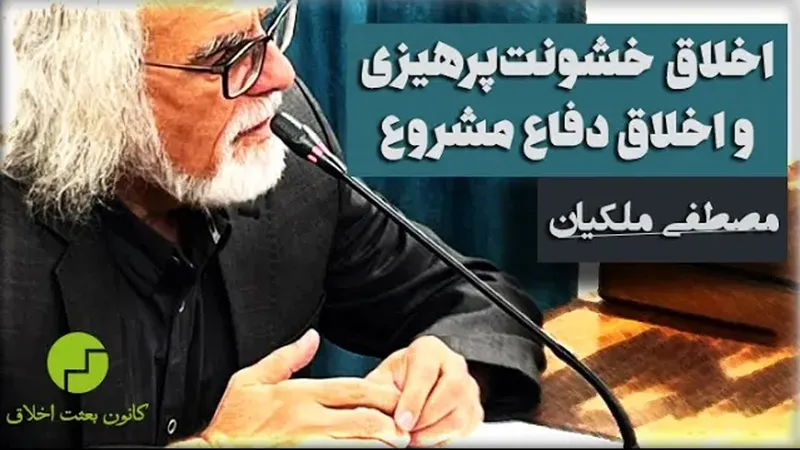
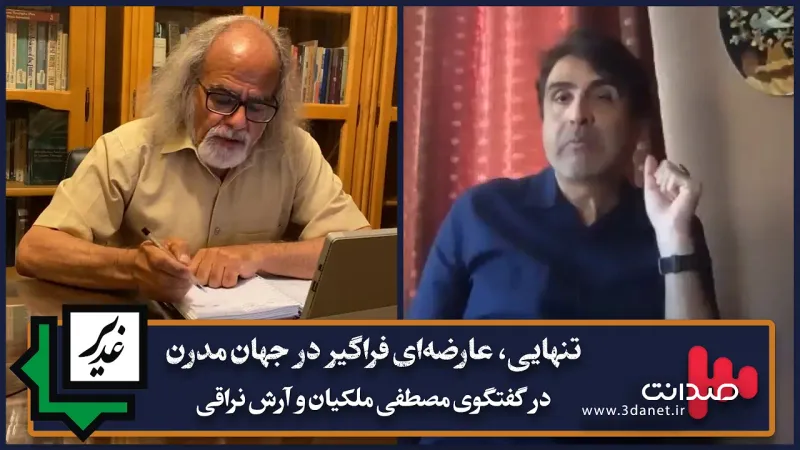
A Critique of the Method and Ethos of Mostafa Malekian's Intellectualism, by Amir Yahya Ayatollahi
With his 'Rationality and Spirituality' project, Mostafa Malekian sought to diminish traditional imitation, yet his method and manner have inadvertently reproduced person-centred authority and deference in the guise of modern intellectualism.
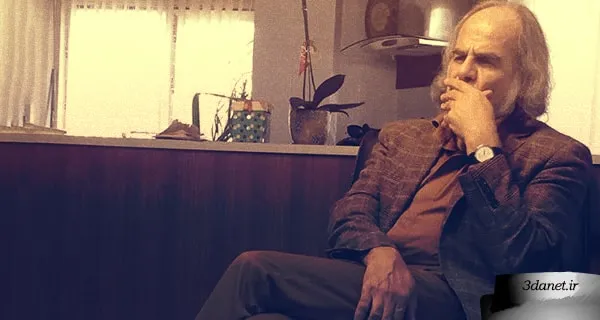
These days, few among those who seek out intellectual discourses and dialogues in Iran have not heard the name Mostafa Malekian. His scholarly endeavors in recent decades, from whichever angle we consider them, are a sign of a great transformation in the formulation and advancement of intellectual problems in our land.[1] Perhaps Malekian's most valuable contribution is precisely the training and cultivation of a generation of graduates from Iran's oldest institution of knowledge who flaunt their simultaneous mastery over parts of the Islamic tradition and Western thought. Now the fruits of Malekian's intellectual struggle can be clearly seen here and there. Today we are faced with a rare breed of seminarians and clerics who speak clearly and precisely, have deeply understood the necessity of rethinking the sources of religious knowledge and have methodically undertaken it, and have ultimately replaced anti-Westernism with an active engagement with the Western tradition. All of these, in their own right, deserve recognition and praise. Nevertheless, in the midst of this, Mostafa Malekian himself has become a problem among the unresolved knots of Iranian intellectualism.
The aim of this writing is to recognize this problem and to provide a fitting analysis of its aspects. The content of this critique, insofar as it also addresses the personality of a thinker or his individual behaviors, treads on slippery ground that is both provocative and in need of proper organization, lest the virtues of Malekian's enlightening activity be overlooked in the grip of some of its consequent results. Nevertheless, the alleged harm has found clinical signs in the public sphere that worry any observer about the functioning of "spiritual intellectualism" in our land. It is hoped that this text will be viewed merely as an introduction, concerned about the re-creation of traditional obedience and bigotry in the valley of our modern intellectualism.
Preamble: The Struggle Against Jurisprudential Authority and the Reproduction of Traditional Authority
Intellectualism in Iran after the collapse of the Pahlavi monarchy has always been entangled with the reality of the rise of a religious regime from the heart of the last classical revolution of the twentieth century. As a result of this confrontation, the discourse of a part of the intellectual body shifted from the struggle against global arrogance and the values of the new world to a recognition of the religious tradition, and the harms of the politicization of Islam and then the critical understanding of the political characteristics of this religion became the axis of the intellectual efforts of those who, after a while, called themselves "religious intellectuals." The distinguishing feature and main characteristic of this spectrum was precisely opposition to religious domination over the political (from the position of safeguarding religiosity) by resorting to religious studies, and each of their approaches in pursuing this intellectual commitment differed from the other, from grasping the mystical tradition in opposition to the jurisprudential reading and transforming Muhammad from a ruling prophet to an attained mystic, to utilizing European hermeneutics in solving the problem of political verses and how to confront a text that claims collective guidance, to seeking the roots of secularism in the Quran and the history of the Prophet of Islam's life, and focusing on the capacity of the Shia religion in suspending the rulings of Sharia, and finally considering spirituality as the essence of all religions, all fell under the analysis of why the Islamic Revolution occurred.
The common denominator of all these intellectual strivings was one: to bring down the authority of the jurists. Most of these religious intellectuals were either educated in the religious sciences or had equipped themselves with an acceptable knowledge of the language of religion and jurisprudential texts. Such equipment was entirely wise and necessary, because they were determined to change something whose boundaries of interpretation had, until then, been determined only by its official representatives.
Mostafa Malekian must be regarded as a significant turn in the continuation of this generation of intellectuals. This religious new-thinker (if, of course, such a title can still be attributed to him) moved from the critique of religious knowledge to the critique of religion itself, and from there built a foothold for attaining a trans-religious spirituality. His critical examination of the Quran and the life of the bearer of that book has been more methodical and systematic than all his predecessors.[2] Since he himself belongs to the lineage of spirituality-seekers, he had the fortune that his approach to the assessment of religion was far more freethinking than other leading figures of religious intellectualism,[3] because (based on an attachment to the existentialist tradition) in his own words, his sole concern is “the human being,” not religion, civilization, or any other human construct. Malekian bestowed unprecedented depth and precision upon the philosophical view of religion and the posing of epistemic problems in this domain (with the aid of the analytic tradition). In analyzing the relationship of ethics[4] with other spheres of human life, he is the most serious Iranian thinker and can be considered the diligent founder of the philosophy of ethics in Iran.[5]
Before anything else, it is necessary to recall that the pathology of forming person-centered authority is not exclusive to spiritual intellectualism and is, unfortunately, one of the inverted and actual functions of Iranian intellectualism (religious or non-religious), just as the struggle against the authority of jurists has been a common feature of all prominent intellectual currents after the formation of the Islamic Republic. Perhaps the existence of several characteristics in the framework of Malekian’s thinking and ethos (most of which are aligned in their emotional impact on the audience) caused a non-critical halo to form around his personality among his admirers. The parts of this section are an attempt to recognize these features in Malekian’s intellectual work.
1. The Consequence of the “Rationality and Spirituality” Project
Alongside the Transformation of the Philosophy of Ethics into “Moral Counsels”
The belief in the possibility of a realm of existence where empirical science has no right to pry, alongside the popularization of theoretical discussions of ethics and the declaration of the manifesto of the “authentic moral life,” caused Malekian’s critical meticulousness to give way to spiritual emotional expansiveness before his audience. It seemed this change of image showed that these two faces (at least in the public’s digestion) did not quite match each other. Malekian, who claimed that Iranians’ backwardness was due, among other things, to imitation, dogmatism, and personality worship, should have monitored the grounds for the occurrence of such afflictions more than anyone. Just as Malekian has always been apprehensive (rightly or wrongly) about the anti-rational dangers of disseminating postmodern ideas in Iran, it would have been fitting for him to also be concerned about the consequences of promoting spiritualism. It is astonishing that he explicitly acknowledges the conflict between the philosophical life and the mystical life, yet he does not see this same confrontation between his critical approach and his spiritual style! [6] In a land where people are already predisposed to follow a religious authority, recreating the same state before an intellectual authority with spiritual content was not far-fetched. The illegitimacy of Malekian possessing such an authority is based on his own teachings about rationality.[7]
The frailty of the human constitution is precisely the reality that Malekian's propagation of spirituality (following his ethical creed) has overlooked: that human beings are, primarily and essentially, neither altruistic nor rational. The spiritual intellectual is inevitably optimistic about human nature, or at least strives to draw this nature out of its state of selfishness and self-alienation.[8] The path Malekian sought for liberation has now, in certain respects, reached an inverse conclusion. He intended to replace the historically institutionalized authority of the masters of religions and denominations with a rival discourse that is seemingly comprehensive and inclusive, but which in fact seeks to challenge the totalitarian dominance of a centuries-old tradition. Malekian said, "The first task in realizing spirituality is to eliminate the element of dogmatic adherence from religion," and he called it "rationalized or rationalized religion" and "a kind of religious empiricism" that simultaneously possesses the characteristic of "desacralization of persons"[9]. The project of spirituality, in the realm of theory, is bold, intelligent, and entirely in line with the idea of religious tolerance and free thought. Malekian, of course, accepts that "in spirituality, there is recourse to a master, but only as a shortcut"[10], and in clarifying his intent, he emphasizes the empiricist and testable aspect of spiritual solutions. However, the implementation of this project showed that the adherents now seek in the domain of spirituality the very same unquestionable sanctity they once attributed to religion. The more the spiritual dimension of this project was enriched, the more Malekian's image came to resemble that of a sage rather than an intellectual. If, until yesterday, the pronouncements of the Ayatollahs of Qom were the final word, today Malekian's audio files have attained the same status, with the difference that they explicitly assert their position, whereas Malekian denies such a position.
It should also be added that the spectrum of zealous admirers of Mostafa Malekian has largely emerged from the student class rather than from seminarians of the religious sciences. For obvious reasons, that intellectual subservience has been less observed, or has been transient, among his peers compared to those who lacked lived experience within the religious tradition. The audacity to set foot on the "desert island of knowledge" and the close encounter with "age-old exemplars of obedience" often prevents those who have changed course to the intellectual world from reproducing the same uncritical relations. In other words, the harms of Malekian's spiritual approach led to astonishing results when his intellectual work and the renown of his ideas entered a much broader level, and the first people to regard his spiritual commodity with thoughtfulness were from among these very reformist seminarians (and not mere students), and the outcome proved that their scholarly pessimism was more or less justified.
In any case, let us not forget that traditional authority possesses an institution, a track record, a history, and official spokespersons, and all these characteristics mean that the critique of such authority has already found its framework and method. However, assessing that kind of spiritual authority which simultaneously claims to be anti-authoritarian will be a far more difficult and complex task. From a conservative view of human nature and history, curbing classical authority has a lower margin of error than constructing a new authority to pull down its historical rival.[11] Hence, the costs and benefits of the first project (investing in curbing religious authority and then utilizing it) are predictable to some extent, whereas we have no abacus to estimate the consequences of focusing on a frameworkless spirituality. The recent considerations are closely tied to envisioning a future of secular policymaking in Iran, which appears impossible without attention to the institution of religion. It can be said that Malekian's spirituality is fundamentally apolitical and individualistic. Such a defense, besides being further evidence of Malekian's detachment from the political matter, does not explain how the proposal of such an idea (spiritual rationality or rational spirituality) has, in practice, led to mere spiritual seeking and formalistic moralism in politics.
A similar objection, but with the reverse motivation (opposition to secularism), can be seen in Hadi Sadeghi's critical piece[12], where he speaks of the lack of a social dimension and the purely individual focus in the project of spirituality. He rightly points out that the attainment of non-individual outcomes from such a project is contingent upon the emergence of a utopia or virtuous city, and throughout the article he refers to Islam's directives for guiding society. Sadeghi wants to conclude that historically institutionalized religion is the sole competent authority for decision-making in the collective sphere. The present writing, in contrast, contends that a secular future for Iran is unattainable without dispossessing religion of the public domain, while at the same time, completing the process of religious separation is easier with regard to historically institutionalized religion than with an unidentifiable spirituality. To put it more clearly, secularism in Iran is aligned with ending the supremacy of Islam, and it advances such a project on two fronts: Shiite rethinking (including the idea of political quietism during the Occultation) and opening up space for rival discourses to assert themselves, from Baha'ism and dervish orders to the spiritual movements of the new age. The curbing of religion and the freedom of religiosity are intertwined and share the same fate. In all this, one must not forget that the primary addressee of secularism in our recent five-hundred-year history is the Shiite faith, and it might have been more beneficial for Malekian's project to preserve more of its negative and critical aspect toward its main rival, rather than being an affirmative and foundational project for a kind of quasi-religious life with similar harms.
Islam, as Hadi Sadeghi explicitly states, has a plan for managing society and, at least in contemporary history, a failed record approaching its fortieth year. Malekian's spirituality is entirely apolitical and without aspirations to power, but wherever it has cast a sidelong glance at day-to-day politics (in terms of approach), it has gone completely astray. Accepting the reality that the sphere of influence of the spiritual intellectual is not comparable to that of the religious authorities (whether in terms of the former's small numbers or the latter's historical institution-building), the concern that the multitude of spirituality enthusiasts might, under Malekian's authority, engage in political activism is not entirely misplaced, and the project's owner has shown that despite the general character of his ethical views, he suddenly, in the sacred name of that very ethics and spirituality, enters the realm of determining specific and particular instances. Of course, just as prohibiting religion from political intervention does not mean prohibiting the religious, secular spirituality is not supposed to lead to the political inaction of spirituality-seekers either. But on the other hand, if the religious ought not to determine society's destiny based on religious beliefs, spiritualists also ought not to do so based on spiritual convictions. The common good in the realm of politics can be neither religious, nor spiritual, nor ethical. Religion, spirituality, or ethics are all in harmony in the irresolvability of their decrees. There is little public consensus on any proposition from these three, and more importantly, none offers a real guarantee in the political arena. Political convergence based on any of these three realms is making a pact on nothing and everything. In this respect, the encroachment of spiritual or ethical authority upon political issues is just as catastrophic as the intervention of religious authority.
2. From Political Evasion in "The Primacy of Culture"
to Moralism in Day-to-Day Politics
Intellectualism in this land has had a tragic story. During the Pahlavi era, for whatever reason (including the inflexibility of both sides), the ruling political order (which is the pinnacle of modernization and structural development in our contemporary history) and anti-imperialist intellectualism could not reach a consensus on the nature of political despotism and how to transition from it. Instead, the convergence of a significant portion of the post-revolutionary intellectual body with the Islamic Republic, in bewildering the people within the labyrinth of "choosing between bad and worse," has forged that very political consensus with an entirely reactionary and totalitarian regime over the "consolidation of anti-Western religious governance."[13]
Malekian’s persistent insistence that the primary problem of society (in his words: the sole cause or the cause of causes of problems) is “cultural” has not prevented him from calling upon his audience to go to the ballot box at every election season with various justifications. In 2008, he deemed voting for Mohammad Khatami, partly on account of his “strong and lively moral conscience,” a “moral duty of Iranian elites”[14] and, in the most recent electoral contest, by seizing upon the concept of “hope” and elevating the hopeful over the hopeless[15] (with the claim that hopelessness is invariably harmful), he once again encouraged the people to choose Hassan Rouhani. His first reaction demonstrates, above all, a failure to distinguish between moral virtues and political virtues and an equation of the two. Moreover, from purely moral-psychological considerations, he arrived at a very weighty normative judgment (determining the instance of a moral duty for elites) in the political sphere. His second reaction (that is, the use of contradictory-in-instance and ambiguous concepts such as hope/hopelessness as a measure of political behavior) indicates, above all, a romantic approach to politics. One could easily say, employing those very concepts, that hopelessness has not always been harmful and, as it happens, can lay the groundwork for a lasting hope. Language games in the realm of analogical and poetic politics are a double-edged sword.
Taking into account both of Malekian’s approaches, namely “the primacy of culture” and “political participation,” the outcome can be clearly observed: citizens must attain moral virtues through introspection and inner journey, and simultaneously strive to determine their own destiny within the framework of the Islamic regime. The combination of these two teachings leads, in the long run, to the atomization[16] of citizens and social fragmentation, and to merely seasonal solidarities at junctures approved by the political system. Thus, the primacy of culture in his view possesses a significant dimension of political escapism, and the occasional summons to the magic box of “republicanism” is a sign of political obsession.
Contrary to Malekian’s repeated emphases, struggling against a political system does not necessarily mean that we consider it the cause of causes of society’s problems, nor that we have become eulogists of the people so as to conclude that, for instance, such a great nation deserves a better government. There is no necessary link between political overthrow and populism. As it happens, the periodic injection of hope into the body of society at every election season can be the greatest instance of “preferring what pleases the people over their best interests.”[17] The fallacy Malekian commits is equating the primacy of culture with the invalidity of radicalism. In “The Theoretical Foundations of Reformism,”[18] he also appears in the guise of a political thinker and supports democratic, peaceful, and gradual reforms. If only one objection can be raised against Malekian, it is precisely his mistaking the realm of politics for the realm of ethics. This claim would be false if Malekian had merely confined himself to outlining his ethical expectations in the political arena. But this moralism has been accompanied by political guidance. At election times, he uses his social influence to mobilize public participation, and the backing for his request is nothing other than these very moral ideals.
Malekian’s constant emphasis on “Abraham Maslow’s hierarchy of human needs” and the priority of physiological wants over other demands (social, political, or spiritual) also falls within the framework of his “Theoretical Foundations of Reformism” and the primacy of culture. Furthermore, Malekian’s exclusive focus on individual ethics as the sole path to improving the collective condition and subsequently the political system is not very consistent with his insistence on Maslow’s theory, especially considering Malekian’s advice to “forget about reforming society”[19] and “not to make the goodness and pleasantness of life contingent upon the political regime,”[20] and instead to commit solely on a personal level to observing ethical principles. The totality of these incompatible teachings leaves the people indecisive in the face of a thoroughly corrupt governance incapable of fulfilling even that first level of the hierarchy of needs. It seems that, from Malekian’s perspective, the most important path to liberation is attaining “second-order satisfaction”[21] (reconciliation with oneself) in the face of the adversities of the external world. On the whole, the Stoic dimension of Malekian’s intellectual system appears incompatible with the idea of reform.
In fact, Malekian's subjectivism, which first seeks the root of every disorder within, leads to no outcome other than neutralizing society in the face of the ruling political system, and this is a kind of Stoicization of the political sphere. From such a perspective, it makes little difference whether you live under the banner of liberal democracy or under the flag of the Guardianship of the Jurist, for if there is oppression and darkness, it stems from within each and every one of us. We ask Malekian: when will compulsory hijab and organized misogyny be cast aside? Where are the structural roots of the repression of dissidents and dissenters? What connection does systematic discrimination have with individual transformation? His answer is to first reform yourselves, and in the next stage, strive to elect reformists within the governing structure. But what place does historical experience (nearly twenty years) have in all this? Has "reformism" itself not become an intellectual dogma that has no interpretation other than that we have been unable to free ourselves from religious despotism, and instead, we refer the people to inner liberation more than outer freedom? Malekian's "primacy of culture" is the most eloquent confession of the absence of political thought in his spiritualized rationality. The logical consequence of Malekian's teachings leads to this unrealistic and baseless notion that all political regimes are reformable if their individual citizens are reformed.
It would have been fitting for our intellectuals not to offer political solutions merely by virtue of their intellectual prestige. A society that, in the absence of progressive politicians, turns to didactic intellectuals will also reduce politics and the collective good to ethics and individual purification. Malekian's approach clearly suffers from the fallacy of "appeal to an indefinite future." By conditioning the desired political change on individual ethics, he defers the time required for it to an impossibility. Not to mention that Malekian does not explain how this very "education and training" and "culture" have institutions that are entirely under the control of the political regime, and how the project of "cultural transformation" can be advanced under conditions where the smallest independent organizations are being shut down and isolated. Although the track record of the Islamic Republic's cultural institutions speaks of inverse results, this does not mean that, following this antagonism, the regime has been entirely unsuccessful and that the current cultural anarchism is to our benefit. Malekian's deliberate disregard for the "importance of institutions" reveals itself more than ever at such critical junctures. Ultimately, the enigma of "political power" requires appropriate deliberation and a political solution, not moral exhortations.
Ethical politics differs fundamentally from the politicization of ethics. This statement is linked neither to Machiavellianism nor to support for the idea that “politics is inherently corrupt and has no place for ethics” [22]. The issue is that under a totalitarian and ideological political regime that is the founder and promoter of systematic and structural discrimination in a society, on what ethical grounds can one invoke moral principles for choosing the head of the executive branch? Here, applying the rule of “that which cannot be entirely attained should not be entirely abandoned” is baseless, because the political body is not like simple parts that together form a whole. The set of governing institutions has an organic harmony with one another. If the politics of lies is the foundation of a government, then removing a number of political lies means busying oneself with the role of Ivan. In fact, is not the moralization of participation in the pseudo-democratic selections of such a system itself immoral? While the entire governing body is founded on falsehood, are we morally permitted to consider the removal of lies from the executive apparatus a moral duty? According to Arendt’s view in analyzing the behavior of people under totalitarian regimes, can one harmonize with pervasive evil to achieve a limited good? [23] Of course, addressing the relationship between society and government is also possible outside this ethical dispute and from other aspects and perspectives. Raising these doubts is only to recall that, in the face of the moralization of political participation in the Islamic Republic, there are refuting reasons and instances of ethical violation. The most effective ethical document at present is the “Universal Declaration of Human Rights,” which, at least we know, took a “more hopeless” turn during Hassan Rouhani’s era (and with the use of Malekian’s political discourse centered on hope). [24] From that very perspective of ethical politics, the Islamic Republic signifies for us the end of ethics. One might ask how our intellectuals, from the claim that “peaceful and non-violent change is only realized through elections,” reached the conclusion that, without any revision in their mode of political action and based on the fetishization of the ballot box by the ruling theologians, they should always invite the people to the electoral rite and, by preemptively negating the existence of any other solution, keep the horizon of the political future confined within the limits of the Islamic Republic?
3. Generalizing the Analytical Approach from Structure to Content;
Promoting General and Ahistorical Discussions about Specific and Historical Subjects
The innovation that Malekian introduced in a kind of psychological-ethical analysis of everything has had little precedent among his predecessors. From the discovery of the “twenty factors behind Iranians’ backwardness” [25] to the induction of the “nine characteristics of a true intellectual” [26], all stem from a lack of historical perspective in his thought. It is astonishing that Malekian introduces his particular approach in seeking the causes of backwardness as “the problem of me, an Iranian of the early twentieth century living in the Islamic Republic,” and thereby seems to insist on the historical character of what is undoubtedly ahistorical! [27] In the meantime, an injustice has also been done to the word “precision,” which requires rehabilitation. Meticulousness or depth of insight in any field has its own requirements. Precision in posing socio-political subjects means observing the minutiae of the context and time of the discussion, and as it happens, Malekian’s intellectual discourse is by no means precise in these respects. For a long time, his precisions have turned into short, brochure-like aphorisms for every subject. The style of Malekian’s numbered and exemplary analyses has come to resemble “verbal miracles.” It is as if examining any issue means obtaining the necessary and sufficient condition of its definition and then, by resorting to a simplified analytical method, bringing the process of cognition to completion. Malekian consciously and deliberately insists on this abstract and generalizing approach and compensates for the absence of a historical view in examining Iranian issues with moral advice and admonitions.
He speaks of the backwardness of Iranians, but the content of his remarks can more or less be applied to any people, nation, or inhabitants of other lands. His sermonizing critique of intellectualism[28] is also devoid of historical perspective and problem-solving. The essential shortcoming of his intellectual ethos is that he has nothing to say specifically to the “Iranian person,” and he even emphasizes this silence and prides himself on his cosmopolitanism. Malekian claims that the problems of Iranians are not necessarily tied to Iranian history and culture, and that we can benefit from the experiences of other nations, both in terms of shared afflictions and similar solutions for our own particular afflictions. This statement is, in fact, meant to negate Iranian projects in the realm of intellectualism. Nevertheless, when Malekian wants to address the historical problems of Iranian society, his sole and only insistence is on mentioning dogmatism, rigidity, prejudice, bias, narcissism, and their like. He does not explain that these cultural afflictions are neither specific to Iranians, nor does the way Malekian addresses them bear any trace of historicism or an Iranian dimension to his intellectualism. The reality is that Malekian’s historically evasive approach, in addition to its ineffectiveness, is inconsistent with his own claim regarding the necessity of considering temporal and spatial exigencies for intellectual work.[29] The vast majority of Malekian’s works, if translated into any language, would lead the people of that land to think they were written for them, because most of the subjects he has researched possess general and universal characteristics. But whether he wants it or not, he is ultimately an Iranian thinker and must be able to conceptualize and think specifically for the person of his own society. Nevertheless, this necessity requires a historical understanding of national issues. The negation of nationalism with this same a priori, ahistorical, and utopian view that seeks to base the denial of Iranian identity on moralism is a sign of the absence of political thought and historical understanding of the necessity of a “national intellectualism.”[30]
Even the general outline of secularism in Malekian’s expression is entirely epistemological, without the slightest historical anchor or the smallest recourse to lived/possible experiences in the Iranian world.[31] In his universalist perspective, everything is reduced to moral and cultural pathology, and real and particular distinctions vanish. It is as if Malekian, like the God of the Peripatetic philosophers, is entirely free from history and without need to turn to particulars. Contrary to philosophical innovations, the issues Malekian raised in the political arena were often alien to the political itself.[32] For example, in his discourse “Secularism and Religious Government,”[33] to prevent the occurrence of the dictatorship of the majority and the violation of minority rights, he has no solution other than the growth of spirituality in human beings through inner and esoteric conduct, so that where power and justice allow the majority to make decisions (by referring to public opinion), they do not use this opportunity to the detriment of other members of society. This is while the least suggestion from a public intellectual on such an issue should be an emphasis on establishing an independent judiciary institution so that the protection of minority rights gains objective backing and structural guarantee. Otherwise, according to Malekian’s model, at the beginning of the formation of the Islamic Republic, the majority of the people voted for theocracy, and therefore the establishment of the Islamic system did not contradict Malekian’s philosophical secularism (since religious beliefs are of the type of objective matters that are currently unverifiable, and according to the dictates of justice, which does not tolerate preference without a preponderant reason, one must resort to the ballot box to establish a religious government), and historical evidence shows that Ruhollah Khomeini’s interpretation of Islamic governance was not much different from the general conception. Then, these same people remained silent in the face of the targeted humiliation of women, the suppression of Baha’is, and the violation of the rights of Jews and other minorities by their political representatives. Furthermore, Malekian offers no explanation that a religious government means, among other things, the imposition of the laws of one religion upon an entire land, and such a choice, even if hypothetically democratic, bears no relation to “universal human rights.” For the rule of the values of one religion necessarily leads to sanctioning discrimination against the citizens of society; then how is such a phenomenon compatible with Socratic justice or secularism?
Finally, Malekian must answer this question: what boundary does he draw between democracy and secularism? [34] For it appears that in his epistemological scheme he has equated the two and ultimately dissolved secularism into democracy; since the majority of people have chosen religious rule, theocracy does not contradict secularism. It is in this way that Malekian’s abstract formulation of secularism ends in a paradoxical product. This very example shows how his philosophical approach to the issue has led to the negation of the historical essence and the socio-political function of secularism.
4. The Oral Intellectual
1.4 Preferring the Lecture to the Book
Like many others in our contemporary history who laid the foundations for and cultivated the “oral tradition of intellectualism,” Malekian, too, has turned to lecturing more than writing. It is true that his analytical approach is also reflected in his talks, but the same methodological shortcomings mentioned earlier can be traced in his speech as well, and indeed with greater intensity than in his writing. Malekian himself acknowledges three advantages of writing over speech: correcting errors before the audience becomes aware of them, immunity from the emotions of the audience and the surrounding emotional atmosphere, and finally, providing sources and references for claims [35]. Among these three differences, what is most relevant to the subject of this article is precisely Malekian’s awareness of the advantage of composing thought in solitude as opposed to recounting thoughts before an assembly of listeners. He goes on to attribute the reason for this choice to the “inevitability of political action” by intellectuals and arising from Iran’s conditions, and then strongly rejects the suspicion of “inciting the audience” but clearly accepts the goal of “attracting the audience.” Even if we accept that Malekian’s writings are complex and that he has turned to lectures and interviews due to the greater interest of enthusiasts, it still remains unclear where his standing as an academician lies in all this. Malekian taught for many years and, before entering the intellectual sphere, was a distinguished professor in the seminary and university. Nevertheless, his books, more than being collections of articles, trace back to his interviews, and of course, his class handouts continue to circulate.
On the other hand, in the realm of intellectualism, Malekian has been pursuing a challenging project such as “Rationality and Spirituality” for over ten years, but this pursuit has never led to the writing of even a single dedicated work for this intellectual schema, in which the various parts of this project could be explored and its unclear aspects examined in a more or less comprehensive book, taking into account all three of those advantages he himself enumerated for an authored work. His intellectual responsibility required that he be more concerned with the subject itself than with the audience’s reception. This “responsibility” is not of the kind of commitment that pre-revolution intellectuals spoke of, demanding the complete upheaval of the country’s foundations—in which they indeed succeeded—but rather stems simply from the necessity of establishing a balance between an individual’s social roles and the need to create proportion between a plan and its execution. Over a decade ago, the Persian-speaking community was promised the publication of three volumes of “Religious Ethics and Secular Ethics,” but the book market in Iran never saw these volumes. With the foregoing considerations, it is not unreasonable to conclude that Malekian’s professional preference (in prioritizing speech over writing) has not been very proportionate to the requirements of a spiritual intellectual’s work, Malekian’s academic standing, or, finally, to launching such a grand project in Iran’s intellectual space.
2.4 Accessibility: Strength or Weakness
One of the common criticisms of the ethos of our intellectuals is that they are often inaccessible, and no one can manage to meet and communicate with them without overcoming immense obstacles. But it seems we stand at a crossroads, each path of which has consequences. On the one hand, we contrast the extensive connection of the clergy with society against the inaccessibility of intellectuals, and consider it the secret to the former’s success and the latter’s failure. On the other hand, we regard the special, public, and easily accessible mode of communication of the spiritual intellectual as laying the groundwork for idol worship and ideological subservience. What is the solution?
The answer can be found by revisiting a criticism we first leveled at intellectuals. Comparing the function of the intellectual and the cleric reveals the presupposition of a "rivalry" between these two classes. Some of the afflictions of Iranian intellectualism arise from accepting a contest on a ground that does not fundamentally belong to them. The intellectual is like a tightrope walker who is at every moment in danger of falling, and this movement on the border between elitism and populism demands greater sensitivity in our region. Just as the spiritual intellectual is scrupulous about refraining from praising the people, he must also be concerned about turning himself into an object of praise. But the temptation of greater influence over the general audience often leads to the reinforcement of intellectual authority, and the outcome takes on a strange resemblance to traditional authority; the same zealotries, personality cults, and allegiances are recreated. Short-term impact leaves no room for long-term planning, brilliant orations replace enduring works, and attracting novelty-seekers overshadows the revision of new utterances.
3 . 4 Home Gatherings; Practicing Dialogue or Receiving Edification
Holding discussion sessions at home is one of our intellectual traditions. The most renowned instance in our contemporary history is undoubtedly Ahmad Fardid's lectures at the home of Amir Hossein Jahanbegloo, which were attended by some of today's most prominent intellectuals. It appears that the occasional series of meetings held by Mostafa Malekian at his home (even more famous than the similar sessions of Abdolkarim Soroush) is the second most famous example in the current era. It is worth pausing briefly on the difference between lecturing at a university or institute and doing the same under the roof of a home. It seems that a home gathering is more select, intimate, and private. The familiarity or fellowship among individuals is far greater in the latter. To the same extent that this intimacy increases, critical scrutiny of the speaker will decrease. After a while, the connection with the thinker at home turns into an exclusive and rare honor for the participants, and private speech, with the refrain "I was told thus," blends with an atmosphere of devotion-centeredness, which yields no product other than the swelling of the halo of sanctity created around the speaker. We have heard much about Fardid's tactics for belittling and dominating his audience in those bygone sessions. Without comparing these two personalities (who are miles apart and whose conduct lies at two opposite ends of a spectrum), one must inevitably accept that the characteristic of such home gatherings in our region leads to the intensification of a "cult of personality"; something that has deep roots in human nature generally and in our historical Iranian psyche particularly. Although Malekian outwardly always welcomes critical dialogues and Socratic exchanges, his manner of behavior with others (especially when he is the host) is so ceremonious, formal, and elaborate that it places them in a "psychological enclosure" vis-à-vis Malekian. Out of the excess of Malekian's reverence, the individual feels a deep sense of embarrassment. This exceedingly gracious encounter heightens the feeling of devotion and humility in the audience. The crux of the critique lies precisely here; in no such process can all the blame be placed on the disciples and the person who is the focal point of a massive volume of emotions and expressions of devotion be considered free of fault.
The evidence suggests that the atmosphere prevailing in these gatherings, at its very heart and depth, bears no trace of Malekian's teachings regarding a commitment to critique and scrutiny; and the discussions that take place in this space, under the heavy shadow of the host, resemble a contest between student and master, where all spectators expect the eventual, if not immediate, persuasion of the novice questioner before the wise sage. Malekian's manner of dealing with questions in private homes has subtle differences from his responses to the same critiques in the public sphere; a disarming intimacy that is characteristic of "intimate circles." The situation is such that the audience accepts Malekian's words as soon as they are uttered, and if an argument is subsequently presented by him, it is regarded as an additional favor and a bestowal of heartfelt assurance of the correctness of his words. In such an atmosphere, criticizing Malekian is tantamount to depriving the eager followers of the pleasure of obedience. Thus, both disciples and critics share a fate of self-alienation; the former by merging their individuality into the other, and the latter by concealing their individuality from him. In this regard, it is clear that no thinker should act in a way that causes others to lose themselves in the magnetism of his presence and to regard everything they see in their master as a virtue, to the point where if someone points out a flaw, they look upon them with harshness and reproach. Malekian's personality is strong and captivating, and this alone is enough for the other party to be drawn to him. But one should not deliberately prolong this process of attraction further, for there is a fear that nothing of the audience's personality will remain, and the guest will reach a station that the mystical tradition has termed "annihilation in God." But this station is for the servants of God, not the audience of an intellectual.[36]
4. 4 Assimilating Others and Mass Replication of the Self
One of the clinical signs in the process of forming a halo of sanctity around an individual is the observation of an increasing trend of imitative behaviors. It should be noted that attaining such a position among scholars and those who follow intellectual discussions itself indicates intellectual and personal ability, and Malekian is in every respect capable in this regard. Creating such a context, consciously or unconsciously, means the dissolution of the individuality of others; the very individuality that is the most fundamental pillar of rationality. One can never claim that Mostafa Malekian intends to increase the number of his admirers or takes steps toward such a goal. We are not privy to anyone's intentions and inner secrets, and as far as Malekian is concerned, he is introverted and has no desire for fame. For Malekian, whether his doors are open or closed, and whether he is invited to speak or not, makes little difference. Nevertheless, in analyzing what has occurred, we only have access to phenomena, and we address only those; and in the course of this examination, one cannot depict a one-way street between the intellectual and his audience and reduce this entire connection to a one-sided view directed at the audience.
In this respect, the present writing stands directly opposed to critiques in which all responsibility is placed on the shoulders of the disciples, and the master essentially has no existence (except in their imagination).[37] Such an approach, in a self-destructive manner, deepens the very harm it criticizes, because it sees the interaction between the intellectual and society as only one-sided and couples praise for the former with condemnation of the latter. The product of this kind of critique is the preservation of the intellectual's unassailable position and the deepening of devotion in the reproached audience. But the fact that a person appears as a master in the eyes of others cannot be entirely due to their distorted vision. As the saying goes, sometimes there is a flaw at the source as well, and one cannot always say that the receivers need to be adjusted. A distorted image also has a footing in the reality of the image's subject, and a mistaken perception of another on such a vast scale cannot be unconnected to the person himself. The formation of an incorrect image of an individual among a large number of his audience also relates, in part, to the way the individual represents himself. Severing this connection means falling into the realm of extreme idealism and claiming a separation between mind and object. What we see is a growing emulation of Malekian's manner of engaging with subjects,[38] and we must be able to have a realistic understanding, explanation, and recognition of this issue.
Conclusion: The Necessity of Rethinking the Function of Spiritual Intellectualism
In summing up the claim of this article, it can be said that the persona Malekian presented as a “moral counselor,” along with his quasi-analytical generalizations about particular, historical subjects, combined with the resonance of his intellectual project among his audience (in the embrace of rationalism and the quest for spirituality), became ready material that was ultimately ignited by the seasoning of intimate home gatherings and Malekian’s own affectionate and compassionate personality.[39] In practice, Malekian’s “Rationality and Spirituality” project (and judging by our intuition of the circle of disciples that has formed around him and his words) has not been very successful and has, in a sense, inverted the irreplaceable, primary function of the intellectual. The product and consequence of insisting on spirituality has led to the weakening of rationality; successive moral exhortations (and not theoretical discussions of moral philosophy) have blocked the path to critique and criticism. Regrettably, the silence in the face of the growing proliferation of imitative followers and the indifference to curbing these reason-consuming emotions do not allow us to place the intellectual himself beyond criticism when examining the process by which this kind of intellectual devotion and the hypertrophy of personal influence have taken wing.
It must be noted that Malekian’s valuable efforts in presenting new ideas in a novel manner, as well as his intellectual assistance to many who have sought it (ranging from editing and revising translations to drafting study plans, letters of recommendation, doctoral proposals, and even listening to personal troubles), are undeniable. In every conversation, Malekian has always been patient, empathetic, instructive, and genial in the face of others’ relevant and irrelevant questions. Moreover, based on the essence of his own teachings, which is nothing other than valuing individuality and rejecting uncritical submission, this piece can be the best possible repayment of the debt owed to Malekian. For affection for anyone must not lead to ignoring the truth (or, more precisely, what we take to be the truth).[40] Malekian is altruistic and content with establishing such a connection with those around him. Regardless of whether he is an intellectual or a professor, he is a noble human being. Even if his reasons for the correctness of “altruism” are open to objection, his own conduct is the best testimony to the sincerity of his words.
Nevertheless, none of these virtuous dispositions alters the fact that the feedback from Malekian’s approach (whether in practical or theoretical terms) has resulted in the frustration of his intellectual purpose. What has occurred arises directly from a two-way need between the intellectual and his audience. Yet such a bond has culminated in devotion-centeredness and personality worship. Spiritual intellectualism, as a theoretical construct, may well be less contradictory than religious intellectualism, but in a part of its realized reality, it has led to the negation of its own ideals, including self-governance and independent thinking. The endeavor to disseminate the “authentic life” has resulted in the adoption of inauthenticity in the lives of a significant portion of its audience. Malekian emphasizes that his changes of opinion throughout his life have been motivated by a quest for truth and not by fashion.[41] The entire point of this text is that, in the meantime, Malekian himself has become fashionable, and not a few people promote his views out of love, as “justified true belief.” Malekian’s example shows that we must once again think seriously about the hows and whys of popularizing philosophical theories, the reason for the absence of political thought in religious-spiritual intellectualism, and, ultimately, how products incompatible with the original intellectual projects are generated.
.
.
Notes
[1] Arash Naraghi considers Malekian’s position to be the most radical within the spectrum of “religious new-thinking,” one that took this project to the limits of its capacity. (See: “The Future of the Authority of Religious Thought,” Arash Naraghi)
[2] As an example, refer to Malekian’s interview years ago with Fararah magazine (specializing in Quranic studies) titled “The Hermeneutics of the Quran and the Conflicts between Modern Reason and Revelation.” In this interview, he rightly speaks of the inevitability of having presuppositions when confronting the sacred text, while also stressing the necessity of adhering to interpretive principles, and he accepts plural readings of religion only on the condition of avoiding methodological anarchy in interpretation.
[3] For a better understanding of the difference between religious intellectualism and spiritual intellectualism, see: “What Do You Do with Your Paradox?” (Religious Intellectualism in a Detailed Conversation of the Farhang-e Emrooz Website with Mostafa Malekian).
[4] For an empathetic understanding of the motivations behind Malekian’s intellectual work, we must ask why he cast himself in the role of a moral intellectual. One cannot dispassionately overlook the bitter reality that the function and record of the Islamic regime over these four decades have driven some of our intellectuals toward the necessity of moralism in the Iranian psyche. From Mostafa Malekian’s “spirituality” to Mohammad Reza Nikfar’s “piety,” the roots of this concern can be explored (although the former seeks individual good more in the realm of ethics, and the latter seeks the collective good more in the realm of politics).
[5] In this context, one can particularly point to his lecture series on “moral psychology” and his introduction of humanistic approaches in psychology and their connection and relation to moral philosophy.
[6] See: The Gift and the Encounter of Islamic Mysticism, an interview by Seddiq Qotbi with Mostafa Malekian, first published in the monthly magazine “Andishe-ye Eslah,” Issue 1, Tir 1394.
[7] It is important to recall that in some other spiritual-minded intellectuals who did not seek to reconcile rationality and spirituality (such as Dariush Shayegan), we have never witnessed this degree of zealousness.
[8] Regarding “the obedience of the general public to authority,” a reflection on the Santa Clara University report is beneficial. In analyzing how German citizens came to cooperate in the death camps and what motivates the unethical behavior of ordinary people, Stanley Milgram’s experiment shows that two-thirds of participants, in response to a command that increased an electric shock to the victim for each incorrect answer, obeyed this brutal order. However, subsequent new findings indicate that Malekian’s insistence on a simple, precise, and universally understandable presentation of topics in moral philosophy (regardless of the authority that has emerged around his person) might one day prevent Iranians from committing “crimes against humanity,” as happened in Nazi Germany. This possibility is conditional on “moralism” itself being safeguarded from the peril of becoming a social gesture, and mere moralizing not causing its distortion into hollow slogans. In summary, Steven Sherman’s experiment recounts the fact that the moral education and training of participants led to a result exactly opposite to Milgram’s experiment and caused the dominance of inner awareness over external authority. The article concludes that reflecting on moral issues before an individual becomes involved in them leads to action in accordance with moral conscience and defiance of authority in real life. According to the second experiment, moral considerations and discussion about good or bad significantly increase the moral quality of an individual’s future choices. Alongside the pessimism and harms present in Malekian’s moral approach (especially as a proposal presented as a political solution), this hope should not be overlooked that the dissemination of his moral reflections might also prompt us Iranians, for example, to rethink our negligence and culpability in the horrific suppression of the Baha’is and the execution of thousands of political prisoners in the 1980s. See:
‘Conscience and Authority’, Developed by Manuel Velasquez, Claire Andre, Thomas Shanks, S.J., and Michael J. Meyer. Santa Clara University (The Jesuit University in Silicon Valley).
[9] See: Tradition and Secularism (Discourses by Abdolkarim Soroush, Mohammad Mojtahed Shabestari, Mostafa Malekian, and Mohsen Kadivar), Serat Cultural Institute, Tehran, 1384 (electronic version), pp. 126, 128, and 130
[11] Not to mention that spiritual authority, at times through the “condemnation of insulting religion” (and with a purely moral justification for imposing assumed pain and suffering on those who take refuge in Islam), willy-nilly aids the dominance of religious authority. (See: Malekian's view on drawing caricatures of the Prophet of Islam)
[12] See: “Andisheh-Shenakht; Malekian,” Hadi Sadeghi, first published in the quarterly Ma'rifat-i Kalami, Year 1, No. 3, Autumn 1389
[13] At the beginning of the Reformist administration, Malekian was an intellectual within the structure and supported the religious revolution and the government that arose from it. These statements were once clearly made, but although we know in brief that his views have now been turned upside down, we are uninformed about the extent of this transformation or his candor in expressing it. This transparent departure from the past is fateful, especially for religious or spiritual intellectualism, because it turns the struggle against jurisprudential authority into a clear political idea. Nevertheless, Malekian’s paradoxical explication of secularism, which ultimately makes it compatible with a kind of optimal religious government, still keeps our awareness of the nature and extent of his intellectual transformation in suspension.
[14] See: “Mostafa Malekian: Striving for Khatami’s candidacy and victory in the elections is the moral duty of Iranian elites.” Published on the official website of the Society of Invitation and Reform.
[15] See: “Professor Malekian will also vote,” Niloufar website.
[16] “Atomideh” is Dariush Ashouri’s equivalent for the word “atomized” in the “Farhang-e Olum-e Ensani (Second Edition)” [Dictionary of Humanities].
[17] See: Interview with Mostafa Malekian in Shargh newspaper (dated 7 Khordad 1389) titled “Intellectuals should abandon narcissism.”
[18] “The Theoretical Foundations of Reformism” was presented years ago at the Institute for Knowledge and Research. You can read a report on its publication in Malekian’s new book in Shargh newspaper (dated 14 Mordad 1393).
[19] See: My Life; Mahmoud Moghaddasi's conversation with Mostafa Malekian.
[20] See: A Meeting and Conversation of a Group of Teachers with Mostafa Malekian.
[21] See: My Life; Mahmoud Moghaddasi's conversation with Mostafa Malekian.
[22] See: Ethics and Politics, Mostafa Malekian, Ayin Journal, No. 15, 1387 [2008-2009].
[23] For a clear exposition and good classification of Hannah Arendt's view on the relationship between the people and a totalitarian government, refer to this article:
Tamar de Waal, ‘Personal responsibility under totalitarian regimes: An analysis of Hannah Arendt’s philosophy on the prevention of evildoing and criminal liability for international crimes’, published in the academic journal of Amsterdam Law Forum, January 2012.
[24] Refer to the report by two human rights organizations on a new record set for the number of executions in Iran and also the Amnesty International report on the execution of 743 people in the past calendar year, which has been unprecedented since 2002.
[25] See: The report of Mostafa Malekian's lecture on Twenty Factors Behind the Backwardness of Iranians.
[26] See: Nine Characteristics of a True Intellectual (Report of Malekian's speech at the commemoration ceremony for Eslami Nodushan), Niloufar website.
[27] See: Interview with Etemad newspaper dated 24 Esfand 1392 [March 15, 2014] titled "Pathology of Iran's Intellectual Community in Conversation with Mostafa Malekian: The Intellectual Must Be the Arbiter of the People"
[28] See: Conversation with Mostafa Malekian in Shargh newspaper (dated 17 Khordad 1389 [June 7, 2010]) titled "Intellectuals Should Abandon Narcissism".
[29] See: Interview with Etemad newspaper dated 24 Esfand 1392 [March 15, 2014] titled "Pathology of Iran's Intellectual Community in Conversation with Mostafa Malekian: The Intellectual Must Be the Arbiter of the People"
[30] See: “A Philosophical Approach to the Concept of Nationality,” a session with the participation of Mostafa Malekian, Asghar Dadbeh, and Shervin Vakili, Sedanet website. It is worth noting that the warning of Malekian’s critics in this roundtable—that his remarks negating nationalism and Iranian identity would become a tool for exploitation by those who use human differences as fodder for spreading hatred—has been substantiated, at least in the realm of the global internet; the reception of his interview from years ago with the chosen headline “Iranian civilization is a big lie.” Observe that the same website elsewhere denies the national characteristic of the Persian language for all Iranians and introduces it merely as the national language of the Persian ethnic group. (For other similar remarks by Malekian on this matter, refer to: “Mostafa Malekian: Iranian modernity is meaningless,” Payam-e Iranian blog).
[31] Compare his philosophical view of secularism with Mohammad Reza Nikfar’s effort to present a formulation oriented toward the historical experience of Iranians with secularization. Refer to Malekian’s discourse in the chapter “Secularism and Religious Government” in Tradition and Secularism (discourses by Abdolkarim Soroush, Mohammad Mojtahed Shabestari, Mostafa Malekian, and Mohsen Kadivar), Serat Cultural Institute, Tehran, 1384 (electronic version), page 114, and also to Nikfar’s discourse titled “Outline of an Indigenous Theory of Secularization” in Aftab magazine, no. 27, Tir 1382 (PDF version accessible on the Nilgoon website).
[32] In contrast, see the article “The Thinker of the Establishment Period” by Mohammad Mansour Hashemi, which, although it does not consider Malekian a political thinker in principle, evaluates his view of politics (in comparison with other religious intellectuals) as possessing critical progress.
[33] See: Tradition and Secularism (discourses by Abdolkarim Soroush, Mohammad Mojtahed Shabestari, Mostafa Malekian, and Mohsen Kadivar), Serat Cultural Institute, Tehran, 1384 (electronic version), pages 114 to 121
[34] This problem has also been recognized by others in Malekian’s theory of secularism, individuals from the first generation of his seminary students whose understanding of this theory is more comprehensive than Malekian’s. The irreconcilability of secularism and theocracy consequently forces us to choose only one of the two. (See: Mohammad Taqi Sobhani, “Re-reading the Relationship between Secularism and Religious Government,” Naqd va Nazar Quarterly, Fall and Winter 1383, nos. 35 and 36)
[35] See: Malekian's interview with the Iran Book News Agency (dated July 20, 2015) titled "The change in my thought stems from truth-seeking, not fashion."
[36] The God of Muhammad, in verse eighty-seven of Surah Yunus, addressing Moses and Aaron, says that (according to one interpretation) out of fear of Pharaoh's people, they should choose houses in the land of Egypt for the Children of Israel: "and make your houses a Qibla, and establish prayer, and give good tidings to the believers" (see: Tafsir al-Tabari on the mentioned verse). The story of a part of our intellectualism is similar, in that they have turned their houses into places of worship, with the difference that religious despotism has more or less left the way open for conducting intellectual rituals in the public sphere, and taking refuge in home gatherings seems unwarranted. Again, if someone from these houses desired a network connection among the supporters of a protest movement and recalled its socio-political function (see: Statement Number Nine by Mir-Hossein Mousavi), it would be more acceptable than gatherings where an intellectual (as a pole of thought) sits before devotees who seek to obtain spirituality from his presence.
[37] As an example, see Mehdi Khosravani's piece titled "Lovers versus Malekian."
[38] An imitation of Malekian's abstract, ahistorical, and pseudo-analytical method (mentioned in the third paragraph) can be seen in the article "A Pathological Review of the Relationship Between Intellectual Actions and People's Well-being" by Nima Afrasiyabi. This piece is a clear example of the proliferation of Malekian's disproportionate method in examining social issues and also a testimony to his replication in others. The author, in his own imagination, has succeeded in discovering "thirty-one reasons and causes" by "considering which, the avoidable gaps between the people and intellectuals can be reduced and the coefficient of the intellectuals' positive impact can be increased." But if twenty factors of our backwardness or nine characteristics of a true intellectual have been able to provide some understanding of the subject, these thirty-one items can also claim to address the issue. Unfortunately, this text is a meticulous imitation of Malekian's writing style and the generalizations of his lectures and writings.
[39] See: The opening passages of Mehrnameh magazine's interview with Malekian (Issue 32, December 2013) titled "The Fifth Malekian"
[40] This Platonic doctrine has been recounted by Malekian himself repeatedly in various expressions.
[41] See: Malekian's interview with the Iran Book News Agency (dated July 20, 2015) titled "The change in my thought stems from truth-seeking, not fashion."
.
.
A Critique of the Method and Ethos of Mostafa Malekian's Intellectualism
Author: Amir Yahya Ayatollahi
Amir Yahya Ayatollahi (a graduate of the Qom Seminary), after completing his bachelor's degree at Mofid University, received his master's degree in Western Philosophy from the National University with a thesis on the concept of tradition in the view of Edmund Burke (the English conservative philosopher), and is now pursuing his doctorate in Germany with research on "The Link Between Iranian Conservatism and Religious Reformism." He has published a series of articles in "Ketab-e Mah-e Tarikh va Joghrafia" (Monthly Book of History and Geography), the "Radio Zamaneh" website, and "BBC Persian."
.
.



.webp)
Discussion2 comments
سلام ضمن تبریک سال نو به عزیزان صدا نت لطفا ترتیبی اتخاذ فرمایید تا فایل مورد نظر را به توان به صورت پی. دی اف دانلود کرد. متشکرم
دانشگاه ملی؟؟؟!!!