Religion
Abolqasem Fanai: The Religious and the Trans-Religious in the Message of Ashura
Abolghasem Fanai sees Imam Hussein's words on freedom without religion as containing two truths: the independence of morality from religion and the trans-religious command. Accepting these two fundamentally transforms the approach to religiosity.
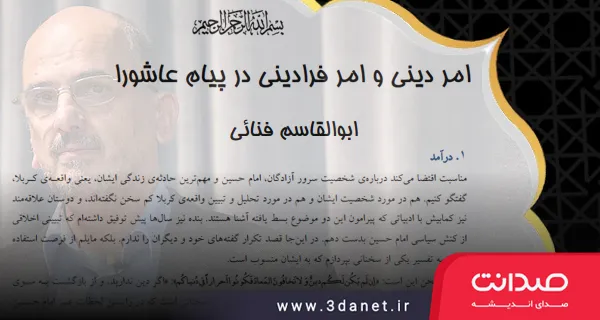
The Religious and the Trans-Religious in the Message of Ashura[1]
Abolqasem Fanai
The occasion calls for a discussion about the character of the Master of the Free, Imam Hussein, and the most important event of his life, namely the incident of Karbala. Much has been said about both his character and the analysis and explanation of the Karbala event, and interested friends are more or less familiar with the literature that has developed around these two subjects. I, too, had the opportunity years ago to offer an ethical explanation of Imam Hussein's political action. I do not intend to repeat what I or others have said here. Rather, I would like to use this opportunity to interpret one of the sayings attributed to him.
That saying is: "اِن لَم يَكُن لَكُم دينٌ وَ لاتَخافُونَ المَعادَ فَكُونُوا اَحراراً في دُنياكُم": "If you have no religion, and do not fear the return to God, [at least] be free in your world." This is one of the sayings uttered by Imam Hussein in the final moments of his life, addressing Yazid's army. At first glance, this saying has a simple and clear meaning, but contrary to its simple and clear meaning, it is very profound. Two very important and key truths are hidden in this saying, which, if taken seriously, can completely change our approach to religious studies and religiosity, giving them a different color, scent, style, and context.
These two truths are:
(1) "The independence of ethics from religion" and
(2) "Recognizing trans-religious matters" or "Separating the realm of religion from other realms."
Our discussion tonight is dedicated to elaborating on these two truths. It seems that if the religious want to secure and guarantee their happiness in this world and the hereafter, one of the necessary prerequisites is to submit to these two truths.
[1]. Transcription and editing of a speech delivered on the occasion of Ashura among a group of Iranian students and compatriots residing in Cambridge.
November 16, 2013 or ۲۵ آبان ۱۳۹۲
.
.
Abolqasem Fanai: The Religious and the Trans-Religious in the Message of Ashura
Download the full PDF of this text
.
.


Discussion1 comments
آقای فنائی خودشان پیرو چه نوع اخلاقی می دانند؟ از میان اخلاق بردگی و اخلاق تاجران و اخلاق آزادگان؟ حمله شخصی نیست میخواهم بدونم