Sociology
Ali Shariati: An Analytical Report on the Ghani-Nejad–Abdolkarimi Debate
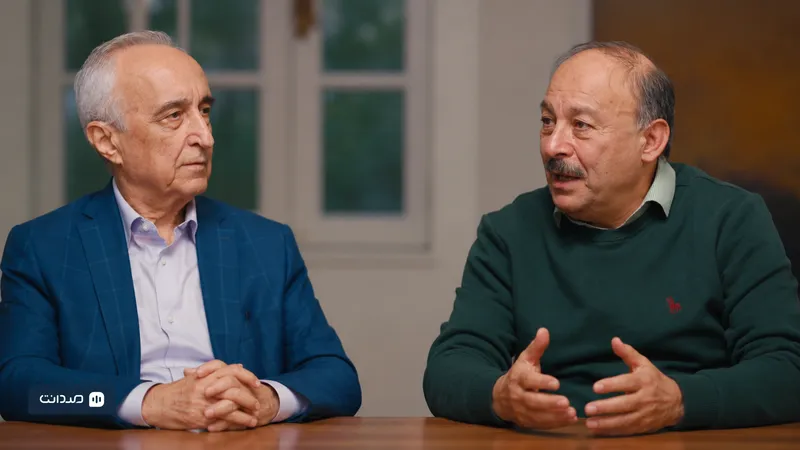
The debate between Mousa Ghani-Nejad and Bijan Abdolkarimi, arranged after Ghani-Nejad called Shariati a "charlatan," ran for two hours between two opposed accounts of him: a great legacy for social self-awareness, or the groundwork for a "state religion." This report retraces the main axes of the discussion: the logic and method of intellectual work, the relation between religion and politics, the assessment of modernity and positivism, and the meaning of ideology.
Ali Shariati: From Political Islam to State Religion
A Report on the Debate between Mousa Ghani-Nejad and Bijan Abdolkarimi
Moderator: Mehdi Ahmadi
Recorded: 14 Aban 1405 (5 November 2026)
Link to watch the debate at the end of the piece
Introduction
It began when Mousa Ghani-Nejad, in a debate with Milad Dokhanchi, called Ali Shariati a "charlatan." The word provoked a flood of reactions online: one camp saw it as an insult to one of the most influential figures in Iran's intellectual history, while another defended Ghani-Nejad against the backlash. The present debate was arranged in the wake of that controversy and on its pretext, so that the two views could be weighed face to face and by argument rather than by the exchange of labels.
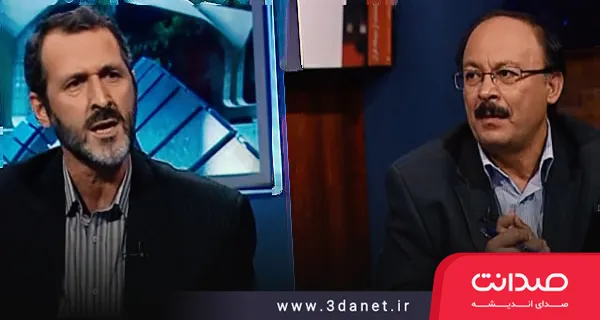
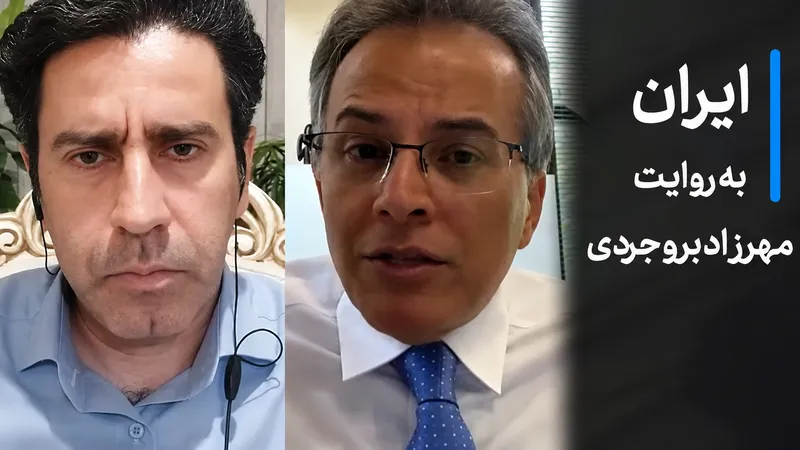
The debate between Mousa Ghani-Nejad, an economist, and Bijan Abdolkarimi, a professor of philosophy, moderated by Mehdi Ahmadi on Rasaneh Azad, spent more than two hours on a question that has returned again and again in Iran's intellectual life in recent years: is Ali Shariati a great asset for the social self-awareness of Iranians, or the man who, by turning religion into an ideology, paved the way for a "state religion"? The conversation grew heated from its first minutes and at times strayed from the subject, but amid the polemics several clear axes took shape: the logic and method of intellectual work, the relation between religion and politics, the interpretation of the history of Shiism, the assessment of modernity, socialism, and the meaning of "ideology."
Two Accounts of One Figure
Ghani-Nejad spoke bluntly from his first sentences: "Shariati did not serve Islam; he betrayed Islam." In his view, Shariati's betrayal lay in having "made Islam political," because "no religion is political; religion is belief." He regarded Shariati as someone who made religion "ideological" and turned it into an "instrument of political struggle," and he saw the consequence of this path in a "state Shiism" and a "state religion." From his standpoint this approach was a "deadly poison" for Iranian society, and "today we are paying for it."
Abdolkarimi, by contrast, called Shariati a "great legacy" and one of the "most authentic figures" in Iranian history: a man who gave a nation "human, social and historical self-awareness" and told it that religion is "not merely a dead tradition" and "not only for the dead," but must be joined to social commitment. He stressed that the critics lack the "capacity to read" Shariati, and that depriving a nation of such an asset is, in his view, a "betrayal" of that nation. The two speakers used one word, "betrayal," in opposite directions, and this set the tone for the rest of the conversation.
The Claim to Authenticity and "Future Thought"
Ahmadi asked Abdolkarimi to set out his formulation of Shariati's project. Abdolkarimi laid out the plan of his remarks in four parts: Shariati is one of the most authentic figures in Iranian history; his relation to the future of thought is greater than his relation to the revolution, and "the time of Shariati has not yet come"; his ideas are aligned with the orientations of global thought; and, finally, Ghani-Nejad's criticisms must be answered.
To explain "authenticity" he pointed to Kierkegaard's parable of the two coachmen: one follows a route made familiar by habit, the other a path that is unknown and perilous. [1] He then quoted the French Iranologist "Henri Massé," who likens Ferdowsi to Homer, Saadi to Anatole France, and Hafez to Goethe, but finds "no counterpart" for Rumi. [2] The conclusion he drew was that history contains figures who are "unrepeatable," and Shariati is one of them. He placed Shariati alongside Ayn al-Qudat Hamadani, both for "precocious genius" and for being sacrificed for their convictions, and added that Shariati "imitates the Prophet," not in the sense of claiming prophethood, but in the sense that, unlike others who each cling to one aspect of the Prophet's character (sages to the philosophical, mystics to the mystical, fighters to the political), he tries to make the Prophet a model for living "in the totality of his personality." He compared Shariati to Kierkegaard, who at the height of the Enlightenment said he wished to be "a contemporary of Christ."
Abdolkarimi anticipated that this claim would raise the doubt of whether Messrs. Khomeini and Khamenei were not also "imitating the Prophet." His answer was that both leaders are great, and the country owes them a "great debt," but they are "very strongly attached to their earlier tradition"; the "intellectual renaissance" and the "paradigm shift" found in Shariati are not seen in the seminary clerics and the leaders of the revolution.
"Logic and Argument" or "Language Games"?
Ahmadi asked Ghani-Nejad how he would formulate Shariati and whether he saw anything "typical" in him at all. Ghani-Nejad replied: "I am a man of logic and argument; in the countless works of Shariati that I have read, there is no argument and no coherent thought." He called Shariati a "layman" who "doesn't know Aristotelian logic at all," who says contradictory things, and who is "intellectually a deadly poison" for the young, because he "creates Husayni fervor" yet has no answer to the question "what do we do tomorrow?"
Abdolkarimi turned the question around: what proof is there in Hafez? What argumentative structure in the words of Christ? Christ "speaks only in parables." [3] He then drew on Wittgenstein's "language games": "check" and "checkmate" have meaning in chess, and "offside" and "penalty" in football; what Ghani-Nejad calls "nonsense" is nonsense "within his own linguistic system." In his view, Ghani-Nejad and his like-minded colleagues have made "Greek-Western metaphysics" absolute. His example was the story of Abraham sacrificing his son: by "modern reason" it is sheer "folly" and "mental illness," yet billions of human beings have lived within the horizon of this very story. [4] Husayn ibn Ali, too, is "rational, but neither with the calculating reason nor with the reason of the Ghani-Nejads."
Ghani-Nejad replied that Abdolkarimi was "showing off" with names and terms, and that the subject of the debate was Shariati, not European philosophers. In his view the problem was that Shariati himself had read none of those philosophers; among others, "he hadn't read Sartre, but he cites quotations from him." Abdolkarimi, who called on him to produce evidence ("tell me by what rigorous method we are to know this"), received no clear answer, and the claim remained unreferenced. Abdolkarimi added that Ghani-Nejad's "rationality is totalitarian in essence," because it recognizes only one epistemic system and dismisses every other as "nonsense." Ghani-Nejad did not accept this charge, and Abdolkarimi explained that he had not called him a "purveyor of nonsense" and was only saying that his outlook arises from a different tradition.
Positivism, Modernity and "Spaced-Out Talk"
Abdolkarimi presented his "second claim" this way: Shariati's foundational teachings are aligned with the "thought of humanity's future": the critique of instrumental rationality, the critique of scientism and positivism, the critique of mechanism and technological civilization, breathing spirituality into the body of modern civilization, the effort to move beyond the conflict between science and religion, the critique of one-dimensional, alienated man, the liberation of democracy from the domination of capitalism, and the liberation of socialism from totalitarian ideologies. For each axis he listed Western thinkers (from Horkheimer, Adorno and Marcuse to Heidegger, Foucault and Gadamer) and concluded that Ghani-Nejad's defense of instrumental rationality has no defenders in the world today and "smells of the eighteenth and nineteenth centuries." He called intellectuals who are still attached to it "backward" and said he knows of "not one serious thinker anywhere in the world" who defends such rationality. He closed with this: a wasteland with little intellectual capital burns even that meagre capital with the label "charlatan."
Ghani-Nejad called this whole list "slogans": "All of it is slogans; you didn't say a single correct thing." He stressed that in his two books on the methodology and epistemology of economics he himself had criticized positivism, so criticizing it does not amount to defending Shariati. He then asked Abdolkarimi what positivism is. The conversation turned here into a theoretical dispute over the definition of positivism. Abdolkarimi distinguished between an "overt" positivism (the glorification of the empirical sciences and hostility to metaphysics) and a "covert" positivism that, in his belief, lies hidden in the very essence of philosophy, and in this sense he even called Husserl and Kant "positivists"; he also said that Ghani-Nejad too is a "positivist," because whenever he encounters philosophy he says "this is all slogans." Ghani-Nejad rejected this and, for his definition, referred to Auguste Comte: positivism means regarding science as the "reflection of reality in the mind" and counting everything else as "metaphysics"; he added that this claim is "utter nonsense and unscientific." [5] Ahmadi tried several times to bring the discussion back "down to earth," asking what Shariati said on concrete questions, from the relation of religion and politics to the critique of the West.
In reply, Abdolkarimi summed up the intellectual history of the West in two experiences: the experience of theological systems, which led to the tyranny of the Church, the Crusades and the trial of Galileo, and the experience of self-grounded rationality, which ended in nuclear weapons, the environmental crisis and world wars. In his view, the humanity of the future seeks a "non-theological and non-nihilistic thought," and Shariati follows this very path: he criticizes traditional theological systems "under the heading of Safavid Shiism and Umayyad Islam," but does not surrender to nihilism and keeps "a truth from tradition." He added that if truth leaves human life, man becomes an animal that "casually puts thousands of people under multi-ton bombs." To sum up this section, a verse of Attar of Nishapur was recited: [6] "Between the mosque and the tavern there is a road…"; he called this very "third way" the thought of Shariati.
Ghani-Nejad replied that this was "spaced-out talk" and asked him to "put his feet on the ground." The main flaw he saw was neglect of economics: "The great flaw of these intellectuals is that they don't know economics. Economics is a modern thought." He assessed modernity as having "lifted humanity out of poverty" and said: "Life expectancy 200 years ago, that is, in the early nineteenth century, was 20 years worldwide; now it is above 70." [7] To say "modernity built the atomic bomb," he suggested, is like saying the world before it was all "roses and nightingales." Abdolkarimi responded by stressing that being anti-modern is "foolish" and that there is no point outside modernity, but he asked whether one can accept aspects of it and question its dark sides; in that case, his distance from Shariati is small. Ghani-Nejad conceded that Shariati is "not anti-modernity, he is a critic of modernity," and claimed that Shariati's message today is the same as what "they put on flags in the streets at night."
Pointing to more than 240 nights of people's presence in the streets, Abdolkarimi asked Ghani-Nejad not to "demean" the people, and said that by this approach he supplies "mental provisions" to the hardliners. Ghani-Nejad replied that a nightly presence is not in itself proof of the truth of an argument, and only asked him to avoid the analogy "they left, they stayed, be Zaynabi or else you are Yazidi," because by that logic "these very people who are now putting up flags" are the "Zaynabis" and everyone else the "Yazidis."
"Husayni, Zaynabi, Yazidi": The Binary of Truth and Falsehood
Ghani-Nejad made a sentence attributed to Shariati the focal point of his critique: "Those who left did a Husayni deed; those who stayed must do a Zaynabi deed, or else they are Yazidis." In his view this means "either you are with us or against us," "either you are right or false," and it reduces humanity to two poles: "This is a truly nonsensical statement, both religiously and logically; human beings are not merely truth and falsehood." He added: where does the "ought" come from, and "who are you" to set duties for humanity? He then claimed that the Islamic Republic applied this same logic: "Because I am the one who holds power and I am right, you are false," and from this it built "insiders and outsiders." [8] By this he meant that those who defend Shariati today are the same people who once, in the Headquarters of the Cultural Revolution, created "insiders and outsiders," and his reference was to Abdolkarim Soroush. [9] Abdolkarimi's reply was that Shariati did not introduce the binary of truth and falsehood; in a world without truth he wants to show that "truth exists," and Shariati "gives a nation an orientation." In his words, what Ghani-Nejad calls "nonsense" has its own intelligibility in another linguistic system.
The "Charlatan" Affair and "Chandelle"
Ghani-Nejad had earlier called Shariati a "charlatan" somewhere, and the word had drawn criticism from many. In the debate he first clarified the matter: (addressing Soroush) "I don't hurl abuse. Abuse means something that is undeserved. I say what Shariati deserves. A man who tans hides is called a tanner; a man who practices fraud is called a charlatan." His argument was that Shariati "created" a figure named "Chandelle" who "has no external existence," then cited him with publisher and page numbers; when critics found no trace of Chandelle or his book, it became clear these were "false references." He also quoted Soroush as having called him, in reply, "insolent," "ignorant," "uninformed" and "foul-mouthed," and invited Soroush to a debate to show that he is in "compound ignorance" in mysticism, religious studies and epistemology. Ahmadi pointed out that this discussion concerns a third party and phrased the invitation within that framework.
In the closing part, Abdolkarimi, in a sharp tone, spoke of criticism "on an equal footing": "I do not accept Dr. Ghani-Nejad's views, but if someone were to say that Ghani-Nejad is a charlatan, that he was paid to say these things, I would punch him in the mouth. Dr. Ghani-Nejad's standing is far higher than that." He added that the same respect should be shown to Shariati: "Shariati is a manifestation of the genius and creativity of the Iranian spirit; let us not squander such assets."
Shiism and the State: Did Shariati Build a "State Religion"?
Ghani-Nejad framed Shariati's betrayal this way: "Shiism in Iran, from Safavid Shiism through the Qajar period and Reza Shah and even Mohammad Reza Shah, stood alongside politics, was not mixed up in politics, and moderated it. Shariati came and made Shiism statist. Sir, our Shiism now is state Shiism." He also invoked the financial independence of the Shia clergy from the state: their income came from the people, not the government, and the marja' to whom people today "truly have faith" is Ayatollah Sistani in Najaf. [10] In his words, this situation damaged people's religion: "People fell into doubt and suspicion, saying, 'Is this what Islam is?'"; and young people in particular left religion. "The problem is political Islam, not Islam. Islam is a religion."
Abdolkarimi stressed that this picture does not match Shariati's works: "Everyone who has so much as leafed through Shariati's works knows that a large part of Shariati's criticism of state religion, and his defense of Shiism against the caliphal order, is that the caliphal order's Islam is a governmental Islam." He pointed to "Alid Shiism and Safavid Shiism," cited Shariati's criticism of Allameh Majlisi and his flattery of the Safavid king, and said "the critique of church religion and state religion is entirely evident in Shariati's works." He added that Ghani-Nejad feeds the audience several concepts in "one package": religion as a spiritual and moral tradition, religion as a program for organizing society, and religion as an instrument for gaining power. Until these are separated, it cannot be determined what exactly Shariati did. [11] At this point Ahmadi asked whether political Islam, if it succeeds, would not inevitably end in founding a kind of religious government and a bond between it and the institution of religion, making the project "self-contradictory." Abdolkarimi gave no direct answer to this question, and the discussion moved on to religion and politics.
Is Islam "Political by Essence"?
The fundamental question was whether Islam is "inseparable from politics." Abdolkarimi said Muhammad is "a prophet with a book in one hand and a sword in the other," and that this differs from Catholic Christianity, which says "render unto Caesar the things that are Caesar's and unto Christ the things that are Christ's." [12] Ghani-Nejad said Abdolkarimi's flaw is that he "doesn't know Islam," and Abdolkarimi replied that his own complaint is that he sees Ghani-Nejad as "estranged from Islam": did the Prophet not have expeditions and battles, and was he not the first to establish the institution of government in the Arabian Peninsula? Ghani-Nejad said "that is no proof that his religion was political."
Here Abdolkarimi raised a distinction that seems to be the most important point of convergence between the two sides: "Islam is not political by essence. A Muslim's job is not to take part in the game of carving up the cake of power and to gain power. If I were to seek power, it would be foolish; power is worth no more to me than a goat's sneeze. But a Muslim, by essence, feels committed to the fate of society. The Prophet said this." And he recited the hadith: "Whoever wakes in the morning without concern for the affairs of the Muslims is not a Muslim." [13] He continued: "Religion is not an apparatus for organizing and planning society; that is a correct statement," and called Ghani-Nejad his comrade in the struggle against "political Islam," but stressed that this does not mean Islam "has nothing to do with politics."
Ghani-Nejad explained that he too had not said this; his opposition is to Islam's "becoming an instrument of power." Abdolkarimi then raised a challenge that remained unanswered to the end of the debate: "Show me one sentence out of forty volumes of Shariati's works in which he wants religion for gaining power; if you show it, I will drop my claim." Ghani-Nejad first cited a jurisprudential principle and Shariati's interpretation of it, and then said Shariati made religion an instrument of "socialist ideology."
"Al-nās musallaṭūn…", Abel and Cain, and Socialism
To show "instrumental use," Ghani-Nejad pointed to the jurisprudential rule "People have dominion over their properties and their persons," and said Shariati translated "al-nās" as "society" in order to extract social ownership from it, and treated "their persons" as an added and groundless phrase. In Ghani-Nejad's view, "nās" means people, and this "invented interpretation" has been tied to socialism. [14] Abdolkarimi said he did not recall such a passage from Shariati at the time of the conversation and asked Ghani-Nejad to give the source; at the end of the same section Ghani-Nejad read a quotation from Shariati's "Islamology" (vol. 1, p. 57): "This story [of Abel and Cain] proves this scientific truth: first, that life, society and history rest on contradiction and struggle, and second, that, contrary to the idealists, its principal factor is economy and sex, which prevail over the forces of religious faith, fraternal bonds, right and morality." And he said: "From Islam one can derive neither a socialist interpretation nor a liberal one; neither. Islam is a religion. Sir, leave people's religion alone." He insisted on the equivalence of the two interpretations: if someone offers a "liberal interpretation" of Islam too, that is likewise instrumental and wrong; he himself has a "free-economy project," "regardless of what your religion is."
They disagreed over the definition of socialism as well. Ghani-Nejad defined it as "belief in collective ownership and the negation of private property" and said "socialism is one of the catastrophes of humanity." Abdolkarimi said he considers himself a socialist: private property is respected and everyone should own the fruit of his own labor, but if a limited group, through rent and monopoly, takes the fruit of others' labor, is the state's right of oversight and intervention gone? That does not mean Stalinism. He added that even if Shariati is a socialist, "it does not necessarily mean he is a supporter of state capitalism or of a totalitarian state. These are very big logical leaps." According to him, Shariati "sharply criticizes" Marx's materialism and historical determinism, and taking a class perspective from Marx does not make one a Marxist. Ghani-Nejad answered that Iran's situation today, with its rent-seeking, its "trusts" and its aghazadehs, is the result of a "state economy," not a free economy: "When we made everything political, we made the economy political too." Abdolkarimi asked whether the oligarchy in Russia and America also comes from a state economy, and Ghani-Nejad did not consider the American economy "statist."
Abdolkarimi accused Ghani-Nejad of "reductionism": when he speaks of the revolution, he ignores factors such as geopolitics, the system of domination, Middle Eastern oil and the Pahlavi regime's gendarme role in the region, and "reduces the whole of the Iranian revolution to four lectures by a 37- or 38-year-old youngster at the Hosseiniyeh Ershad." If Mr. Ahmadi has no home, "then damn all of Shariati's efforts"? In his view this method imports the emotional charge of the people's protest into the discussion. Ghani-Nejad said what he had said was "very clear." [15]
What Does "Ideology" Mean?
At Ahmadi's suggestion, the conversation turned to the relation between religion and ideology. Abdolkarimi stressed that "ideology" is a "homonym," like "shir," which can mean the lion of the jungle, a cow's milk, or a water tap. He listed five meanings: (1) "the science of ideas" among eighteenth-century French intellectuals; (2) its negative sense for Napoleon, who called intellectuals "ideologues" and inert; (3) "false consciousness" for Marx; (4) "thought as a guide to action" for Lenin; (5) the liberal sense after 1991, which counts every form of idealism and utopia as ideology, together with the postmodern critique that sees opposition to ideology as itself a kind of ideology. [16] He added that Shariati's opponents, including his own teachers (Soroush, Seyyed Javad Tabatabai and Dariush Shayegan), first took ideology in the Leninist sense ("thought as a guide to action") and then criticized it from a liberal position, whereas for Shariati ideology is "a kind of human, social and historical self-awareness," which he himself equates with "vidya" (the Indians), "sophia" (the Greeks), "farzanegi" (the Iranians) and "hikmat" (the Arabs). [17] Abdolkarimi said that if religion is not turned into "human and social self-awareness," it is "culture" and "heritage" and "has no bearing on my life" (a child in whose ear the call to prayer is whispered, who is given the name Ali, and who assumes he is a Muslim). He added that his teachers had "erred" on this point and that, in his view, Soroush's recent attack on Ghani-Nejad was "not very chivalrous."
Ghani-Nejad replied that he takes the word in the sense Marx uses it, "false consciousness"; and after a brief misunderstanding he clarified that he means that Shariati "made religion ideological, that is, made religion an instrument of political struggle," and that his argument was that "Islam is the same as socialism." He said that Shariati, like Bani-Sadr and the "left-wing Mosaddeqists," was a victim of the "socialist ideology" that had spread in Iran since the 1940s: "He thought it was scientific. Man, it isn't scientific, it's anti-science." [18] He also criticized religious intellectualism and religious democracy on the same occasion: "Religious democracy is one of the most nonsensical concepts one could come up with"; "religious intellectualism is an anti-concept," like a "triangular circle." As for the view "be an intellectual; what business do I have with your religion," and he who calls himself a "religious intellectual" says "he wants to make religion an instrument for taking political power."
Conclusion: Shariati for Today
Ahmadi asked the two guests what should be taken from Shariati's teachings for today and what should be avoided. Ghani-Nejad again said that Shariati was a "victim of socialist ideology," called it a "betrayal of Islam" because it made religion an instrument of power, and said that over the past 47 years the same error had been repeated in the Islamic Republic, among both reformists and principlists. In his view, the people have now "moved beyond" both camps. He also credited present-day Iran with achievements such as "becoming a regional power," which Abdolkarimi considered less defensible set against inflation, poverty and homelessness.
In his own summation, Abdolkarimi saw Shariati as distinguished by five accomplishments: (1) he calls the Iranian "cast out of tradition and left behind by modernity" to a new relation with the world; (2) in a "nihilist" world he does not let the meaning of life be lost; (3) he opposes reducing man to "economics," because a nation needs identity and cultural cohesion in addition to a market; (4) with a phenomenological approach he is open to all cultures ("when the Buddha teaches, it is as if he were a Buddhist; when Marx teaches, as if he were a Marxist"); (5) he showed us that "a tradition that is not revived is not a tradition; it is a dead, rotting corpse, and fundamentalism comes out of its belly." He also analyzed the Imamate from a historical perspective, moving it from the "theological" category to the "historical." And comparing him with "Edward Said," he called Shariati "another Edward Said," crying out that you understand yourselves through "Western spectacles." Ghani-Nejad rejected this comparison, and Abdolkarimi said that Ghani-Nejad and others had taken their ideas from Hayek and Friedman, not from the "logos and Iranian wisdom." [19] He called Shariati an instance of Heidegger's idea of "the passage from theology to ontology" and named Hölderlin, Nietzsche and Heidegger: [20] and declared that Shariati, too, announces the death of "traditional Islam."
In the last minutes, Ghani-Nejad asked how it was that Abdolkarimi repeatedly cited Nietzsche and Heidegger, when in his view "these two are the great theorists of fascism." Abdolkarimi said this subject would need another session and asked why, if so, the two are regarded as great in every university in the world. Ghani-Nejad called Heidegger a "member of the Nazi party" who "became rector of the University of Freiburg because of it." Abdolkarimi referred him to his own book, "Philosophy, University and Politics." [21] At the end, Abdolkarimi apologized for his sharpness toward Ghani-Nejad and said: "We love you from the heart." Ghani-Nejad thanked him, and Ahmadi thanked both and said he hoped the conversation had given "enough clues" to anyone who wishes to judge.
An Analytical Look
Points of agreement. The two sides came clearly close on one point: neither accepts "political Islam" in the sense of making religion an instrument of power. Abdolkarimi said Islam is "not political by essence" and "religion is not an apparatus for organizing society"; Ghani-Nejad too accepted that Islam is not alien to "commitment to the fate of society." Both regard modernity as a "global reality" that cannot be left behind, and there is no dispute between them over the critique of despotism and rent-seeking. The main disagreement is over the "root": Ghani-Nejad seeks the root of the present situation in Shariati's intellectual tradition, while Abdolkarimi finds it in multiple factors, from geopolitics to rent-seeking and mismanagement.
Methodological weaknesses. A large part of the time was spent defining terms, especially "positivism" and "ideology," and both sides repeatedly dragged the conversation to another "level," from "the ground" to "philosophy" and back. Both made many textual claims (about the words of Shariati, Marx, Comte, Heidegger and others) that could not be verified on the spot. A clear example was the "one sentence out of forty volumes" challenge raised by Abdolkarimi: in response, Ghani-Nejad cited the "rule of dominion" and "Abel and Cain," which, assuming the quotations are accurate, show a "socialist interpretation" and not directly a "quest for power"; and he did not establish the link between the two.
Strengths of each side. The strongest part of Ghani-Nejad's argument was his concern about the "polarizing" mechanism of the truth/falsehood idiom and its consequences in politics, as well as his insistence on separating religious tradition from political projects. The strongest part of Abdolkarimi's argument was that from being a "socialist" or "borrowing from Marx" one cannot conclude "support for a totalitarian state," along with his point that every critique must be accompanied by an awareness of the multicausality of historical phenomena. On the other hand, each side also has a weak point: Ghani-Nejad spoke without references or imprecisely on important matters (Safavid Shiism, the reference to "Chandelle," the definition of Comte); and Abdolkarimi, especially in the opening section, used "language games" in a way that blunts the assessability of Shariati's claims and places every critique "outside his linguistic system."
Tone. Words such as "nonsensical," "nonsense," "charlatan" and "compound ignorance" on the one hand, and "the Ghani-Nejads" and "backward intellectuals" on the other, showed that the tone of the debate, in places, was closer to a brawl than to a scholarly exchange. Even so, both speakers spoke of mutual respect to the end, and the conversation closed with apology and thanks.
[1] Abdolkarimi gave no specific reference to a work of Kierkegaard. The analytical point is that the term "authenticity" was developed in existentialist readings of Kierkegaard and especially in Heidegger's concept of "Eigentlichkeit," and Kierkegaard himself did not use it as a term in this form. Invoking him to prove that a particular thinker is "authentic" is therefore less an argument than an interpretive framework that the listener must accept.
[2] The exact source of this quotation (work and page) was not given in the conversation, and verifying it would require consulting the works of Massé (Henri Massé). Abdolkarimi himself stated that he was offering the example to show the "logic" of authenticity, not to judge particular instances.
[3] Abdolkarimi attributed to Christ a parable in which a child lets go of his father's hand in the market and says "my father abandoned me," but is told, "your father did not abandon you; you let go of your father's hand." This story, in this form, is not found in the four Gospels; the nearest canonical parable is that of the "Prodigal Son" in the Gospel of Luke (chapter 15, verses 11 to 32). If what was meant was a parable from later traditions or spiritual literature, its source was not specified in the conversation.
[4] The Quranic account of this event appears in Surat al-Saffat, verses 99 to 113. The father-son dialogue reads: "Fa-lammā balagha maʿahu al-saʿya qāla yā bunayya innī arā fī al-manāmi annī adhbaḥuka fa-unẓur mādhā tarā, qāla yā abati ifʿal mā tuʾmaru, satajidunī in shāʾa Allāhu min al-ṣābirīn" (Saffat: 102) and its conclusion: "Wa-fadaynāhu bi-dhibḥin ʿaẓīm" (Saffat: 107). The Quran does not name the son; the Jewish and Christian tradition (Genesis, chapter 22) holds him to be Isaac, and the common Muslim account, especially among Shiites, holds him to be Ishmael. In analysis: the example of Abraham shows that part of religious language is not "argumentative," but from the fact that religious language is not argumentative it does not follow that every proposition made in it, including political and social ones, is exempt from rational evaluation. In reply, Ghani-Nejad too raised this very point, that "the subject is belief," that is, he recognizes the domain of faith but sees Shariati as operating in a domain that makes public and political claims.
[5] Analysis of the two definitions: (1) The "three stages" law that Abdolkarimi cited from Comte (the theological, metaphysical and positive stages) is accurate and appears in Comte's "Course of Positive Philosophy." (2) Ghani-Nejad's definition of Comte, "science is the reflection of reality in the mind," is not exactly what Comte said: Comte regarded science as the knowledge of the laws of observable phenomena and the abandonment of the search for ultimate causes. The "reflection theory" is better known from the tradition of dialectical materialism (Lenin). The etymology he offered (positif from the Latin root meaning "to place") is correct. (3) Abdolkarimi's placing of "Popper" in the line of positivism is also contested; Popper regarded himself as a critic of logical positivism and criticized the principle of "verifiability." (4) Calling Husserl and Kant positivists stretches the term so far that it loses its power to distinguish; Abdolkarimi himself said he meant another sense of the word. Conclusion: the two sides argued over the definition of a term, and this pushed the discussion about Shariati to the margins.
[6] The verse is from the ghazal "Which Is the Road to the Tavern and the Mosque" in the divan of Attar of Nishapur and is recorded in the form "Neither in the mosque did they admit me, for he is a rake / nor in the tavern, for this tavern-keeper is raw / Between mosque and tavern there is a road / I am a stranger, a beggar; which way is the road?" The recorded versions vary (for example "is a rake / I am a rake" and "between / beyond the mosque and the tavern").
[7] Estimates of global life expectancy at birth around 1800 do not put it at "twenty years"; according to estimates from "Our World in Data" (based on Riley's data), the global average in 1900 was about 32 years and in 2023 about 73 years. Estimates for 1800 are also around thirty years. The general trend Ghani-Nejad describes (life expectancy doubling over two centuries) is correct; the starting figure, and the picture of a family in which "one child in ten survives," is exaggerated, although child mortality in pre-industrial Europe was very high.
[8] The claims in this paragraph consist of two layers. The first layer is the interpretation of Shariati's text: the exact source of the phrase (book and page) was not specified in the conversation, and verifying it requires consulting the printed text of Shariati's works. The second layer is the causal relation between this logic and the post-revolutionary "insider/outsider" divide, which is a historical and interpretive claim and is not confirmed by a single passage. The example Ghani-Nejad gave, namely ideological screening in hiring and the "Headquarters of the Cultural Revolution," dates to after Shariati's death (1977). His claim therefore concerns "intellectual influence," not Shariati's direct responsibility, and to prove it one would have to show that the agents of those policies actually drew on this idiom.
[9] In this conversation Ghani-Nejad at times says "Hajj Farajollah Dabbagh" instead of "Abdolkarim Soroush" (an allusion to Soroush's birth name, "Hossein Haj Faraj Dabbagh"); wherever such an expression appears in this report, Soroush is meant and he is given by his own name. Soroush was a member of the Headquarters of the Cultural Revolution from 1980 and later became its critic; attributing the "insider/outsider" affair to him and Shariati in a single chain is a generalization that was not documented in this conversation. Abdolkarimi, too, considered Soroush and his two other teachers mistaken for labeling Shariati "ideological" (see the "Ideology" section of this report).
[10] Historical assessment: the claim of "Shiism's independence from the state" for the Qajar to Pahlavi period, with the qualifier "relative," has support; the institution of the marja'iyya in the Qajar period drew an important part of its resources from religious dues. But precisely with respect to "Safavid Shiism," which Ghani-Nejad put in the same sentence, the case is harder: the Safavids, by the decree of Shah Ismail I (907 AH), made Twelver Shiism the official religion, brought scholars to Iran from Jabal Amil and elsewhere, and created offices such as "sadr" and "shaykh al-Islam." Allameh Mohammad-Baqer Majlisi (d. 1110 AH) was one of the official figures of this very establishment. The phrase "Safavid Shiism" is therefore not a counterexample to Ghani-Nejad's claim but exactly the point at which Shariati confronted it in his book "Alid Shiism and Safavid Shiism." Ghani-Nejad's statement about the independence of Shiism in Iran thus holds chiefly for the Qajar period and, for the Safavid period, needs qualification and exceptions.
[11] This paragraph contains two entirely different claims. (1) Abdolkarimi's claim about Shariati's criticism of "Safavid Shiism" and of Majlisi is correct and documented: "Alid Shiism and Safavid Shiism" (Collected Works 9) explicitly distinguishes between two conceptions and criticizes the Safavid religious establishment. (2) But this alone does not answer Ghani-Nejad: Ghani-Nejad does not say that Shariati defended "state religion," but that his project, despite his intention, led to the production of state religion. To assess this claim one must distinguish between the "author's intention" and the "consequences of the intellectual application"; and in this debate both sides stayed mostly at the level of intention or consequence and built no bridge between them.
[12] The sentence quoted from Christ is a simplified form of his saying in the Synoptic Gospels: "Apodote oun ta Kaisaros Kaisari kai ta tou theou tō theō" ("Therefore render to Caesar the things that are Caesar's, and to God the things that are God's"; Matthew 22:21; Mark 12:17; Luke 20:25). In the text it is "God," not "Christ." Moreover, the history of medieval Christianity, with its long disputes between pope and emperor, shows that even in the Christian tradition the separation of the two realms was not a fixed principle; the contrast "political Islam / non-political Christianity" therefore cannot be used without qualification.
[13] The Arabic text of the hadith as it appears in al-Kafi (Kitab al-Iman wa al-Kufr, chapter on concern for the affairs of the Muslims) is: "Man aṣbaḥa lā yahtammu bi-umūri al-muslimīna fa-laysa bi-muslim" (al-Kafi, Sheikh Kulayni, vol. 2, p. 163). Similar forms also exist in Sunni sources, such as "Man lam yahtamma bi-amri al-muslimīna fa-laysa minhum" (narrated by Hudhayfa, Tabarani in his Mu'jams). Assessment of the chain: many Sunni hadith scholars have considered the chains of this hadith weak, and the assessment of Shiite scholars of the chain of the al-Kafi version was not raised in the conversation. Analysis: even assuming its authenticity, "concern for the affairs of the Muslims" (being concerned) carries no implication of founding or seizing a government, and this is precisely the "commitment-centered" interpretation Abdolkarimi has in mind; in his view religion is not "organizing society to gain power" but a moral-social commitment. The verbal difference between the speaker's phrasing ("Man aṣbaḥa wa lam yahtamma…") and the text of al-Kafi ("Man aṣbaḥa lā yahtammu…") is minor.
[14] The text of the hadith/rule as it appears in jurisprudential and hadith sources is "Al-nāsu musallaṭūna ʿalā amwālihim" and is reported in Awali al-La'ali of Ibn Abi Jumhur (vol. 1, p. 222 and vol. 2, p. 138) and in Bihar al-Anwar (vol. 2, p. 272). In the sources examined, the common form lacks "wa anfusihim"; so if Shariati said that "wa anfusihim" was added to the text, this textual claim is consistent with the common form of the hadith, and if what he meant was rendering "al-nās" as "society," the matter is one of interpretation. The chain of the hadith is considered "mursal," and jurists, on the basis of its fame, or the consensus and practice of the Companions, have made it the basis of the "rule of dominion" (though Ayatollah Khoei did not consider fame a remedy for a weak chain). The exact address of Ghani-Nejad's reference to Shariati ("Islamology, vol. 1, Nashr-e Qalam, pp. 93 and 94") was likewise only stated orally in this conversation, and checking it against the printed text has not been done in this report. Analytical point: even if Shariati rendered "al-nās" as "society," one cannot conclude from that alone "opposition to private property"; as Abdolkarimi said, this is a "logical leap."
[15] For assessment: in this debate Ghani-Nejad did not trace "the whole revolution" back to Shariati; his claim was about "intellectual consequence" (influence on the ideologization of religion). Abdolkarimi summarized part of it in the form of a jibe. Historical research on the 1979 revolution (including the works of Abrahamian and Keddie) places multiple economic and political factors, mosque and bazaar networks, Ayatollah Khomeini's leadership and intellectual discourses side by side, and regards Shariati's role as important but not the sole factor. Shariati died in June 1977 (about a year and a half before the revolution), and his lectures at Hosseiniyeh Ershad continued until its closure in 1972.
[16] Historical remarks: the word "idéologie" was coined by Antoine Destutt de Tracy at the end of the eighteenth century, and Napoleon used it negatively; these two points are correct. But the phrase "false consciousness" (falsches Bewußtsein) was used by Engels in a letter to Mehring in 1893 and does not appear in this form in Marx's own texts, although the concept of inverted consciousness is present in his "German Ideology." "The End of Ideology" (1960) is the title of a book by Daniel Bell, and Fukuyama wrote the article "The End of History?" in 1989 and his book in 1992; so the year 1991 in Abdolkarimi's remarks is approximate. The positive sense of ideology for Lenin is found in "What Is to Be Done?" These remarks do not damage the substance of his claim, but they show that fixing the "correct meaning" is much harder than can be settled in a debate.
[17] The source of this phrase attributed to Shariati ("Ideology is what the Indians call vidya, the Greeks sophia…") was not given in the conversation and must be sought in his text. Analytical point: if the sense Shariati himself intended by "ideology" is "religious self-awareness," then the critique by Ghani-Nejad and others must distinguish between "ideology as self-awareness" and "ideology as an instrument of political mobilization"; and whatever sense Shariati intended, the question of "consequence in practice" (which Ghani-Nejad raises) remains separate.
[18] Analysis: a distinction must be made between two claims. The historical claim that "leftism was the dominant ideology of Iranian intellectual life from the 1940s" (the founding of the Tudeh Party in 1941) has broad support. But concluding that "Shariati, to justify the compatibility of Islam and socialism, made Islam an instrument in an absolute sense" is a claim about his intention and method, which Ghani-Nejad rested on a single set of examples (Abu Dharr, the rule of dominion, and Abel and Cain). In reply, Abdolkarimi distinguished between borrowing concepts from Marx and being a Marxist. Determining which picture is more accurate requires examining the collected works; the evidence offered in this conversation was conclusive for neither side.
[19] Here "Iranian wisdom" and "logos" are used metaphorically and the claim has no documentation; one cannot prove or refute whether Ghani-Nejad's economic ideas are "Iranian" or "Western," and Abdolkarimi did not claim that one must live only within the Iranian tradition. Even so, this charge (known in studies of political thought as the "genetic fallacy") should not replace an assessment of the ideas themselves: even if Ghani-Nejad's ideas have a Western origin, their truth or falsity does not follow from that fact; and the same consideration applies to Shariati and his borrowings from Marx, Fanon and Massignon.
[20] In "Bread and Wine" (Brot und Wein), Hölderlin writes: "Aber Freund! wir kommen zu spät. Zwar leben die Götter, / Aber über dem Haupt droben in anderer Welt" ("But, friend, we come too late. The gods are alive, / but above our heads, up in another world"), and "Patmos" opens with these lines: "Nah ist / Und schwer zu fassen der Gott. / Wo aber Gefahr ist, wächst / Das Rettende auch." ("Near is / and hard to grasp, the God. / But where danger is, grows / the saving power as well."). The theme of "the flight of the gods and the coming of a new god" goes back more to "Bread and Wine" and to Heidegger's commentary in the essay "What Are Poets For?" (1946) than to "Patmos." Nietzsche wrote "Twilight of the Idols" (Götzen-Dämmerung, 1889). The phrase Abdolkarimi attributed to Heidegger ("our time is far too late for the gods that have gone and far too early for Being") is counted among Heidegger's well-known formulations, but its exact reference was not given and it must be checked against his text.
[21] Historical analysis: Heidegger was elected rector of the University of Freiburg by the university's faculty on 21 April 1933 and joined the National Socialist Party around 1 May 1933; the chronology "party membership and, because of it, the rectorship" is therefore inaccurate (the rectorship came before the membership). No serious scholarship denies Heidegger's alignment with Nazism until 1945 and his membership, but the description "theorist of fascism" for him is contested, and for Nietzsche (d. 1900), whose sister edited and interpreted his works in a way that fit Nazism, scholarly consensus rejects this label, although Nietzsche was repeatedly misused in the twentieth century. The two sides agreed that this subject calls for a separate session.


Discussion0 comments
No comments yet; let yours be the first voice.