اندیشهفلسفهخردگفتگوحکمتمعناپرسشفرهنگ
Religion
Seyyed Hassan Eslami Ardakani: Let Us Look to Our Own Food
Seyyed Hassan Eslami Ardakani argued that food extends beyond what we eat—what we see and hear is also our nourishment. Today we suffer from intellectual indigestion, and we must cultivate wisdom by avoiding useless information and studying great works.
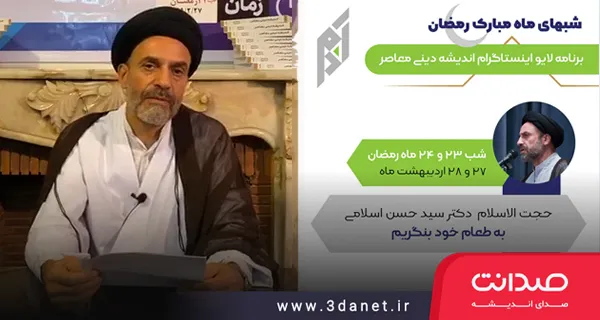
Organized by the Contemporary Religious Thought Research Institute, in the virtual sessions of the nights of the holy month of Ramadan, Seyyed Hassan Eslami Ardakani (professor at the University of Religions and Denominations) delivered a lecture at dawn on Saturday, May 16, and on the evening of Sunday, May 17, under the title “Let Us Look to Our Own Food.” Below, you can read the IQNA (International Quran News Agency) report on these sessions and access their audio and video files.
.
.
IQNA Report on the First Session of “Let Us Look to Our Own Food”
Hujjat al-Islam wal-Muslimin Seyyed Hassan Eslami Ardakani, a professor at the University of Religions and Denominations, stated at dawn on Saturday, May 16, during the “Let Us Look to Our Own Food” session: The Holy Quran, in verse 24 of Surah ‘Abasa, says: “So let man look at his food”; man must look at the food he eats. Naturally, one of the preoccupations of all our lives is what to eat, drink, and wear, and in the words of Sa‘di, “Life’s precious moments were spent on this: what shall I eat in summer, and what shall I wear in winter.”
He added: We live in a world where eating has become a dilemma; in one part of the world, people face nutritional deficiencies, and in another part, the problem is overindulgence in food and the problems arising from it. I define food beyond edibles. What we see, eat, wear, and hear daily is our food.
Eslami Ardakani, noting that mystics were the first to pay attention in this field, said: The first person to raise this discussion was Ibn Khafif Shirazi, a mystic of the fourth century AH; he considers food to be the food of the body and the soul, and states that the carnal soul’s pleasure is three things: eating, sleeping, and intercourse, and our spirit also takes pleasure in three things: pleasant scents, music, and seeing beautiful sights.
Food from the Perspective of Mystics
He specified: After him, Abu Nasr Khanqahi, a mystic of the sixth century AH, also said that we have four types of food: the food of the body, the food of the heart, the food of the intellect, and the food of the soul. The food of the body is food, drink, sleep, and bodily pleasures; the food of the heart is worship and the remembrance of God; the food of the intellect is learning and knowledge; and the food of the soul is a vision without obligation. If we look at eating this way, we see that we suffer from deficiency, malnutrition, and indigestion in hearing, seeing, eating, knowledge, and so on.
Eslami Ardakani stated: One type of food is the food of the intellect, which, according to some narrations, is the inner prophet, and to stay alive, it needs rehabilitation, strengthening, and proper nourishment. A part of our existence and life is rational; we are constantly making decisions, and for this, we must always have information and news, which are not always reliable. Therefore, we need a criterion to separate truth from falsehood. This power is the distinguishing feature of humans over other beings and causes their dominance over nature, but unfortunately, we are destroying nature through our folly.
The professor at the University of Religions and Denominations, stating that we largely suffer from a deficiency of intellect and willy-nilly gravitate toward information that has little substance and causes harm like fast food, remarked: We are in a world suffering from information overflow, which deprives us of the power and ability to analyze, because at every moment, disparate and different information reaches us. The requirement for cultivating wisdom is to avoid useless foods; to abstain from many conversations, things heard, and things seen that are of no benefit to our intellect, and to deliver the true food of the intellect to it; to observe a fast of silence and abstinence.
Silence and Proper Study Are the Food of the Intellect
He added: We constantly want to talk; we are not people of silence and love to always be in the social space and express opinions. This issue separates us from ourselves and our wisdom. Much news, instead of being a source of concentration, is a source of distraction, whereas the requirement of wisdom is concentration, and the philosophy behind part of the tradition of seclusion (i‘tikaf) is precisely this matter.
The professor at the University of Religions and Denominations, emphasizing that we must avoid useless information, stated: That such-and-such an actor has married or divorced; that a football player's income is this much or that much, and so on, does not contribute to our intellectual growth. We achieve intellectual growth when we realize that our mind is not a trash can into which anyone can dump whatever they wish. These are the negative aspects of the matter, and on the other hand, we must strengthen reason by reading great philosophical, religious, and other works.
This researcher remarked: To cultivate the intellect, we must be mindful of what we read, hear, see, and so on. Sometimes we watch series after series, which erodes our intellect. If we have had a book at home for six months, we remember it, but we forget a series we watched a month ago. We usually fill our ears with unpleasant songs and vain music, and our eyes with forbidden and inappropriate sights, and we do not have a moment of peace and tranquility. These things cause indigestion for the intellect and lead to instability in thought and reflection.
A Deficiency in Epistemic Nourishment
Stating that inappropriate spiritual and intellectual nourishment becomes part of our identity, he added: Just as our society today is afflicted with physical ailments like obesity, heart disease, vascular problems, and so on, we are afflicted with "What should I do! What should I do!", bewilderment, and confusion, and we lack peace and tranquility. We suffer from attention and concentration deficits, are full of anxiety and rivalry, and are indifferent to reading books and our epistemic nourishment.
The professor at the University of Religions and Denominations stated: The very same people who say books are expensive spend the most money on other things, including fast food. Our problem is not a lack of money but a predicament in our culture. In slogans, we say "Let Moses follow his religion and Jesus his," and that no one will be buried in another's grave, but in practice, when our neighbor buys a better car and amenities, it causes turmoil in our soul and psyche. We are constantly in a state of competition and rivalry, and our spirit is restless in a flawed direction. A believer is someone who does not suffer spiritual fragmentation amidst life's upheavals, but because we have not cultivated our intellect and wisdom, we are afflicted with these problems.
.
.
IQNA Report on the Second Session of "Let Us Look to Our Own Food"
Hujjat al-Islam wal-Muslimin Seyyed Hassan Eslami Ardakani, a professor at the University of Religions and Denominations, on the evening of Sunday, Ordibehesht 28, in the second session of "Let Us Look to Our Own Food," stating that nourishment is not limited to material eating, said: Mystics divide nourishment into the nourishment of nature, the heart, and the intellect, because human existence has three realms.
Emphasizing conscious consumption, he added: Conscious consumption means that when we hear a song, watch a film, and read a book, we should observe what we are reading and what we are seeing. Regarding the food we eat, we should observe what we are eating.
Referring to the nourishment of the body, Eslami added: The first question in this area is, why do we eat? Some are accustomed to eating at certain times, and some eat and drink out of habit and pleasure. Some people eat when they are angry, and some when they are happy, none of which is a good justification, because we eat to meet our physical needs.
The professor at the University of Religions and Denominations stated: The question of why we eat is a good compass for reforming our eating behaviors and giving them direction. The Quran's invitation to reflect upon food is a fundamental invitation and a genuine request. Why, when we are thirsty, do we drink soda instead of water? Is it for the body's need? No, it is because we have grown accustomed to it.
The Quran's Emphasis on Eating Wholesome Sustenance
He stated: The second question in this regard is what we should eat; the Quran emphasizes tayyibat, meaning the best and purest foods. The Quran's invitation is not to refrain from eating, but to eat well and properly. The purity (tayyib) of sustenance has legal and jurisprudential dimensions, ensuring it is not impure or the property of others. Fruit is among the tayyibat, but most industrial products are not tayyib; they are rubbish. They fill the stomach but do not satiate us.
He added: We manipulate the best product of nature, namely wheat, and eat it with salt, sugar, and so on, and fry it, thinking we have eaten good and delicious food. But to the extent that food is processed, it departs from being tayyib. The third question is how much we should eat. If food is for meeting the body's needs, not for entertainment, we must practice moderation and balance, neither undereating nor overeating. Yet most of us forget this; therefore, we predominantly suffer from overeating. Our physical activity is also low, and day by day the body becomes more tired and sluggish.
He added: There is a famous saying that the stomach is the home of all diseases. Most of us, when we encounter illness, ask what we should eat. The best course of action is not eating, because fatty liver and many other diseases are the result of eating poorly and eating too much.
The Harmful Effects of Fast Food
Eslami, noting that the next question is how much it costs for us to eat a meal, said: For the food we eat, we impose a great cost on the body, the soul, and nature. Let us remember that as long as we are in this world, nothing is free. When society moves towards fast foods, one of its consequences is the destruction of forests, the degradation of soil and nature, bodily weakness and lethargy, and mineral deficiencies.
He added: The only creature that produces waste is the human being, and nature returns the damage to us. In principle, in this universe, no action goes unanswered; it is not the case that we can do whatever we want and eat whatever food without any reaction. In the words of the Quran, whoever has done an atom's weight of good or evil will see it.
Iranian Society Suffers from Overeating
The seminary and university professor asserted: In today's Iran, no one dies from a lack of food; rather, we have a problem with overeating. Meanwhile, eating less helps us be more vibrant. Therefore, in all the world's mystical traditions and in various religions, we witness specific dietary abstentions and a kind of restraint that, in the long term, brings vitality to the body. Imam Ali (AS) ate simple and little food and said: Do not make your stomachs a graveyard for animals (referring to eating little meat).
The professor at the University of Religions and Denominations stated: In principle, a simple life, simple living, and imposing a little hardship on oneself makes a person more resilient. To the extent that we surrender to the body's desires and turn to overeating, we lose the vitality of the psyche, heart, and body. Therefore, overeating is an obstacle to alertness.
The Body is a Temple of Light
He added: In the Islamic tradition, it is said that the body is a temple of light and the locus of God's manifestation, and the heart is the abode of God. We can replace our car after a while, but we cannot replace our body. The spread of fast foods is an injury to nature; the carton in which the food is placed means the cutting down of trees. The white bread and the meat inside it are all impositions on nature. Bread, naturally, dries out in two to three days; so if a cake has a six-month expiry date, it is problematic. The most obvious measure for health is weight measurement; a person's weight should not differ from the age of 25 to 40.
Eslami Ardakani emphasized: The sustenance God has ordained for us is for eating and drinking in due measure. Once we have clarified our duty towards the body, we enter the realm of the heart. Let us learn that our behavior and our speech affect others, and to the extent that we regulate our relations with others and nature, we provide good nourishment to the soul. If envy, rivalry, and vengeance exist within us, they certainly have different effects compared to altruism, self-sacrifice, charity, and so on.
Referring to the food of the intellect, he emphasized: One of the ways to provide good food to the intellect is that one should not see, hear, and read everything. We must have intellectual hygiene, which can be cultivated through critical thinking; that is, we should not accept every claim nor cite every source.
.
.
Institute for Contemporary Religious Thought:
.
.
Session One of "Let Us Look to Our Own Food"
Watch the video of Session One on Aparat
Watch the video of Session One on YouTube
Download the audio of Session One
.
Session Two of "Let Us Look to Our Own Food"
Watch the video of Session Two on Aparat
Watch the video of Session Two on YouTube
Download the audio of Session Two
.
.




Discussion0 comments
No comments yet; let yours be the first voice.