Philosophy
Why and How Do We Fail? By Costica Bradatan
In this essay, Costica Bradatan shows that philosophers sometimes sacrifice the originality of their thought precisely out of fear of failure. They do it for the sake of group belonging, power games and the shelter of ready-made philosophical languages. Drawing on Diogenes the Cynic, he treats failure not merely as an obstacle to success but as a chance to escape conformity with the crowd and arrive at authenticity. Perhaps philosophy's hardest failure is the inability to stay silent, but the way out is to redefine our relationship to failure.

Costica Bradatan
نویسندهWhy and How We Fail
We fail precisely because we fear failure so much.
By Costica Bradatan[1]
¤
In this essay, published in the Los Angeles Review of Books in September 2017, Costica Bradatan, a professor of humanities at Texas Tech University, raises a simple and caustic question: why do philosophers, who are supposed to be free seekers of truth, fall so readily into the traps of power games and group belonging? His answer begins with Diogenes the Cynic, a philosopher who made failure not his fate but his element and his habitat.
Bradatan shows that a philosopher's failure occurs on three levels. First, on the social stage: to escape the label of "loser," the philosopher submits to the group, to the rankings and to the names handed down by those in power, and sacrifices his authenticity. Second, in language: instead of building a personal idiom, he takes refuge in the ready-made vocabulary and jargon of an "ism," and his writing drifts toward mechanical gibberish. And third, in speaking itself: a more fundamental failure that may be nothing other than the inability to stay silent.
This essay can be read alongside Bradatan's other piece on Emil Cioran: “The Philosopher of Failure: Emil Cioran and ‘On the Heights of Despair’”. There, failure was traced in the life and writing of a single thinker; here, the same theme turns into a critique of the state of philosophizing and of academic culture. Cioran, who also makes a brief appearance in this essay, is an example of the very "failure" who fled the university and remained authentic.
For the Persian-speaking reader, this text offers two things: an invitation to rethink the relation between thinking and belonging, and a reminder that failure, rightly understood, may be a condition of authenticity. Some of the examples, of course, concern the American academic scene, and the reader should weigh them against his or her own circumstances.
¤
Diogenes the Cynic (c. 412–323 BCE) apparently had to flee his native Sinope after becoming embroiled in a scandal involving the defacing of Sinopean coinage.[2] Yet he managed to save face, turning from the unsuccessful career of counterfeiting coins to the more promising profession of philosophizing. Diogenes always spoke cheerfully of the criminal days of his early life. Years later in Athens, when someone reminded him of the scandal of the recoined money, he answered proudly: "Wretch, that is exactly why I turned to philosophy." Still, the two careers did not always stay apart; Diogenes boasted, for instance, that his skill at recoining came in handy when he began his great philosophical project, the revaluation of all the values of Athenian society.
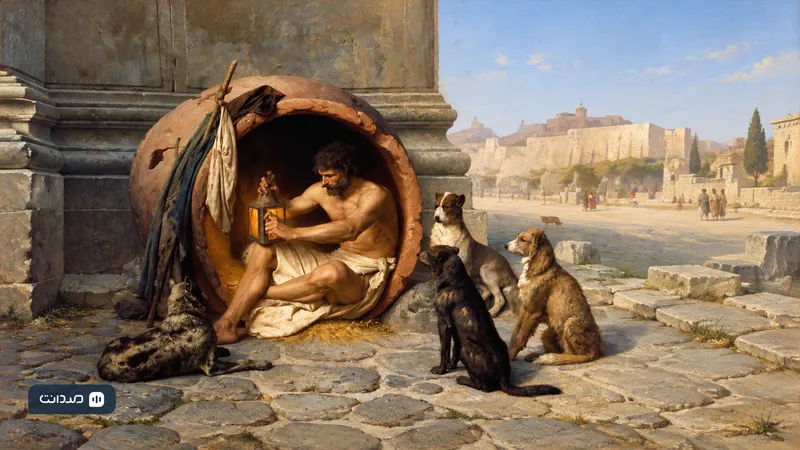
A life of poverty may not be exactly a counterfeiter's dream, but it was what Athens offered Diogenes. The irony cannot have escaped him: he was in one of the richest places on earth at that time, a place where anything money could buy was to be found, and yet the former coin-maker was penniless, reduced to begging and making do. But Diogenes had not lost his creativity. He must soon have realized that he could turn poverty into philosophical insight and begging into an art. And that in doing so he could beat Athens at its own game: in a city that placed such a high value on excellence in every kind of human endeavor, Diogenes could excel at the art of doing nothing; he could be the best of idlers, the aristocrat of the dregs. In a city where the cult of success had taken over every dimension of life, he must have realized that he could build a brilliant career out of failure. Of his teacher Antisthenes[3] Diogenes once said, with a flash of gratitude: "This man turned me from a rich man into a beggar and made me live in a storage jar instead of a big house." In his view, Antisthenes deserved praise, because he had turned him into a social failure and, by that route, into a great philosopher.
Diogenes found Socrates wanting: lukewarm and conciliatory, still too attached to things. Socrates had a pleasant give-and-take with the world and yielded to its temptations: success, reputation, followers, social appearances. Diogenes, the former coin-maker, complained that Socrates "lived a life of luxury, because he had taken too much trouble over his little house, his little bed and his sandals." In Diogenes' eyes, this was what made Socrates suspect of selling himself out.
And so Diogenes saw his philosophical mission as pushing Socratic ideas to the breaking point. When Plato called Diogenes "Socrates gone mad," he may have said more than he intended. Diogenes brought to actuality much of what in Socrates was only potential. From Hypatia to Thomas More to Jan Patočka,[4] a number of thinkers have died a death like Socrates', but few, if any, have managed to live a life like Diogenes'. That many of his sayings and deeds are apocryphal does not matter here; if anything, that very fact bears witness to the hold this figure has on our imagination and to the respect we have come to feel for his "failure." Diogenes placed failure squarely at the heart of his philosophical project. He made failure his element, and a fish does not drown.
¤
It is the collectivist nature of human beings that draws philosophers into failure from the start. Whether we know it or not, a powerful and ancient impulse works in all of us, driving us to seek the company of others, to form groups and bands and to cling to them. The group promises protection, a sense of security and, of course, a great deal of animal warmth. As long as we are part of the group and play by its rules, we can expect to survive. In return we give up part of our freedom, individuality and autonomy, but most of the time this is a good bargain. Though the impulse has roots in distant ages (nowadays we could survive on our own), we still find nothing worse than being cast out, alone and solitary, the one in the corner to whom nobody speaks. One can hardly imagine a harder condition than belonging to no tribe, claimed by no one, defenseless against everybody, and hence doomed to perish. We know this instinctively: being cast out like that means being socially weak, and we do everything to avoid such a fate. Loneliness is another name for failure. Solomon Asch is famous for showing how far we yield to group pressure, even in the smallest things.[5]
Philosophers, too, as a group (human, all too human[6]), play the social game. They always have. The "isms" in the history of philosophy arise as much from a philosopher's identification with a larger family of "kindred minds" as from the need to belong to an influential group, something that offers the sense of security, protection and strength that only a "home" can. This was true of ancient students who joined a philosophical school in search of wisdom, and of medieval or early modern students who faithfully followed their master from one university town to another. Even into the twentieth century it was not unusual for professors of philosophy in Germany, when they moved to other universities, to be followed by some of their closest graduate students. Yet the nature of the modern university has made philosophers' social game especially intense. In the last century or two, their game has become both more complicated and more self-destructive.
Academic philosophers rarely admit to their collectivism; we are fiercely independent, deliberately iconoclastic. We understand that we stay together because philosophy is all about debate and argument, is it not, and because the pursuit of truth is a collective enterprise and philosophizing is inherently dialogical. True. But dialogue is a conversation among equals. And although genuine dialogue does take place among academic philosophers, the most pervasive and consequential form of interaction here is an intense conversation, sometimes a shout, sometimes a whisper, and just as often a silence with clenched teeth, about power. About who has it and who does not, the best ways to get it and keep it, who is inside and who is outside, and similar questions. The striking thing about this conversation is that it is highly performative: power is produced as the conversation unfolds, gained and lost, increased or weakened. It may begin among equals, but the conversation breeds inequality: it adds a little power for the few at the expense of the many, corrupts the interaction among those involved and seriously alters the nature of philosophizing itself.
This power includes power over budgets, resources, opportunities, degrees, positions and honors, but, more subtly and with graver consequences for those involved, power over the meaning of words. In his Memoirs,[7] Hans Jonas recounts that once, when he and Hannah Arendt were teaching philosophy at the New School for Social Research in New York, the dean of the graduate faculty asked several University of Chicago philosophers what they thought of the work of Arendt and Jonas. However proud the dean may have been of his star faculty, he was in for a cold shower: one of the Chicago analytic philosophers replied: "That is not philosophy. It is interesting, it is good that it exists, and there should be groups working on such things. I agree. But the name has not been invented yet. I don't know what it should be called. I only know it is not philosophy." The power of naming things, as those who have been crushed by it know well, is among the greatest powers: what you do, what you have been doing all your life, even the name of your profession, is something others who hold that power can determine.
Just as important, this is a power over defining success and failure; the power of naming is the power to issue scales and rankings and lists of winners and losers. The closer one is to the seat of this power (for us, universities, academic journals and presses, funding bodies), the more successful one is counted. And since nobody wants to be counted a failure, the social mobilization that these definitions and rankings set off is a sight to behold: everyone rushes there. No price is too steep, no sacrifice too small, no expense beyond one's means to get there. Most players in the academic game are intoxicated, almost to drunkenness, by the nearly otherworldly prestige of this power. Whatever issues from it looks plausible, ennobling, worthy and worth pursuing. How generous this power is, what a wonder: it not only gives you an identity, it also gives you a sense of your own worth and a promise of salvation. It delivers you from your worst nightmare: the prospect of failure.
And it is right here that we fail. For all this rushing is fundamentally alien to the genuine search for truth; it falsifies the nature of philosophy and turns the philosopher into something else. Caught in this game, the philosopher becomes a politician, a courtier, a clansman, a henchman, a tribal chief, anything but a thinker. The political game estranges the philosopher from what philosophy is essentially about and causes what is said (or a large part of it, at any rate) to be dictated not by the requirements of philosophizing but by an alien force. The guiding compass has shifted from truth to power.
When this happens, instead of writing springing from existential problems or philosophical obsessions, that is, from a genuine impulse to communicate something important, it all becomes strategy: an attempt to show the writer's presence within a given structure of power, his readiness to go along and to cause no trouble. The success-chasing philosopher works on a wide range of fashionable topics, open-minded, flexible, ready to bend and adapt when necessary in order to serve the powerful, please them, silence opponents and attract new followers, so as to be a good soldier. Obviously all of this happens between the lines; otherwise the writing is about obscure points of metaphysics, new arguments for free will, the trolley problem, the highest good in Plato or the latest developments in the philosophy of mind. But it is written politically, not philosophically. Its success is its failure.
This is of course not true of philosophers alone. Scholars in other fields fail in exactly the same way; their work is political, that is, in the service of ends alien to the search for truth. What makes the failure of philosophers especially crippling is that philosophy, beyond its moments of sociability, is at bottom a deeply private exercise. There is rarely anything collectivist in the way one puts oneself in order, strives to find meaning in a meaningless world and tries to understand oneself and one's own mechanisms. Philosophizing happens when we are in our most intimate state, and it is vital that this encounter take place in the right setting. Michel de Montaigne speaks of a "back room" (arrière-boutique)[8] as the proper stage for this process. For him the space of this encounter is so private that not even members of one's family should enter it:
We must reserve a back room for ourselves, entirely our own and entirely free, in which to establish our real liberty and our principal retreat and solitude. Here our ordinary conversation should be between us and ourselves, and so private that no outside company or communication can find a place in it.
Outside the "back room," philosophy occupies a social space in which it can still act authentically. After all, thinkers seek one another's company; philosophical fellowship is as old as philosophy itself. Yet this space is defined and relatively narrow; when the philosopher steps outside his circle, trouble can begin at any moment. For to remain authentic, philosophy must be critical, outspoken and unpleasant. If true philosophizing is "thinking against oneself," done systematically, ruthlessly, without a safety net and without an escape route, then how should others (including fellow thinkers) expect the philosopher to behave? In an important sense, insofar as he must practice parrhesia (parrēsía)[9] (frankness), the philosopher is doomed sooner or later to find himself in a dangerous position: a strange figure, against the current, set apart, whom nobody defends and who is defenseless against everyone. The philosopher often finds himself exactly "the one in the corner to whom nobody speaks." He then becomes a social failure, not by accident but as a personal mission.
If the philosopher now yields to the power of the group, he fails twice. First, because in the eyes of others he has already failed: he is a weakling, an outcast. Then, because he does not know how to be a failure: how to use the privileged position of being an outsider for philosophical purposes. For philosophically speaking, being a failure is something very important, almost a blessing. Instead of being crushed by his social failure, the philosopher can put it to good use: to gain insight into the mechanisms of the mind, the affairs of human society, the abyss of the human soul. Provided he knows how to use it, a philosopher's social failure can make him a richer, more penetrating and more authentic thinker.
For authenticity is the principal victim here. To play the political game, philosophers must, as the saying goes, be "good team players," avoid standing out and tone down their special traits, personal quirks, "crazy" ideas and the grain of madness that philosophy badly needs. They are no longer eager to challenge conventional wisdom, to puzzle and to offend; they are caught in the game, and the worst thing that can now happen to them is to draw the mockery and ridicule of their peers, the end of their game. The long-term result is a vast plain of blandness in academic philosophy, as striking as it is depressing, even as attendance at conferences grows. The collectivism of philosophers has its own punishment. You cannot be at once philosophically authentic and politically shrewd; you cannot have your cake and eat it too: keep your integrity and also make a living from it.
It is now easy to see why some of the most authentic and innovative figures of modern thought, from Spinoza to Kierkegaard to Thoreau, worked outside the university. The university made Nietzsche ill, in the literal sense. And it left Schopenhauer with a lifelong loathing of "professors of philosophy." In 1928 a group of eminent academics at Goethe University Frankfurt found Walter Benjamin's habilitation thesis seriously inadequate[10] and closed the teaching profession to him. Simone Weil found many occupations, factory work or farm labor for instance, more fulfilling than a university chair. Cioran, with his characteristic irony, enrolled at the Sorbonne as a doctoral student in philosophy only to gain access to the cheap student cafeteria; and when he was no longer allowed to eat there, he abandoned the doctorate.[11] All of these academic "failures" turned out to be deeply authentic philosophers. They made us see the world and ourselves with new eyes; after encountering them we are no longer the same. But if they managed to produce something authentic, it was despite the university, not because of it.
It goes without saying that a considerable amount of high-quality philosophical work comes out of the academic environment. Academics have produced important philosophical works for centuries, and important philosophical movements have begun in academic circles. And yet. When we consider the number of people involved and the time, resources, opportunities and talent at their disposal, the result is rather disappointing. The American Philosophical Association, for instance, has more than 9,000 active members, about the size of the entire Irish army. The ancient Greeks invented the discipline and managed to formulate nearly everything fundamental in it with a handful of people, fewer than a bunch.
¤
If we failed as thinkers only on the social stage, we would be lucky. But our failure goes far deeper and implicates us more widely. For failure can take shape in the most personal aspects of philosophy; like a worm it creeps into the very heart of thinking.
Although philosophy begins as an entirely private impulse, a pervasive movement to which we have no choice but to surrender ourselves completely, when it comes time to formulate and express it we usually use a language that is not our own. However personal our concerns and however authentic our philosophizing, most thinkers, even some of the best, fail to invent an equally personal philosophical language. Instead we take refuge in one of the great existing philosophical vocabularies: Platonism, Thomism, Hegelianism, Marxism, logical positivism, phenomenology. The radical loneliness of philosophizing becomes perhaps oppressive, perhaps too unbearable, and we carry it to a place, the shared philosophical vocabulary, where our loneliness joins the loneliness of others and thus becomes easier to live with.
The problem, of course, is not confined to philosophy; in a sense every great creative field must face it in its own way and on its own terms. In The Anxiety of Influence (1973),[12] Harold Bloom famously speaks of the burden of the past with which every young poet must wrestle while proving himself. In his view, every time a "strong" poet appears, a new poetic language must be invented, which is a complicated business given the heavy influence of earlier poetic languages. There is always a hard struggle, an agon, in the poet's soul between his own poetic world and what came before him, and he must make his voice heard against it. Philosophers who are also creators of a philosophical language are very few and scattered, but their influence is enormous, perhaps stronger than that of Bloom's "strong poets." Whether they "misread" or "misinterpret" earlier thinkers (as, by Bloom's account, poets do), or freely draw on their work, or build everything from scratch, these creative philosophers finally establish themselves decisively against the existing vocabulary. Plato, Aristotle, Kant, Hegel, Marx, Husserl, to name only a few, matter not just for the intrinsic value of their ideas but for their distinctive philosophical vocabularies. The conceptual worlds they created lasted far beyond themselves and shaped the history of philosophy in ways both obvious and hidden. These philosophers changed the way others speak, think and live, even people who had never heard their names. They are "strong" and irresistible thinkers.
Once a philosophical vocabulary has imposed itself, it becomes a hospitable place in which other thinkers take refuge. They have no qualms about living in someone else's house. The failure to create a personal vocabulary does not seem to torment philosophers as much as it does poets; most thinkers appear not to suffer from the "anxiety of influence." And yet, from Aristotle's break with Plato to Marx's rupture with Hegel, Western philosophy has a distinct tradition of philosophers who break with their masters. Discontinuity, rupture and crisis are the keywords here. Nietzsche, who himself went through a noisy divorce (from both Schopenhauer and Wagner), even devised a small theory of philosophical separations. In Thus Spoke Zarathustra[13] he has the master tell his disciples:
Now I go alone, my disciples. You too now go alone. Thus I want it.
Go away from me and stand against Zarathustra! And better still: be ashamed of him! Perhaps he has deceived you.
The man of knowledge must not only love his enemies, he must also be able to hate his friends.
One repays a teacher badly if one always remains nothing but a pupil. And why do you not want to pluck at my wreath?
Nietzsche himself is a striking example of a complete break with his masters, in fact with every master, school and ism. He was no ordinary creator of a philosophical language; there is nothing heavy, technical, scholastic or convoluted in the language he uses. It is as if Nietzsche had stumbled upon the holy grail of philosophical style: the art of formulating the most difficult philosophical points imaginable in the most elegant personal language possible. Which makes him not only unparalleled but infinitely elusive. One of the most penetrating of modern philosophers, he cannot speak "like a philosopher."
Using an existing philosophical vocabulary does not necessarily diminish a thinker's depth; some of the best minds borrowed their conceptual apparatus and philosophical vocabulary from others and produced authentic, lasting work. There are brilliant Thomists who are not Saint Thomas, Hegelians who never saw Hegel and Marxists who lived long after Marx. An ism can prove a fertile ground for ideas, a place for serious thinking and even for innovation. All well and good. The real consequences of this failure show up elsewhere, and they can be uniquely unpleasant.
The further down the scale of authenticity you go (from the creators of vocabularies toward the other end, whatever it may be) the more you reach, somewhere, a threshold beyond which lies another world of lightness. Here thinking is no longer personal but merely mechanical. The texts no longer seem to have been written by flesh-and-blood authors, but by machines; they closely resemble those hoaxes built on content generated at random by computer software. Telling technical jargon from sheer gibberish becomes painful; terminology-mongering takes complete control, hijacks the writing and makes the author disappear. Here everything becomes a caricature of itself: Scholastic Thomism turns laughable, Hegelianism sheer nonsense, Marxism propaganda trash and poststructuralism an object of mockery. We know the result: all of us, more than we would have liked, have seen those frightfully unintelligible works for which the university is, sadly, notorious. And this goes well beyond philosophy itself; from comparative literature to religious studies, no human field is entirely safe from such a devastating failure.
I have no doubt that such writers badly need a form of belonging. We are human, all too human, and we do not want to be cast aside: unaffiliated, unknown and unloved. We must hate failure, and in order to avoid it we try, through our texts, to join a larger community of kindred spirits. Yet what we produce gives off a deep sense of intellectual alienation from ourselves, painful to read and impossible to follow. The companionship we hope to find by writing those things turns out to be no companionship at all: merely an optical illusion produced by the jargon that drowns our thought. We flee from ourselves, hide and bury ourselves under that intimidating heap of unintelligibility. And failure is waiting for us right there. Once again, we fail precisely because we fear failure so much.
¤
And yet, in a sense, all these vocabularies (the vocabularies of the householder thinkers and of their tenants, the authentic ones and the counterfeit, the great personal styles and the unintelligible) are in the end nothing but the expression of perhaps the greatest philosophical failure of all: the failure to stay silent. Before the cosmic silence, with which we are condemned to come to terms, whatever we say, however grand, can be nothing but insignificant chatter. Nothing we might utter can make any difference. All our efforts, our essays,[14] are doomed to fail. A humble silence: perhaps that is the ultimate philosophical success, the supreme achievement. But to dwell on this too long would be self-defeating.
¤
One day, according to the accounts, a mocking Athenian said to Diogenes, with barely concealed contempt: "You play the philosopher without knowing anything." We can imagine the Cynic answering with an ironic smile: "Even if I only pretend to wisdom, that itself is the mark of one who is in pursuit of it." Our small hope, then: though what we do may not be the real thing, only a failed imitation of philosophy as Plato, Aristotle and Nietzsche understood it, we need not throw out the baby with the bathwater. To move from copy to original we must redefine our relationship to failure. We must tame failure and set it where it belongs: at the heart of what we are.
And for this, Diogenes is an unrivaled master: from him we can learn not only how to overcome failure and live with it, but even how to flourish from it. Because a fish does not drown. Not at all.
¤
Costica Bradatan is a professor of humanities at Texas Tech University. His most recent book is Dying for Ideas: The Dangerous Lives of the Philosophers (Dying for Ideas. The Dangerous Lives of the Philosophers, Bloomsbury, 2015). At the time this essay was published he was working on a new book titled In Praise of Failure (In Praise of Failure) for Harvard University Press.
¤
[1]Costica Bradatan, “Why We Fail and How”, Los Angeles Review of Books, September 24, 2017.
This translation was made from the English text of the essay; the quotations too are renderings of that English text, not official translations of the works cited.
[2]The main source of the anecdotes and quotations attributed to Diogenes in this essay, including his remark about Antisthenes and Plato's phrase, is Book VI of Diogenes Laërtius, Lives of Eminent Philosophers.
[3]Antisthenes was a disciple of Socrates and, in the tradition, is counted as the teacher of Diogenes.
[4]Hypatia, the Alexandrian philosopher, was killed by an angry mob in 415 CE; Thomas More was executed in 1535; and Jan Patočka, the Czech philosopher, died in 1977 after police interrogations.
[5]A reference to the conformity experiments of the social psychologist Solomon Asch in the 1950s: under majority pressure, participants gave a plainly wrong answer even when judging simple lines.
[6]A reference to Nietzsche's book Human, All Too Human ("Human, All Too Human").
[7]Hans Jonas, Memoirs. Hans Jonas and Hannah Arendt both taught at the New School for Social Research in New York.
[8]Michel de Montaigne, “De la solitude” (On Solitude), Essais, I.39.
[9]The Greek word παρρησία, meaning frankness and fearless truth-telling, even at the cost of danger, is a key concept in the Cynic tradition and in the work of Michel Foucault.
[10]Benjamin submitted his study The Origin of German Tragic Drama (Ursprung des deutschen Trauerspiels) to the University of Frankfurt in 1925 and it was rejected; 1928 is the year of the book's publication. The original essay gives this same date, and it has been kept in the translation.
[11]On this episode and Cioran's relation to failure, see: Costica Bradatan, “The Philosopher of Failure: Emil Cioran and ‘On the Heights of Despair’”»
[12]Harold Bloom, The Anxiety of Influence (New York: Oxford University Press, 1973).
[13]Friedrich Nietzsche, Thus Spoke Zarathustra, Part I, “On the Bestowing Virtue” (Part One, "On the Bestowing Virtue"). The rendering is from the English text of the essay.
[14]The word essay comes from the French verb essayer, meaning "to try" and "to attempt"; with his Essais, Montaigne gave this name to the short piece of reflective writing.











Discussion0 comments
No comments yet; let yours be the first voice.