Philosophy
A Critical Reappraisal of Mostafa Malekian’s Remarks on Ethics and Darwinism
If empathy, fairness, and cooperation emerged over the course of human evolution, is morality anything more than a tool for survival? In two talks, Mostafa Malekian connects this question to a personal dilemma: why should we bear the costs of living morally if the benefits accrue to the group? A closer examination of his remarks shows that this philosophical question remains important, but answering it requires correcting the account of natural selection and distinguishing the origins of morality from its validity.
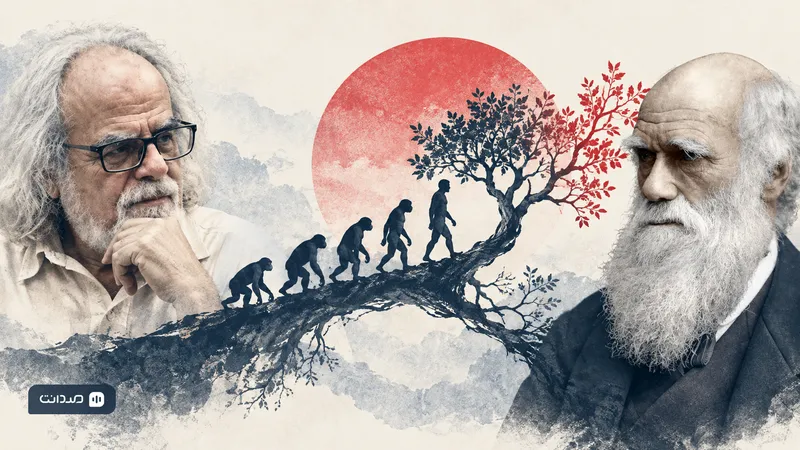

Mostafa Malekian
اندیشمند مورد بررسی
Charles Darwin
اندیشمند مورد بررسیDoes Evolution Undermine Morality?
A Critical Reappraisal of Two Talks by Mostafa Malekian on Ethics and Darwinism
If empathy, fairness, and cooperation emerged over the course of human evolution, is morality anything more than a tool for survival? In two talks, Mostafa Malekian connects this question to a personal dilemma: why should we bear the costs of living morally if the benefits accrue to the group? Another interview clarifies his own position: he is receptive to a Darwinian account of the origins of morality, but does not regard morality’s role in the survival of the human species as sufficient to generate practical commitment in the individual. A reappraisal of these materials shows that the philosophical question remains important; but answering it requires both correcting the account of natural selection and distinguishing the origins of morality, moral motivation, and normative justification.[1]
Sources and Method of Reconstruction
To reconstruct Mostafa Malekian’s view, this article draws on three sources: first, the audio recording “The Darwinian Meaning of Morality”; second, the audio recording “Social Darwinism and Ethics,” from the lectures on moral psychology at the Porsesh Institute, winter 2016; and third, the interview “Mostafa Malekian on Darwinism and Virtue Ethics,” which clarifies his personal position on the relationship between the evolutionary origins of morality and practical commitment. The two audio recordings are available in the appendices to this article, and references to them identify the talk and the relevant topic.[2]
What Is Malekian’s Problem?
The talk “The Darwinian Meaning of Morality” seeks to clarify what is meant by a Darwinian explanation of morality by analogy with biological traits. Malekian discusses the giraffe’s neck, the webbing of a duck’s feet, and examples involving the senses, and lays out the general picture as follows: traits that have helped organisms persist through natural processes have been preserved; morality, on this account, has likewise played a role in the survival of the human species. Because this function is understood as pertaining to the species, a moral individual may personally suffer harm without this being inconsistent with morality’s evolutionary function. In the end, he moves from this picture to formulations such as “useful but not sacred” and the absence of a “transcendent dimension.”[3]
The talk “Social Darwinism and Ethics” turns the same picture into a question of individual motivation. The central example is the courageous soldier: courage may increase an army’s chances of victory while at the same time increasing the soldier’s risk of death. Malekian then extends this pattern to moral life: truthfulness, the pursuit of justice, or resistance to power may benefit society while costing the individual wealth, power, freedom, or even life. In such a case, if the individual regards morality merely as a mechanism for the survival of the species, they may feel that they have become “a tool of the human species,” and their motivation may weaken. Malekian himself explicitly notes that “the human species” is not a conscious agent and that his formulation is metaphorical, not an attribution of intention and volition to the species.[4]
For the sake of fidelity in reconstruction, we must distinguish between what Malekian reports in these two talks as the view of “ethical Darwinians” and his own position. If these two talks were all we had, the extent of his personal commitment to “ethical Darwinism” would not be entirely clear. But the interview “Mostafa Malekian on Darwinism and Virtue Ethics” largely resolves this ambiguity: he explicitly says, “On the first issue, I have no objection whatsoever to ethical Darwinism,” and adds that the persistence of human beings who value morality may have an evolutionary explanation. [5] In light of this interview, therefore, this part of the earlier reconstruction needs to be revised: Malekian himself is receptive to a Darwinian explanation of the origins of morality, although he does not infer from this that morality’s role in the survival of the human species is by itself sufficient to commit an individual to morality.
This clarification gives us a more precise picture of Malekian’s position: he distinguishes between explaining why human beings have come to value moral values and explaining how individuals can be brought to commit themselves to those values in practice. Even so, the article’s two main questions remain: does biology really regard morality merely as a means to the survival of the species? And does having a natural origin and function deprive morality of its value or binding force? In addition, we must ask how far an answer to the problem of motivation stands apart from the separate problem of normative justification.
Three Questions That Must Not Be Conflated
The first question concerns origins: why did capacities or dispositions such as empathy, cooperation, and sensitivity to cheating emerge in human beings? The second concerns motivation and practical commitment: what actually leads an individual to live in accordance with moral values, especially when living morally comes at a personal cost? The third concerns normative justification: why is an action genuinely right, and why ought the individual to perform it?
For example, one might have an evolutionary hypothesis about the tendency to support one’s relatives; then ask, in a situation where impartiality works against my interests or those of people close to me, what motivates me to remain impartial; and, at another stage, ask whether hiring a less qualified relative instead of a deserving applicant is just. These three questions are related, but an answer about origins does not by itself determine the answer about motivation or justification.
Malekian Himself Also Distinguishes the Origins of Morality from Commitment to Morality
The interview “Darwinism and Virtue Ethics” shows that this distinction is not merely a construct of the present reconstruction. Malekian takes one question to be why human beings have come to value moral values, and another to be how individuals can in practice be brought to commit themselves to those same values. To illustrate the gap, he uses the example of marriage: the fact that marriage has played a role in the continuation of the human species is not, by itself, sufficient reason to persuade every individual to marry. By the same token, even if morality has played a role in the persistence of the human species, that fact alone does not provide individuals with sufficient motivation to bear the costs of acting morally. His proposed answer at the second level is “virtue ethics with a mystical interpretation”: that is, cultivating motivations and removing obstacles within the individual that make practical commitment easier.[6]
This distinction is important, but another distinction must also be preserved: explaining what enables or inclines an individual to live morally is still not quite the same as explaining why that conduct is morally justified or obligatory. Mystically inflected virtue ethics may offer an answer to the problem of motivation and moral formation; whether and how it also provides a normative justification for a moral judgment is a separate question and should not be attributed to Malekian without argument.
In the same interview, Malekian introduces another distinction as well. In his view, accepting Darwin’s biological theory does not commit a person to any particular philosophy, worldview, religion, or ethical theory; hence, according to him, accepting evolution by itself entails neither consequentialism nor deontology, and neither religiosity nor irreligion. His stronger formulation is that “no non-empirical implications follow from Darwin’s empirical claims.” This statement is reported here as Malekian’s own position; assessing the scope of the claim is a separate matter. For the present discussion, its significance lies in the fact that he himself does not seek to derive an ethical or metaphysical system directly from acceptance of evolutionary theory.[7]
In “The Darwinian Meaning of Morality,” the discussion moves from “origins” to “sacredness” and “transcendence”; in “Social Darwinism and Ethics,” it moves from collective function to the problem of personal motivation. The interview shows that Malekian himself recognizes the gap between origins and motivation and likewise does not wish to treat acceptance of Darwin as entailing any particular ethical theory. Even so, moving from historical explanation to judgments about value, as well as relating motivation to normative justification, still requires additional premises. The article’s central question thus becomes clearer: which part merely explains how morality arose, which part concerns what moves us to act, and which part actually offers a reason for the moral “ought”?[8]
Social Darwinism Is Not the Name for All These Debates
The title “Social Darwinism and Ethics” and some statements in the talk use “social Darwinism” in a broad sense to refer to extending evolutionary explanation to morality. To understand the issue on its own terms, it is better to distinguish this usage from the research program concerned with explaining the emergence of cooperation. Evolutionary explanations of morality, prescriptive evolutionary ethics, and political theories that seek legitimacy in the language of competition and evolution are not the same thing. In the history of ethics, for example, Spencer sought to connect evolution with progress and a higher form of life; this teleological picture cannot be equated with Darwinian theory or with the views of all contemporary researchers. [9]
Consequently, the phrase “if you subscribe to evolutionary ethics” in “Social Darwinism and Ethics” has an excessively broad scope unless its meaning is specified. One may accept an evolutionary origin for some moral capacities without deriving from it any political, egoistic, or skeptical prescription.
A Giraffe’s Neck Does Not Grow Longer by Stretching
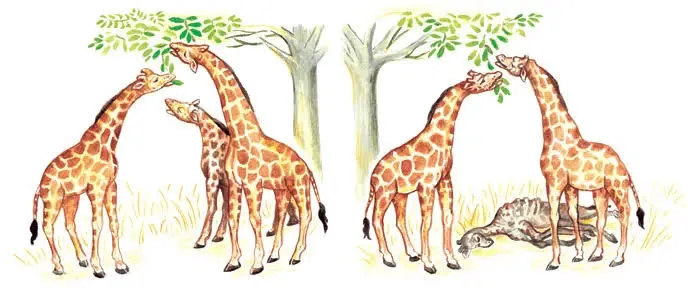
In “The Darwinian Meaning of Morality,” giraffes stretch their necks to reach leaves, and this elongation is transmitted “genetically” to their offspring. As an account of natural selection today, this is incorrect. The model of using an organ and transmitting an acquired change to the next generation is closer to the familiar Lamarckian account. Lamarck, in “Zoological Philosophy,” presented this very example of the giraffe in the framework of habit, use of organs, and the inheritance of modifications. [10], ،[11]
In a selectionist account, heritable differences among individuals are what matter: if, in a given environment, some differences lead to greater reproductive success, their share increases in subsequent generations. The need to reach leaves does not by itself produce the appropriate genetic change; nor is natural selection the same as an animal’s deliberate or unconscious effort to alter one of its organs. In his discussion of the giraffe in the sixth edition of “On the Origin of Species,” Darwin speaks of differences among individuals and the advantage of being able to reach food slightly higher up. [12]
Of course, the history of science should not be oversimplified. Darwin, too, accepted the effects of use and disuse and, in the same discussion, referred to increased use; he did not have access to modern genetic theory. Thus, the historical contrast “Lamarck only inheritance of acquired characteristics, Darwin only modern genetics” is inaccurate. Even so, this does not turn the account of neck-stretching and the genetic transmission of that elongation into a valid explanation in contemporary biology. [13]
Even when it comes to why giraffes evolved long necks, we should not mistake a simple story for a settled scientific conclusion. Competition for food and sexual selection are two important hypotheses. A 2024 study by Cavener and colleagues on the body proportions of Masai giraffes shows that females have longer necks relative to their forelimbs, whereas males have broader necks. This finding is inconsistent with the simplest version of the hypothesis that “long necks evolved solely for male competition”; the authors discuss the possible role of both processes. The study does not settle the question once and for all for every giraffe and throughout their evolutionary history. [14]
The error in the giraffe example does not invalidate Malekian’s philosophical question; but it does show that the question should not be framed in terms of a scientific mechanism that itself requires correction.
Nature Does Not Write a Prescription for Saving the Species
In Malekian’s argument, the claim that natural selection is “species-centered” is not a peripheral point; it explains why, in his view, a trait may impose costs on an individual and nevertheless be preserved in nature. He says that “Darwin himself believed the species,” rather than the individual, to be the unit of selection; thus, the survival of the species can be secured even if some bearers of the trait suffer harm. This formulation needs correction. Differences among individuals in survival and reproduction play a central role in Darwinian natural selection; Darwin’s own discussion of the giraffe likewise rests on differences among individuals. Yet this correction should not lead us to the opposite claim that Darwin never invoked selection at the group level.[15], [16], [17]
Contemporary biology likewise offers no single, uncontested one-word answer for every use of the phrase “unit of selection.” We must ask what is replicated, which entity interacts with the environment, and at what level differences in success are measured. Gene, organism, and group are not always rival answers to one and exactly the same question. Species selection theory, moreover, is a specialized debate about differences in speciation and extinction; it is not the same as the claim that organs and morality were fashioned “for the good of the species.” [18]
Another ambiguity lies in the word “survival.” An individual’s longevity, the number of their successful offspring, the spread of a trait, and the persistence of a species are four different things. In selectionist explanations, merely staying alive is not enough; reproductive success, whether direct or through effects on relatives, matters. Likewise, “fittest” in this context means more successful under particular biological conditions, not nobler or more moral. [19]
A trait may therefore increase in frequency within a population without guaranteeing that population’s or species’ rescue from extinction. Even present success offers no guarantee for the future. The metaphorical phrase “adapt to me if you want to survive” is intelligible if used to explain differential success; but if it casts nature as a planner intent on preserving the species, it becomes misleading. The goal of saving the species must not be substituted for the mechanism of differential reproduction.
Darwin Himself Wrote About Morality
“The Darwinian Meaning of Morality” says that Darwin confined himself to the biology of bodily organs and that others later extended his theory to psychology and ethics. This historical account is incorrect. In “The Descent of Man,” Darwin discusses the moral sense, conscience, social instincts, and mental capacities. In chapter five, he also addresses a difficulty very close to Malekian’s example: self-sacrifice may be costly to the individual, while a group containing helpful and courageous members may fare better in competition with another group. [20], ،[21]
This overlap matters: the problem of the individual costs of cooperation was not discovered outside evolutionary theory or in opposition to it; it is one of the theory’s longstanding problems. Yet a “more successful group” in competition with another group is not the same as “the human species as a whole.” The success of one group may even come at the expense of another group within the same species.
Nor should the contrast between “biological” organs and “mental and psychological” capacities create the impression that the mind lies outside the domain of biological evolution. Behavior and cognitive capacities can also be studied from an evolutionary perspective. Moreover, cooperation and the foundations of empathy are not found only in humans; research on animal behavior, including the work of Frans de Waal, examines continuities across species. This does not mean that animals possess every form of human moral judgment. [22], ،[23]
Useful Analogies and Unproven Necessities
Before assessing the details, the role these examples play in the argument must be made clear. Malekian invokes the webbing between a duck’s toes, the structure of the eye, the range of hearing, the feet of mountain goats, and the example of blindness to illustrate a general idea: useful traits help organisms persist, and their absence at the population level can make survival more difficult; he then places morality in the same family. This analogy is intelligible as a way of framing the question, but the present usefulness of a feature does not by itself show that the feature was selected precisely because of that benefit, or that its absence would necessarily have led to extinction.[24], [25], [26]
Some details in these examples are genuine but peripheral errors and should not be made to bear the weight of the argument. For example, the figure “16 to 4,000” is not correct for the full range of human hearing; the conventional range for a young, healthy person is approximately 20 to 20,000 hertz. Malekian, however, introduces the figure with the qualification “if I’m not mistaken”; it is therefore better regarded as a numerical slip in an oral talk rather than a basis for the main criticism. The more important point is that our inability to hear frequencies outside the human range does not by itself establish that any other hearing range would be incompatible with human survival.[27], [28]
The same caution is required regarding timescales and genealogical analogies. Broad figures such as “100 to 800 million years,” without specifying the trait and lineage in question, do not constitute a precise scientific explanation; and if the phrase “rabbits and horses emerged from one another” is taken literally, it should be corrected to refer to common ancestry, not the transformation of one present-day species into another present-day species. These points are not decisive for the article’s main thesis, but they show that the scientific formulation of the examples needs to be translated from the approximate language of an oral lecture into the more precise language of evolutionary biology.[29], [30]
At the same time, Malekian’s basic warning about timescale is correct: many evolutionary changes occur on scales that cannot be measured against the experience of a single human lifetime. But it does not follow that all evolutionary processes necessarily require millions of years. A report of hybrid speciation among Darwin’s finches over the course of a few generations is an example of this temporal diversity; it is a special case and should not be treated as a model for all speciation.[31], [32]
The example of a blind person likewise illustrates a limited point: lacking a particular ability does not necessarily prevent an individual from living a long life. But this example cannot establish that humanity would inevitably become extinct if everyone lacked sight; such a hypothetical outcome would depend on the environment, social institutions, and the possibility of compensating through other senses. Likewise, if the analogy between a blind person and an immoral person is pushed too far, it conflates two different issues.
The main issue in this section, then, is not a handful of scattered figures and analogies but a methodological problem: one cannot directly reconstruct a definitive story of a feature’s origins from its beneficial function in the present. Gould and Lewontin’s famous critique of excessive adaptationism was directed precisely at this haste to turn possible functions into definitive explanations of origins. A trait may be a by-product, the result of developmental or structural constraints, and may later acquire a new function. In the case of morality, too, specific mechanisms and independent evidence must be provided; social usefulness alone does not establish a history of selection.[33]
The Selfish Gene Is Not a Command to Be Selfish
In the account given in “The Darwinian Meaning of Morality,” Dawkins is presented as the next stage in the history of explanation: as though Darwin had taken the species to be the unit of selection and Dawkins then shifted the focus to the gene. In the same context, Dawkins is also said to have received “the Nobel Prize in Biology.” The second claim is plainly false: Dawkins is not a Nobel laureate, and there is no separate award called the “Nobel Prize in Biology.” Since this error plays no role in the philosophical argument, it should be corrected without giving it undue weight.[34], [35]
The first claim is partly correct but oversimplified. “The Selfish Gene” in 1976 gave the gene-centered view a highly influential formulation and popularized it; but this perspective did not arise through a sudden shift from “Darwin’s species” to “Dawkins’s gene.” Work in population genetics and Hamilton’s research had laid the groundwork before the book appeared. Within this framework, the gene is not a conscious agent; what matters is the increasing representation of hereditary copies in subsequent generations. Metaphorical selfishness at this level can coexist with helping behavior at the level of the organism. [36], ،[37]
This point matters for the question of motivation. Explaining that a disposition became established because it helped propagate genetic copies does not show that a person now helps others with the intention of propagating their genes. The historical cause of a capacity’s emergence and the person’s actual motivation for exercising it are two different questions. Love for one’s child or compassion for another’s suffering cannot be turned into a hidden, selfish intention merely by citing its evolutionary function. [38], ،[39]
How Cooperation Can Be Selected
The account that “the individual suffers so that the species may survive” overlooks one of the most important achievements of modern theories of cooperation: the ways in which costly behavior can persist without assuming the salvation of the species as a whole. These theories are not discussed in the two talks; introducing them here supplements and corrects the background to the discussion rather than attributing them to Malekian.
In two 1964 papers, Hamilton proposed a theory of how social behavior affects relatives. In the simple form of Hamilton’s rule, helping behavior can be selected if the recipient’s reproductive benefit, weighted by relatedness, exceeds the helper’s reproductive cost: rB > C. “Inclusive fitness” takes into account the effect of behavior on an individual’s own reproduction as well as its weighted effect on others. This simple formulation comes with conditions and assumptions; it is not a formula for calculating moral value. [40]
Put more plainly, a behavior may reduce an individual’s direct reproductive success while helping relatives who are more likely to carry shared hereditary variants. The animal need not know this calculation, nor need the good of the species as a whole be the goal of the mechanism. Nor does this theory provide moral license for nepotism.
In 1971, Trivers formulated the theory of “reciprocal altruism”: help given today may, under conditions such as the prospect of repeated interaction and mechanisms for dealing with cheating, be repaid by help in the future. In such a model, a short-term cost is not necessarily a net long-term loss. For this reason, some contemporary terminologies distinguish mutually beneficial reciprocal cooperation from biological altruism involving a net cost. The historical name of the theory should not obscure this distinction. [41], ،[42]
Social reputation, partner choice, and networks of interaction also matter: someone who helps others may come to be regarded as a more desirable partner or may benefit from others’ help in the future. In a 2006 paper, Nowak examined several mechanisms of cooperation side by side in specific models. These models explain the conditions under which cooperation can arise; none establishes that every helper benefits in every situation. [43]
Group and multilevel selection likewise take the problem seriously. In one model, less cooperative individuals may have an advantage within each group, while groups with higher levels of cooperation may fare better in competition between groups. The stability of cooperation depends on the relative strength of these forces, the way groups are formed, and the transmission of traits; merely being beneficial to the group is not enough. Some formulations of kin selection and multilevel selection are mathematically related or equivalent representations of a process; debate continues over the limits of this equivalence and their best explanatory uses. [44], ،[45]
Correcting Malekian’s account, then, does not mean eliminating groups from biology. The necessary correction is to avoid treating “group,” “species,” and “humanity as a whole” as interchangeable, and to avoid substituting collective benefit for a demonstration of the mechanism of selection.
From Biological Cooperation to Human Morality
“Altruism” in biology is not the same as altruism in its everyday moral sense. The biological definition turns on the reproductive costs and benefits of behavior; it makes no judgment about conscious intention or moral rightness. A behavior without moral intent may be biologically altruistic; a morally right behavior may also benefit the person performing it. [46], ،[47]
We therefore cannot move directly from explaining cooperation to a complete explanation of justice, truthfulness, keeping promises, humility, and compassion—the virtues grouped together at the end of “The Darwinian Meaning of Morality.” Each has its own history of learning, cultural forms, and distinctive normative questions. Cooperation can even be strengthened in the service of an oppressive group. Solidarity within a group, without regard for the treatment of outsiders, is not a sufficient criterion of morality.
In research on humans, culture and institutions play a substantial role. A study by Henrich and colleagues across fifteen populations examined differences in fairness and punishment behavior in relation to social variables. These findings establish empirical associations; they do not prove that any particular institution by itself “creates morality.” Even so, they matter because they help us move beyond a uniform and purely genetic account of morality. [48]
Cultural group selection theory likewise asks whether rules and institutions transmitted across generations and groups can spread through social competition. Richerson and colleagues have defended the importance of this theory; the extent of its role in explaining human cooperation remains disputed. The reader need not regard any one of these frameworks as the final explanation of all morality in order to accept that culture, institutions, learning, and biology must be studied together. [49]
Similarly, evolutionary psychology is not a wholly unified field speaking with one voice. The hypothesis that a psychological capacity is an adaptation requires evidence and comparison with alternative explanations. A story that identifies a behavior as “useful” to our ancestors is not yet a scientific test of that hypothesis. [50]
The statement in “The Darwinian Meaning of Morality” that “morality only ... prevents the human race from becoming extinct” is therefore both overly reductive and makes an unproven claim of necessity. A more defensible formulation would be that capacities involved in morality and cooperation have an evolutionary history; but not all the content of morality, all its present functions, or all the reasons for its justification can be reduced to the preservation of the species.
The Costs of Morality Are Real; Deprivation Is Not a Universal Law
In “Social Darwinism and Ethics,” Malekian moves from the example of the courageous soldier to a more general concern: behaviors that benefit the group may be costly to the agent, and in social life a moral person may likewise be deprived of opportunities for wealth, power, fame, or security. This part of the argument highlights the genuine problem of conflict between individual interest and moral obligation. Even so, we must distinguish possibility from universal law: the fact that courage may increase danger in a particular situation, or that truthfulness may eliminate an illegitimate opportunity, is not the same as claiming that becoming more moral always, or generally, reduces every form of personal success.
In “Social Darwinism and Ethics,” no specific empirical support is offered for the historical claim about “most” moral individuals, followed by the categorical formulation that “the more moral” a person becomes, the more their wealth, power, fame, popularity, and even academic qualifications decline. The virtue in question, the measure of benefit, the society, and the time frame would all need to be defined. As an absolute generalization, the claim is false; its statistical version concerning “most” cases is likewise not established by the sources provided. [51]
Research by Eriksson and colleagues, for example, found associations in the data examined between prosocial behavior and income and number of children that were inconsistent with the simple expectation that “selfishness always pays more.” On the one hand, this research does not measure every virtue; on the other, it does not establish that generosity causes success for every individual. Its relevance to the present discussion lies in limiting the universal claim that moral individuals necessarily lose out. [52]
The reference in “Social Darwinism and Ethics” to “Hayek’s famous article” also requires clarification. The English title “Why the Worst Get on Top” is the title of chapter ten of “The Road to Serfdom”; Malekian may have had in mind a translation or separate publication of that chapter. Hayek’s discussion there concerns the mechanisms of power in totalitarian systems, not a universal law governing the relationship between baseness and success under every political order. The source may illuminate an institutional question; it is not sufficient to establish such a global generalization. [53], ،[54]
With all these corrections, the core problem remains: truthfulness may eliminate an opportunity for illicit gain; resistance to oppression may lead to imprisonment or death; helping another person may bring no return. A defense of morality should not deny these costs. But the existence of costs in some cases is different from the claim that deprivation is necessary in every case.
The comparison of an immoral person to someone who exploits the morality of others also comes close to the familiar problem of “free riding.” A person may benefit from general trust and cooperation while refusing to bear the cost of following the rules. Theories of cooperation ask precisely what mechanisms prevent this strategy from spreading. Recognition, punishment, or changing partners may make such behavior costly; in a dysfunctional institution, cheating may instead remain advantageous. Social outcomes, then, do not depend solely on individual psychology. [55], ،[56]
From “Is Beneficial” to “Ought”: The Problem of Normative Justification
Even if the selective origin of a disposition were fully known, we still could not infer from it that the disposition is good or binding. Reproductive success is a descriptive criterion; moral value is a normative one. Thus, the fact that a behavior contributes to a group’s stability is not by itself a sufficient reason to perform it. A group may also become more stable by suppressing dissenters; the moral question is precisely what kind of stability, and at what cost, is acceptable.
Hume’s famous warning about the transition from “is” to “ought” concerns precisely this need for argument: the introduction of a normative conclusion must be explained. To derive a moral duty from the natural consequences of behavior, a normative premise is required—for example, a premise specifying which interests ought to be respected and why. The theory of natural selection itself does not supply that premise. [57], ،[58], ،[59]
The term “naturalistic fallacy” in Moore’s historical sense is not identical to Hume’s problem. In “Principia Ethica,” Moore argued against identifying the good with other properties. In contemporary usage, the term is sometimes applied to inferring “good” from “natural”; for the sake of precision, these two issues should be kept separate. Nor is Moore’s critique regarded in contemporary philosophy as a conclusive argument against every form of ethical naturalism. [60], ،[61]
At this point, the interview clarifies an important point in Malekian’s favor: he himself accepts that if all one says is “morality has helped the human species survive,” an individual who must bear the cost still lacks a sufficient reason for practical commitment. This clarification narrows and sharpens part of the motivational critique. Philosophically, however, motivation and justification remain distinct: what enables or inclines me to act in accordance with a moral value differs from what makes that action justified or obligatory. The insufficiency of species survival as a reason does not show that all moral reasons are absent.[62]
From “It Is Natural” to “It Is Worthless”
The inference in the opposite direction is also problematic. The fact that empathy has a natural history does not show that the suffering to which empathy responds is unimportant. The fact that our capacity for reasoning has a natural origin does not invalidate every argument. In assessing a belief, both the process by which it was formed and the reasons currently supporting it matter; merely identifying its origin cannot substitute for either.
The statement “useful but not sacred” in “The Darwinian Meaning of Morality” admits of several readings. If it means that an evolutionary explanation of the emergence of dispositions does not require positing supernatural intervention, it is a limited and intelligible claim. But the possible adequacy of a natural explanation for the emergence of a capacity does not entail the rejection of every theological foundation or every moral truth. Such conclusions require independent arguments. If “sacred” means intrinsic value, inviolability, or binding force, the move from biological function to their denial is unwarranted without an additional premise.
We must also distinguish between “this morality was selected for survival” and “morality is valuable only for survival.” The former, if supported by evidence, is a claim about the history of a capacity; the latter is a definition or theory of value. At several points, the account presented narrows the gap between the two but does not provide the argument required to eliminate it.
Does Evolution Undermine Our Trust in Morality?
A stronger objection can be raised than “morality is natural, therefore it is invalid.” If the mechanism that produces a belief is fundamentally indifferent to its truth, learning about that mechanism may reduce our confidence in the belief. This is an argument about the reliability of belief, not merely about its natural origin.
In a 2006 paper, Sharon Street poses the problem for theories that regard evaluative truths as independent of our attitudes: if natural selection shaped our evaluative tendencies because of their effects on fitness, what relationship do those tendencies bear to independent moral truth? A merely coincidental relationship makes our confidence difficult to sustain; yet the claim that natural selection tracked moral truth itself also requires explanation. This challenge is directed at forms of realism; its simple conclusion is not that “no moral judgment is justified.” [63]
Richard Joyce, in “The Evolution of Morality,” likewise examines the implications of evolutionary origins for the justification of moral beliefs. These discussions are commonly called “evolutionary debunking arguments.” They should not be conflated with a definitive conclusion of empirical science or with the claim that every scholar of evolutionary ethics is a skeptic. [64]
The responses are serious as well: perhaps not all the content of moral beliefs is a direct product of selection; perhaps general capacities for reasoning and cognition enable us to correct our initial dispositions; or perhaps, within a naturalistic theory, some truths about suffering and flourishing are connected to what our evolved capacities reveal. The critic replies that the very tools of correction may themselves have been shaped by the same history. Debate continues over the extent of this influence and the possibility of justified confidence. [65]
The real issue, then, is not “Does morality have a natural history?” The more precise questions are: which belief was formed by which mechanism, why should that mechanism be regarded as reliable or unreliable, and what reasons for the belief remain after reflection?
Why Should I Bear the Cost? Malekian’s Answer and the Remaining Question
The interview “Darwinism and Virtue Ethics” directly addresses the heart of the problem here. Malekian says that the mere fact that morality has played a role in the survival of the human species is not enough to persuade an individual. The example of marriage is meant to illustrate precisely this gap: someone may accept that marriage has played a role in human survival, yet say that it still does not follow from this fact that I personally ought to marry. By the same token, morality’s evolutionary role does not fully answer the question, “Why should I bear the costs of living morally?” At this level, Malekian turns to virtue ethics with a mystical interpretation to explain the motivations and inner conditions required for practical commitment.[66]
In “Social Darwinism and Ethics,” too, awareness that morality serves the human species may leave the individual unmotivated. As a psychological possibility, this is defensible: some people may feel deceived or exploited. But the talk provides no evidence for a general law about the effect of learning about evolution on motivation. Others may come to understand empathy in naturalistic terms, regard it as part of human life, and continue to value it. [67]
If awareness of morality’s evolutionary origins is taken to imply that self-sacrifice is worthless to the individual, the inference contains a hidden premise: something is worth pursuing only if its benefits return to me. Evolutionary theory does not establish this premise. If we accept it, the conflict between morality and self-interest has been resolved in favor of self-interest from the outset; if we reject it, we must discuss the weight of reasons concerning others.
This discussion should not be brought to a close with the promise that “morality will always benefit you in the end.” Sometimes that promise is false. Mystically inflected virtue ethics, if successful, may explain how a character and motivation can develop that make it easier for an individual to bear such costs; but the more difficult philosophical question remains: can another person’s suffering, their rights, or the possibility of justifying my conduct to them give me a reason, even when my ultimate benefit is not guaranteed? Consequentialist, deontological, contractualist, and virtue-ethical answers differ here; none can simply be derived from the formula of natural selection.
At the same time, there is an institutional question. If a society depends for its survival on people who bear the costs of truth-telling and dissent, we should ask why its institutions impose those costs on them. Protecting whistleblowers, limiting power, and reducing the rewards of cheating can narrow the gap between morality and self-interest. These proposals themselves require a defense in terms of values such as justice and the reduction of harm; but they show that the answer to the problem cannot consist solely in exhorting the person who bears the loss.
The Raw Materials of Morality and the Possibility of Critiquing Nature
Evolution can be regarded as part of the explanation of the raw materials of morality: the capacities for feeling, social attachment, learning, and attending to others. This picture requires neither a “gene for justice” nor the assumption that reason and culture are disconnected from nature. Capacities with a natural history can be put to use in new forms of reasoning, education, and institution-building.
These same capacities open up the possibility of critically assessing our dispositions. The impulse to favor those close to us may conflict with impartial justice; group solidarity may exclude outsiders; an immediate reaction to cheating may lead to disproportionate punishment. Rather than sanctifying or rejecting everything with natural roots, we should assess each disposition in its particular context and on the basis of reasons.
The important claim is not that human beings have somehow shed their past or stepped outside evolution. It is that causal history, by itself, does not issue the final verdict on whether present behavior is justified. The capacity for reflection is itself a subject for investigation; it cannot be discredited merely by pointing to its natural origins.
Conclusion: What Remains After the Account Is Corrected?
The interview “Darwinism and Virtue Ethics” gives us a more precise philosophical picture of Malekian’s position. He is personally receptive to a Darwinian explanation of the origins of morality, but does not regard morality’s role in the survival of the human species as sufficient to generate practical commitment in the individual; for the problem of commitment, he turns to virtue ethics with a mystical interpretation. In the same interview, he also emphasizes that, in his view, accepting Darwin’s biological theory does not commit a person to any particular philosophy, religion, or ethical theory. A reconstruction according to which he moves directly from “morality arose for survival” to “therefore the individual ought to live morally” would thus be unfair.[68]
This philosophical correction does not eliminate the article’s scientific critique. In the same interview, Malekian still explains that human beings who value morality have persisted, that moral living has played a role in the survival of the human species, and that Darwinism in this context concerns the species rather than the individual. It is precisely this formulation that requires biological scrutiny. Natural selection cannot be reduced to saving the species; differences among individuals and reproductive success are fundamental to it, while cooperation is explained through a variety of mechanisms, including kin selection, reciprocal interaction, and multilevel processes. The Lamarckian account of the giraffe and several other historical or numerical claims also need correction, but the main weight of the critique falls on this explanatory structure, not on peripheral slips.[69]
At the philosophical level, three issues must remain distinct: the origins of morality, motivation and practical commitment, and normative justification. The interview shows that Malekian distinguishes between the first two; this point qualifies part of the philosophical critique and makes it fairer. But an answer to the problem of motivation, even if successful in the form of mystically inflected virtue ethics, still does not by itself explain why a behavior is morally justified or obligatory. Conversely, an evolutionary origin neither automatically generates moral obligation nor automatically undermines it.
After all these corrections, the central question comes into sharper focus: even if we can explain why human beings became creatures capable of empathy, cooperation, and moral sensitivity, we must still ask why some of these dispositions are justified, why others ought to be restrained, and why we should remain committed to morality when it comes at a cost to us. Evolution explains part of the story of origins; character and moral formation explain part of the story of motivation; but answering the question “What ought we to do, and why?” still requires normative argument.
Questions for Continuing the Conversation
1. For which capacities involved in morality do we have strong evolutionary evidence, and where do competing hypotheses still remain?
2. What criterion can justify favoring relatives within the family while rendering the same partiality unjustified in public-sector hiring?
3. If acting morally in a particular case harms the individual, what kind of reason can explain why the interests of others should matter to that person without promising guaranteed personal benefit?
4. Are empathy and fairness ways of apprehending moral truths, or merely starting points for judgments that must be corrected through reasoning? How can we adjudicate between these two possibilities?
5. What shows that rational reflection can correct evolutionary or cultural biases? What errors might remain within that reflection itself?
6. Which institutions can distribute the costs of morality more fairly, so that social stability does not depend on depriving those who abide by the rules?
[1]Mostafa Malekian, “Mostafa Malekian on Darwinism and Virtue Ethics,” Sedanet. Original source: “An Examination of the Virtue-Ethical System,” interview with Ali Varaminī, Negah-e Aftab, no. 1, Soroush-e Molana Institute.
https://3danet.net/darvinism-and-virtue-ethics
[2]Mostafa Malekian, “Mostafa Malekian on Darwinism and Virtue Ethics,” Sedanet. Original source: “An Examination of the Virtue-Ethical System,” interview with Ali Varaminī, Negah-e Aftab, no. 1, Soroush-e Molana Institute.
https://3danet.net/darvinism-and-virtue-ethics
[3]Mostafa Malekian, “The Darwinian Meaning of Morality.”
[4]Mostafa Malekian, “Social Darwinism and Ethics,” lectures on moral psychology, Porsesh Institute, winter 2016.
[5]Mostafa Malekian, “Mostafa Malekian on Darwinism and Virtue Ethics,” Sedanet. Original source: “An Examination of the Virtue-Ethical System,” interview with Ali Varaminī, Negah-e Aftab, no. 1, Soroush-e Molana Institute.
https://3danet.net/darvinism-and-virtue-ethics
[6]Mostafa Malekian, “Mostafa Malekian on Darwinism and Virtue Ethics,” Sedanet. Original source: “An Examination of the Virtue-Ethical System,” interview with Ali Varaminī, Negah-e Aftab, no. 1, Soroush-e Molana Institute.
https://3danet.net/darvinism-and-virtue-ethics
[7]Mostafa Malekian, “Mostafa Malekian on Darwinism and Virtue Ethics,” Sedanet. Original source: “An Examination of the Virtue-Ethical System,” interview with Ali Varaminī, Negah-e Aftab, no. 1, Soroush-e Molana Institute.
https://3danet.net/darvinism-and-virtue-ethics
[8]Mostafa Malekian, “Mostafa Malekian on Darwinism and Virtue Ethics,” Sedanet. Original source: “An Examination of the Virtue-Ethical System,” interview with Ali Varaminī, Negah-e Aftab, no. 1, Soroush-e Molana Institute.
https://3danet.net/darvinism-and-virtue-ethics
[9]FitzPatrick, W. J. “Morality and Evolutionary Biology.” Stanford Encyclopedia of Philosophy.
Especially sections 2, 3.2, and 4.1.
https://plato.stanford.edu/entries/morality-biology/
[10]Mostafa Malekian, “The Darwinian Meaning of Morality.” Passage: “they kept stretching their necks.”
[11]Lamarck, J.-B. (1809). Philosophie zoologique, vol. I, part I, ch. VII.
English text of chapter VII in Ian Johnston's translation, Vancouver Island University.
https://web.viu.ca/johnstoi/lamarck/lamarck7.htm
Historical translation: Hugh Elliot (trans.). (1914). London: Macmillan.
https://www.biodiversitylibrary.org/item/181612
[12]Darwin, C. (1872). The Origin of Species, 6th ed. London: John Murray, ch. VII, pp. 177–179.
Collated text at Darwin Online.
https://darwin-online.org.uk/Variorum/1872/1872-177-s.html
https://darwin-online.org.uk/Variorum/1872/1872-178-s.html
https://darwin-online.org.uk/Variorum/1872/1872-179-dns.html
[13]Darwin, C. (1872). The Origin of Species, 6th ed. London: John Murray, ch. VII, pp. 177–179.
Collated text at Darwin Online.
https://darwin-online.org.uk/Variorum/1872/1872-177-s.html
https://darwin-online.org.uk/Variorum/1872/1872-178-s.html
https://darwin-online.org.uk/Variorum/1872/1872-179-dns.html
[14]Cavener, D. R., Bond, M. L., Wu-Cavener, L., Lohay, G. G., Cavener, M. W., Hou, X., Pearce, D. L., & Lee, D. E. (2024). “Sexual dimorphisms in body proportions of Masai giraffes and the evolution of the giraffe’s neck.” Mammalian Biology, 104, 513–527.
https://doi.org/10.1007/s42991-024-00424-4
Open-access article.
https://link.springer.com/article/10.1007/s42991-024-00424-4
[15]Mostafa Malekian, “The Darwinian Meaning of Morality.” Passage: “What is the unit and atom of Darwin’s account?”
[16]Darwin, C. (1872). The Origin of Species, 6th ed. London: John Murray, ch. VII, pp. 177–179.
Collated text at Darwin Online.
https://darwin-online.org.uk/Variorum/1872/1872-177-s.html
https://darwin-online.org.uk/Variorum/1872/1872-178-s.html
https://darwin-online.org.uk/Variorum/1872/1872-179-dns.html
[17]Darwin, C. (1871). The Descent of Man, and Selection in Relation to Sex, vol. I. London: John Murray.
Especially chapters III–V, pp. 163–166. Full text.
https://darwin-online.org.uk/content/contentblock?basepage=1&itemID=F937.1&viewtype=side
[18]Lloyd, E. “Units and Levels of Selection.” Stanford Encyclopedia of Philosophy.
Especially sections 1 and 4.1–4.3.
https://plato.stanford.edu/entries/selection-units/
[19]Okasha, S. “Biological Altruism.” Stanford Encyclopedia of Philosophy.
Summer 2025 archive; especially the sections on definition, kin selection, and motivation.
https://plato.stanford.edu/archives/sum2025/entries/altruism-biological/
[20]Mostafa Malekian, “The Darwinian Meaning of Morality.” Passage: “Darwin stopped at this point.”
[21]Darwin, C. (1871). The Descent of Man, and Selection in Relation to Sex, vol. I. London: John Murray.
Especially chapters III–V, pp. 163–166. Full text.
https://darwin-online.org.uk/content/contentblock?basepage=1&itemID=F937.1&viewtype=side
[22]Mostafa Malekian, “The Darwinian Meaning of Morality.” Passage: “humans were no longer like ... animals.”
[23]de Waal, F. B. M. (2008). “Putting the Altruism Back into Altruism: The Evolution of Empathy.” Annual Review of Psychology, 59, 279–300.
https://doi.org/10.1146/annurev.psych.59.103006.093625
[24]Mostafa Malekian, “The Darwinian Meaning of Morality.” Passage: “why ducks” and “why dogs’ eyes.”
[25]Neitz, J., Geist, T., & Jacobs, G. H. (1989). “Color vision in the dog.” Visual Neuroscience, 3(2), 119–125.
https://doi.org/10.1017/S0952523800004430
[26]Jacobs, G. H., Deegan, J. F., II, & Neitz, J. (1998). “Photopigment basis for dichromatic color vision in cows, goats, and sheep.” Visual Neuroscience, 15(3), 581–584.
Article record.
https://pubmed.ncbi.nlm.nih.gov/9685209/
Full text.
[27]Mostafa Malekian, “The Darwinian Meaning of Morality.” Passage: “our ears hear sounds between 16 and 4,000.”
[28]Sumner, C. J., Bergevin, C., Oxenham, A. J., & Shera, C. A. (2022). “What Makes Human Hearing Special?” Frontiers for Young Minds, 10, 708921.
Educational overview of the general human hearing range.
https://doi.org/10.3389/frym.2022.708921
[29]Mostafa Malekian, “The Darwinian Meaning of Morality.” Passage: the sections on the giraffe and “regarding mountain goats.”
[30]Venditti, C., Meade, A., & Pagel, M. (2011). “Multiple routes to mammalian diversity.” Nature, 479, 393–396.
https://doi.org/10.1038/nature10516
University repository copy.
https://centaur.reading.ac.uk/29518/
Bibi, F. (2013). “A multi-calibrated mitochondrial phylogeny of extant Bovidae (Artiodactyla, Ruminantia) and the importance of the fossil record to systematics.” BMC Evolutionary Biology, 13, 166.
https://doi.org/10.1186/1471-2148-13-166
[31]Mostafa Malekian, “The Darwinian Meaning of Morality.” Passage: “why, in these 60–70 years, have we...”
[32]Lamichhaney, S., Han, F., Webster, M. T., Andersson, L., Grant, B. R., & Grant, P. R. (2018). “Rapid hybrid speciation in Darwin’s finches.” Science, 359(6372), 224–228.
https://doi.org/10.1126/science.aao4593
Publisher educational page.
https://www.scienceintheclassroom.org/research-papers/hybrids-evolution-action
[33]Gould, S. J., & Lewontin, R. C. (1979). “The spandrels of San Marco and the Panglossian paradigm: a critique of the adaptationist programme.” Proceedings of the Royal Society of London B, 205, 581–598.
https://doi.org/10.1098/rspb.1979.0086
Gould, S. J. (1997). “The exaptive excellence of spandrels as a term and prototype.” PNAS, 94(20), 10750–10755.
https://doi.org/10.1073/pnas.94.20.10750
[34]Mostafa Malekian, “The Darwinian Meaning of Morality.” Passage: “Dawkins ... won the Nobel Prize in Biology.”
[35]Nobel Prize. “About the Nobel Prize” and “All Nobel Prizes.”
https://www.nobelprize.org/about/
https://www.nobelprize.org/prizes/lists/all-nobel-prizes/
Royal Society. “Professor Richard Dawkins FRS.”
https://royalsociety.org/people/richard-dawkins-11316/
[36]Dawkins, R. (1976). The Selfish Gene. Oxford: Oxford University Press.
Publisher page for the 40th anniversary edition.
https://www.oupjapan.co.jp/en/products/detail/15197
[37]Hamilton, W. D. (1964). “The genetical evolution of social behaviour. I” and “II.” Journal of Theoretical Biology, 7(1), 1–16 and 17–52.
https://doi.org/10.1016/0022-5193(64)90038-4
https://doi.org/10.1016/0022-5193(64)90039-6
Part I full text.
https://pdodds.w3.uvm.edu/files/papers/others/1964/hamilton1964a.pdf
Part II full text.
https://joelvelasco.net/teaching/167win10/Hamilton64b-thegeneticalevolutionofsocialbehavior.pdf
[38]Okasha, S. “Biological Altruism.” Stanford Encyclopedia of Philosophy.
Summer 2025 archive; especially the sections on definition, kin selection, and motivation.
https://plato.stanford.edu/archives/sum2025/entries/altruism-biological/
[39]de Waal, F. B. M. (2008). “Putting the Altruism Back into Altruism: The Evolution of Empathy.” Annual Review of Psychology, 59, 279–300.
https://doi.org/10.1146/annurev.psych.59.103006.093625
[40]Hamilton, W. D. (1964). “The genetical evolution of social behaviour. I” and “II.” Journal of Theoretical Biology, 7(1), 1–16 and 17–52.
https://doi.org/10.1016/0022-5193(64)90038-4
https://doi.org/10.1016/0022-5193(64)90039-6
Part I full text.
https://pdodds.w3.uvm.edu/files/papers/others/1964/hamilton1964a.pdf
Part II full text.
https://joelvelasco.net/teaching/167win10/Hamilton64b-thegeneticalevolutionofsocialbehavior.pdf
[41]Trivers, R. L. (1971). “The Evolution of Reciprocal Altruism.” The Quarterly Review of Biology, 46(1), 35–57.
https://doi.org/10.1086/406755
[42]West, S. A., El Mouden, C., & Gardner, A. (2011). “Sixteen common misconceptions about the evolution of cooperation in humans.” Evolution and Human Behavior, 32(4), 231–262.
https://doi.org/10.1016/j.evolhumbehav.2010.08.001
Open-access copy at the author's website.
https://gardner.wp.st-andrews.ac.uk/files/2015/05/WestElMoudenGardner_2011.pdf
[43]Nowak, M. A. (2006). “Five Rules for the Evolution of Cooperation.” Science, 314(5805), 1560–1563.
https://doi.org/10.1126/science.1133755
Open-access text.
https://pmc.ncbi.nlm.nih.gov/articles/PMC3279745/
[44]Marshall, J. A. R. (2011). “Group selection and kin selection: formally equivalent approaches.” Trends in Ecology & Evolution, 26(7), 325–332.
https://doi.org/10.1016/j.tree.2011.04.008
[45]van Veelen, M., García, J., Sabelis, M. W., & Egas, M. (2012). “Group selection and inclusive fitness are not equivalent; the Price equation vs. models and statistics.” Journal of Theoretical Biology, 299, 64–80.
https://doi.org/10.1016/j.jtbi.2011.07.025
For a broader reconstruction of the dispute, see also the biological altruism source cited above.
[46]Okasha, S. “Biological Altruism.” Stanford Encyclopedia of Philosophy.
Summer 2025 archive; especially the sections on definition, kin selection, and motivation.
https://plato.stanford.edu/archives/sum2025/entries/altruism-biological/
[47]West, S. A., El Mouden, C., & Gardner, A. (2011). “Sixteen common misconceptions about the evolution of cooperation in humans.” Evolution and Human Behavior, 32(4), 231–262.
https://doi.org/10.1016/j.evolhumbehav.2010.08.001
Open-access copy at the author's website.
https://gardner.wp.st-andrews.ac.uk/files/2015/05/WestElMoudenGardner_2011.pdf
[48]Henrich, J., Ensminger, J., McElreath, R., Barr, A., Barrett, C., Bolyanatz, A., Cardenas, J. C., Gurven, M., Gwako, E., Henrich, N., Lesorogol, C., Marlowe, F., Tracer, D., & Ziker, J. (2010). “Markets, Religion, Community Size, and the Evolution of Fairness and Punishment.” Science, 327(5972), 1480–1484.
https://doi.org/10.1126/science.1182238
University repository copy.
https://scholarworks.boisestate.edu/anthro_facpubs/8/
[49]Richerson, P., Baldini, R., Bell, A. V., Demps, K., Frost, K., Hillis, V., Mathew, S., Newton, E. K., Naar, N., Newson, L., Ross, C., Smaldino, P. E., Waring, T. M., & Zefferman, M. (2016). “Cultural group selection plays an essential role in explaining human cooperation: A sketch of the evidence.” Behavioral and Brain Sciences, 39, e30.
https://doi.org/10.1017/S0140525X1400106X
[50]Downes, S. M. “Evolutionary Psychology.” Stanford Encyclopedia of Philosophy.
https://plato.stanford.edu/entries/evolutionary-psychology/
[51]Mostafa Malekian, “Social Darwinism and Ethics,” lectures on moral psychology, Porsesh Institute, winter 2016. Passage: “history shows” and “there is no doubt that the more morally a person lives.”
[52]Eriksson, K., Vartanova, I., Strimling, P., & Simpson, B. (2020). “Generosity pays: Selfish people have fewer children and earn less money.” Journal of Personality and Social Psychology, 118(3), 532–544.
https://doi.org/10.1037/pspp0000213
PubMed record.
https://pubmed.ncbi.nlm.nih.gov/30265021/
[53]Mostafa Malekian, “Social Darwinism and Ethics,” lectures on moral psychology, Porsesh Institute, winter 2016. Passage: “remember Hayek’s famous article.”
[54]Hayek, F. A. (1944). The Road to Serfdom, ch. 10, “Why the Worst Get on Top.”
Caldwell, B. (ed.). (2007). The Road to Serfdom: Text and Documents - The Definitive Edition. Chicago: University of Chicago Press.
Publisher page.
https://press.uchicago.edu/ucp/books/book/chicago/R/bo4138549.html
Chapter text.
https://liberpedia.net/t/Hayek-Why-the-worst-get-on-top.pdf
[55]West, S. A., El Mouden, C., & Gardner, A. (2011). “Sixteen common misconceptions about the evolution of cooperation in humans.” Evolution and Human Behavior, 32(4), 231–262.
https://doi.org/10.1016/j.evolhumbehav.2010.08.001
Open-access copy at the author's website.
https://gardner.wp.st-andrews.ac.uk/files/2015/05/WestElMoudenGardner_2011.pdf
[56]Nowak, M. A. (2006). “Five Rules for the Evolution of Cooperation.” Science, 314(5805), 1560–1563.
https://doi.org/10.1126/science.1133755
Open-access text.
https://pmc.ncbi.nlm.nih.gov/articles/PMC3279745/
[57]Hume, D. (1739–1740). A Treatise of Human Nature, Book III, Part I, Section I, paragraph 27 (T 3.1.1.27; SBN 469–470).
Critical online text.
https://davidhume.org/texts/t/3/1/1
[58]Cavener, D. R., Bond, M. L., Wu-Cavener, L., Lohay, G. G., Cavener, M. W., Hou, X., Pearce, D. L., & Lee, D. E. (2024). “Sexual dimorphisms in body proportions of Masai giraffes and the evolution of the giraffe’s neck.” Mammalian Biology, 104, 513–527.
https://doi.org/10.1007/s42991-024-00424-4
Open-access article.
https://link.springer.com/article/10.1007/s42991-024-00424-4
[59]Lamarck, J.-B. (1809). Philosophie zoologique, vol. I, part I, ch. VII.
English text of chapter VII in Ian Johnston's translation, Vancouver Island University.
https://web.viu.ca/johnstoi/lamarck/lamarck7.htm
Historical translation: Hugh Elliot (trans.). (1914). London: Macmillan.
https://www.biodiversitylibrary.org/item/181612
[60]Moore, G. E. (1903). Principia Ethica. Cambridge: Cambridge University Press.
Especially sections 5–15 and chapter II on naturalistic ethics. Full text.
https://www.gutenberg.org/files/53430/53430-h/53430-h.htm
[61]Lutz, M. “Moral Naturalism.” Stanford Encyclopedia of Philosophy.
Especially section 4.1.
https://plato.stanford.edu/entries/naturalism-moral/
[62]Mostafa Malekian, “Mostafa Malekian on Darwinism and Virtue Ethics,” Sedanet. Original source: “An Examination of the Virtue-Ethical System,” interview with Ali Varaminī, Negah-e Aftab, no. 1, Soroush-e Molana Institute.
https://3danet.net/darvinism-and-virtue-ethics
[63]Street, S. (2006). “A Darwinian Dilemma for Realist Theories of Value.” Philosophical Studies, 127(1), 109–166.
https://doi.org/10.1007/s11098-005-1726-6
Publisher record.
https://link.springer.com/article/10.1007/s11098-005-1726-6
[64]Joyce, R. (2006). The Evolution of Morality. Cambridge, MA: MIT Press.
Especially chapter 6. Publisher page.
https://direct.mit.edu/books/monograph/2597/The-Evolution-of-Morality
Author's introduction.
https://www.richard-joyce.com/the-evolution-of-morality
[65]FitzPatrick, W. J. “Morality and Evolutionary Biology.” Stanford Encyclopedia of Philosophy.
Especially sections 2, 3.2, and 4.1.
https://plato.stanford.edu/entries/morality-biology/
[66]Mostafa Malekian, “Mostafa Malekian on Darwinism and Virtue Ethics,” Sedanet. Original source: “An Examination of the Virtue-Ethical System,” interview with Ali Varaminī, Negah-e Aftab, no. 1, Soroush-e Molana Institute.
https://3danet.net/darvinism-and-virtue-ethics
[67]Mostafa Malekian, “Social Darwinism and Ethics,” lectures on moral psychology, Porsesh Institute, winter 2016. Passage: “if only we did not know” and “then ... we have no motivation.”
[68]Mostafa Malekian, “Mostafa Malekian on Darwinism and Virtue Ethics,” Sedanet. Original source: “An Examination of the Virtue-Ethical System,” interview with Ali Varaminī, Negah-e Aftab, no. 1, Soroush-e Molana Institute.
https://3danet.net/darvinism-and-virtue-ethics
[69]Mostafa Malekian, “Mostafa Malekian on Darwinism and Virtue Ethics,” Sedanet. Original source: “An Examination of the Virtue-Ethical System,” interview with Ali Varaminī, Negah-e Aftab, no. 1, Soroush-e Molana Institute.





Discussion0 comments
No comments yet; let yours be the first voice.