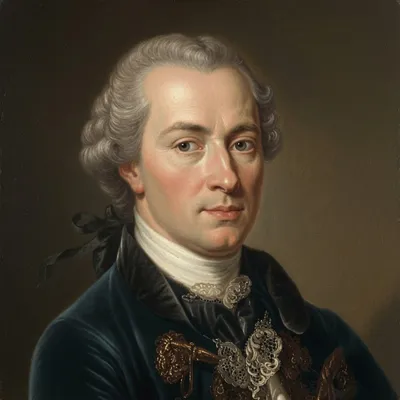
Foreign thinker
Immanuel Kant
Immanuel KantCritical philosophy, epistemology, and ethicsGerman1724–1804
“Two things fill the mind with ever new and increasing admiration and awe, the more often and steadily we reflect upon them: the starry heavens above me and the moral law within me.”


Life and Thought
Immanuel Kant (۱۷۲۴–۱۸۰۴) was a German Enlightenment philosopher and one of the most influential figures in modern philosophy. By founding critical philosophy, he transformed debates in epistemology, metaphysics, ethics, and aesthetics and profoundly influenced much of subsequent philosophy.
Immanuel Kant was born on ۲۲ April ۱۷۲۴ in Königsberg, East Prussia, and spent almost his entire life in the same city. He studied philosophy, mathematics, and the natural sciences at the University of Königsberg and initially developed a serious interest in physics and astronomy. His intellectual work later expanded into metaphysics, epistemology, ethics, aesthetics, and the philosophy of religion.
At the heart of Kant’s philosophical project was an attempt to rethink the relationship between reason and experience. He sought to show that knowledge is neither merely the product of sensory data nor derived solely from reason independently of experience; rather, the human mind plays an active role in organizing and structuring experience. This approach received its fullest expression in his “critical philosophy.”
His three major works, Critique of Pure Reason, Critique of Practical Reason, and Critique of Judgment, address respectively the limits and possibility of knowledge, the foundations of practical reason and morality, and questions of aesthetics and teleology. The fundamental questions pursued throughout Kant’s work can be summarized in four famous formulations: What can I know? What ought I to do? What may I hope? What is the human being?
In ethics, Kant emphasized autonomy, freedom, and the intrinsic dignity of the human person, seeking to ground moral obligation in practical reason. His historical importance extends far beyond epistemology and ethics: Kant profoundly influenced philosophy, theology, aesthetics, law, the humanities, and later moral and political theory. He died in Königsberg on ۱۲ February ۱۸۰۴.
Bibliography
Writings and transcribed lectures19 titles
A New Explanation of the Primary Principles of Metaphysical Knowledge
Physical Monadology
An Attempt to Introduce the Concept of Negative Quantities into Philosophy
The Only Possible Argument in Support of a Demonstration of the Existence of God
Dreams of a Spirit-Seer
Observations on the Feeling of the Beautiful and Sublime
On the Form and Principles of the Sensible and the Intelligible World
Critique of Pure Reason
Prolegomena to Any Future Metaphysics That Will Be Able to Present Itself as a Science
Answering the Question: What Is Enlightenment?
Foundations of the Metaphysics of Morals
The Primary Metaphysical Foundations of Natural Science
Critique of Practical Reason
Critique of Judgment
Religion within the Bounds of Reason Alone
Toward Perpetual Peace
Metaphysics of Ethics
Anthropology from a Practical Perspective
Posthumously Published Works